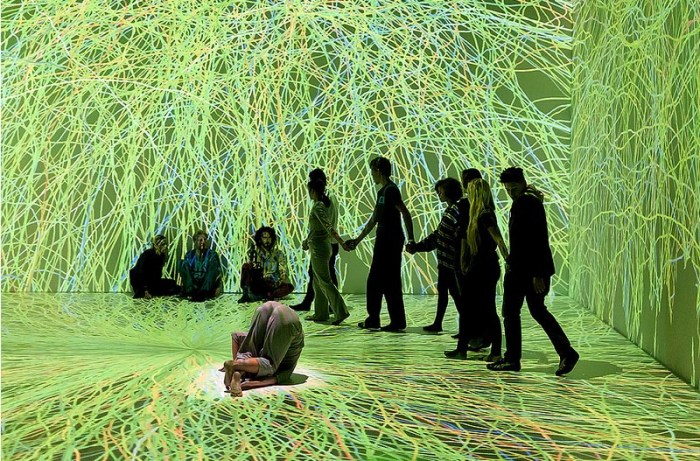
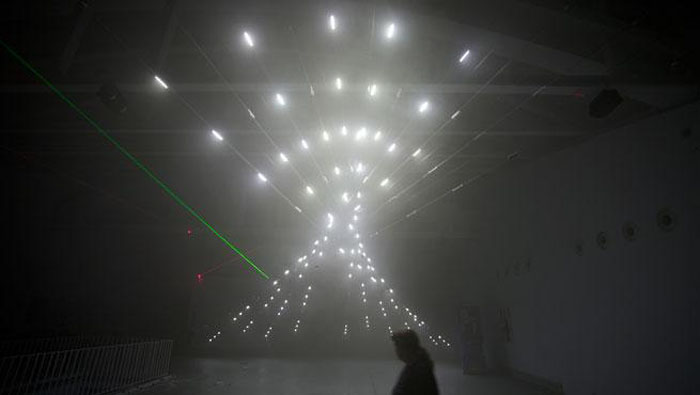
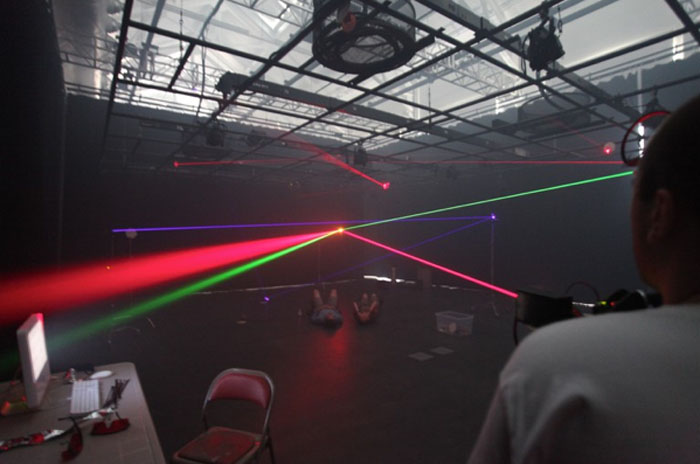
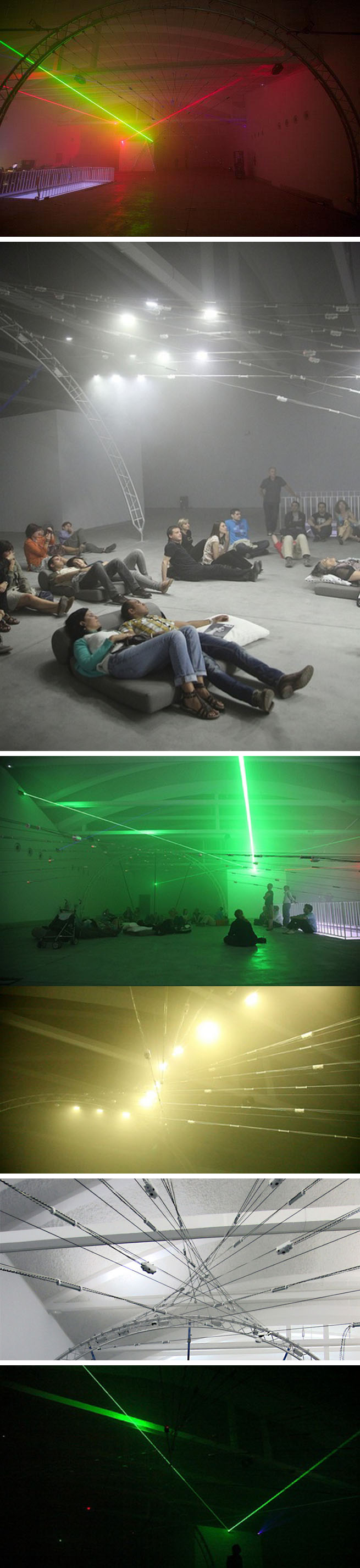
Interactive designers UltraCombos collaborated with Taiwanese dance company Anarchy Dance Theater, on their performance piece titled Seventh Sense which made its European debut recently at the TodaysArt Festival in The Hague. This viewer-centered performance detects all movements including those of the dancers and audience, allowing them to interact through visual effects. The audience becomes not just the viewer, but an active participant via the interactive projection mapping. Very cool.
For those of you in Spain, this Seventh Sense performance will be coming to Centro Parraga in Murcia, October 19 and 20, 2012, so you might want to catch it if you can.
Photos: Top three by Ed Jansen. Bottom three courtesy of Anarchy Dance Theater.
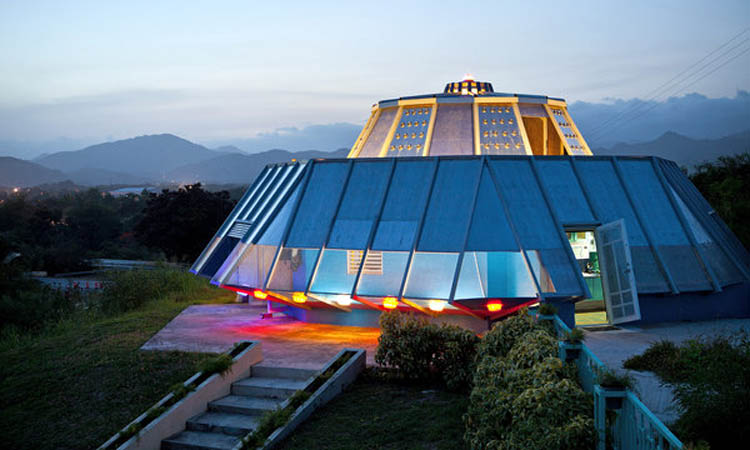
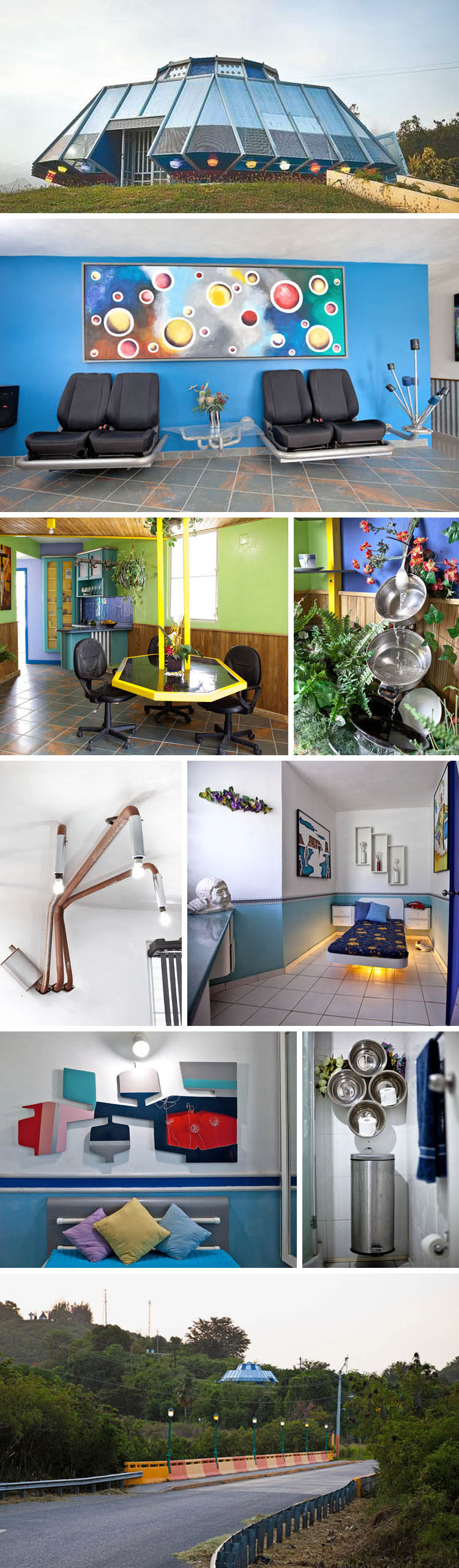
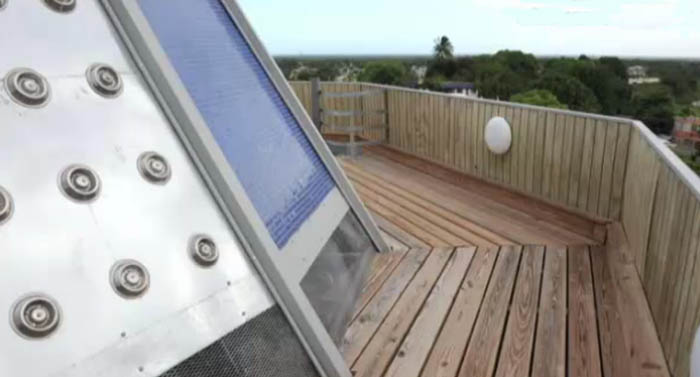
This is not just an interesting-looking home, but also has an interesting story behind it. Retired teacher of industrial arts, Roberto Sanchez Rivera, who lives on the south side of the island of Puerto Rico, built his home to look like a spaceship, complete with lights and audio effects that sometimes play the tune from Close Encounters of the Third Kind and other times salsa. The three-bedroom, two-bathroom house was built for about $150,000 and almost everything in it has been ingeniously created from discount store knickknacks and discarded auto parts. Objects such as the kitchen table and bathroom garbage can were designed to hover above the ground, while lamps are made from objects such as stove burners and lead pipes. Each room has a different personality and color scheme.
What possessed Rivera to design such a home? Love. As a teenager he had a girlfriend that left him after three months. From that moment he decided to build a home like no other to impress this girl. Even the location, up on a hill, visible from the main road, was chosen with the hopes that she would inevitably pass the house and notice it. You can read the whole story here but, in the meantime, needless to say Rivera has a new girlfriend and one unique home.
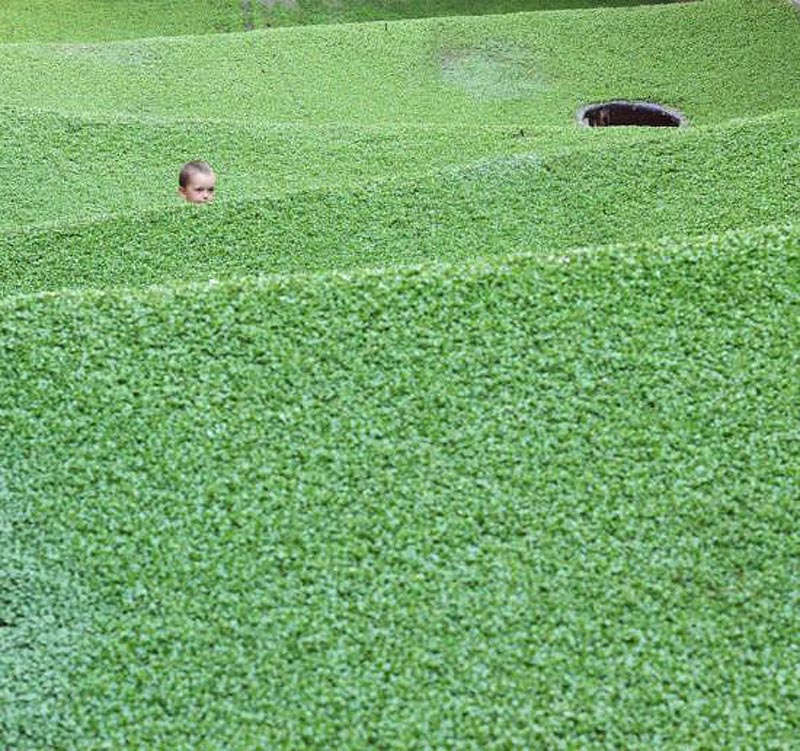
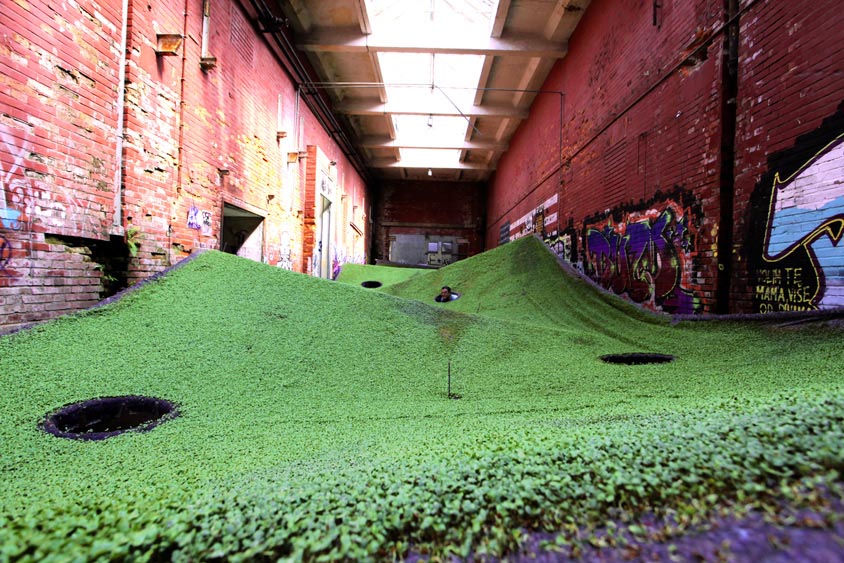
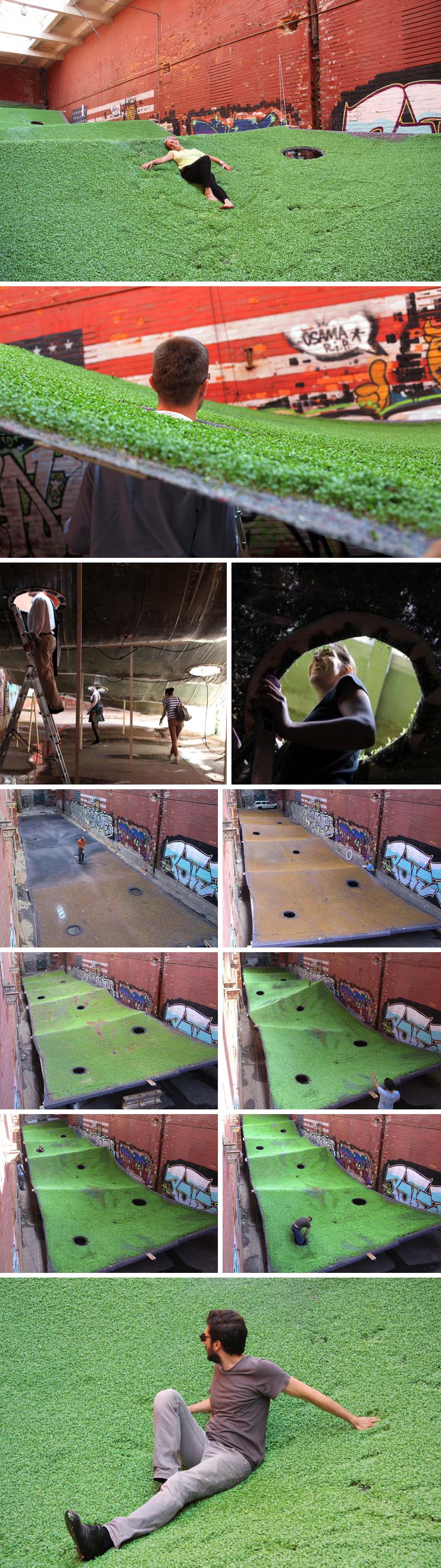
The Croatian-Austrian collective Numen/For Use (previously here) created a fun installation for the D-Day Festival in their own city of Zagreb. The suspended Field, executed in a former slaughterhouse, underwent the entire vegetative cycle from sprouting to disintegration. The grass field was grown on a floating piece of fabric, converting the designers into urban farmers and making them aware of the fragility and power of life. The growing field was not tied down to the ground, contradicting the usual assumptions that earth is an immobile mass of infinite weight and a two dimensional surface. I especially like the fact that people could wander under, as well as above, the installation, peering up through the holes in Whac-a-Mole style.
This might be a nice addition/substitute for the proposed Lowlineproject. Just a thought…
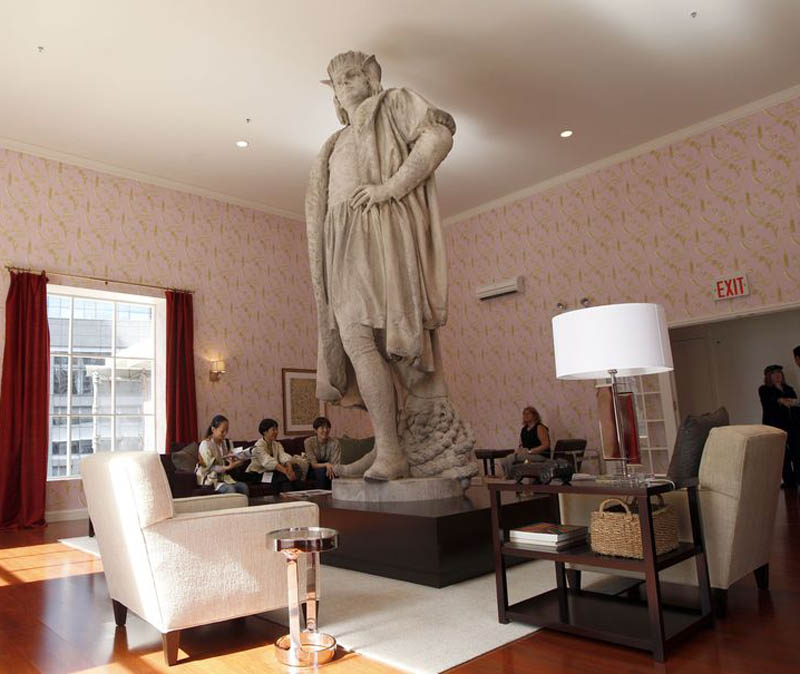
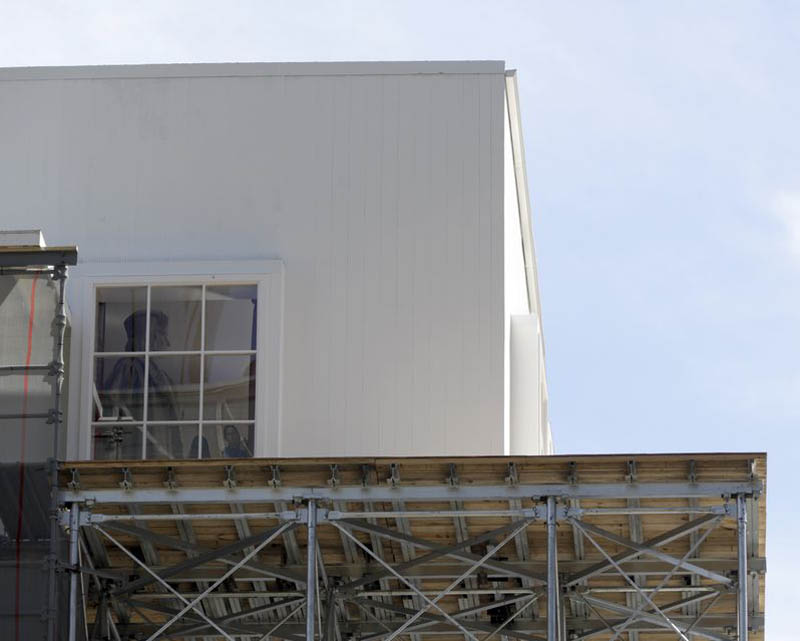
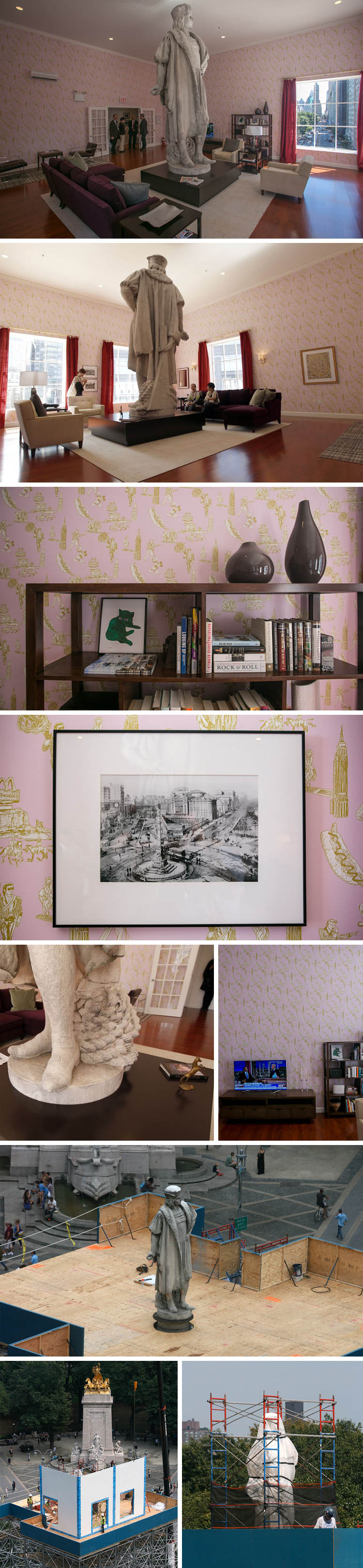
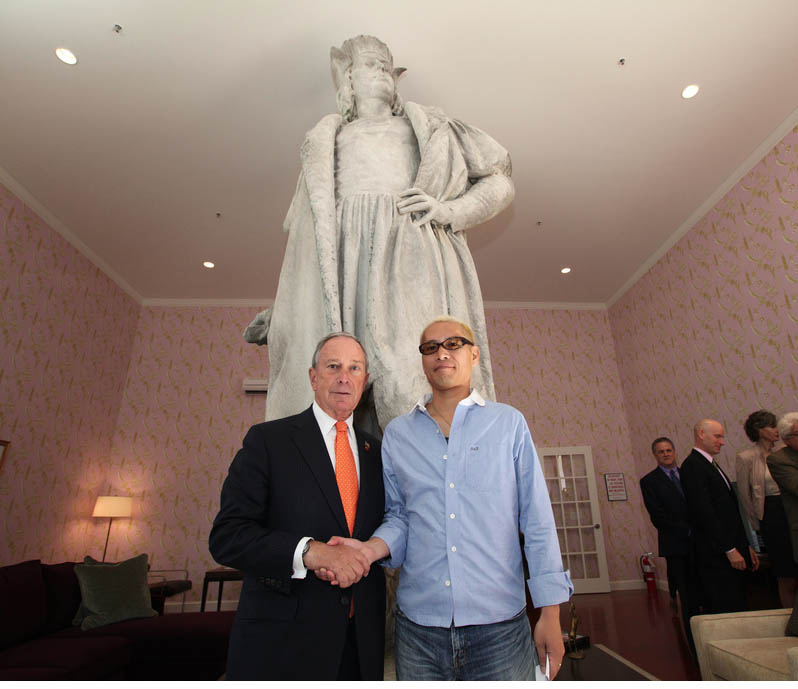
This is it! The day New York art lovers have been waiting for. Tatzu Nishi’sDiscovering Columbus (previously here for background) opens to the public and I’ve got my free pass to stop over later, however, I couldn’t resist the sneak peek from the VIP listers. The large elevated living room is just as described: built around the famous Columbus Circle statue, that stands tall on the coffee table in the center of the room. The wallpaper print is made up of iconic New York City American images ranging from the Empire State Building to a mustard-slathered hot dog, Elvis and Mickey Mouse. There’s even a TV. Totally nutty and fun. I, for one, am really looking forward to this.
Discovering Columbus will be up through November 18, 2012. Visit the Public Art Fund’s website to reserve your timed free pass.
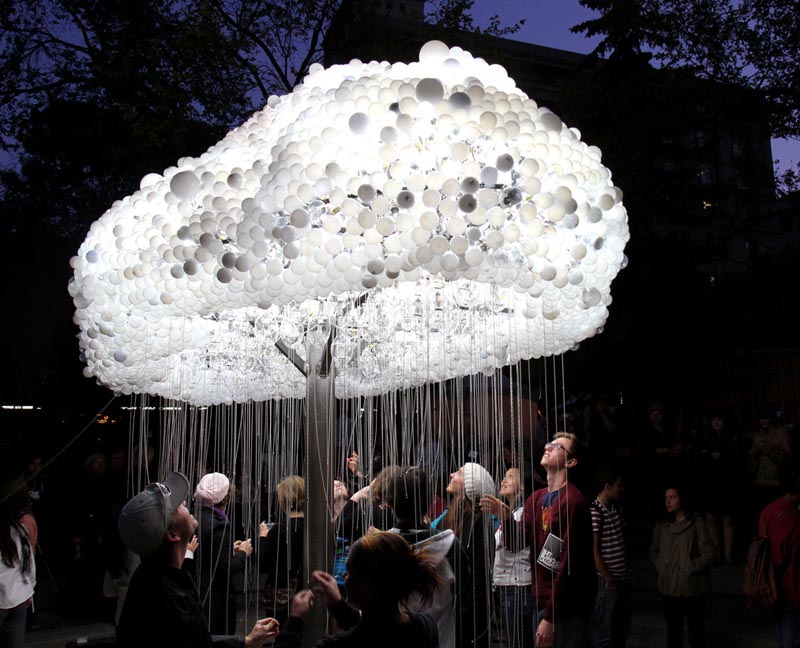
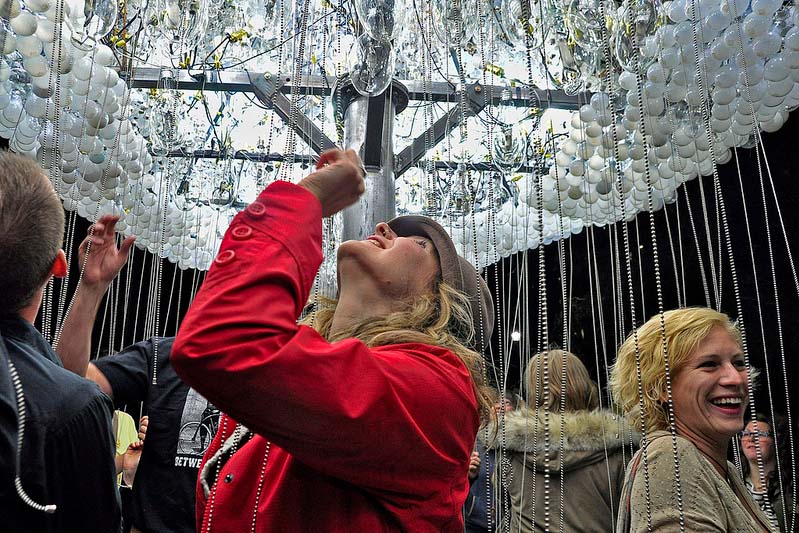
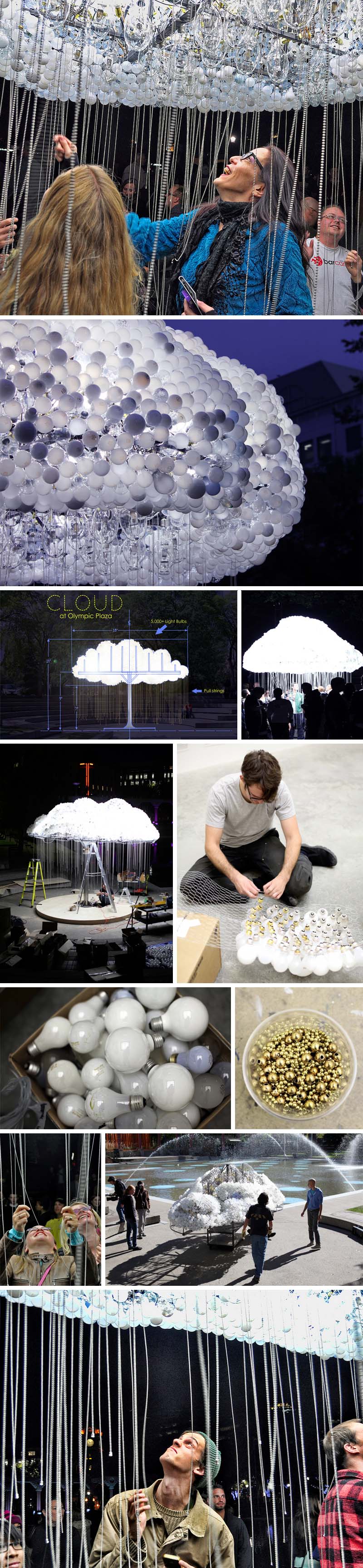
How fun is this? I love it! Calgary-based artist and filmmaker Caitlind Brown created this wonderful large-scale light installation/sculpture titled Cloud, exhibited a few nights ago at this year’s Nuit Blanche in Calgary. Made with more than 5,000 reappropriated domestic light bulbs (only one in every six bulbs actually needs to glow), in addition to compact fluorescent bulbs and chain pull strings, Cloud invites viewers to wander through a rain of pull strings switching lights on and off. When audiences activate the Cloud‘s inner sphere of light bulbs it creates the illusion of lightning on the cloud’s surface. Too clever!
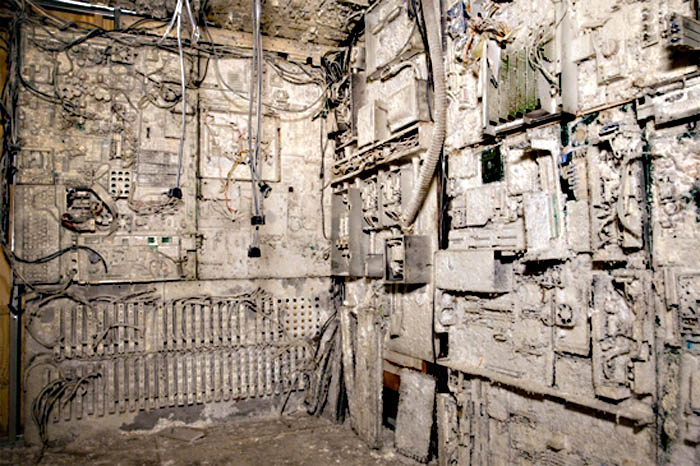
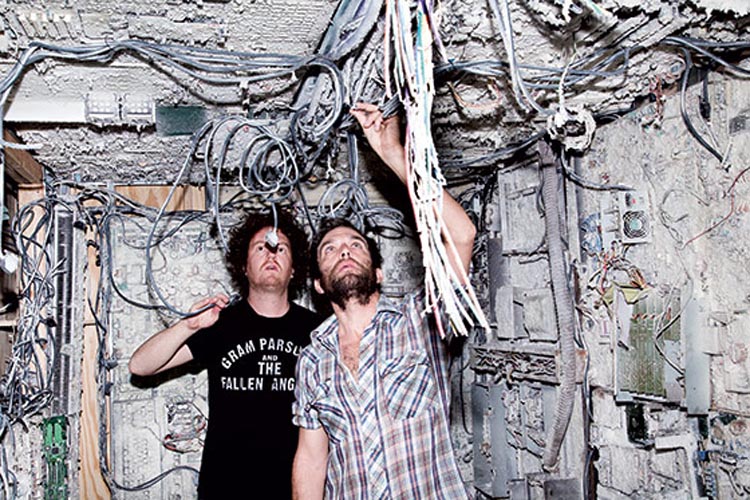
Jonah Freeman and Justin Lowe have collaborated on a few all-immersive abandoned room installations in the past years. The last show they had in NYC was in 2009 at Deitch Projects titled Black Acid Co-op which featured an exploded crystal meth lab among other things. Today, their latest exhibit opens at the Marlborough Gallery in Chelsea. Stray Light Grey, as the new show is called, conjures up the old OTB (Off Track Betting) facilities of the city’s past in its multi-roomed installation. They have converted the Chelsea gallery into what the neighborhood and its occupants were probably like back in the 90s—such as an OTB gambling parlor—shaping it into their own world. Upon first entering the gallery, visitors experience a smaller version of the usual gallery, but as they proceed other, stranger, rooms are revealed, some through holes in walls. The farther in one goes, apparently, the weirder things get. From a storage room to bathroom under construction and ripped out walls, continuing on to other rooms including the OTB-styled parlor and a plastic-surgery center. Artifacts, artworks and videos are dispersed throughout alluding to what is yet to come. And yet, one can never really be sure what to expect.
Stray Light Grey opens today and runs through October 27th, at the Marlborough Gallery.
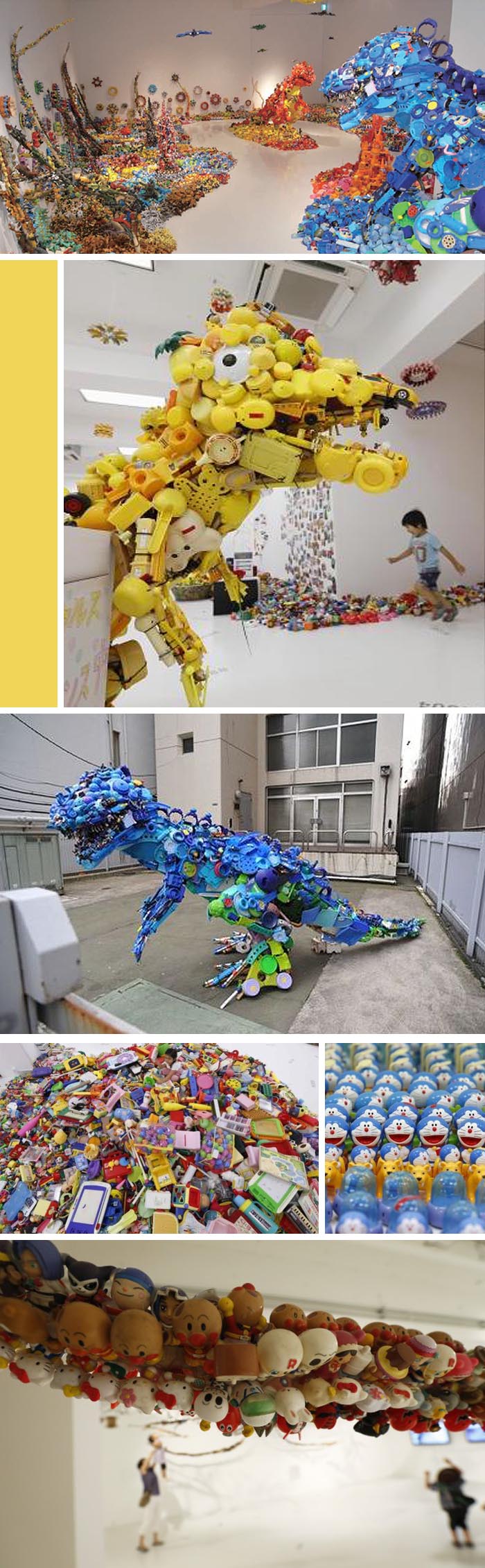
Japanese artist Hiroshi Fuji’s art revolves around “ways of transforming existences that are not valued by society into special existences.” One of the ways he does this is by using recycled materials in his art and inviting others—kids, artists, the public in general—to participate in its creation. He started a toy exchange system called “Kaekko” 13 years ago with over 5000 events having taken place in over 1000 locations across Japan and other countries as well. In his Central Kaeru Station – Where have all these toys come from? (Kaeru meaning to change, return, exchange) exhibit, which just closed in Tokyo last weekend, Fuji brought together over 50,000 toys collected over the years in the “Kaekko” project and created an installation that included works (such as this Toy Sauruses) made from the recycled toys, and the opportunity to bid on some of the works, along with interactive workshops for the community.
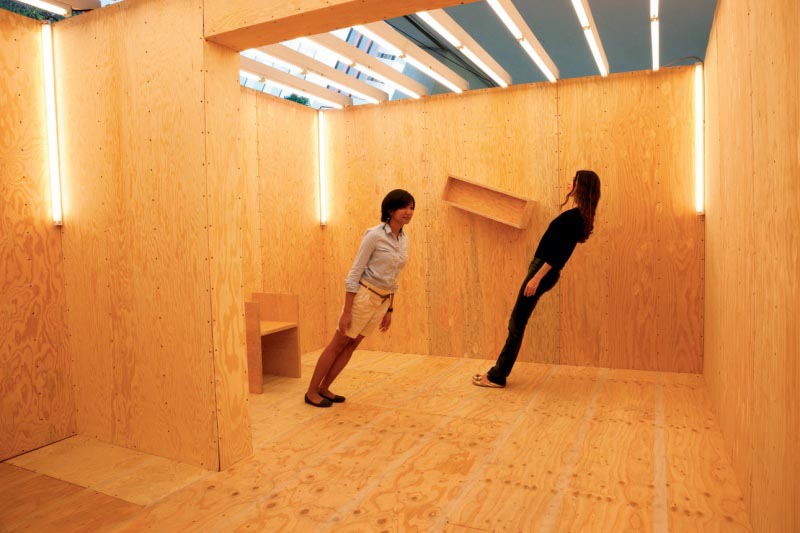
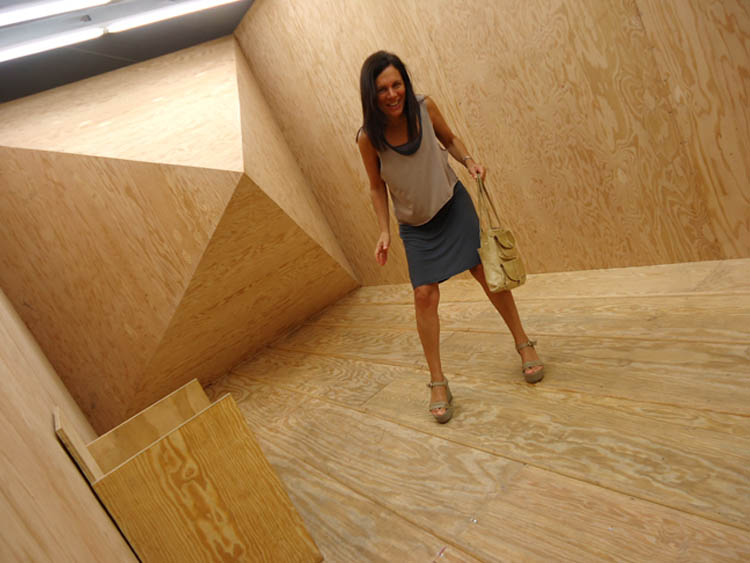
My friend Eric and I strolled over to Chelsea on Saturday between tornado warnings. We stopped by numerous recently-opened exhibits, but the most memorable show perhaps, at least for me, was Julian Hoeber at Harris Lieberman Gallery. Actually, more specifically, it was the centerpiece of the exhibit, DH#2, that was most memorable. This tilted wooden box held together with metal studs, beckons to you through its door. Inside is a steeply inclined room that is amazingly difficult to stand in and makes your head (and stomach) do somersaults…even just looking at these photos again is bringing back that queasy feeling. But it’s definitely fun and incredibly surprising. Makes for some laughs (and a little nausea.) DH#2 is, apparently, a variation on the Los Angeles artist’s previous work Demon Hill(the latter pictured in the top and bottom photos.)
These free-standing structures are based on the architecture of “gravitational mystery spots” that are often found in fun houses. Mystery spots claim to be sites of supernatural power to explain the severe effect of disorientation and vertigo that the visitor experiences, when in reality it’s the result of an architectural trick. Hoeber’s installations reveal the device behind the trickery, while retaining the same effect.
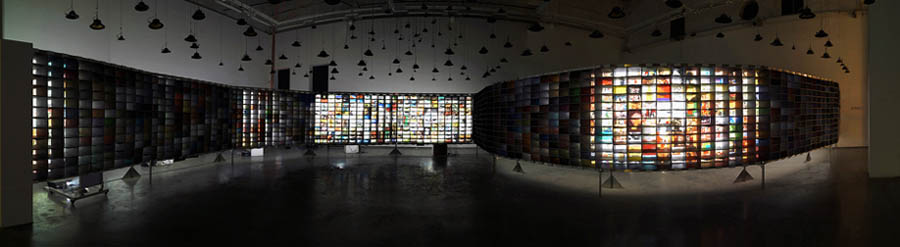
Shanghai-based multimedia artist Hu Jieming created this large-scale video piece titled 100 Years in 1 Minute. His goal was not to offer a panoramic view of history but, instead, to explore the possibilities of multiple combinations of the past century’s visual memory within one minute.
Using hundreds of, what look like, shoe storage bags to frame his videos, 10 high definition projectors, and 120 loudspeakers, Jieming compressed 100 years into 1100 artworks, creating 1100 1-minute videos that deconstruct many a masterpiece of modern times. The effect is noisy, wild and humorous. Jieming sees these purely as experiments; not as art or historical criticism.
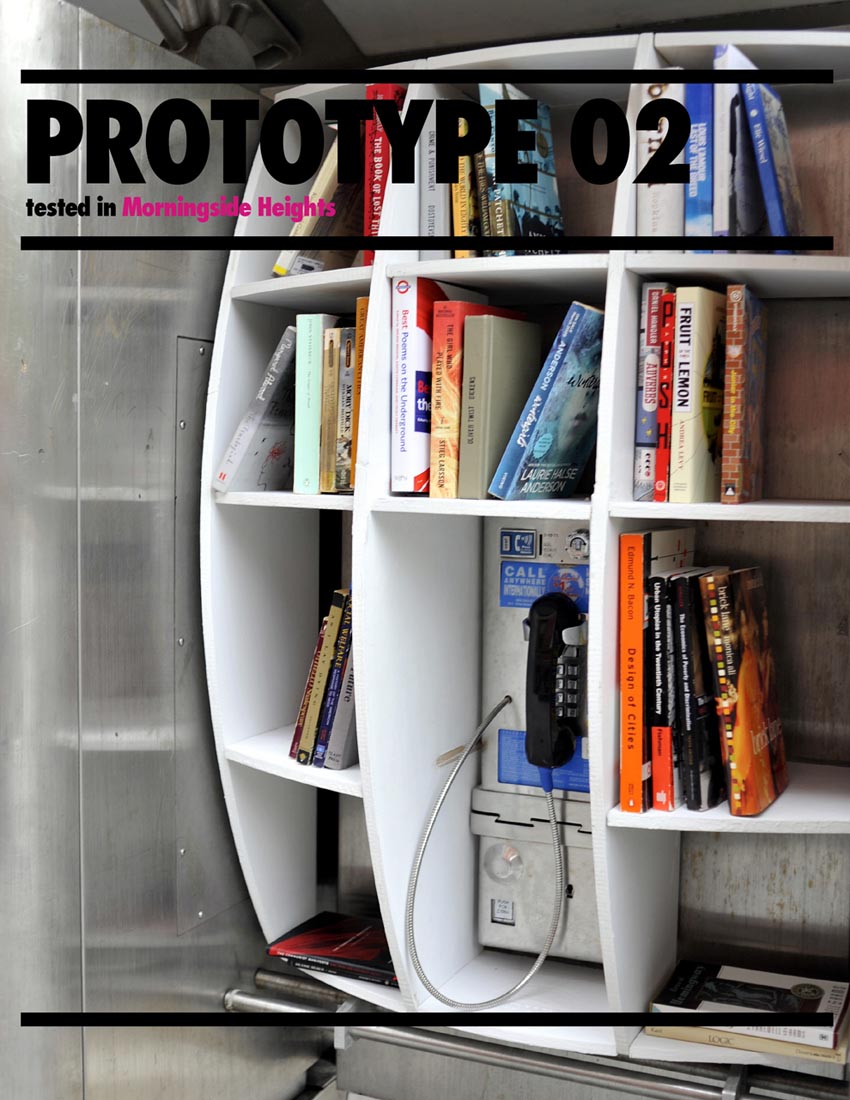
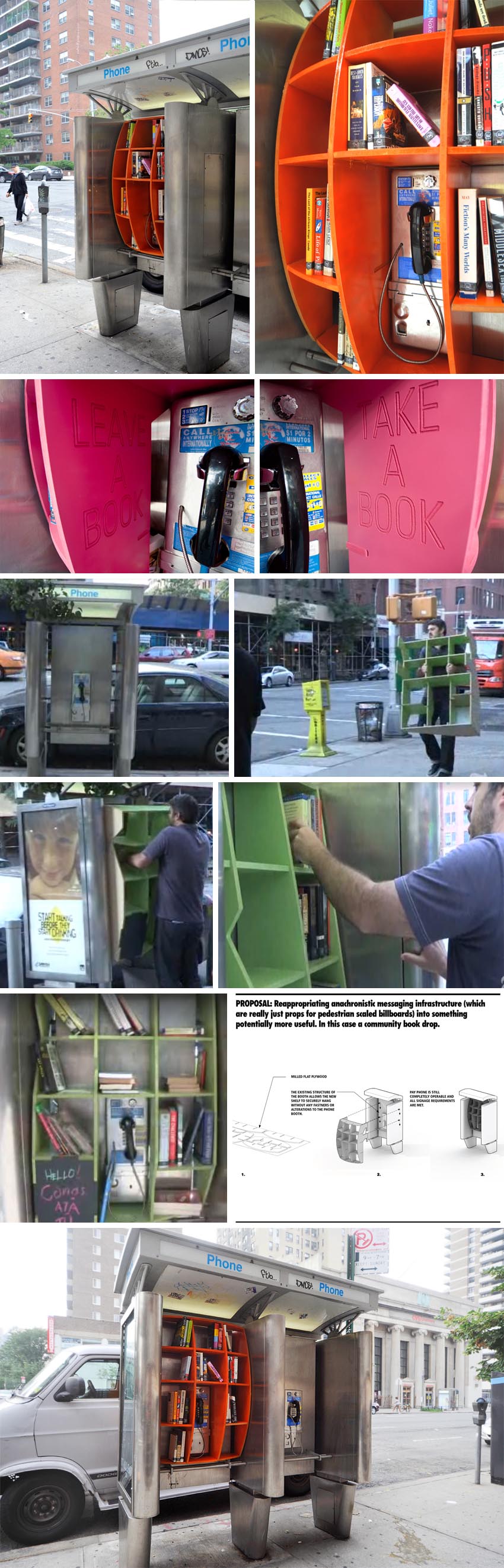
Architect John H. Locke, who lives and works in NYC, has come up with a clever idea for repurposing the underused pay phone booths that adorn the streets of the city. Locke designed a set of lightweight bookshelves, made of milled plywood,to fit inside a standard booth. Hooks on the shelves allow the units to be easily and quickly snapped into place without the use of hardware. Locke has so far installed four of these shelves on the Upper West Side, and finds the reactions interesting. In some cases the shelves (and books) have lasted merely a few hours, in others a few days.
It’s a great, forward-thinking concept that makes for fun street art as well. Presently, John Locke’s project is being featured as part of the U.S.’s contribution to the Venice Architectural Biennale.
You can see Locke speak about the project here. Some of his other interesting projects here. And here’s a link to the class he teaches at Columbia: Hacking the Urban Experience.
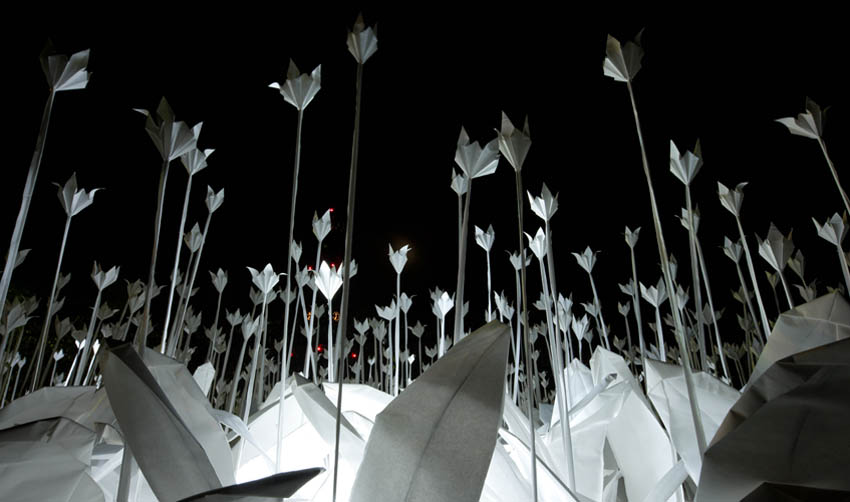
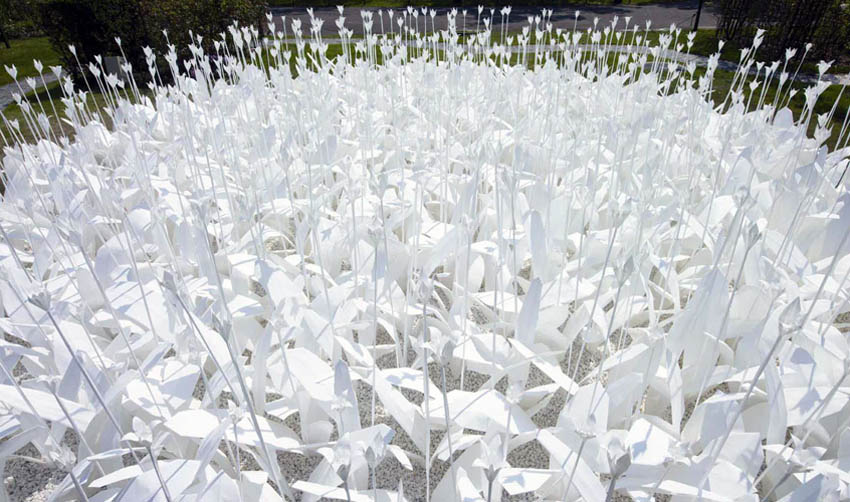
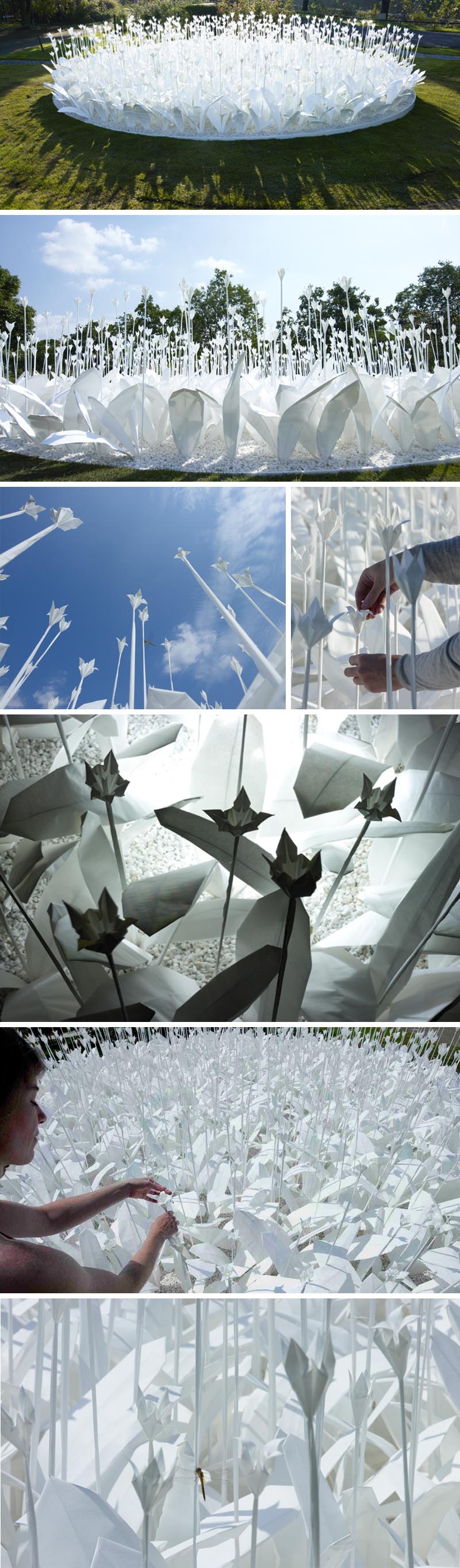
Swiss landscape architect Anouk Vogel lives and works in the Netherlands. Her Paper Garden titled Folding for Peace, was commissioned by the Gardening World Cup (who knew?) in Nakasaki, Japan, last year. Inspired by an ancient Japanese legend which promises that anyone who folds a thousand origami cranes will be granted a wish, such as long life or recovery from illness, Vogel folded thousands of paper flowers and plants with the wish for world peace.
Steve Duncan is an urban historian, explorer and photographer of the urban underground. He has photographed sewers and underground rivers in cities from Antwerp to Yangon, with particular focus on the underground hydrological and wastewater infrastructure of New York City, Los Angeles, Paris, and London.
Through his photography, historical research, public talks and tours, Duncan seeks to communicate his profound enthusiasm for these underground marvels, focussing on how hydrological and wastewater technologies conform to their natural environments and relate to broader histories of design, ecology, public health and public works.
In so doing, he illuminates infrastructures that we take for granted and reminds us that contemporary challenges of wastewater are much more than a technical policy issue. They connect us to our past, and just might motivate us to demand comprehensive, long-term infrastructure planning in the future. Plus, they are beautiful places to visit.
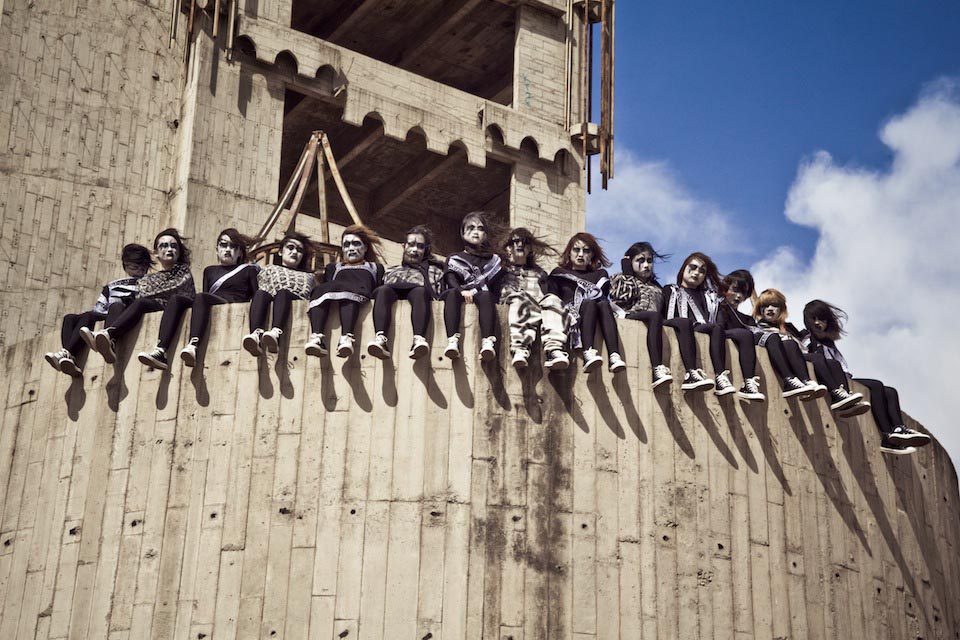
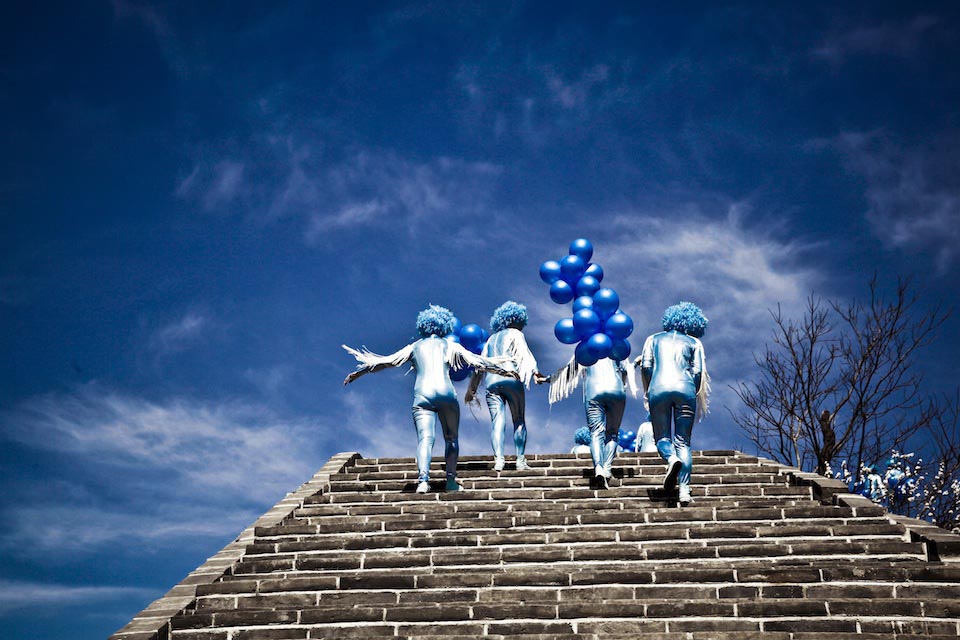
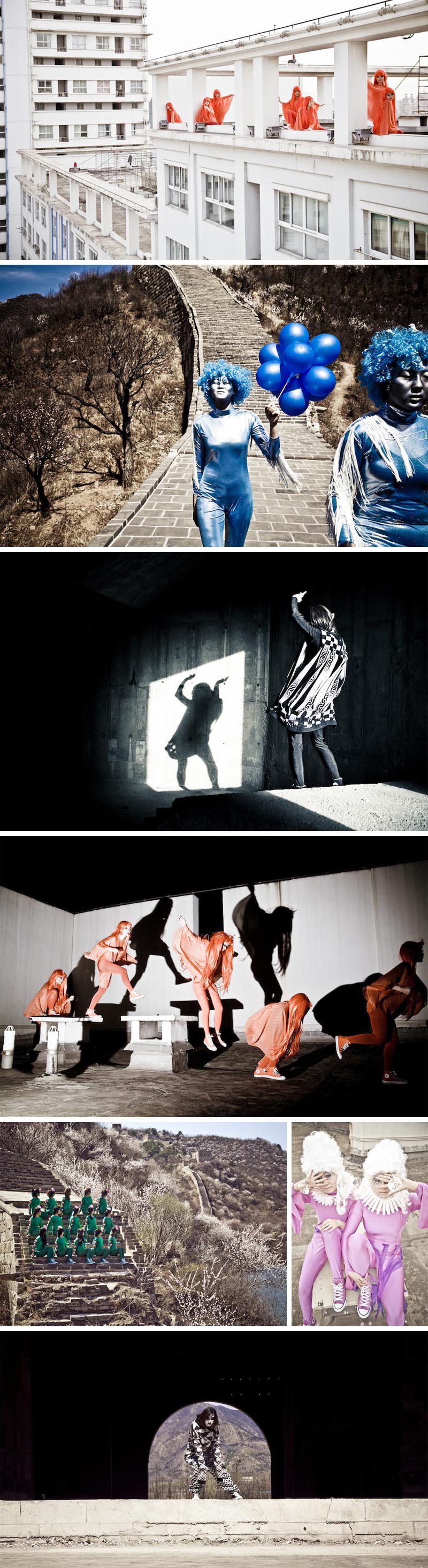
The Weird Girls Project (previously here) creator, Kitty Von-Sometime, was approached by Converse China to produce a series of videos featuring the Fall 2012 Color Collection of their Chuck Taylor shoes. The videos were to follow all of the usual applications of The Weird Girls Project and, excluding the shoes, the video concept and direction had complete free reign. The three-episode series was filmed in China: the first at the Great Wall; the second at a high rise building just on the south side of the river in Shanghai; the last at an abandoned fake Disneyland theme park an hour outside of Beijing. All three contain spectacular imagery and the requisite Weird Girls weirdness.
Below is one of the videos, but if you like what you see here, there’s plenty more to check out on the website.
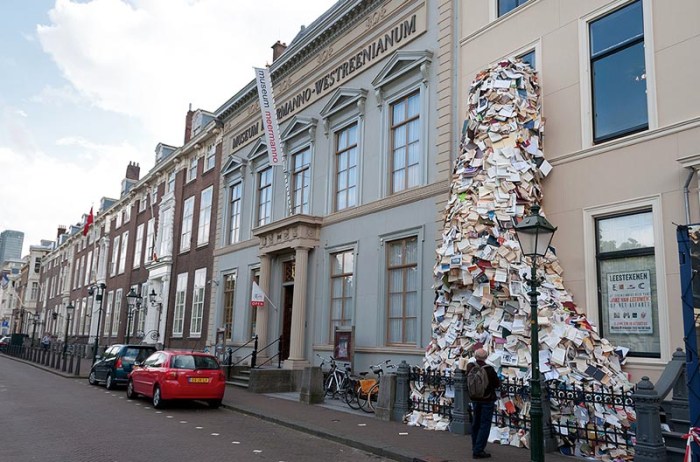
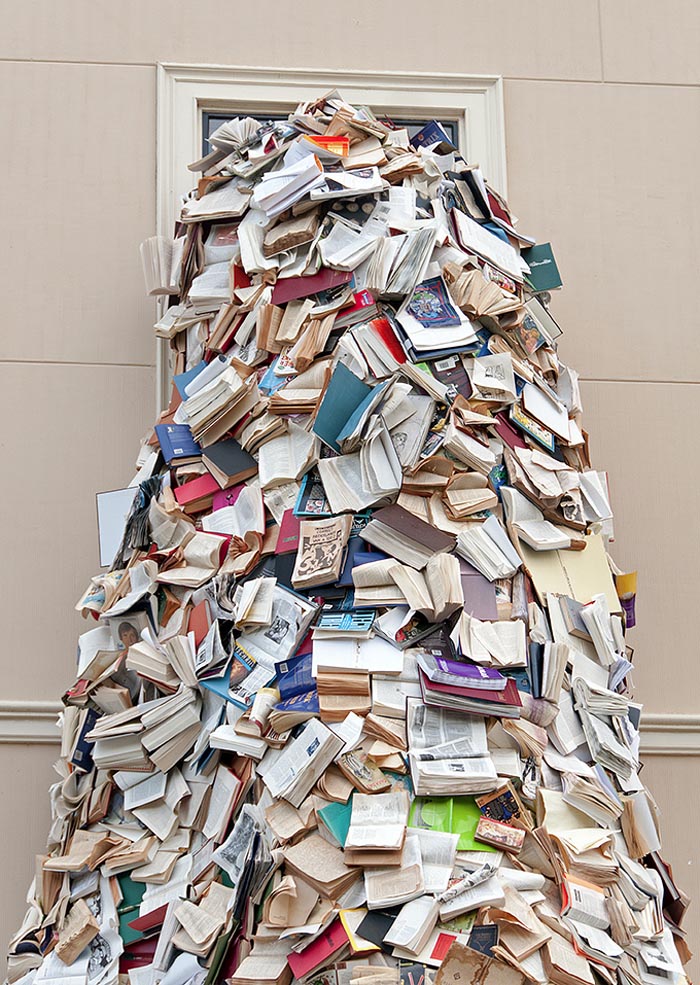
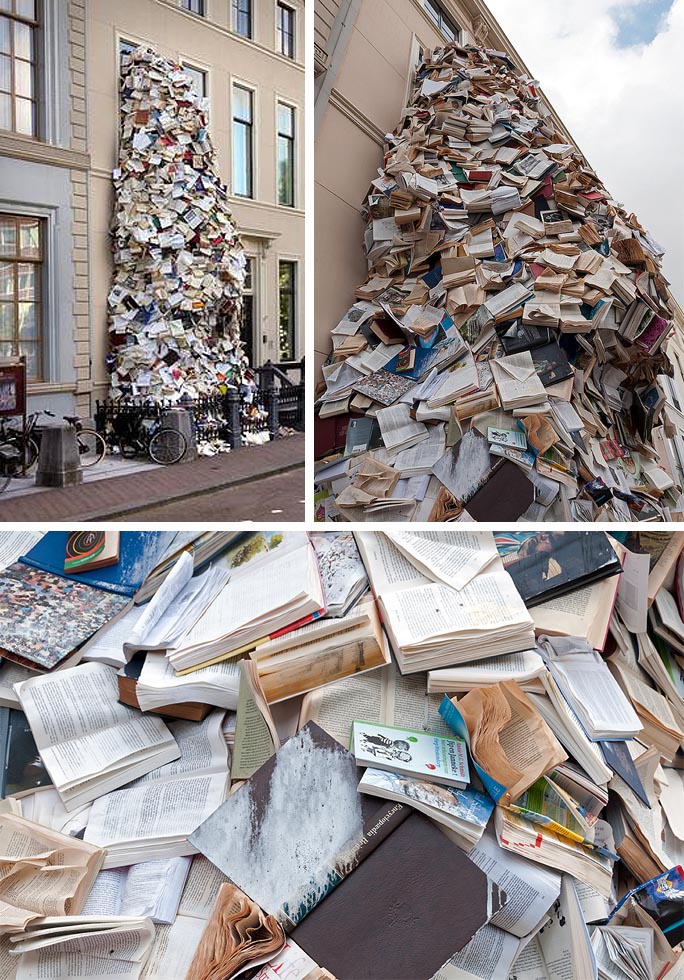
As part of the Paper Biennial 2012 at the Meermanno Museum in The Netherlands, Spanish artist Alicia Martin has created one of her site-specific, signature book sculptures using thousands of books donated by the public for the event. Martin’s sculpture pours out of one of the museum’s windows, down the façade and onto the street. Quite an impressive feat.
The installation will be on view through November 25, 2012.
All photos by Ed Jansen except second from bottom left courtesy of Meermanno Museum.
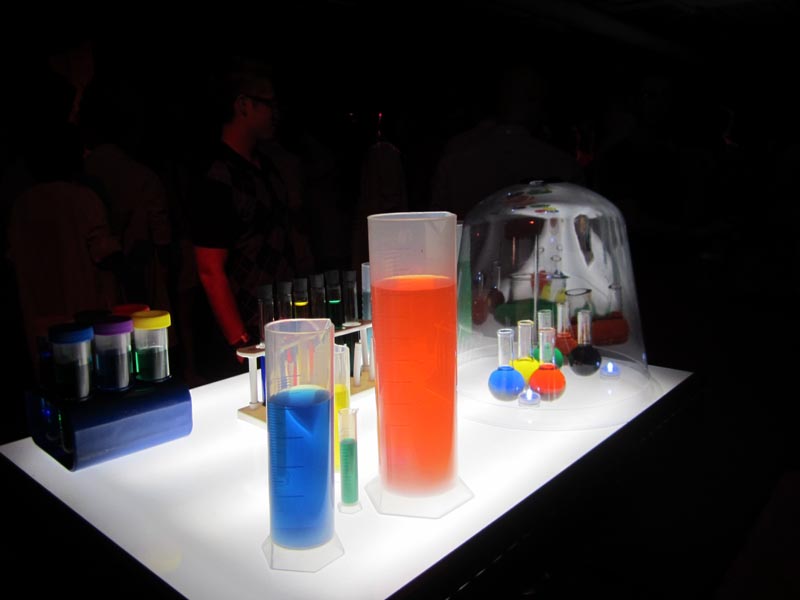
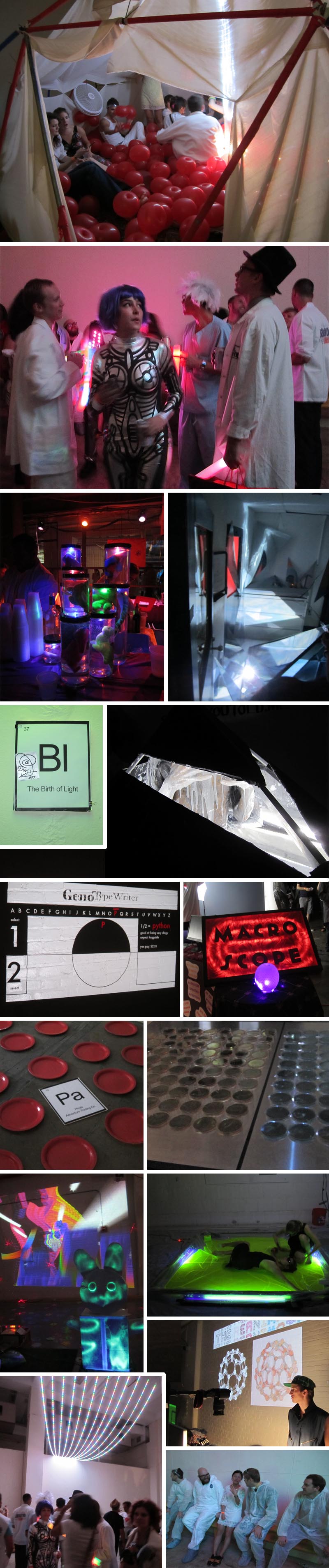
Saturday night, intrigued by their invitation/announcement, I headed over to the abandoned Pfizer headquarters and plant in South Williamsburg to experience Winkel & Balktick’s art/performance/music/dance event/party/experiment: Stranded V – Laboratory. The area around the plant’s location felt creepishly dark and desolate, but as I got closer it was interesting to see the groups of white-clad (the requested form of attire) young people emanate from the dark in all different directions — reminded me of that scene in Witness when all the Amish suddenly appear over the hills to help Harrison Ford. Anyway, the huge and vacant complex of laboratories had two of its large floors taken over by science-themed art installations, bars displaying test tubes, flasks, and beakers filled with colored liquids on light tables, as well as beanie babies in jars, performances such as hula hoopers with multi-color-lit hoops glowing in the dark, modern dancers dancing in shallow pools of a substance similar to Nickelodeon’s old green slime, and a band whose back-up singers consisted of projected talking heads. There were installations that included a cloth covered dome structure filled with red balloons, a seemingly nude man in a trapezoidal box with small slits where the viewer could watch him bathe in a milky mud-like liquid, and floating petri dishes en masse that created interesting patterns on the floor of their contents’ movement. There was many a science-themed table with lab assistants (aka artists and techies) to answer questions and guide you through their inventions reminiscent of a high school science fair, all the while the loud thumping beat of dance music could be heard (and felt) throughout the two occupied floors in dance club fashion. On more than one occasion I overheard comments to the effect of “Everyone who’s not at Burning Man is here.” Not sure of that myself, but kudos to Winkel & Balktick for coming up with a very interesting and unique (at least for me) event, with the added twist of mystery and intrigue.
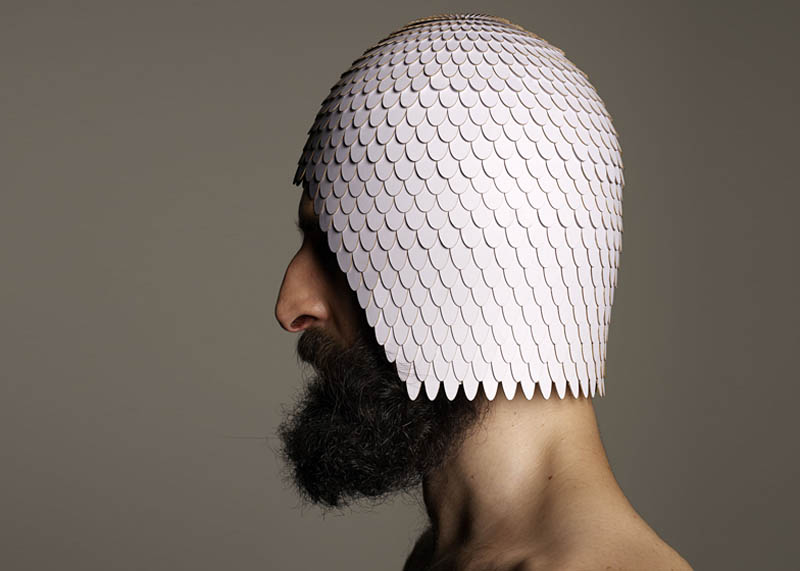
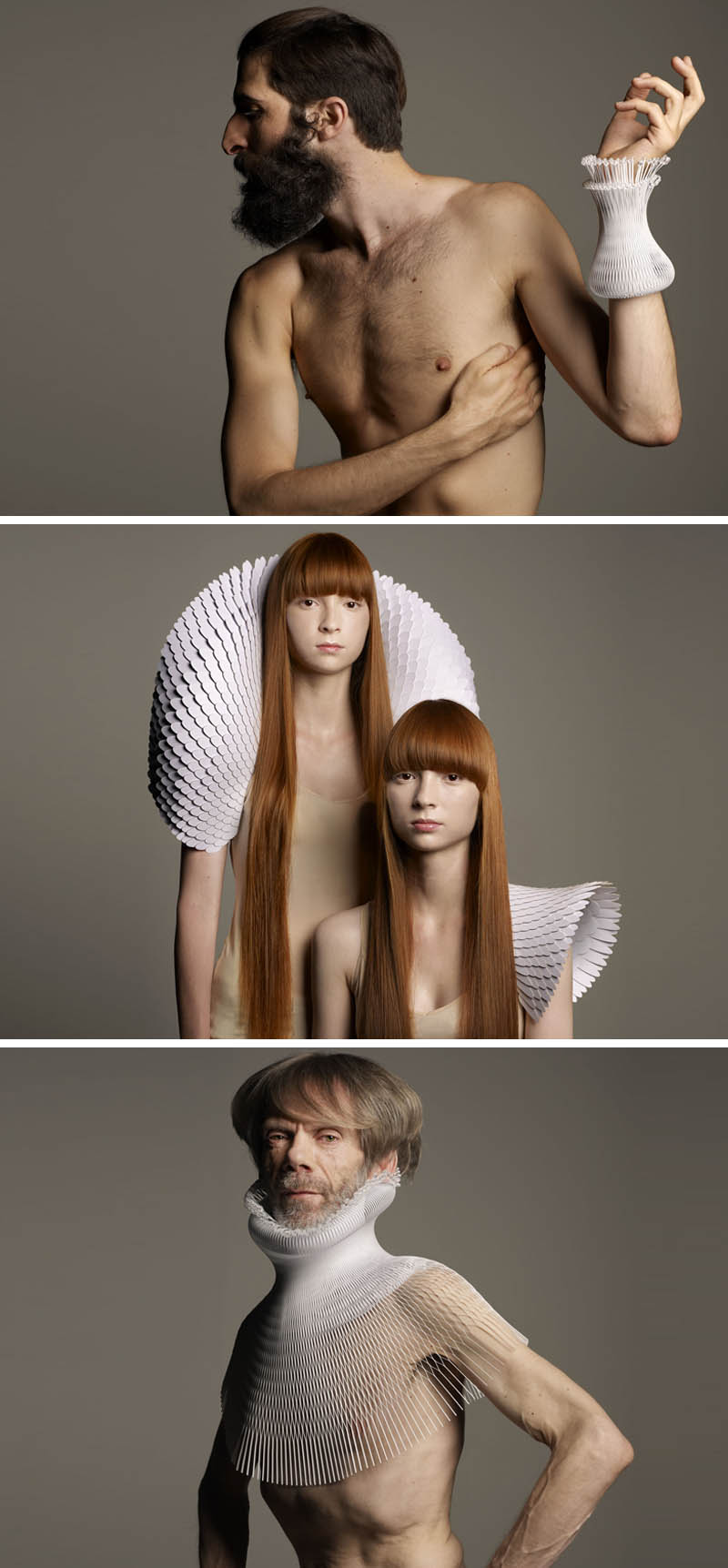
In celebration of their 10th anniversary a few months back, Swiss company Atelier XJC launched an onsite laboratory to study new components and materials in order to create original, offbeat objects. As you can see, they certainly succeeded in their goal. Working in collaboration with various prestigious manufacturers, Xavier Perrenoud and his team have pushed the boundaries on the definition of jewelry and accessories design.
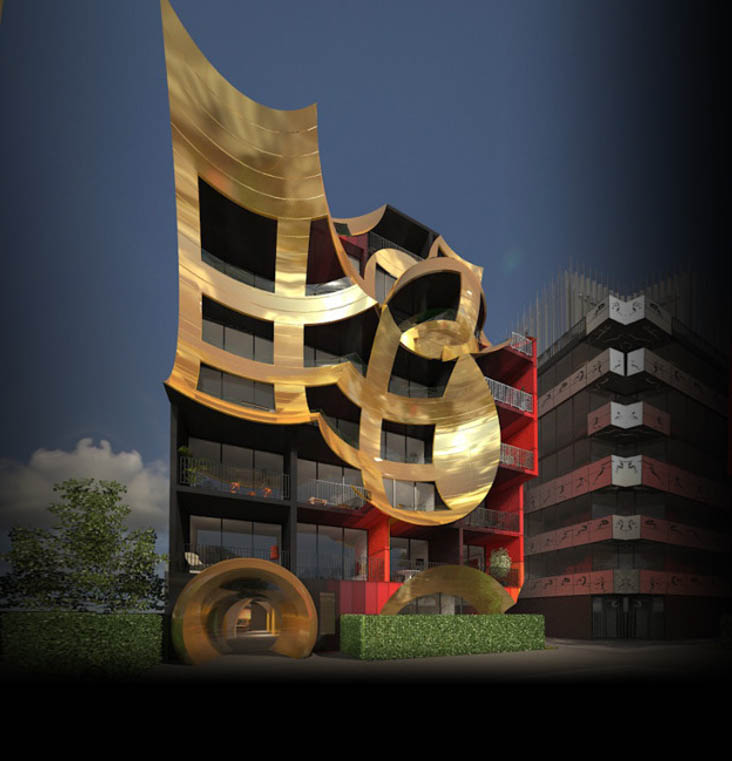
Australian firm ARM Architecture definitely has a unique style and approach to building design (see our post on the Portrait Building for another interesting example.) Taking their cue from Viennese architect Adolf Loos — who believed that apartment buildings fulfill different functions inside (a place to live) than out, where they should contribute to the quality of the street — ARM has some very unusual, leaning toward surreal, façade designs. One of their most recent projects, due to be completed in 2014, is the Orbis Building. A 7-story apartment building in South Melbourne, Orbis was inspired by the works of sculptor Anish Kapoor and surrealist Rene Magritte. The exterior plays with the perceptions of space and depth with its reflective gold concave and convex shapes. It’s interesting to see how the architects have continued, more subtly, these forms in the entrance lobby’s spherical caverns, and the apartments’ windows and balconies.
Orbis is the latest in a series of developments by the ARNO Corporation, which seeks to merge the boundaries of art and architecture and create buildings that themselves become works of public art. 20% of the apartments have already been presold.
Last month at LABoral: Center for Art and Industrial Creation in Gijon, Spain, American media artist Chris Salter presented his large-scale audiovisual installation called n-Polytope. The work subtitled Behaviors in Light and Sound after Iannis Xenakis is a spectacular light and sound environment using lasers and artificial intelligence software technologies inspired by composer Iannis Xenakis’ 1960s radical and pioneering installations named Polytopes (from the Greek meaning many spaces.) A major landmark in the history of audio-visual arts, Xenakis’ works were immersive architectural environments that mimic the chaotic behavior of nature through light and sound.
Chris Salter’s installation (in collaboration with his team: Sofian Audry, Marije Baalman, Adam Basanta, Elio Bidinost and Thomas Spier) uses hundreds of LEDs that function as powerful bursts of light and hundreds of tiny speakers suspended through the space, creating a walk-through performance environment.
Here’s a brief video on the installation with the artist:

 Click to enlarge















 CollabCubed