Designboom Mart 2012 Designs

designboom mart 2012 at ICFF products/designs, frames, stools, bowls, bagsdesignboom mart 2012 at ICFF products/designs, Teevstyle airplane window frames, stools, Bold and Lovely porcelain bowlsAfter two days at the designboom mart 2012 at ICFF, things are going really well at our table with lots of nice feedback, but we’ve also had the pleasure of being surrounded by so many interesting, clever, and beautifully designed products. Here are some of our immediate neighbors whose designs we’ve been admiring.

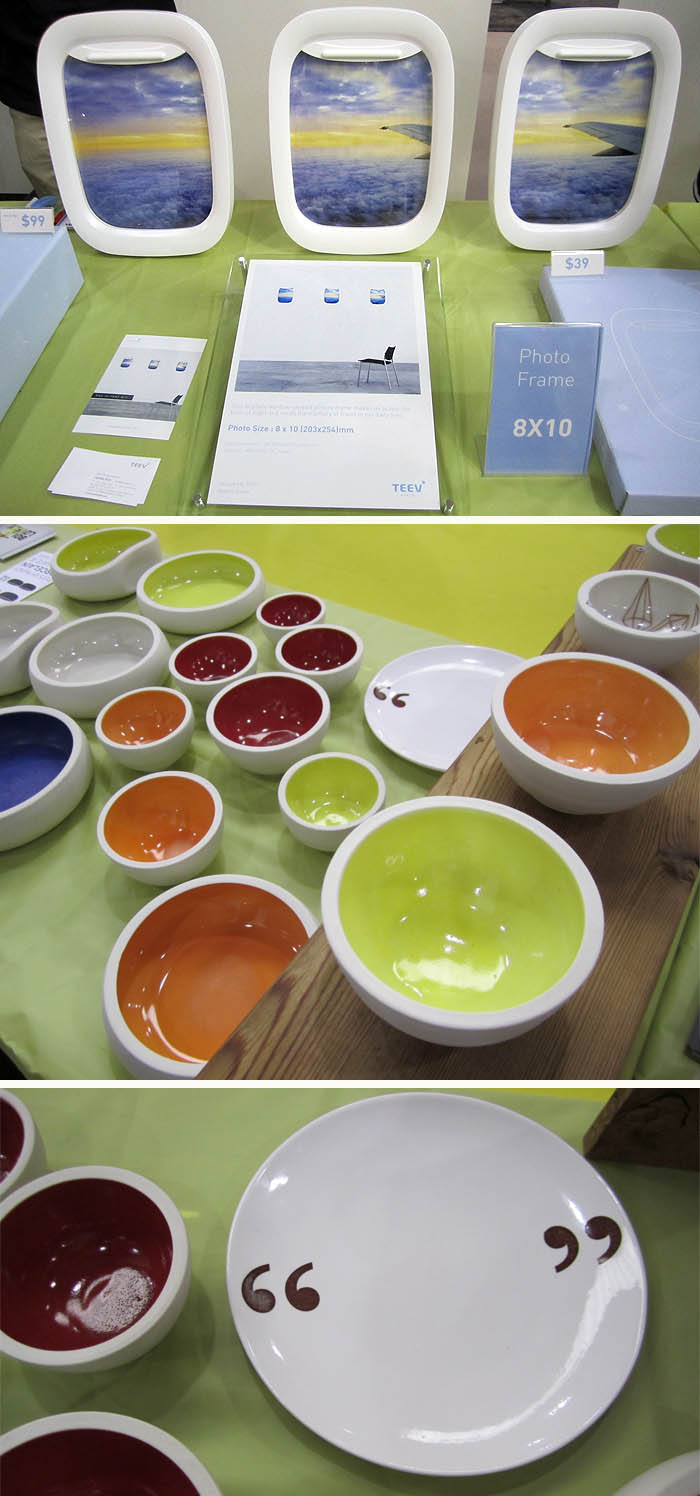
Above top, Seoul-based design studio TEEV has designed these very clever picture frames in the style of an airplane window. No, the window shade does not come down, despite many a person’s attempt at pulling, but even without that possibly-in-the-future fun feature, these frames put a smile on most everyone’s face.

Right below the photo frames, Nancy Froehlich’s Bold & Lovely chunky porcelain bowls with bright and colorful glazed interiors, are simply beautiful. Contemporary and fresh in their design, we’re still trying to decide which one of these bowls from Oregon we’re going to purchase for ourselves. Nancy also has a line of plates with quote marks on them that have been quite popular at the show.

recycled bottle caps into shoulder bags, squashed basketball fruitbowls, R. Mutt toilet stickers, Marcel DuchampA couple of tables over, Colombian design studio Proyecto Tres y Medio have brought along their Tápate messenger bags made of recycled plastic bottle caps that have been sewn together and lined to make a series of very unique bags.

UK-based Alex Garnett has an interesting collection of work that includes ceramic fruit bowls in the shape of squashed basketballs and, Daniela’s favorite (though she got there two minutes after the last one at the mart was sold): Conceptual Crap –“R. Mutt” stickers to transform your toilet into a Duchampian/DADA work of art. Brilliant!

Beautiful woodwork, Dadelion stool and magazine rack, amazing packaging for beautiful ring designsMoissue from Taiwan has some spectacular woodwork. Their Dandelion stool — which doubles as a magazine rack — is beautifully crafted and would make a great sculpture on its own let alone a dual-purpose piece of furniture. Their wood and metal rings are lovely, but what really blew us away is their incredibly innovative packaging; a wooden cylinder that screws shut with the ring inside. Without a doubt the best jewelry packaging I’ve ever seen.

There are  plenty more creative products at the designboom mart and we’ll also be sharing some designs from ICFF 2012 as well in the coming days.
NY Design Week 2012

NY Design Week 2012, Noho District, Tom Dixon-Fab Pop Up London UndergroundNY Design Week 2012, Noho District, Tom Dixon-Fab Pop Up London UndergroundNY Design Week 2012, Tom Dixon, London Underground, Japanese Premium Beef, Balloon Factory beef balloons, Core77 Pop-up Gallery, Partners & Spade Children's ChairsClick to enlarge

Well, it looks like the ever-growing NY Design Week 2012 is off to a great start with exceptionally beautiful weather in store for the next three days. Aside from ICFF at the Jacob Javits Center, the event at the core of Design Week (and we – CollabCubed – will be there as part of the designboom mart, but more on that later) there are special design-related events going on all over the city. Too many to list here, but here are a few I ran across today in my travels through NoHo on my way to the East Village.

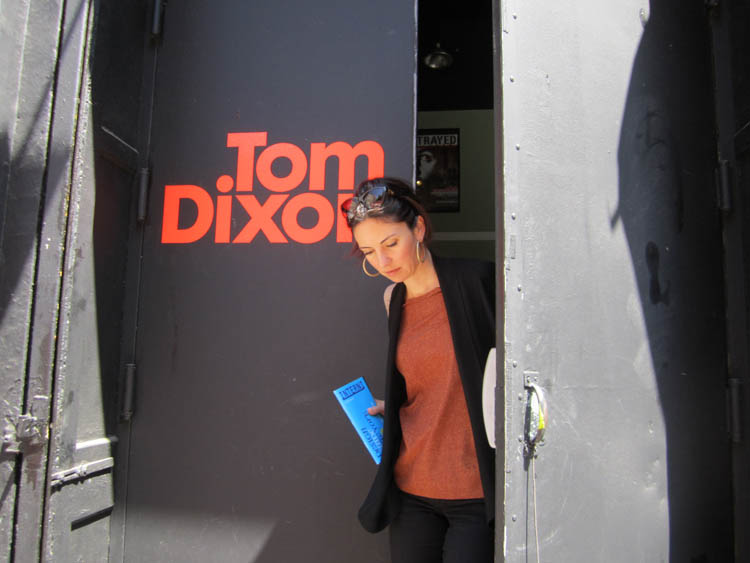
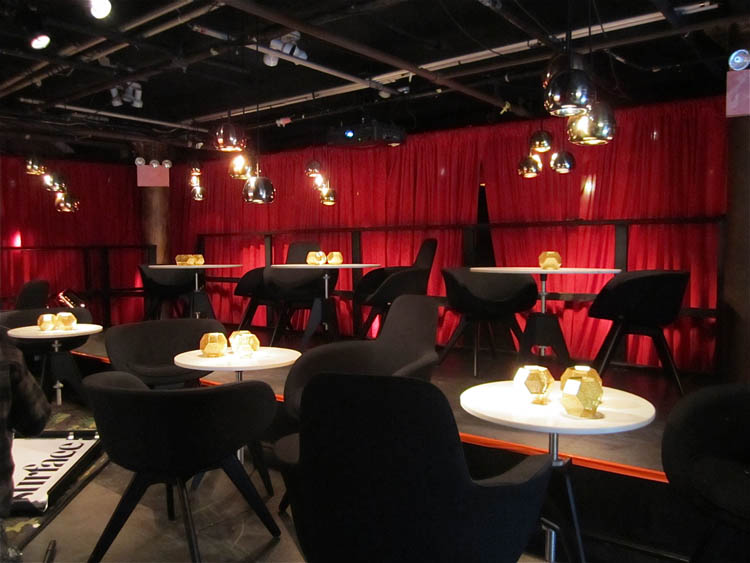
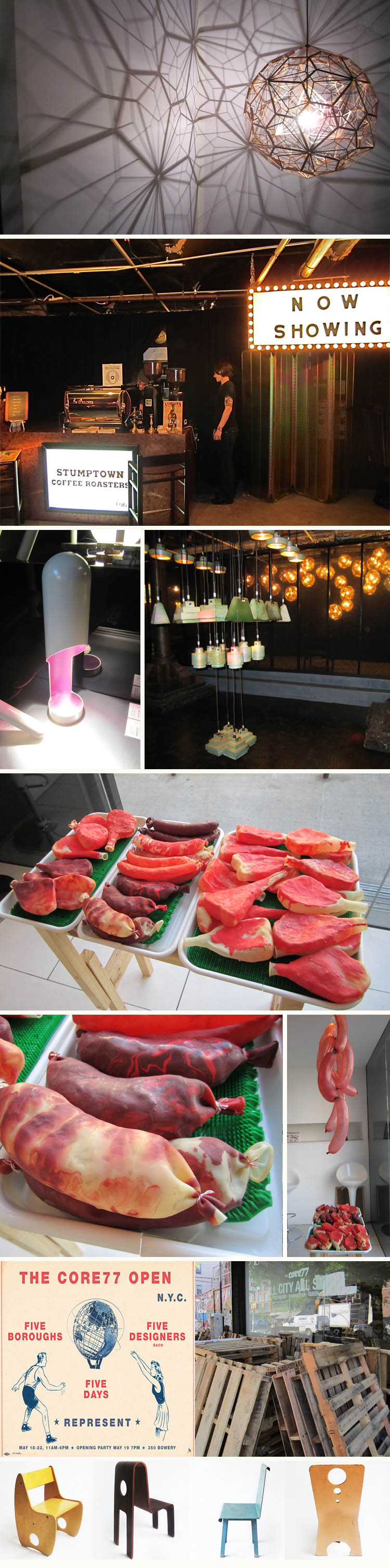
Tom Dixon along with Fab, Surface Magazine and Stumptown Coffee have teamed up and transformed the basement of the Bleecker Street Theater into a Pop-up shop and café: London Underground. Filled with lamps designed by Dixon, the space has a cool feel with interesting shadows cast upon the walls. My favorites? His new line of industrial looking ceramic lamps due out in September.

Two blocks north on Great Jones Street, Japanese Premium Beef (a unique butcher shop worth visiting anytime for its singular boutique-like quality) has a display of beef and sausage balloons created by Balloon Factory.

On the same block, The Future Perfect looked like they were setting up a special exhibit and across the street at Partners & Spade, Mondocane has an exhibit of historically relevant children’s chairs. Around the corner, Core77 was setting up their First Annual Core77 Open, a Pop-up exhibit featuring 5 designers from the 5 boroughs. The stacks and stacks of wooden flats(!) that they were loading into the shop look like they’ll make for an interesting installation.

More events include: Roll & Hill’s temporary showroom at 2 Cooper Square; Areaware at 22 Bond St.; and Hotel California at The Standard East Village.

You can see more events on the Noho Design District site, as well as Metropolis Magazine’s list, Core77, and WantedDesign for other events outside of Noho.

Enjoy!

All photos collabcubed except for bottom row of chairs courtesy of Mondocane and Partners & Spade.

Yeah! More FarmGroup

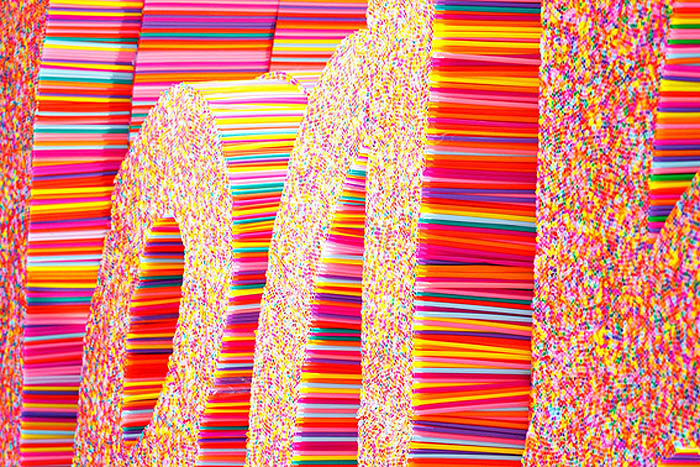
Fun Type Installation made with drinking straws, in Bangkok mall, Yeah!, collabcubedFun Type Installation made with drinking straws, in Bangkok mall, Yeah!, collabcubedFun Type Installation made with drinking straws, in Bangkok mall, Yeah!, collabcubedClick to enlarge

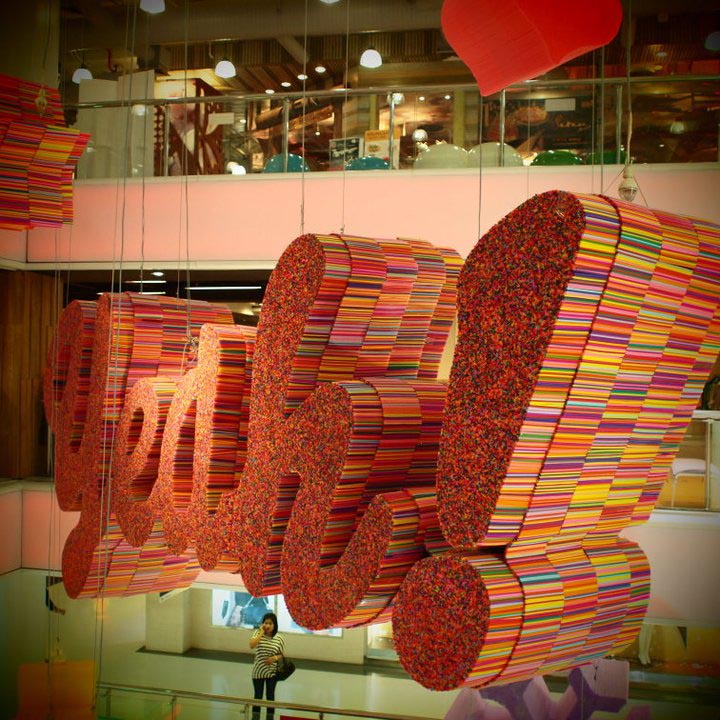
Bangkok-based multi-disciplinary design studio FarmGroup (previously here) created this fun Christmas installation at the Siam Center. Using thousands of colorful plastic drinking straws, the sculpted the word “Yeah!” along with several shapes of animals, stars, and other holiday motifs.

If you like this you might also like Sang Sik Hong’s Straw Sculptures and Scott Jarvie’s Clutch Project, also made with straws.

Kukje Art Gallery: SO-IL Architects

Solid-Objectives – Idenburg Liu, SO – IL Architects, Cool chainlink facade, Kukje Art Gallery, Seoul, KoreaSolid-Objectives – Idenburg Liu, SO – IL Architects, Cool chainlink facade, Kukje Art Gallery, Seoul, KoreaSolid-Objectives – Idenburg Liu, SO – IL Architects, Cool chainlink facade, Kukje Art Gallery, Seoul, KoreaClick to enlarge

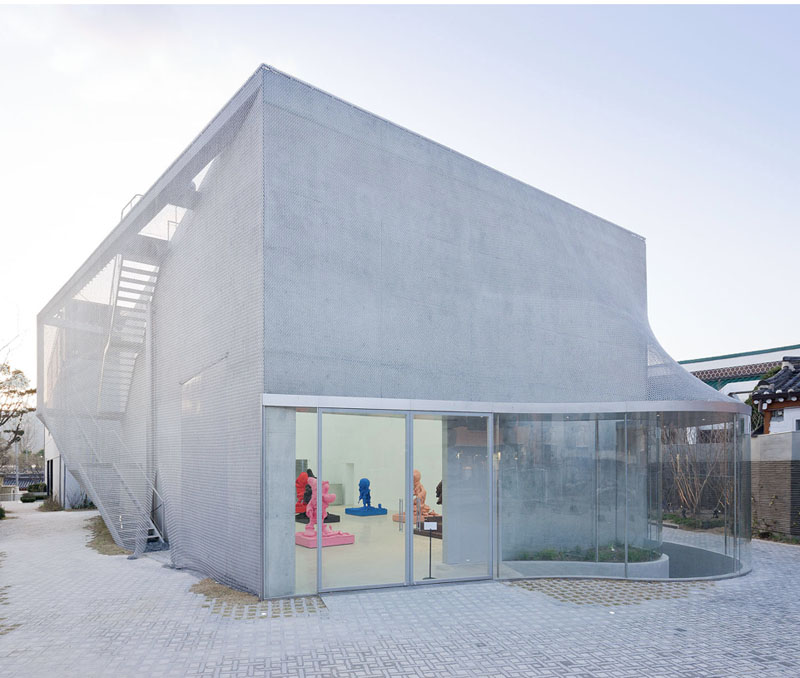
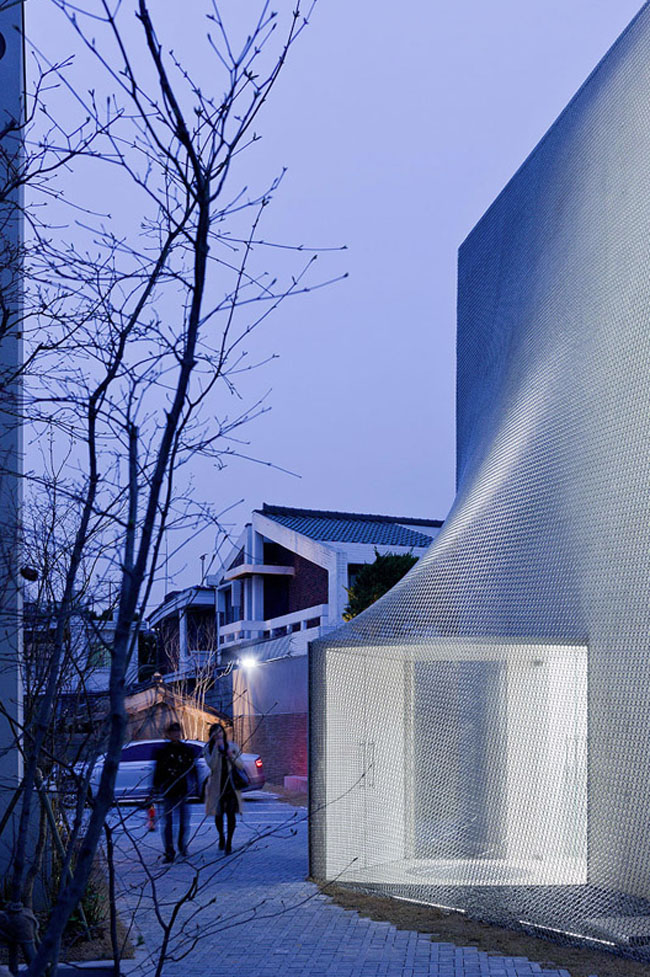
For their recently completed project in the northern part of Seoul, partners Florian Idenburg and Jing Liu of the Brooklyn-based Solid Objectives – Idenburg Liu (SO–IL) architecture studio, diffused the front of their structure for the Kukje Art Gallery with a chainmail veil. As part of their master plan for the gallery’s new “art campus”, SO–IL designed a clear-span art space in the shape of a box to house large contemporary installations. They maintained the pure geometry of the space by pushing the circulation out to the edge of the building. They felt that the white cube was too rigid within the historic environs, so, by enveloping the structure in a steel mesh, they blurred the edges and softened the appearance as a whole, in addition to creating a very cool-looking building.

Working with FrontInc. Engineers, and fabricators in China, to design and manufacture the armor-style mesh, SO–IL oversaw mock-up tests in Southern China for the proper elasticity and geometry before having it transported to the gallery site in Seoul.

The result, needless to say, is very striking.

Photos by Iwan Baan; FrontInc; SO–IL and SO–IL’s facebook.

via afasia and domus

Gregos: Masking the Streets of Paris

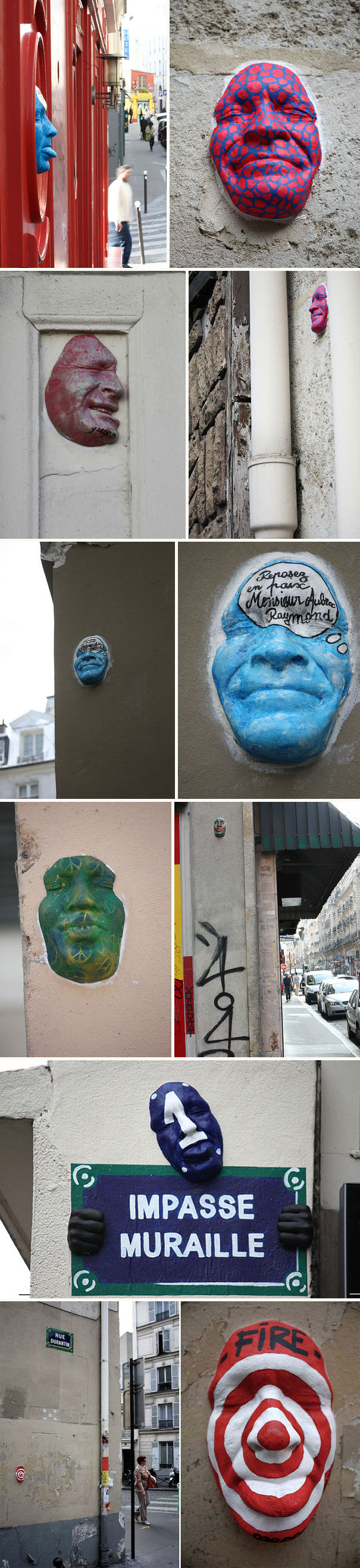
Street art in Paris, painted plaster self-portrait masks, Gregos, graffiti, collabcubedStreet art in Paris, painted plaster self-portrait masks, Gregos, graffiti, collabcubedStreet art in Paris, painted plaster self-portrait masks, Gregos, graffiti, collabcubedClick to enlarge

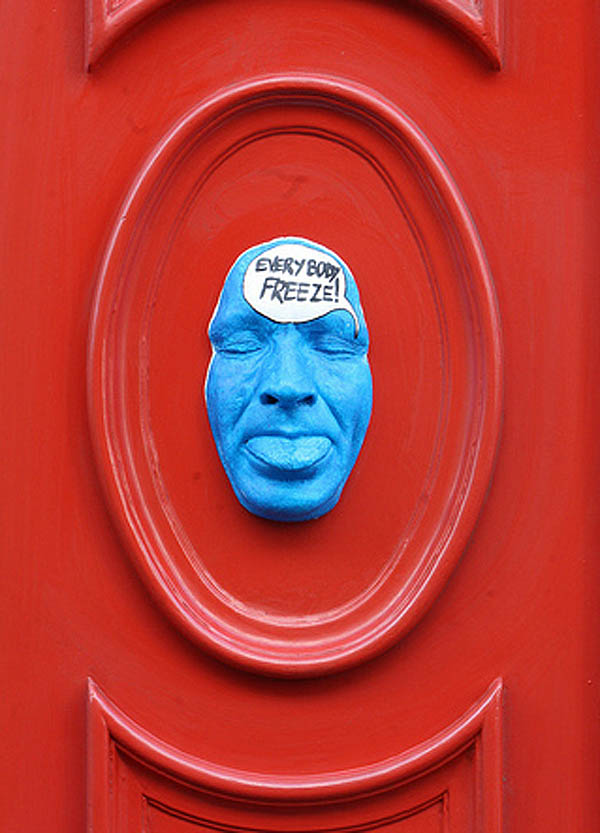
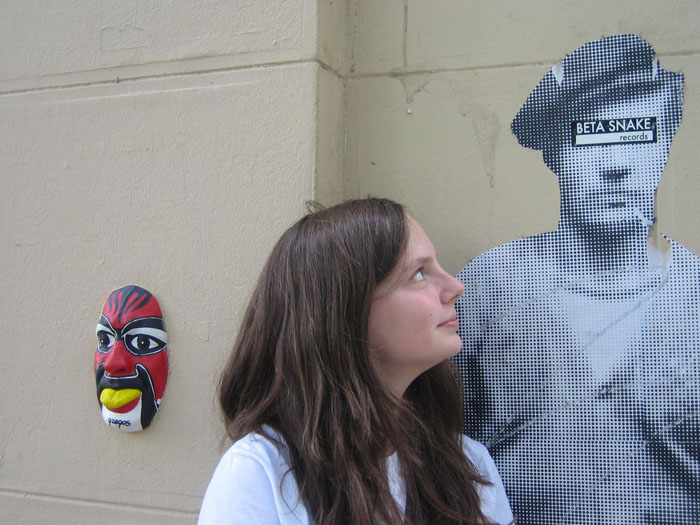
A couple of years ago, on a trip to Paris, we noticed many of these masks emerging from the walls around town. I came across a photo from that trip the other day and decided to google the artist. Gregos, as he is known, grew up in the suburbs of Paris and started graffiti painting in the late 80s. After stints in Athens, Greece and Boston, where he learned sculpting and painting, Gregos returned to Paris and street art, this time inventing his own 3D style combining all his newfound skills: sculpture, molding, and painting.

There are presently more than 400 faces, all cast from his own face — self-portraits that express his humor, thoughts, and most everything about Gregos.

You can see plenty more of these faces on his website and his flickr.

Tomás Saraceno: Cloud City at the Met

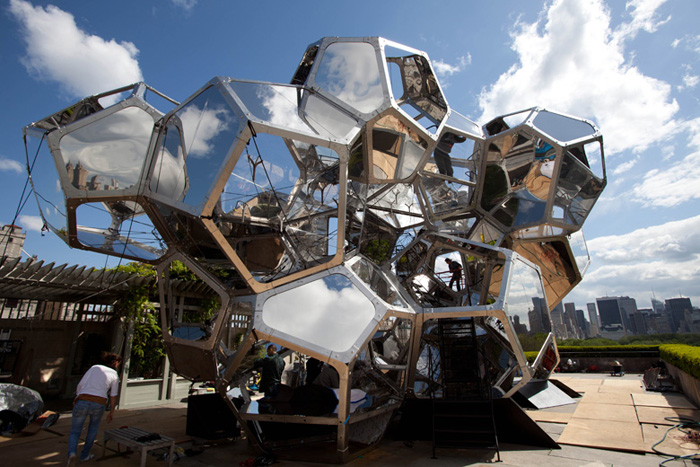
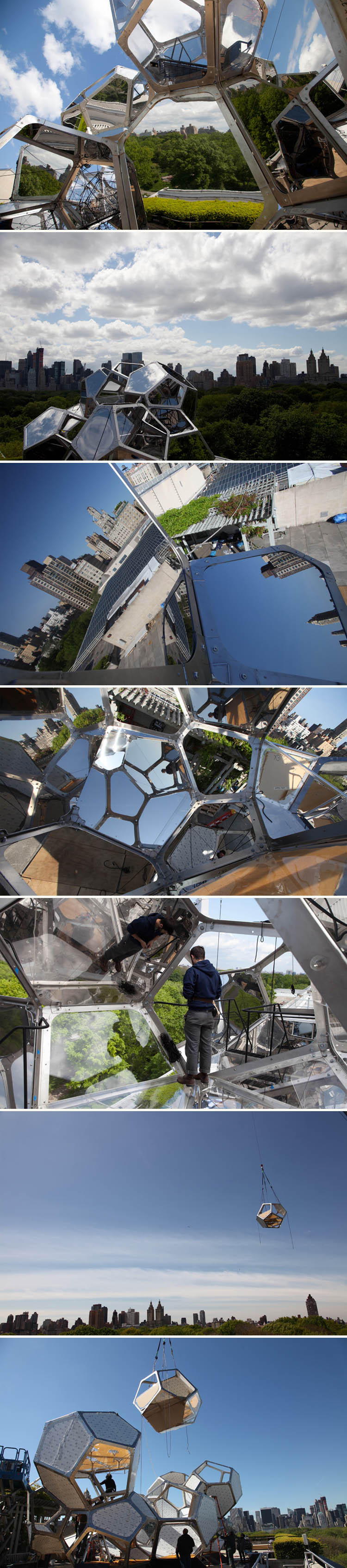
Met Roof Garden installation, Cloud City, Tomas Saraceno, cool installation, contemporary art, collabcubedMet Roof Garden installation, Cloud City, Tomas Saraceno, cool installation, contemporary art, collabcubedMet Roof Garden installation, Cloud City, Tomas Saraceno, cool installation, contemporary art, collabcubedCool installation on roof of the Metropolitan Museum 2012, Tomas Saraceno, Argentine ArtistClick to enlarge

It may not have been the best day to inaugurate Argentine artist Tomás Saraceno’s new installation, Cloud City (his largest in a 10-year-old series Cloud Cities/Air Port City), on the roof of the Metropolitan Museum due to the heavy downpours of rain, but it was the previously determined date. I was looking forward to checking out the installation in person, having been aware of Saraceno’s habitable constructions (previously here) for a while now, but will wait for a sunnier day.

The sculptural/architectural piece atop the Met is made up of interconnected metal and acrylic modules with both reflective and transparent panels. Visitors are able to enter the structure for up to twenty minutes by obtaining a timed-entry ticket. If the regular views from the roof garden weren’t already beautiful enough, I would imagine that both, the views from the additional 20-foot high interior, as well as off of the mirrored panels on its exterior, are even more spectacular, as evident in Saraceno’s photos.

Definitely worth a visit, though there are likely to be long lines to enter, especially on weekends. Luckily, Cloud City will be on the roof of the Met through November 4, 2012, at which point it will travel to Green Box Arts Festival in Colorado where it will be placed in the middle of the forest.

Check out The Met’s site for details.

Photos courtesy of the artist and The Met.

via The Metropolitan Museum and NY Times

Realities United: 2 X 5 (Brothers)

Kinetic Light Installation at Granoff Center at Brown University by Realities UnitedKinetic Light Installation at Granoff Center at Brown University by Realities UnitedKinetic Light Installation at Granoff Center at Brown University by Realities UnitedClick to enlarge

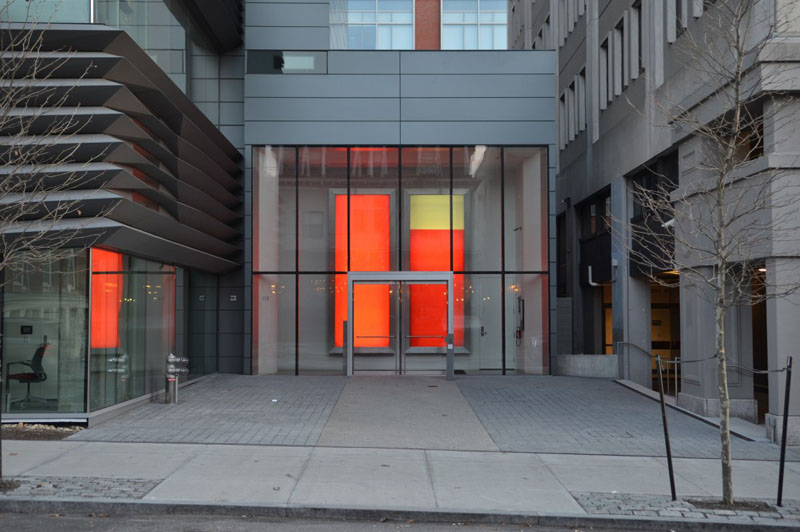
It’s true that we have a soft spot for all things Brown, with Em being up there almost 9 months of the year, but we’ve also been fans of the year-old Granoff Center on campus, designed by DillerScofidio+Renfro, since its opening. And now, I came across the permanent kinetic light installation titled 2×5 (Brothers) by, ironically enough, the two brothers at Berlin-based firm Realities United, which hangs at the entrance of the building as of last month. This colorful installation just adds an extra ‘like’ to all of the above; a little Rothko meets Albers meets Turrell rolled into one that has been beautifully integrated with the window panes and doors of the main ingress.

2×5 is a time-based work with two identical casings containing poster scrollers with full-surface monochromatic colored prints on stretched fabric illuminated from behind.

At the beginning of the academic year, the machines tend to both show the same color equally intensely backlit, and the changes are usually fundamental, i.e., from one color entirely to another. In the course of the year, the probability increases that the two machines will show behavior independent of each other. Then the spatial experience is shaped by up to four different colors of differing intensities at once. With two to four changes per day the frequency of the change is so low that visitors initially experience the installation mostly as static in the respective configuration.

You can see more of Realities United’s work, such as the very cool Bix/Kunsthaus Graz and the more recent mirror installation Transreflex, at their website.

Brian Dettmer: Quotes Cut from Books

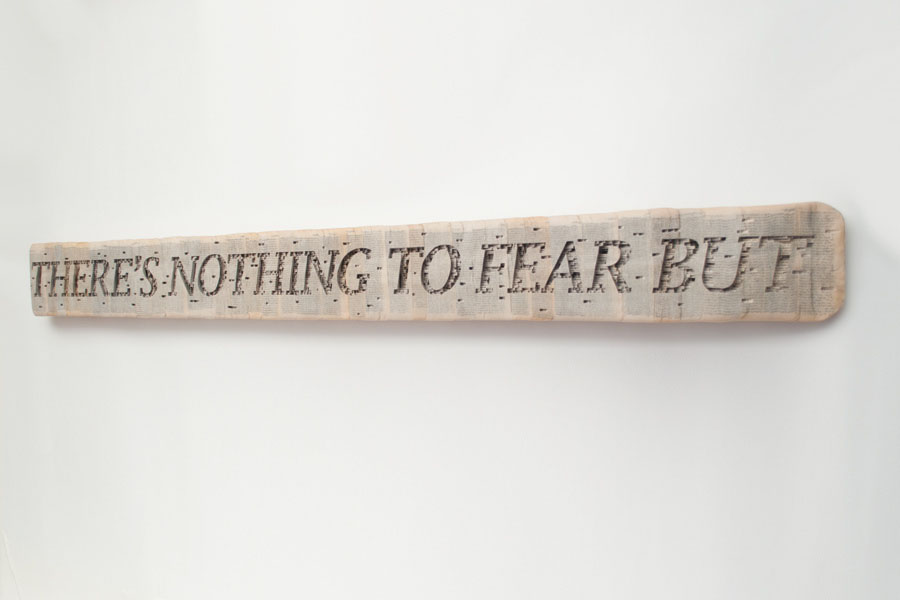
Book Sculptures, Cut books, Phrases cut out of books, typography, Brian Dettmer, Book artBook Sculptures, Cut books, Phrases cut out of books, typography, Brian Dettmer, Book artBook Sculptures, Cut books, Phrases cut out of books, typography, Brian Dettmer, Book artClick to enlarge

Originally from Chicago, artist Brian Dettmer, who creates innovative sculptures with books and other forms of antiquated media, currently resides in Atlanta.

As is the case with other artists working with books as their material of choice, Dettmer uses his art, in part, as a commentary on the waning physical form of the information age. The long-lasting book is being replaced by the intangible, digital file, and the world risks being left with nothing.

Dettmer works by cutting into the surface of books and dissecting through it. Working with knives, tweezers and surgical tools he carves one page at a time. Nothing within is relocated, just removed. Alternate histories and memories are revealed. In the case of the series of quotes above, Dettmer has cut into groups of paperbacks, sealed with acrylic, carving out the easily recognizable unfinished quotes.

You can see much more of Dettmer’s work here (definitely worth a look) and his Pecha Kucha talk from 2 years ago here.

via tribe magazine

Qzina’s World’s Largest Chocolate Sculpture

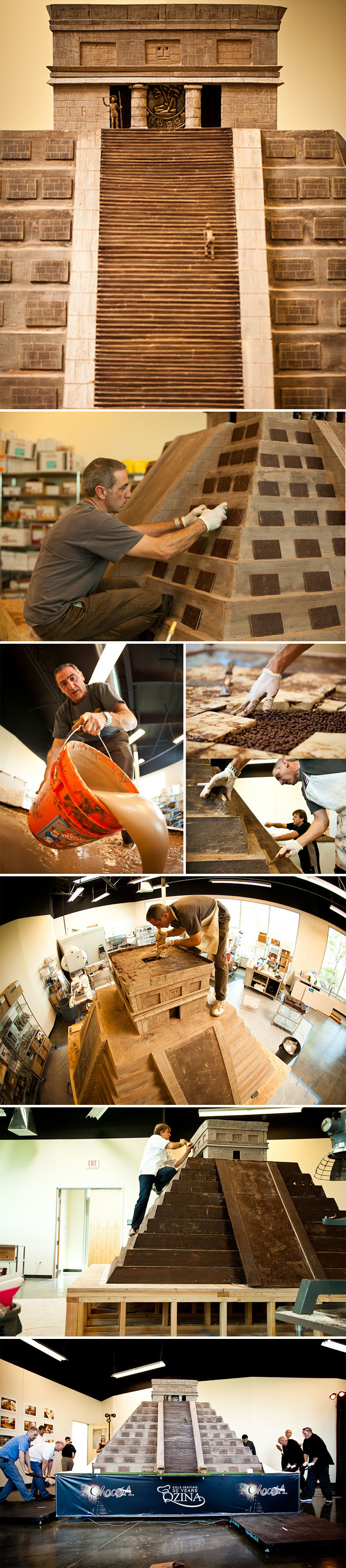
Guiness Book of world's records largest chocolate sculpture, Chocolate Pyramid, Chocolate Mayan Temple, Food Art, CoolGuiness Book of world's records largest chocolate sculpture, Chocolate Pyramid, Chocolate Mayan Temple, Food Art, CoolGuiness Book of world's records largest chocolate sculpture, Chocolate Pyramid, Chocolate Mayan Temple, Food Art, CoolClick to enlarge

Weighing in at 18,239 pounds (!!), Qzina Specialty Foods chocolate model of an ancient Mayan temple has broken the Guinness World Record for largest chocolate sculpture.

Corporate Pastry Chef Francois Mellet and MOF (Meilleur Ouvrier de France or Best Craftsman in France) Stephane Treand led their team in building the winning work. With a 10ft x 10ft square base, and measuring 6 feet high, the chocolate sculpture—which pays homage to the Mayans’ role in the origins of chocolate—accurately recreates the details of a Mayan temple.

The sculpture will be on display at the Irvine-based Qzina Institute of Chocolate & Pastry from June 4 to December 21, 2012, the end of the Mayan calendar year, when it will be destroyed.

If you like this, you might also like Sonja Alhauser’s work.

Photos courtesy of Qzina

via gothamist

Jean Daviot: Typographic Wordscapes

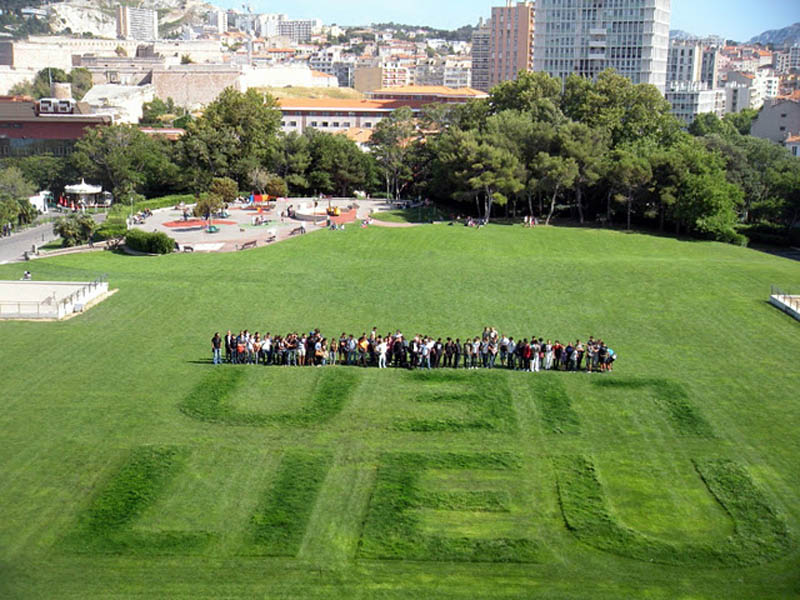
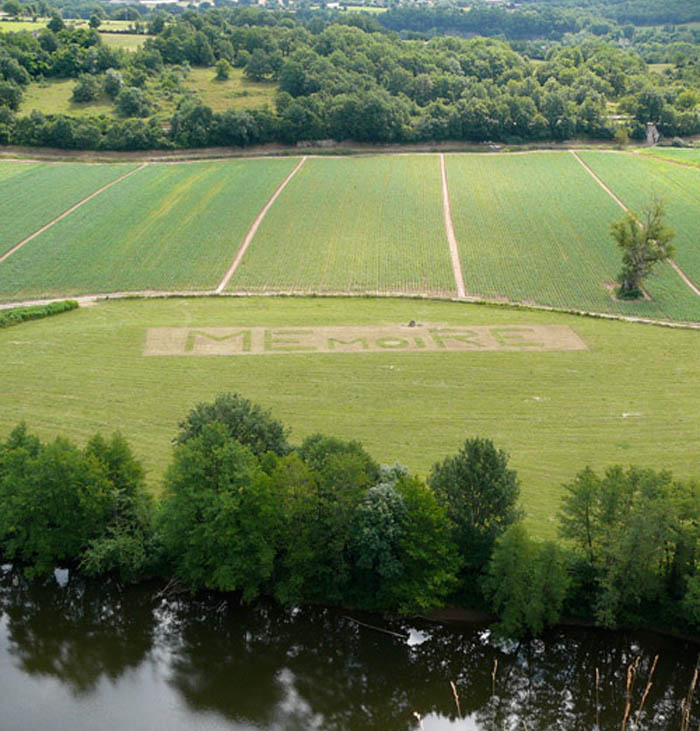
Typography landscapes, wordplay in grass, Lieu Lien, French art, Jean Daviot, type installationTypography landscapes, wordplay in grass, Memoire, French art, Jean Daviot, type installationTypography landscapes, wordplay in grass, Imagine, Memoire, French art, Jean Daviot, type installationClick to enlarge

French artist Jean Daviot works in a variety of mediums including painting, photography, video, and installation art. Throughout, he plays with aural and linguistic analogies. In his installations he is particularly interested in wordplay; in seeing words and type as shapes and then in essence dissecting them and seeing the words within the words. For example: MEmoiRE (memory), a word he uses in several installations, contains the letters M-O-I (self) inserted between the word MERE (Mother). He likes to take the words literally and then turn them upside down.

From the artist:
I’m particularly aware of those moments called entre chien et loup in French (twilight, when a wolf can’t be distinguished from a dog), those fleeting instants when day turns into night or vice versa and shapes are seen in a different light. All of my work is situated in this slippery moment, this passage in one direction or the other, that instant that suddenly reveals the face of things you thought were hidden and now suddenly can be seen, like the appearance of shapes through the intervention of an artwork that invites interpretation.

via documents dartistes and artpress

Laurent Perbos: Myths from the Banal

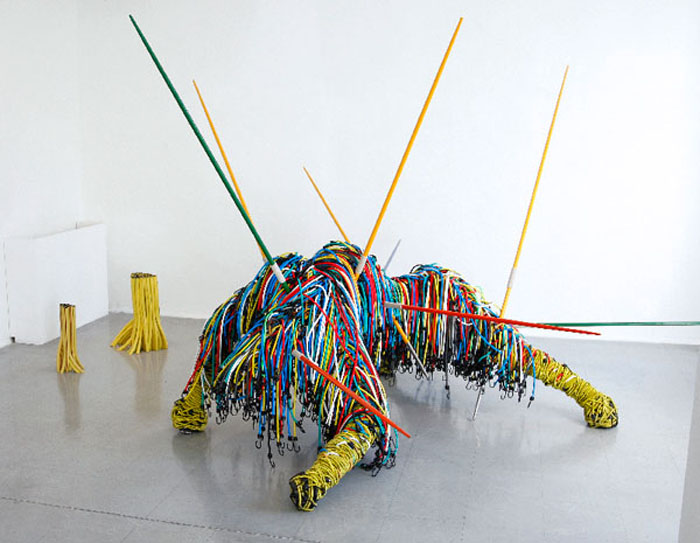
French contemporary sculpture made up of sports equipment such as bungee cords, Calydon,French contemporary sculpture made up of sports equipment such as bungee cords, Calydon,French contemporary sculpture using bungee cords and pvc piping, Laurent Perbos Click to enlarge

French artist Laurent Perbos belongs to the genre of artist that enjoys reappropriating the everyday and banal by converting it into art where it can be seen as playful, ironic and/or critical. He uses materials such as sports equipment, pencils, pvc piping, just to name a few. Many of his works reference mythological figures such as the sculpture at the top – made of bungee cords and javelins – titled Calydon, a wild boar from Greek mythology said to have been sent by the goddess Diane, that devastated the territory of Calydon. Below, Forest Tears, are trees and tree stumps made of pvc piping.

via documents d’artistes

Peter De Cupere: Olfactory Art

Olfactory Art, Performance art, Sweat, Collection sweat, unusual art performance, Peter De Cupere, Performance Art, collabcubedOlfactory Art, Performance art, Sweat, Collection sweat, unusual art performance, Peter De Cupere, Performance Art, collabcubedOlfactory Art, Scent-infused installations, sculptures and painting, unusual art, Peter De Cupere, Performance Art, collabcubedScent Concerts, Peter De Cupere, Instrument that emits scents when played, OlfactianoClick to enlarge

Where to begin? Not since John Waters’ 1981 film Polyester with scratch ‘n sniff ‘Odorama’ have I seen anything like Peter De Cupere’s Olfactory Art. Apparently, a growing number of artists around the world are incorporating scent into their works. Belgian artist De Cupere creates smell installations, scent sculptures, olfactory performances, smell-movies and scented painting. He generates a sort of meta-sensory experience that goes beyond purely seeing or smelling. He started playing with, and noticing, fragrances as a child, fearing that he would lose his vision. He attributes his fascination with the combination of smell and visual to that early-life fear. De Cupere is also fascinated with people’s desire to change or cover their natural smell with perfume in order to be more attractive to others. He seems to be a firm believer in the natural, and not over-washing.

I find all his work very interesting, if a bit bizarre. From top to bottom here are some of his works:

Sweat: Peter De Cupere collected the sweat of dancers wearing plastic suits during a 15-minute performance choreographed by Jan Fabre. He applied the concentrated essence, enclosed in a glass box, to a wall at the dance company’s home base, in Antwerp. Visitors can smell it through a hole in the glass.

Air Polluter: an interactive smell installation which allows the visitor to decide in how far he or she contributes to pollution of the air. By means of a control panel at the start of the installation, visitors can activate good as well as bad smells. This subdivision into two so called Smell Fields is based on the socially accepted appreciation of the various smells.

Smoke Room: a smell installation made of more than 750,000 cigarette butts.

Smile Room: a smell installation made with 3400 tubes toothpaste, pu-components, creating an intense minty toothpaste smell.

Tree Virus: Smell-installation with intensive peppermint smell. Visitors start to cry by entering the plastic dome. The main fragrance is an intense mix of peppermint in combination of black pepper.

Flower Fragum Cardamomi: first Scratch ‘n Sniff Sculpture in the world, 9 meters high. Made of epoxy, metal, 1000 strawberries and cardamon.

Olfactory Tree: scented sculpture made completely of epoxy and fake. Fragrances: pine, cedre, forest, mushrooms, grass

Garbage City Holiday Jina Park: a smell installation made to look like garbage but smelling of pine & cedar, honey mustard, and peach-cassis.

Smell Me Project: People’s necks are stamped with the words “smell me” and everyone goes around sniffing each other exploring others’ scents and which attract and repel.

Olfactiano: A piano-like instrument that emits different smells when played called ‘Scent Concerts.’

There’s much more to explore if you find this as fascinating as I do. For older work check De Cupere’s website, and for more recent his facebook page. Click through the links above for more on the individual projects.

Oh, and he’s making a perfume called ‘Peter’ of his own smells, coming out soon, so keep an eye out for that!

via saatchi online

JIA: Contemporary Chinese Tableware

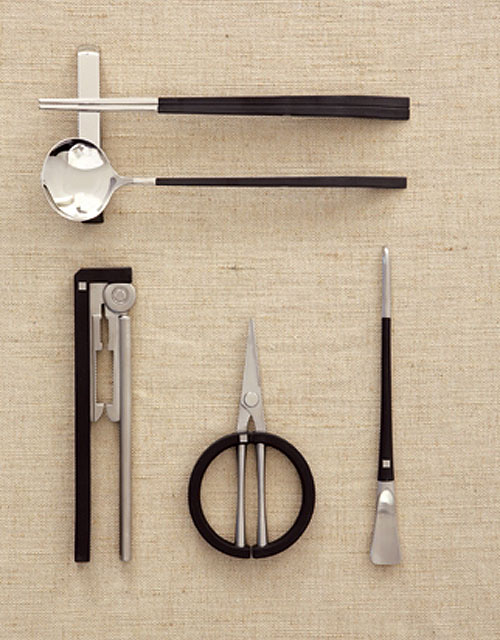
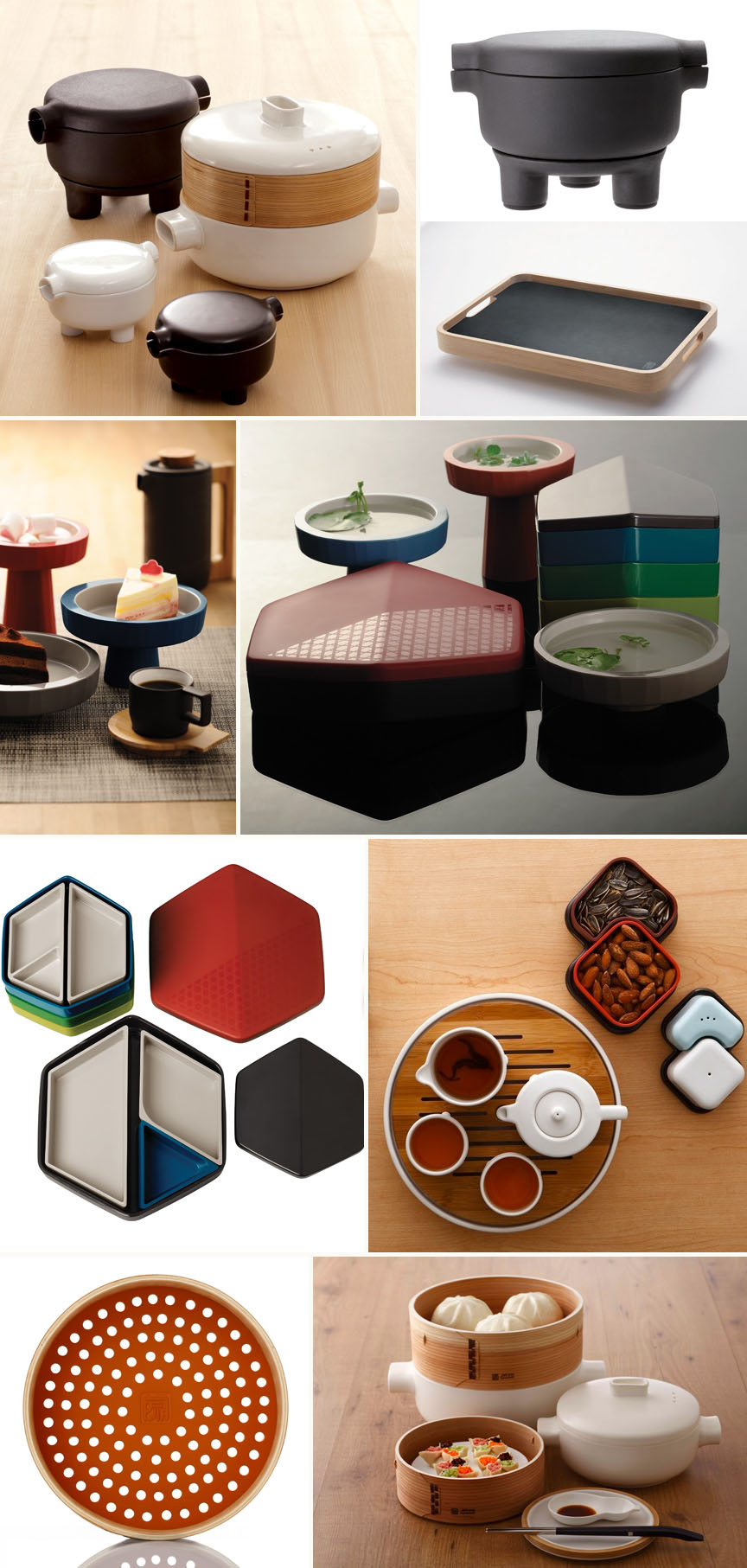
Contemporary chinese tableware, utensils, seafood, beautiful design, JIA, flatwareContemporary Chinese tableware, JIA, industrial design, product design, beautiful flatware designContemporary Chinese tableware, JIA, industrial design, product design, beautiful kitcheware, stylish kitchewareI’d have to say that I pretty much love everything on the JIA kitchen and tableware site. JIA, based in Hong Kong, means ‘home’ in Chinese. The company has invited international designers with different cultural backgrounds to re-interpret Chinese object culture and its traditional craftsmanship for a new and modern housewares market relevant to both the Asian and Western dining tables.

From the seafood set up top, (how beautiful are those tools, eh?) to the chunky Ding casserole and salt & pepper shakers, it’s all just lovely.

Clearing: Lateral Office

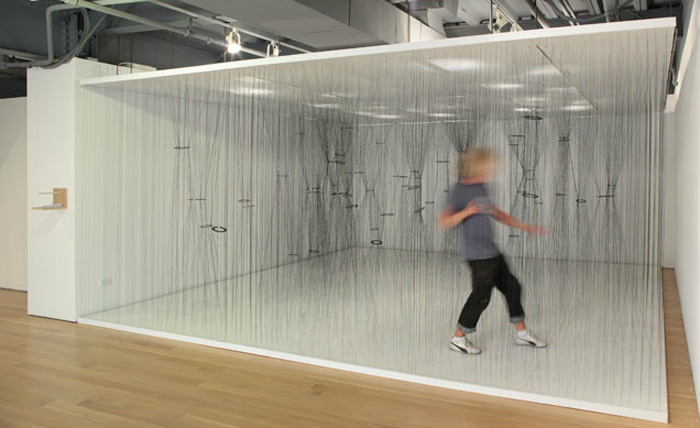
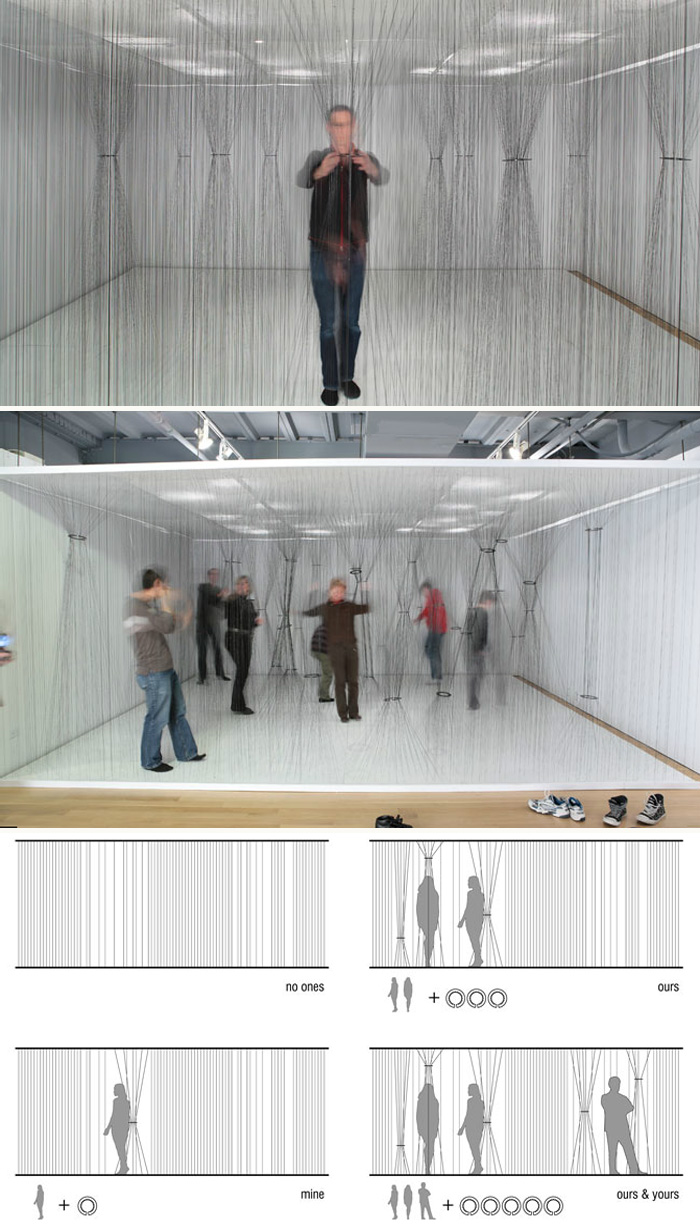
Installation, art installation with threads and strings about ownership of space, Lateral Office, Toronto, Lola Sheppard, Mason WhiteInstallation, art installation with threads and strings about ownership of space, Lateral Office, Toronto, Lola Sheppard, Mason WhiteInstallation, art installation with threads and strings about ownership of space, Lateral Office, Toronto, Lola Sheppard, Mason WhiteClick to enlarge

Lateral Office, an architecture firm based in Toronto and founded by Lola Sheppard and Mason White, was commissioned by the Harbourfront Centre to address the theme of ‘personal space.’ They responded by creating an installation — titled Clearing — with a dense field of over 4000 elastomeric strings running vertically along a tight grid. As people entered the space they would be given an acrylic collector tool that would allow them to navigate the field and manipulate the density of the space.

via Canadian Architect

Daniel Buren: Excentrique(s)

Cool installation at the Grand Palais in Paris, by Daniel Buren, Monumenta 2012, collabcubedCool installation at the Grand Palais in Paris, by Daniel Buren, Monumenta 2012, collabcubedCool installation at the Grand Palais in Paris, by Daniel Buren, Monumenta 2012, collabcubedClick to enlarge

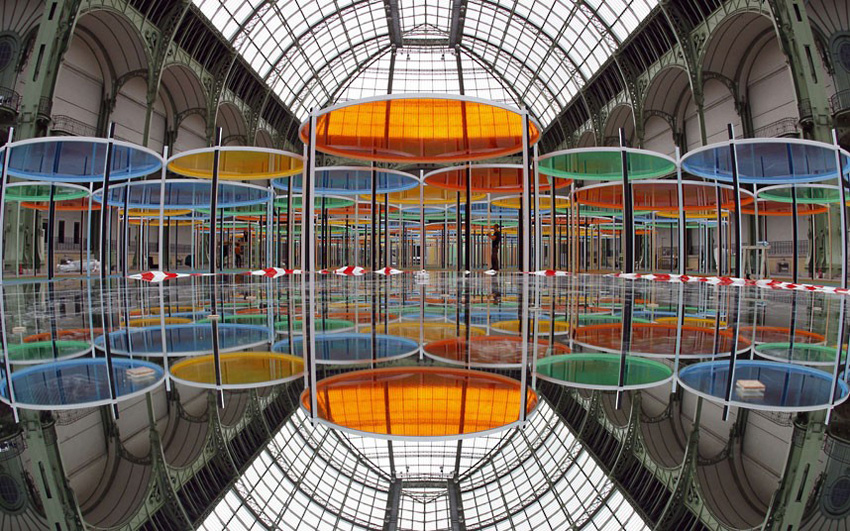
French artist Daniel Buren has unveiled his monumental installation Excentrique(s), Travail in situ, for this year’s Monumenta, the annual art project that’s in its fifth year and challenges an internationally known artist to ‘own’ the 145,000 square foot space of Paris’s Grand Palais.

Buren, a minimalist, has filled the space with primary colored discs horizontally eight feet off the ground, except for the area underneath the nave which has 9 circular mirrors on the floor facing up. Utilizing the sunlight that shines through the space, Buren fills the Grand Palais with color and light that, apparently, is rather breathtaking.

This would be so much fun to see in person…because of the installation and because it’s in Paris!

Photos: Courtesy of Monumenta, Benoit Tessier/Reuters, Francois Guillot/AFP/GettyImages and Francois Mori/AP.

via voanews and the telegraph

Walid Raad: Imaginative Wall Reliefs

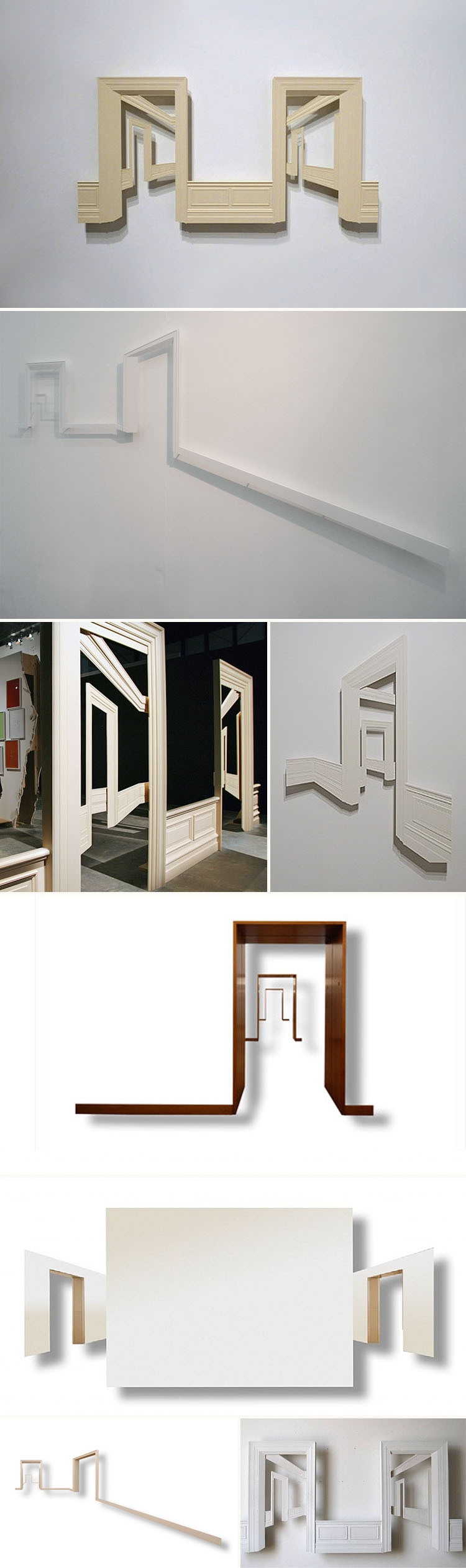
Walid Raad, Contemporary Lebanese Art, sculpture, installation, architectural wall reliefs, collabcubedWalid Raad, Contemporary Lebanese Art, sculpture, installation, architectural wall reliefs, collabcubedWalid Raad, Contemporary Lebanese Art, sculpture, installation, architectural wall reliefs, collabcubedClick to enlarge

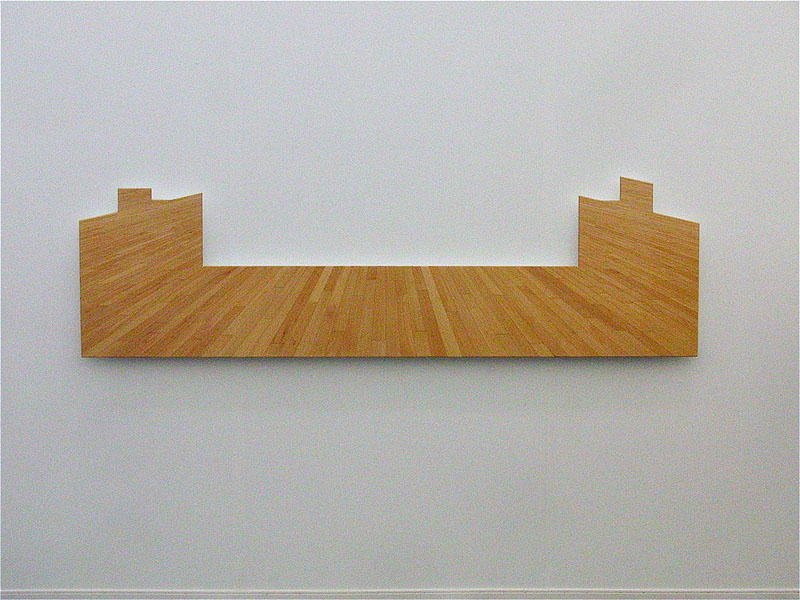
Walid Raad is a contemporary media artist originally from Lebanon and now mostly based in New York. He formed The Atlas Group, an imaginary art collective whose work is exclusively produced by Raad. His works include video, photography, literary essays and these architectural wall reliefs, of which I spotted the top one at the Frieze Fair here in NYC last week.

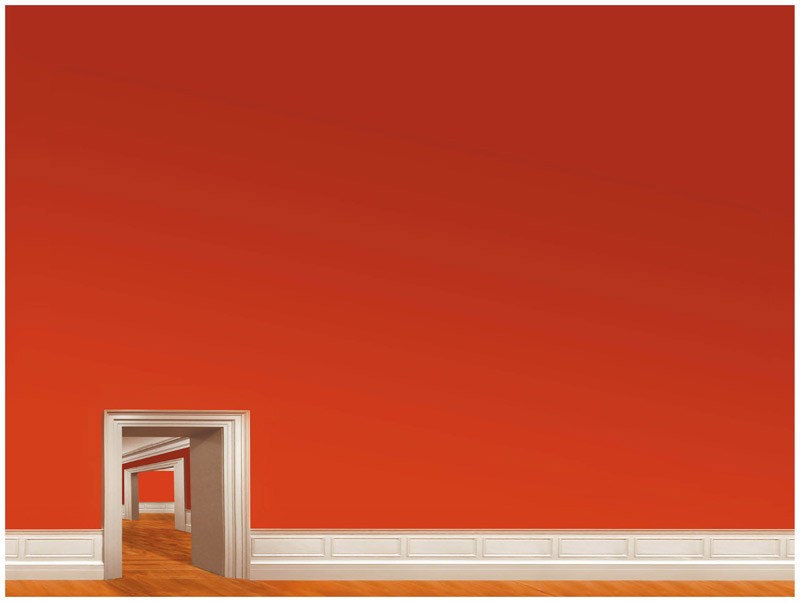
These sculptural wall hangings have an exaggerated perspective and all seem to be inviting one in through their portals. Concerned with the contemporary history of Lebanon, particularly the wars between 1975 and 1991, Raad’s works are often representation of traumatic events. His work examines the social, political, psychological and aesthetic ramifications of the various wars that have been waged in Lebanon.

In his series of wall reliefs—an ongoing project in part titled Scratching on Things I Could Disavow: A History of Art in the Arab World—Raad literally sets the stage for his upcoming play about art institutions in the Middle East, depicting what the architectural interior of the museum’s gallery spaces would be.

Walid Raad is an associate professor at the Cooper Union School of Art.

Top photo by collabcubed; others courtesy of Paula Cooper Gallery, artnet, and The Atlas Group.