Machine Home: AdHoc MSL

Machine Home by adhoc msl, murcia, spain, david frutos photographer, Machine Home by adhoc msl, murcia, spain, david frutos photographer, Machine Home by adhoc msl, murcia, spainClick to enlarge

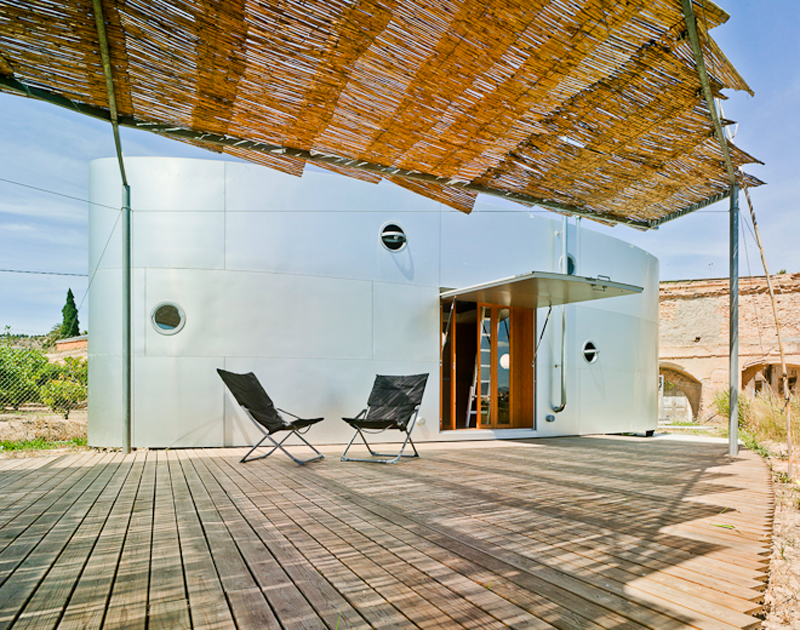
The Machine Home  in Murcia, Spain, designed by adhoc ml, can be described as a cross between the traditional dwelling and the caravan. It is easily transportable and can be put up anywhere. All it needs is a minimal foundation and a connection to MEP installations, be these existing urban services or mechanisms making for the module’s total self-sufficiency: potable and irrigation water, plumbing and purifying systems, telecommunications lines and energy-capturing devices.

The Machine Home has three main parts. The central area is for shared household activities. One of the side spaces contains the sanitary utilities on ground level and the other installations above. The other lateral space is a double-height storeroom. The central room has an overhead hole that the inhabitants climb up to, by means of two ladders, to get to the bedrooms.

Once anchored to the ground, the module proceeds to colonize the place and interact with it through a series of added elements constructed on the site: a pergola, a terrace deck, an outdoor kitchen, a pond. They bring the interior domestic space to the exterior environment by means of a double hydraulic door system that helps reinforce the disturbing machine image of the house.

Photos courtesy the architects and David Frutos.
Heart of the District: ZA Architects

Heart of the District by German ZA Architects, cool hotel design, Cut 'n' Paste exhibit MoMA, futuristic architectureHeart of the District by German ZA Architects, cool hotel design, Cut 'n' Paste exhibit MoMA, futuristic architectureHeart of the District by German ZA Architects, cool hotel design, Cut 'n' Paste exhibit MoMA, futuristic architectureClick to enlarge

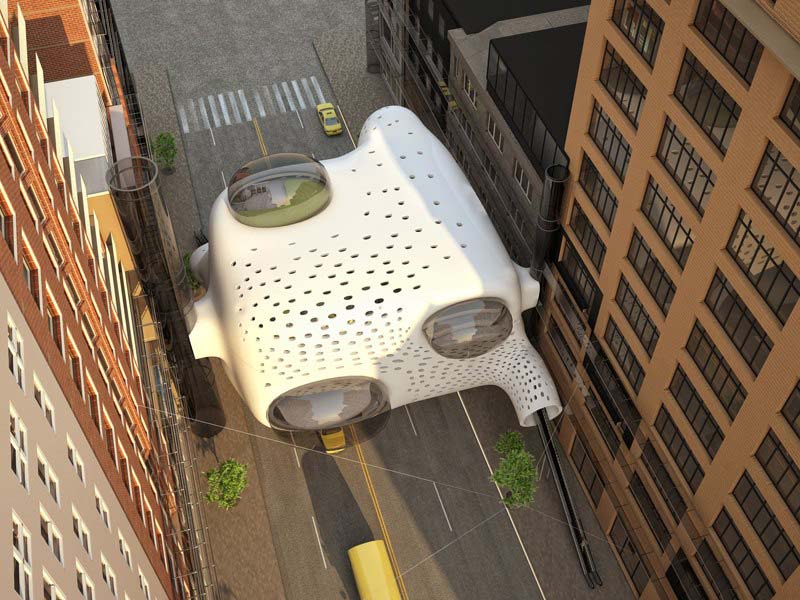
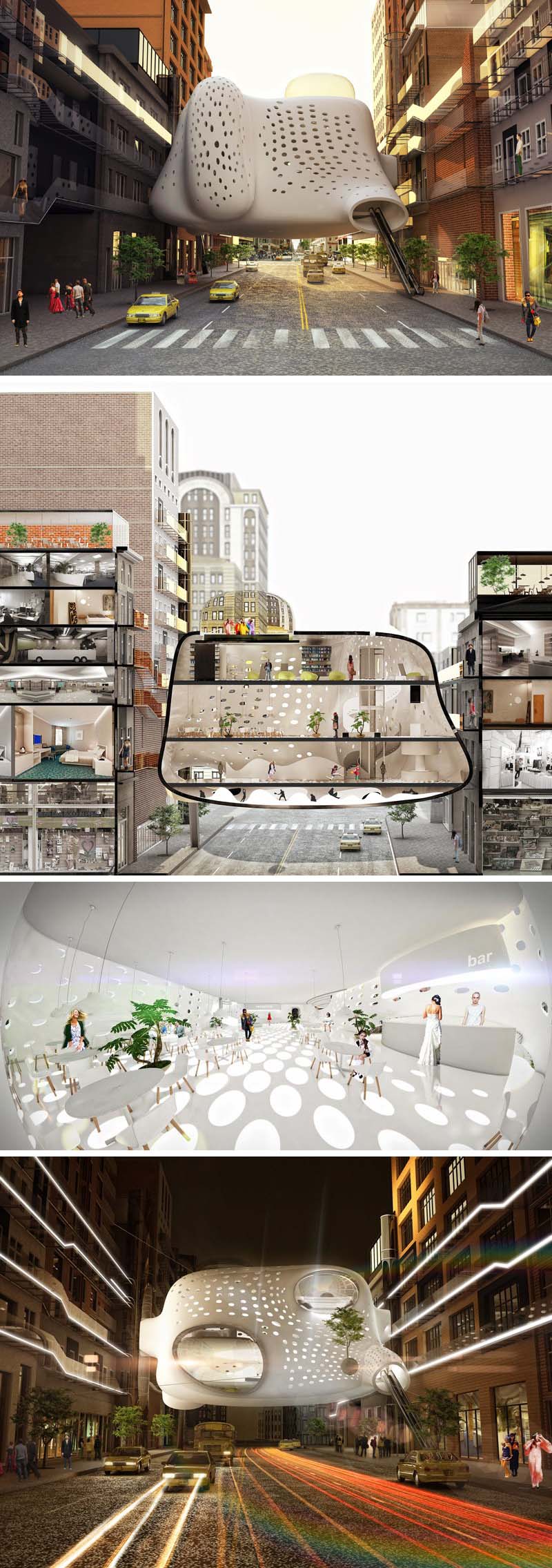
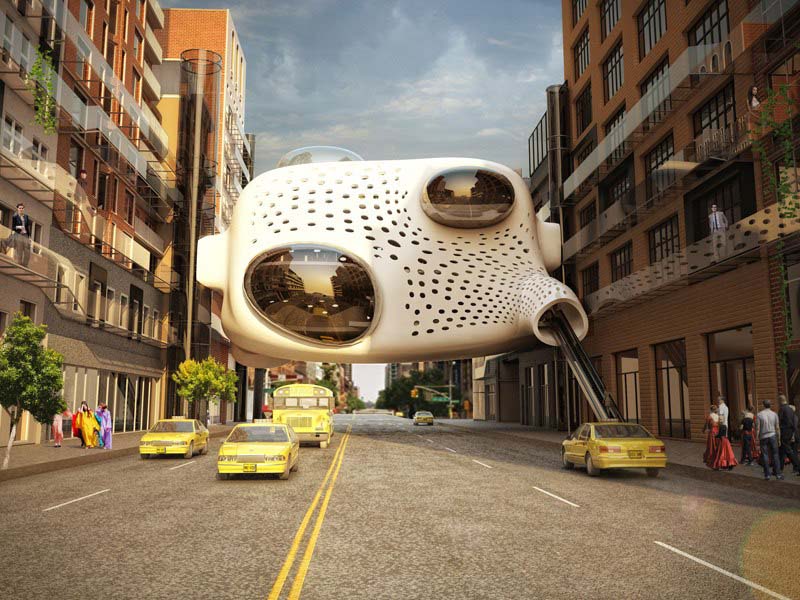
A few weeks ago while taking in several exhibits at MoMA, we came upon a very interesting image as part of a digital slideshow in the architecture Cut ‘n’ Paste exhibit. After running through all the captions on the wall, we finally found what was unmistakably the corresponding one, clued in by the vital organ referenced: Heart of the District by ZA Architects. The Germany-based architecture firm came in second place in an international competition with their futuristic heart-shaped pod-like structure. Their proposal, for a hotel in NYC, integrates the street, the city dwellers, as well as the hotel guests, giving the tourist a more inside experience on their visit. The hotel rooms would reside in the existing adjacent buildings with the heart shape construction acting as a hub to draw people in and mix, acquaint them inside its tight spaces, while they partake in varied activities. The “heart’ itself would contain a playground, shop, exhibition space, café, bar, hotel reception, lounge zone, small cinema, library, conference hall. And, it goes without saying, whether you like it or not, the structure would likely become a NY icon.
All images courtesy of the architects.

Matthew Mazzotta: Open House

Open House, Matthew Mazzotta, Coleman Center for the Arts, Recycled House from private space to public Open House, Matthew Mazzotta, Coleman Center for the Arts, Recycled House from private space to public Open House, Matthew Mazzotta, Coleman Center for the Arts, Recycled House from private space to public Click to enlarge

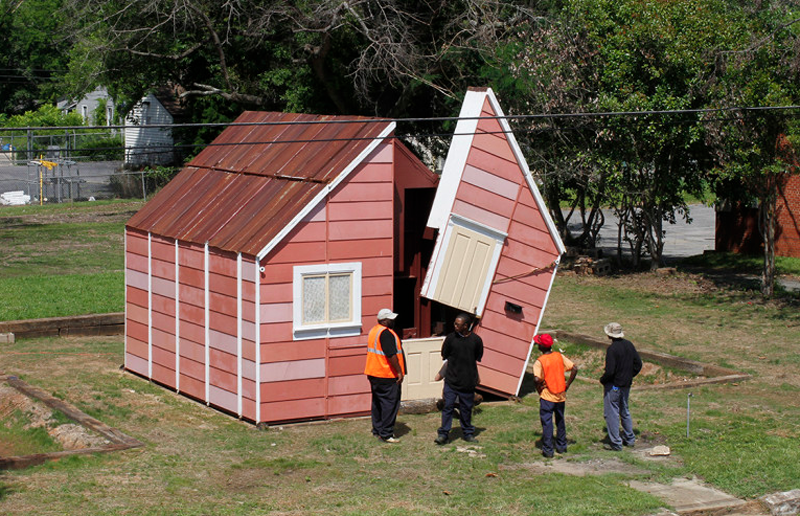
Artist Matthew Mazzotta (previously here) teamed up with Coleman Center for the Arts and the folks of York Alabama to transform one of the town’s most blighted properties into a new public space. Using the materials of an abandoned house as well as the land it stood on, Mazzotta created one of his shape-shifting structures titled Open House. Starting in the shape of a house, the puzzle-like structure is designed to require cooperation. Four people must work together for over an hour to unfold the pieces into a multi-seat theater that can be used for performances or simply a common ground for community dialogue and activities. Everything about this project is ultra-clever and well designed: its construction (and deconstruction); the repurposing of materials; as well as the community-building aspect via the integration of the townspeople. Here’s a video with more background on the project:

Thanks Matthew!

Cloudscapes: Tetsuo Kondo & Transsolar

Tetsuo Kondo, Transsolar, Cloudscapes, cool installations with contained cloudlike formations, contemporary art, Museum of Contemporary Art Tokyo, Venice BiennaleTetsuo Kondo, Transsolar, Cloudscapes, cool installations with contained cloudlike formations, contemporary art, Museum of Contemporary Art Tokyo, Venice BiennaleTetsuo Kondo, Transsolar, Cloudscapes, cool installations with contained cloudlike formations, contemporary art, Museum of Contemporary Art Tokyo, Venice BiennaleClick to enlarge

Ever wish you could walk through a cloud? Japanese architecture studio Tetsuo Kondo Architects and environmental engineers Transsolar, create Cloudscapes where visitors can experience a real cloud from below, within, and above. First, three years ago at the Venice Architecture Biennale 2010 their cloud installation floated within the center of the Arsenal and, more recently they exhibited a Cloudscape encased inside a transparent two-storey cube at the Museum of Contemporary Art Tokyo (MOT). These installations are formed by pumping three layers of air into a contained space: cold air at the bottom; hot humid air in the middle; and hot dry air at the top. The pathways offered to visitors exploring the Cloudscape includes a staircase allowing them to experience the cloud from all angles, including walking through it.

via idporn & mymodernmet

From the CollabCubed Archives

We’re taking a little summer blogging break this month. To keep you entertained, we’ve put together easy access links to some of our more popular posts in the past months but, of course, feel free to peruse instead by category using the drop-down menu in the right sidebar, or click on the ‘random post’ icon also in the sidebar. There’s always our facebook page, as well, with links to all of our posts. And for those of you in NYC, please check out our recently launched site Culture on the Cheap offering daily suggestions of free and cheap events in New York City.

Enjoy and we’ll be back in a few weeks!

jay-shells_jason-shelowitz_rap-quotes_street-signs_street-art_collabcubed

trafiq-budapest-typography-architecture_collabcubedFarmacia-Lordelo_collabcubedUnidisplay_Carsten-Nicolai_collabcubedMirador-del-Palmeral_collabcubedPenique-Productions_collabcubedFarshad_Mehdizadeh_Dayereh-Snack-Bar_collabcubedOlson_Gensler_collabcubedAnn_Hamilton_the-event-of-a-thread_collabcubedinfinity_bridge_Speirs-and-Major_collabcubedPendulumChoir_collabcubedStairway-Cinema_Oh.No.Sumo_Auckland_Australia_collabcubedAlex-Schweder_PerformanceArchitecture_collabcubedClearing-Installation_collabcubedAram-Bartholl_DVD-dead-drop_Museum-of-Moving-Image_2_collabcubedClip-Bag_Bristol_collabcubedREgeneration_CrackingArtGroup_collabcubedgeorge-orwell-birthday-party_surveillance-cams-party-hats_collabcubed

Tham & Videgård: Lagnö Summer House

Tham & Videgard Arkitekter, Contemporary Swedish Architecture, Lagno Summer House, Concrete rooftopsTham & Videgard Arkitekter, Contemporary Swedish Architecture, Lagno Summer House, Concrete rooftopsTham & Videgard Arkitekter, Contemporary Swedish Architecture, Lagno Summer House, Concrete rooftopsClick to enlarge

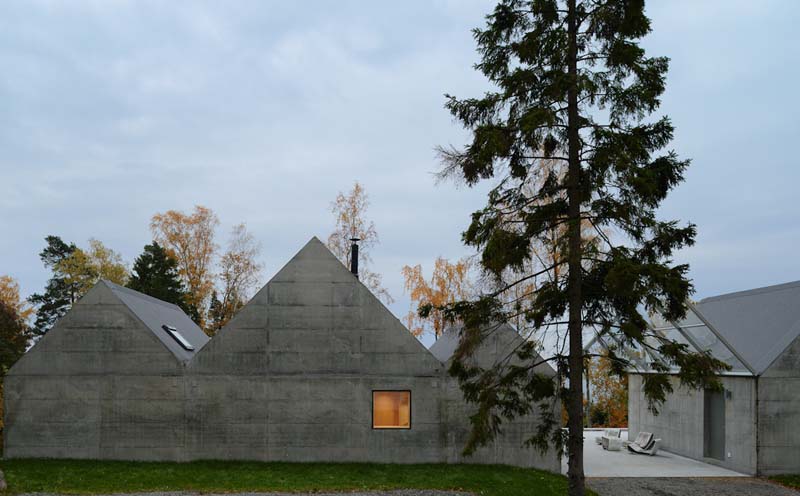
Swedish architects Bolle Tham and Martin Videgård designed this summer house in the town of Lagnö, part of the Stockholm archipelago. What sets this house apart from the more classic rustic timber cabins found in the landscape, is its pleated façade made up of a series of concrete gable roofs. The  exposed concrete and its angular shape, was a deliberate choice by the architects to connect the house to its environment, specifically the archipelago’s granite bedrock. The pitched ceilings make for dramatic interior heights and room shapes, while the large expanses of glass offer spectacular views of the forest and bay.

Photos by Lindman Photography

via ar

Voice Tunnel by Rafael Lozano-Hemmer

NYC August Summer Streets, interactive art installations, Voice Tunnel, Rafael Lozano-HemmerNYC August Summer Streets, interactive art installations, Voice Tunnel, Rafael Lozano-HemmerNYC August Summer Streets, interactive art installations, Voice Tunnel, Coolstop Chat Travieso, The Course of Emotions, Risa PinoClick to enlarge

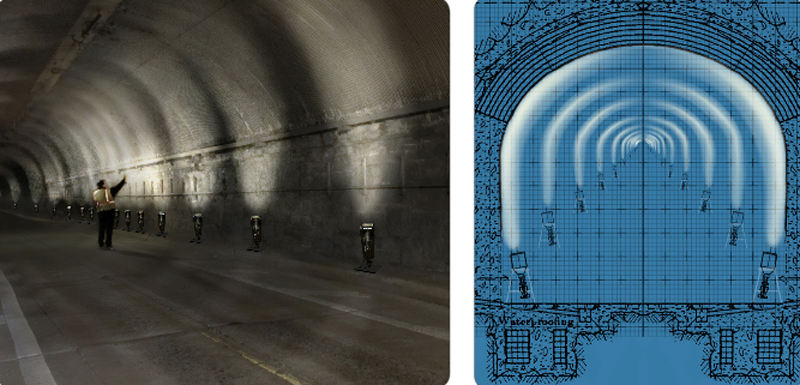
As part of this year’s Summer Streets in NYC — an annual celebration of the city’s most valuable public space: its streets! — for three consecutive Saturdays in August, nearly seven miles from the Brooklyn Bridge to Central Park are closed to traffic and opened for people to play, walk, bike, and enjoy. This year, as part of this event the Park Avenue Tunnel which runs from 33rd to 40th Streets, will be transformed into an interactive sound and light installation, Voice Tunnel, by Mexican artist Rafael Lozano-Hemmer (previously here and here.)  This rare opportunity to stroll the tunnel will invite participants to walk to a midpoint in the tunnel and deliver short messages into an intercom. The words/sounds will then reverberate out in waves of sound and arching light until they disappear. The intensity of the light will be determined by the pitch and volume of the person’s voice.

Voice Tunnel will be taken down after each of the three Saturdays before car traffic resumes, and will be set up again the following week. Other, smaller, interactive installations include Chat Travieso‘s CoolStop at Foley Square, a water mister that connects to fire hydrants made with recycled PVC piping. The 10′ installation resembles a large splash that participants will be able to stand under for a small reprieve from the heat. Also, The Course of Emotions: a mini-golf experience by Risa Puno, that translates everyday feelings into 9 holes of playable fun. Players putt through a range of emotional obstacles, like the seesaw platform of Insecurity and the par-40 Frustration maze.

Summer Streets will take place on the first three Saturdays of August (3rd, 10th & 17th) from 7am to 1pm.

Photos: Chang W. Lee/New York Times; & SummerStreets

Marc Fornes & THEVERYMANY

Marc Fornes & THEVERYMANY, non-lin/lin pavilion, carbon fiber shell, digitally sculptedMarc Fornes & THEVERYMANY, non-lin/lin pavilion, carbon fiber shell, digitally sculptedMarc Fornes & THEVERYMANY, non-lin/lin pavilion, carbon fiber shell, digitally sculptedClick to enlarge

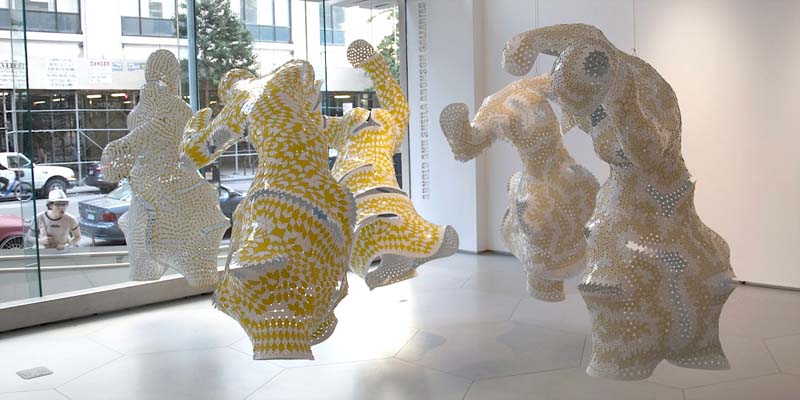
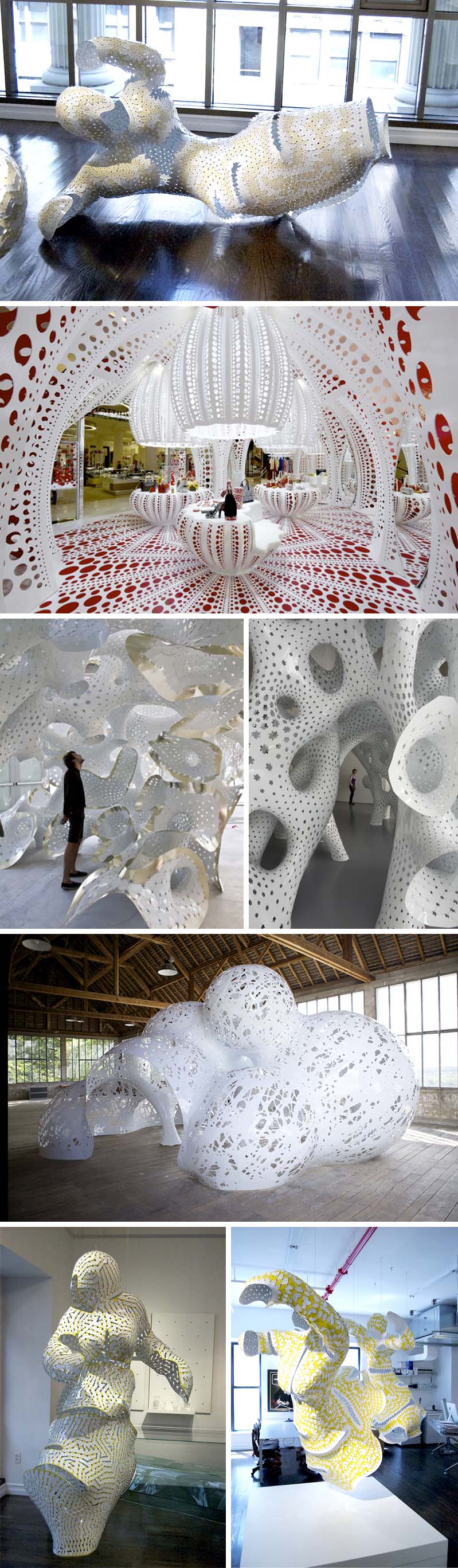
It’s hard to be in the vicinity of Parsons School of Design this summer and not be lured toward its exhibit window. The expression on the person’s face in the second photo is probably similar to the one I had when I crossed the street a couple of weeks ago, catching a glimpse of these striking floating structures from the corner of my eye. Turns out, these digitally sculpted dancers, titled Les Danseurs du Tailor, are the work of one of this year’s Architectural League Prize winners, Brooklyn-based Marc Fornes & THEVERYMANY. Fornes is a leader in the development of computation applied to design and digital fabrication. He realizes geometrically complex and self-supporting structures for both artistic and commercial purposes, from pop-up stores (such as the Louis Vuitton Pop-up Store in London with Yayoi Kusama- 6th photo from top) to gallery installations and park pavilions. I don’t exactly understand the process, but Fornes digitally designs these skins—which are then produced either in carbon fiber, hand-riveted aluminum, or plastic—by analyzing and evaluating the algorithms and rules encoded in computational systems against the explicit forms, resulting in precise but unpredictable operations. Whatever the process, the results are show-stoppingly stunning.

Photos: Francois Lauginie; Guillaume Blanc; Stephane Muratet; and Moss Bureau

Paul Marti: Matchstick Architecture

MAtchstick constructions, Paul Marti, matchstick art, constructions made of matchsticksMatchstick architecture, Paul Marti, matchstick art, constructions made of matchsticksMatchstick architecture, Paul Marti, matchstick art, constructions made of matchsticksClick to enlarge

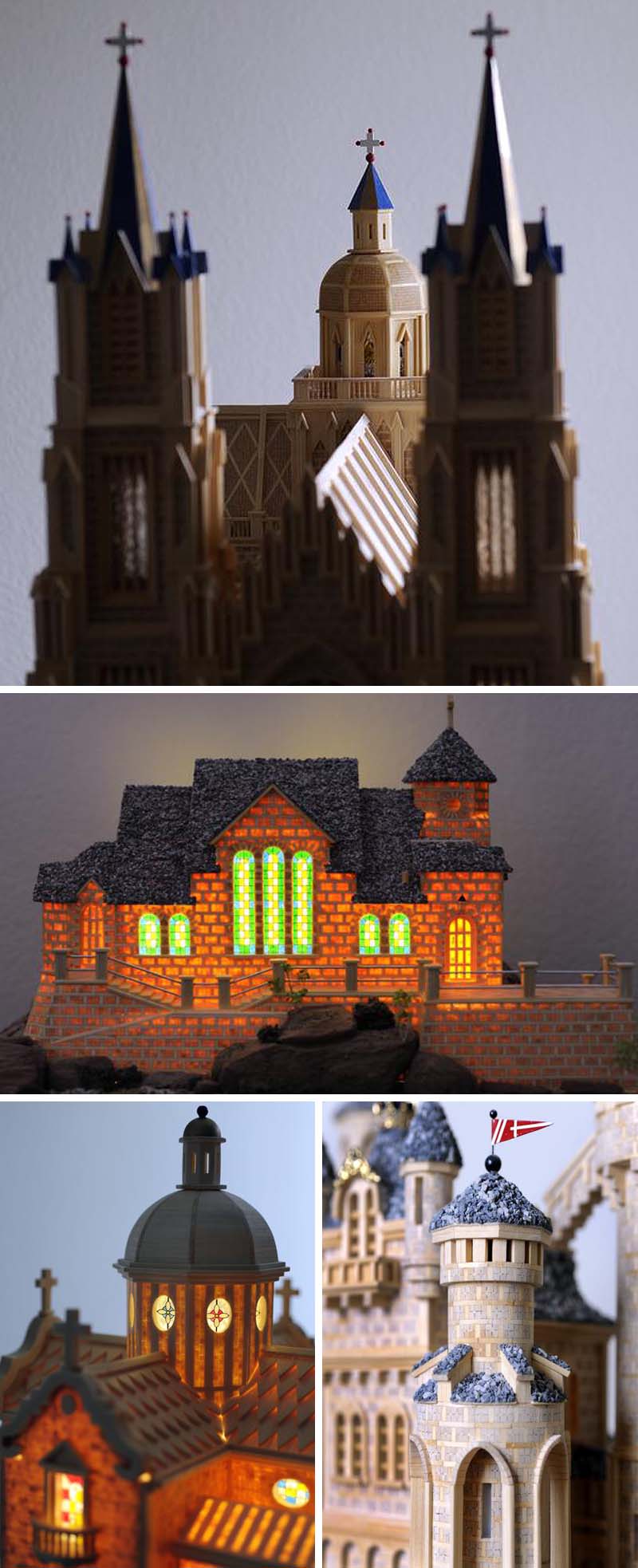
Artist Paul Marti of Englewood, Colorado builds elaborate architectural constructions such as cathedrals and castles using only matchsticks. These intricately designed pieces are not replicas, but rather original artworks conceived by Marti in his head, from their rounded towers and elaborate arches, to their painted stained glass. He solves the construction problems the way an artist does, by envisioning something beautiful first, then executing it. The detail on these is impressive. The “brick” facades are created by stacking cut matchsticks, and even the gravel is made with chopped and painted matches.

Photos Kathryn Scott Osler, The Denver Post

Thanks Ana!

Royal William Yard Staircase: Gillespie Yunnie

staircase, lighting, royal-william-yard-by-gillespie-yunnie-architectsstaircase, lighting, royal-william-yard-by-gillespie-yunnie-architectsstaircase, lighting, royal-william-yard-by-gillespie-yunnie-architectsClick to enlarge

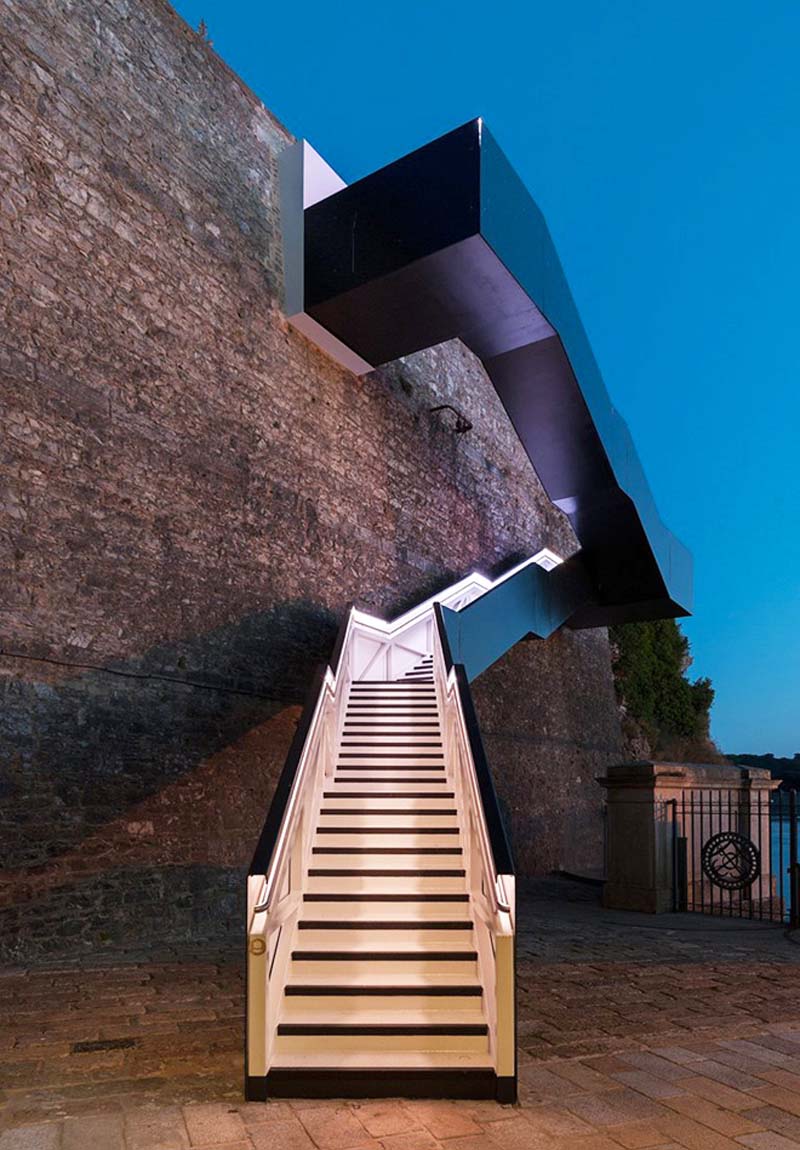
The Royal William Yard in Plymouth, UK has always been a dead end due to its naturally defensive nature and peninsular location. Gillespie Yunnie Architects have recently completed the dramatic staircase that links the far end of the Yard with the open green space above it, a key part of the regeneration masterplan, allowing residents to access the park and historic battlements at the top of the high retaining wall. The staircase, with its striking lighting with changing hues, and stark black exterior, offers that impressive, yet complementary, contrast of old and new against the old stone wall. Plus, the beautifully framed water at the landing, highlighted by the colored lights, makes for a spectacular view.

Photos by Richard Downer

via urdesign

Near Unison: Dan Dodds

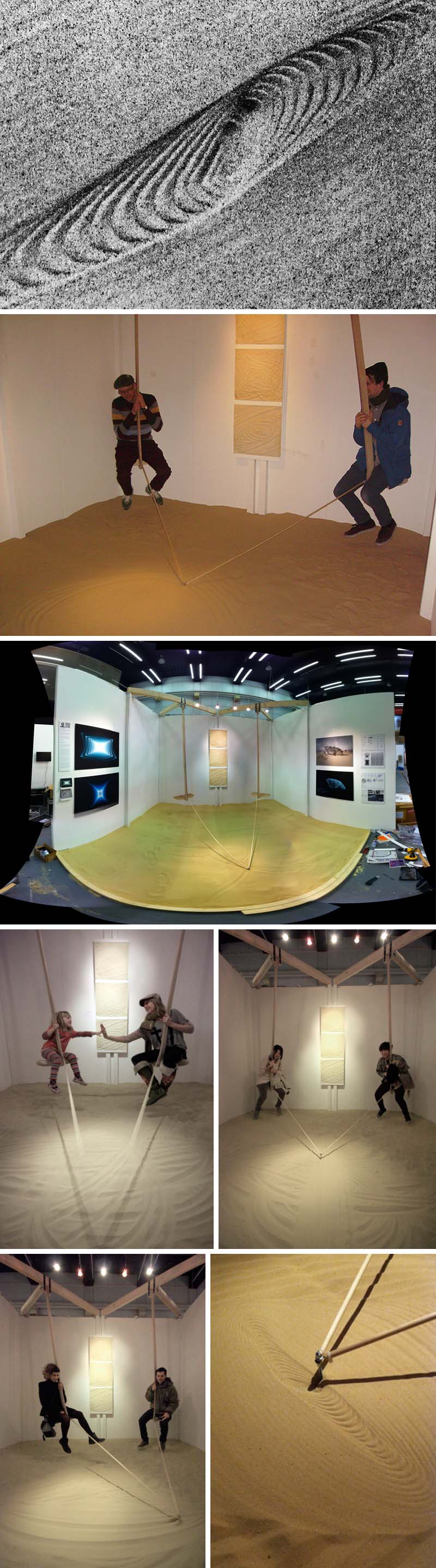
Near Unison Prototype for Burning Man 2013, Kinetic Art Fair, Dan Dodds, Swings, sand, human pendulumNear Unison Prototype for Burning Man 2013, Kinetic Art Fair, Dan Dodds, Swings, sand, human pendulumNear Unison Prototype for Burning Man 2013, Kinetic Art Fair, Dan Dodds, Swings, sand, human pendulumClick to enlarge

UK-based architectural designer and artist, Dan Dodds, has proposed an installation for Burning Man 2013 titled Near Unison that visualizes the harmonic relationship between two people using a pair of pendulum swings. A prototype of Near Unison, sans the elegant and striking exterior structure, was exhibited at this year’s Kinetic Art Fair. The installation specifically explores the harmonograph — a machine that became popular as a 19th century capable of producing beautiful drawings by mapping the relationship between two swinging pendulums. The oscillation frequency of the pendulums can be changed by modifying their lengths. Near Unison acts as a large-scale interactive harmonograph, allowing people to take the place of the pendulum weights, swinging back and forth, creating patterns in the sand that are ‘near unison’ a 1:1 ratio when the people occupying the swings are of similar weight. You can see the prototype in action below and keep your eyes peeled for the even larger version at the next Burning Man Festival in Black Rock Desert this August. Should be fun.

Sebastien Wierinck WorkShop: J1

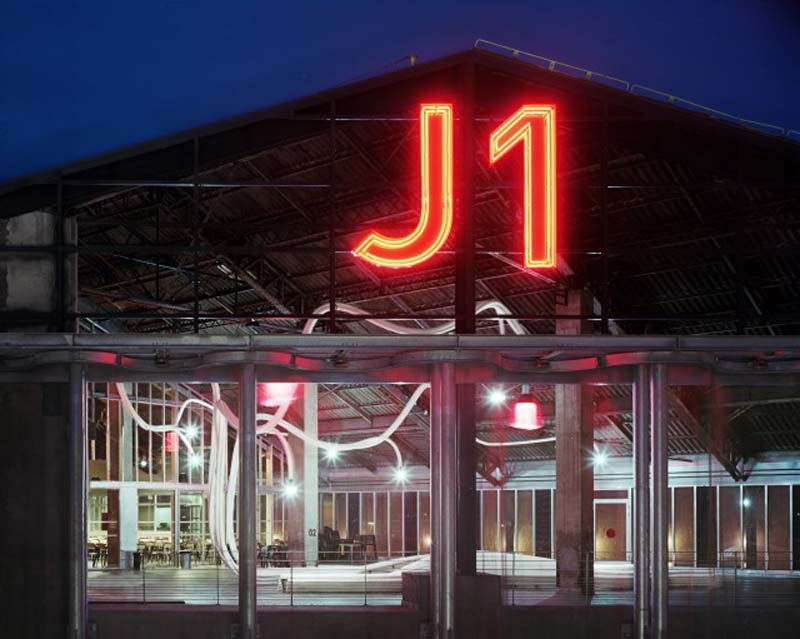
Sebastien Wierinck WorkShop, J1 Hangar in Marseille, Tube installation, Tubular, Cool interior design/furniture installationSebastien Wierinck WorkShop, J1 Hangar in Marseille, Tube installation, Tubular, Cool interior design/furniture installationSebastien Wierinck WorkShop, J1 Hangar in Marseille, Tube installation, Tubular, Cool interior design/furniture installationClick to enlarge

It’s been a while since I’ve checked in to see what French designer Sebastien Wierinck (previously here) has been up to, and not only has he been busy at work with his tubular installations and benches, but the Sebastien Wierinck WorkShop also has a nice new website. One of the newer projects is a white tube installation in the recently renovated J1 Hangar, a 6,000 sq. meter seafront space in Marseille, France, made available to the European Capital of Culture as an exhibition space. Wierinck’s long and winding recycled polyethylene plastic tubes occupy the large space beautifully, creating seating space and lighting in addition to just looking cool.

Here’s a timelapse video of the installation process:

The J1 Hangar and tubular installation will reopen in October and be open to the public through January 2014.

Peace Pavilion: Atelier Zündel Cristea (AZC)

Peace Pavilion by AZC inflatable structure, bethnal green museum gardens in london, new materials, twisty shapePeace Pavilion by AZC inflatable structure, bethnal green museum gardens in london, new materials, twisty shapePeace Pavilion by AZC inflatable structure, bethnal green museum gardens in london, new materials, twisty shapeClick to enlarge

Parisian architects Irina Cristea and Grégoire Zündel of Atelier Zündel Cristea (AZC) are all about peace, love, and happiness. Last fall the architects conceived an inflatable trampoline bridge over the Seine which I loved, but unlikely to become a reality. Their latest structure the Peace Pavilion, temporarily exhibited last month in the Bethnal Green Museum Gardens, uses a similar concept and materials creating a realized sculptural work that can be entered or climbed. The beauty of the shape of this inflatable sculpture lies in its perfect symmetry and fluidity. The geometry of the pavilion blurs the notion of inside and outside. The project is a self-supporting structure with 4m in height and 20m² in area, designed entirely with lightweight materials – 77.96m² of PVC membrane and 20m3 of air.

Photos: Sergio Grazia

via designboom

Stairway Cinema: Oh.No.Sumo

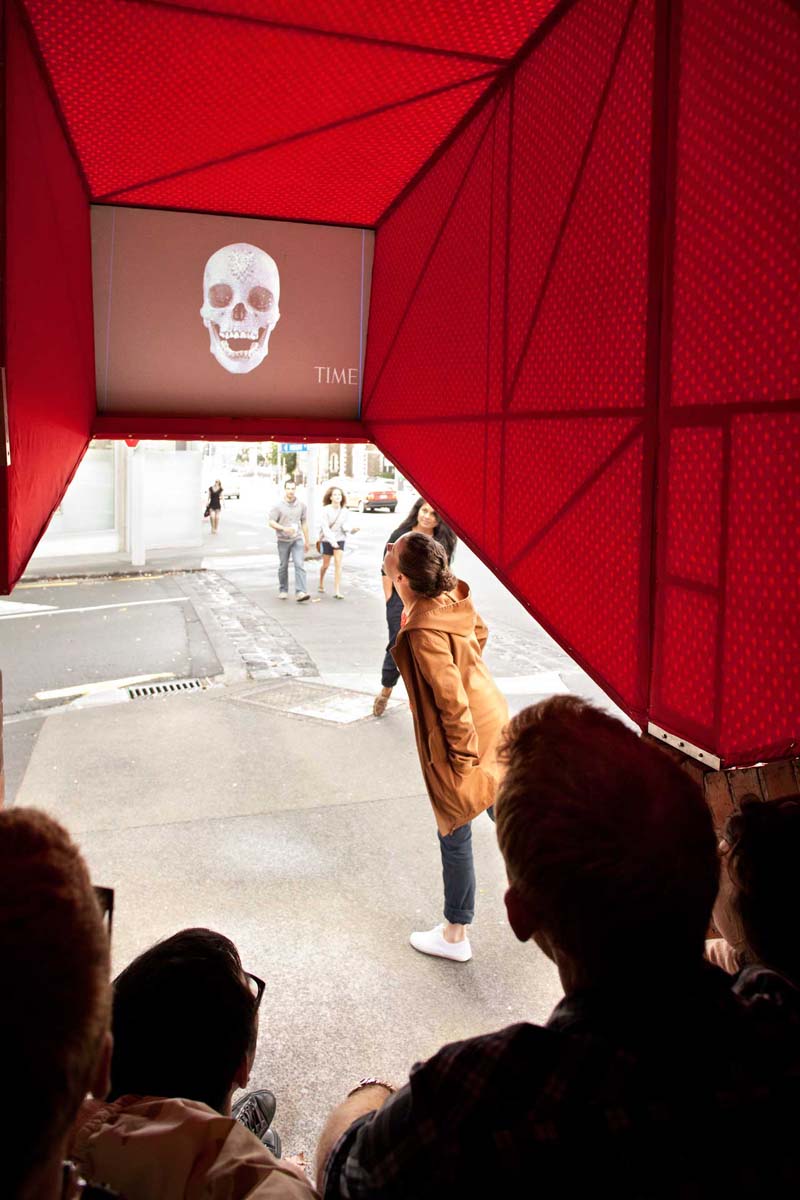
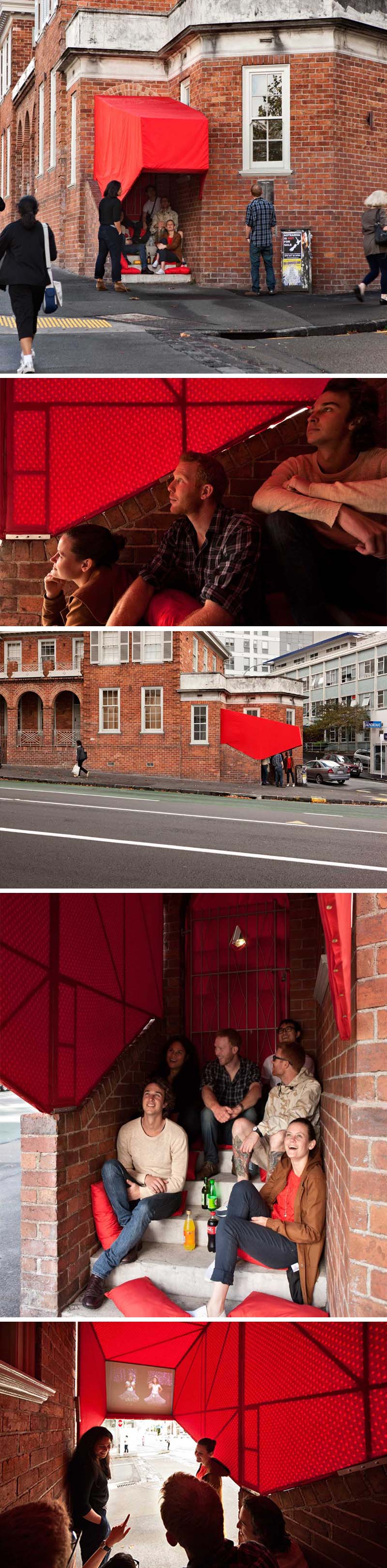
Stairway Cinema by Oh.No.Sumo Collective, Auckland, Australia, movie theater in stairwellStairway Cinema by Oh.No.Sumo Collective, Auckland, Australia, movie theater in stairwellStairway Cinema by Oh.No.Sumo Collective, Auckland, Australia, movie theater in stairwellClick to enlarge

The experimental design collective Oh.No.Sumo started as a creative outlet for four friends graduating from the architecture school at the University of Auckland and soon transformed into a design collective exploring many avenues of design, pushing the boundaries and allowing for uninhibited design freedoms through creative thinking and active participation. Their third and most recent major installation is Stairway Cinema at a corner in Auckland where there’s not much community interaction. By creating a mini movie theater in the stairway of a building, Oh.No.Sumo have in effect countered this issue, creating a communal and social environment that engages passers-by.

The structure was created with a timber truss covered in fabric with a waterproof exterior. Matching red cushions were added to the steps for softer seating while video content is projected onto the cantilevered end of the canopy. Very fun.

via designtaxi

Phoebe Washburn: Sculpture in the Rotunda

Phoebe Washburn, National Academy, Sculpture in the Rotunda, Cool installation, Nudes Housed Within Their Own Clothes and Aware of Their Individual-Thirst Descending  a StaircasePhoebe Washburn, National Academy, Sculpture in the Rotunda, Cool installation, Nudes Housed Within Their Own Clothes and Aware of Their Individual-Thirst Descending  a StaircasePhoebe Washburn, National Academy, Sculpture in the Rotunda, Cool installation, Nudes Housed Within Their Own Clothes and Aware of Their Individual-Thirst Descending  a StaircaseClick to enlarge

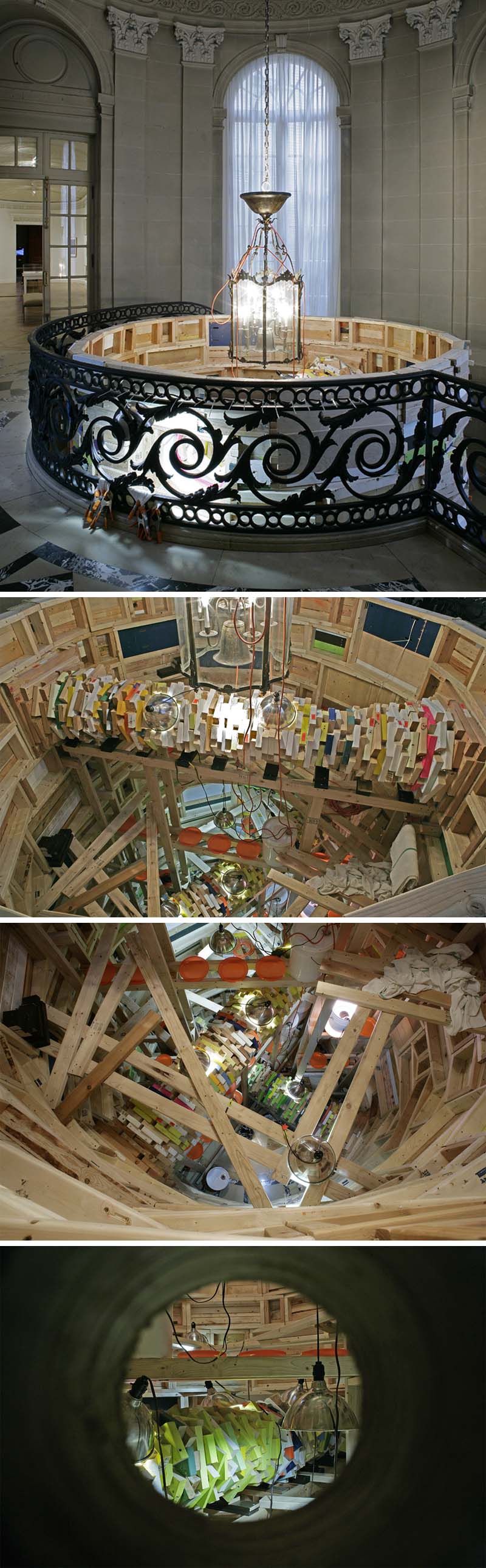
The National Academy here on NYC’s Fifth Avenue, initiated their Sculpture in the Rotunda series in 2011 in which a large-scale site-specific sculpture/installation is placed in the building’s beaux-arts Rotunda. Currently, and through September of this year, the installation Nudes, Housed Within Their Own Clothes and Aware of Their Individual Thirst, Descending a Staircase is by New York-based artist Phoebe Washburn constructed a 15ft high and 11 feet in diameter cylindrical tower perforated with colorful “wormholes” through which visitors can peer in as they walk up and down the spiral staircase. Washburn’s artwork is often made with scrap wood and repurposed materials that she finds around NYC and this installation is no exception speaking issues of recycling, environmentalism, consumable products and the waste created by the current consumer-driven society.

You can see other installations by Phoebe Washburn here, or visit Nudes, Housed Within Their Own Clothes and Aware of Their Individual Thirst, Descending a Staircase at the National Gallery through September 2013.

Photos courtesy of Zach Feuer Gallery

Hald Strand Summerhouse: Jesper Brask

Jesper Brask, Hald Strand Summerhouse in North Zealand, DenmarkJesper Brask, Hald Strand Summerhouse in North Zealand, DenmarkJesper Brask, Hald Strand Summerhouse in North Zealand, DenmarkClick to enlarge

Danish architect Jesper Brask and his family spent three years, living on (in a trailer) and analyzing a woodsy acre of land in North Zealand, Denmark — coming to know everything about the site, from the sun’s movement over the plot in the summertime to its distance from the water — before starting on the design for his family’s summerhouse that would eventually occupy the space where a many a pine tree stood. Brask used the timber from the pines to create his summer getaway along with steel, bricks, and glass for the dramatic sloping  floor-to-ceiling windows and glass doors that bring the woods inside. At the core of the open-plan home is the towering chimney which holds three fireplaces, a conventional oven, and a pizza oven. Definitely the nicest “log cabin” I’ve ever seen.

Photos courtesy of the architect and Karina Tengberg.

via dwell

James Turrell: Aten Reign in the Guggenheim Rotunda

James Turrell Guggenheim, Aten Reign, Elliptical Skyspace, Guggenheim Rotunda, cool light installationJames Turrell Guggenheim, Aten Reign, Elliptical Skyspace, Guggenheim Rotunda, cool light installationJames Turrell Guggenheim, Aten Reign, Elliptical Skyspace, Guggenheim Rotunda, cool light installationClick to enlarge

The very much anticipated James Turrell exhibit at the Guggenheim opened this evening and we were fortunate enough to attend the exciting event. The impressive skyspace installation that occupies the seemingly reduced-in-size rotunda does not disappoint. Aten Reign, as the massive installation is titled, cycles through a spectrum of colors—with varying hues of each—in approximately an hour. From white light to deep shades of reds and purples and eventually to almost complete darkness, the central atrium of the museum glows in a mystical yet soothing array of colors, changing people’s skin tones and even playing with one’s eyes and perception of color in the exterior halls lit in their natural white light that seem to take on a pink glow when the rotunda glows green, and green when pink. The rest of the museum is virtually empty except for about 5 rooms containing older works by Turrell all in white light. The trickery in these works is amazing, causing one to doubt their depth perception on a consistent basis. That which seems flat, is actually an open space, and that which seems open is actually a flat wall with projected light. Same goes for a cube of light that is so convincingly 3-dimensional, when in fact it is completely 2-dimensional. But, back to Aten Reign the exhibit’s pièce de resistance: the multi-tiered scrim creates elliptical circle within elliptical circle, working its way up from the most intense shade to five shades lighter towards to skylight. The rest of the museum looks oddly cropped and bare sans art, but it makes you appreciate the James Turrell installation-filled rooms, all the more.

James Turrell will be on exhibit at the Guggenheim through September 25, 2013.

Photos: collabcubed

Olson Office: Gensler

Cool Typographic Environmental Graphics and signage by Gensler for Olson, Minneapolis Cool Typographic Environmental Graphics and signage by Gensler for Olson, Minneapolis Cool Typographic Environmental Graphics and signage by Gensler for Olson, Minneapolis Click to enlarge

Rapidly expanding Olson, the largest advertising agency in Minneapolis, enlisted Gensler to design their 125,000 sq. ft. offices within Minneapolis’s historic Ford Center building, while maintaining the industrial character of the space. All elements were considered: from work flow to brand rooms to client-focused food and beverage service system. However, it is the treatment of the environmental graphics that I am focusing on here. They support and further the architectural concept, becoming an essential part of the design. Innovative use of super graphics enliven the building’s public spaces, yet continue to respect the building’s original character. The type treatment is bold, fun, and super creative, with giant floor numbers made out of colored string and nails, as just one example. The firm’s name is boldly and amorphously displayed on the ceiling of the top four floors creating an optical illusion, clearly read from the street looking up. The staircases and bathrooms continue with large painted signage and even the wall graphics and colorful furniture scream bold, assertive, and fun.

Photos by Pete Sieger

via segd