Aristarkh Chernyshev: New Media Sculptures

New Media Sculptures, interactive art and installations, Contemporary Russian Art, LEDs, collabcubedNew Media Sculptures, interactive art and installations, Contemporary Russian Art, LEDs, collabcubedNew Media Sculptures, interactive art and installations, Contemporary Russian Art, LEDs, collabcubedNew Media Sculptures, interactive art and installations, Contemporary Russian Art, LEDs, collabcubedClick to enlarge

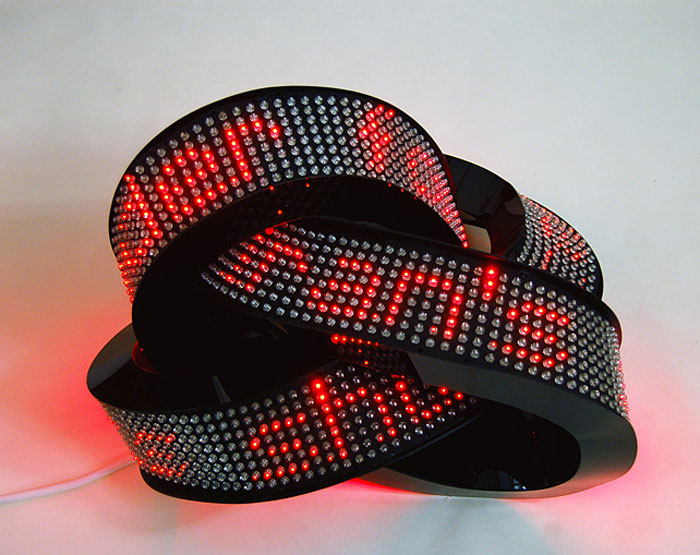
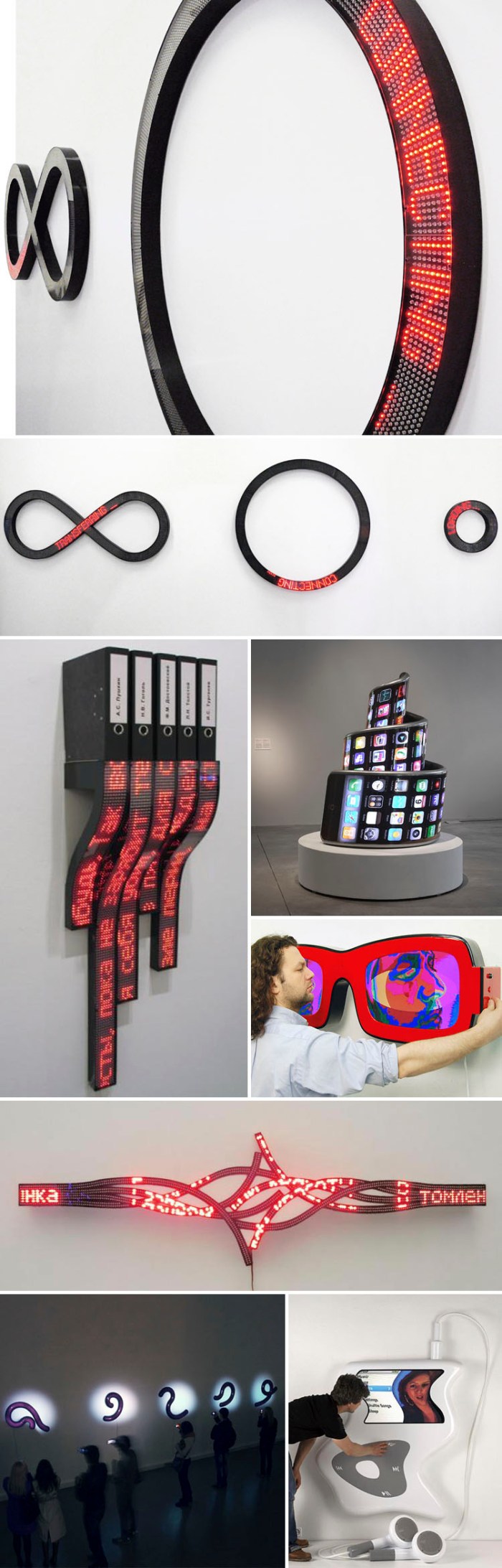
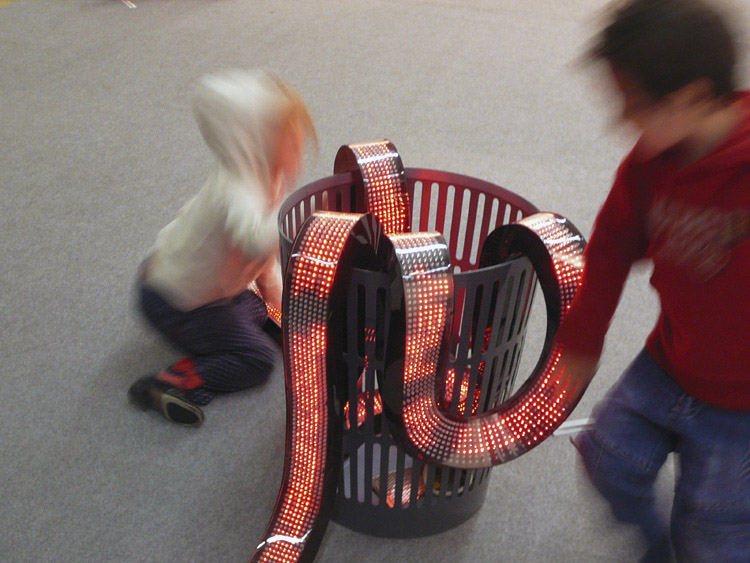
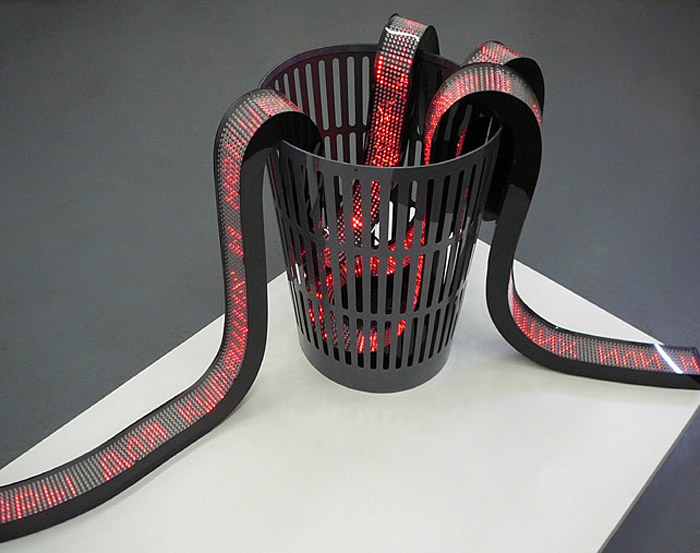
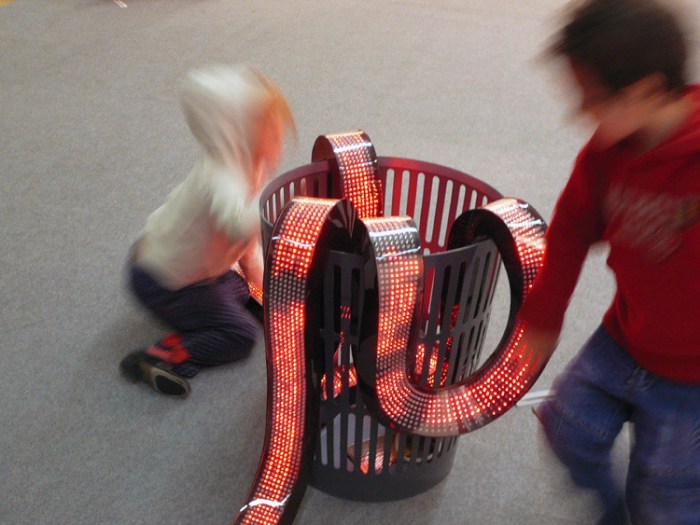
Moscow-based contemporary new media artist Aristarkh Chernyshev creates sculptures that integrate today’s technology while commenting on our obsession with it in a humorous fashion. His LED sculptures play with the idea of information overload, in some instances grabbing real-time news feeds from the internet, winding them around the LED lightboard strips through the trash as in his work Urgently! (top two photos), or winding around endlessly in a knot as in Knode (third from top), as well as taking poetic texts and breaking them apart then reuniting them as stock exchange rates in Lyric Economy (second from bottom).

In addition to his LED sculptures, Chernyshev has collaborated with other artists on some fun and interesting interactive pieces. With Alexei Shulgin —the co-founder of their art collective/gallery/creative electronics production company Electroboutique — they created the eyeglasses piece titled The Way I See It! as well as the wowPod, an oversized distorted iPod.

There’s lots more interesting work that can be seen on the XL Gallery’s site and the Electroboutique site.

Here’s The Way I See It! in action…with a very catchy poppy tune that I, unfortunately, don’t know what it is.

via XL Gallery

Serkan Özkaya: David

Double Manifesto Series, Storefront for Art and Architecture, David on low-boy trailerDouble Manifesto Series, Storefront for Art and Architecture, David on low-boy trailerIf you’re in New York City tomorrow (March 6th) you may notice a double-size golden statue of David being hauled around town from 11am through the early afternoon on a lowboy trailer. This would be the work of Turkish conceptual artist Serkan Özkaya, whose golden replica of Michelangelo’s David was initially created for the Istanbul Biennial in 2005. Özkaya’s work typically deals with the concepts of appropriation and reproduction. Apparently, the sculpture collapsed shortly after its installation, then was restored and two replicas were cast. One remains in Turkey and the other was acquired by 21c Museum in Louisville, Kentucky.

So, tomorrow the museum, in collaboration with the Storefront for Art and Architecture, will tour the David around town arriving at the Storefront Gallery on Kenmare Street in the early afternoon where it will be parked outside on display until 9pm. The gallery will be running a Manifesto Series titled Double, which will include a live staging of manifestos on the topic of doubling, replicating or copying, by a panel of artists, architects, critics and historians.

You can follow David (inspired by Michelangelo) on twitter @storefrontnyc #doubledavid to keep up with its whereabouts or visit the gallery’s website for details on the event.

Boa Mistura: Beauty and Pride in a Favela

typography, street art, graffiti, Brazilian Favela, Brasilandia, Pride, color, collabcubedtypography, street art, graffiti, Brazilian Favela, Brasilandia, Sweetness, color, collabcubedtypography, street art, graffiti, Brazilian Favela, Brasilandia, Pride, Beauty, Sweetness,color, collabcubedClick to enlarge

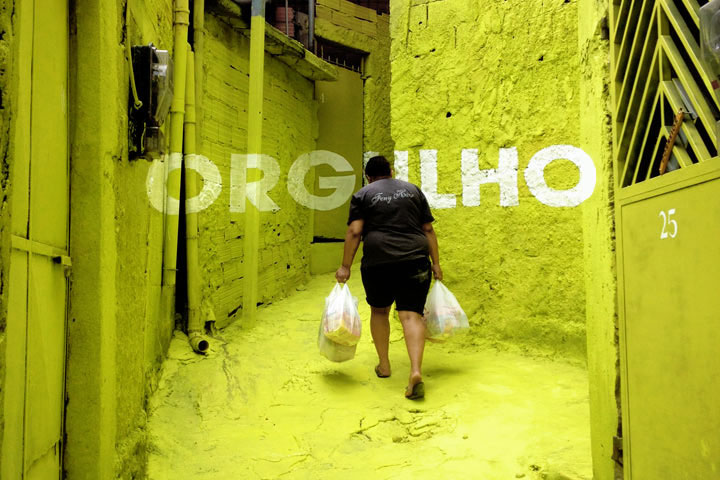
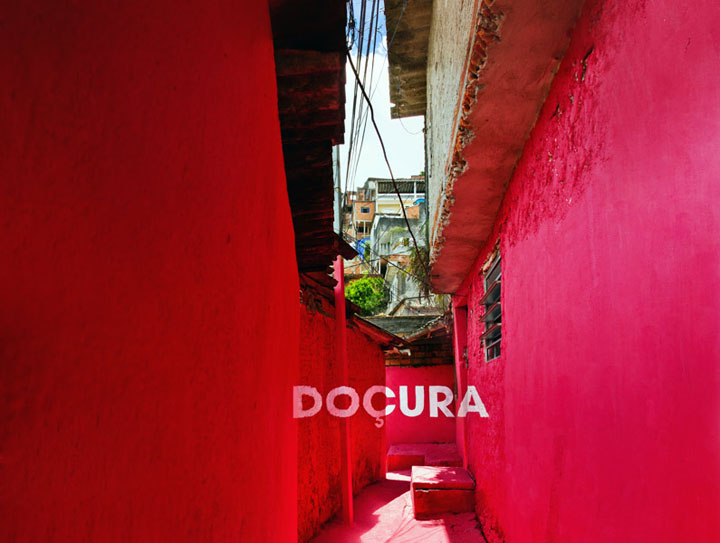
I love everything about this amazing project by the appropriately named Spanish art collective Boa Mistura (good mix): the typography, the color, the participative nature, and most of all the huge heart behind it.

Made up of artists Arkoh, Derko, Pahg, Purone, and Rdick who have developed their work in different fields, Boa Mistura represents a mixture of perspectives combined to create something better. Recently they have started a series of projects in the favelas (slums) of Brazil, starting with Vila Brasilândia near São Paulo where, directly involving the inhabitants, they painted the streets and alleyways with murals using anamorphic typography with pride-inducing words such as, well, ‘pride’ (orgulho), ‘beauty’ (beleza), ‘sweetness’ (doçura), ‘firmness’ (firmeza), and ‘love’ (amor).

As you can see, the result is fantastically joyful. Bravo!

via juxtapoz

Ana Soler: Causa-Efecto

art installation, tennis balls, fun, contemporary art in spain, cool installation, collabcubedart installation, tennis balls, fun, contemporary art in spain, cool installation, collabcubedart installation, tennis balls, fun, contemporary art in spain, cool installation, collabcubedClick to enlarge

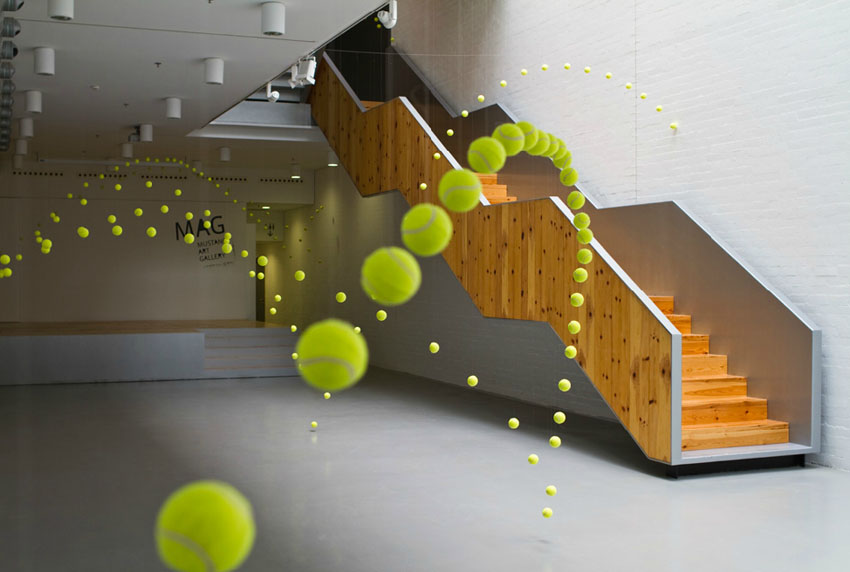
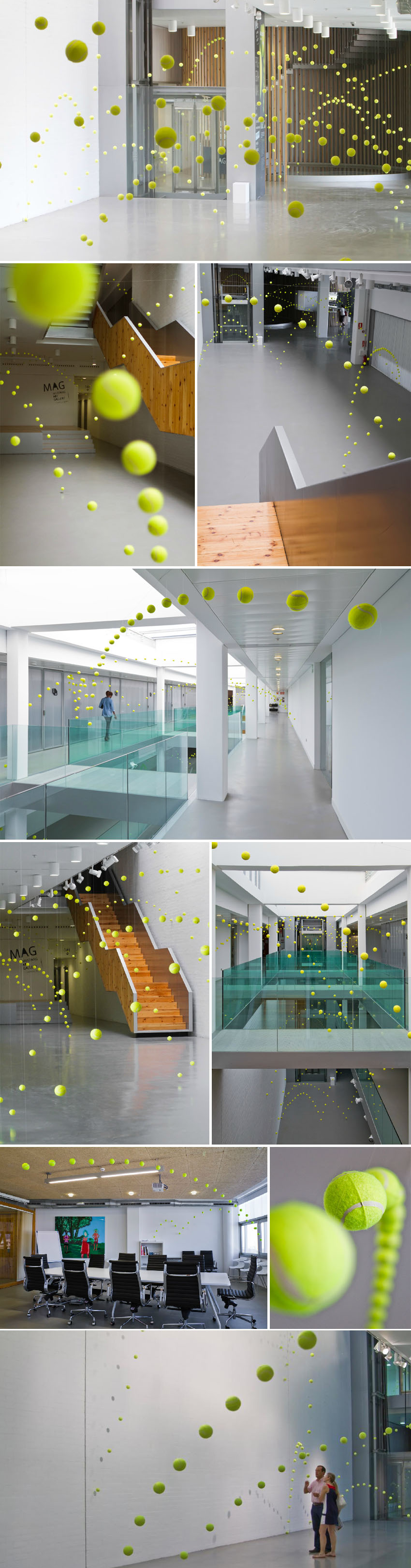
Spanish artist Ana Soler has a knack for taking the everyday object and creating spectacular installations. Her most recent, Causa-Efecto (Cause and Effect) involved 2000 tennis balls giving the illusion of bouncing all over the various rooms and levels of the Mustang Art Gallery in Alicante this past fall. The multiple trajectories that these balls take have you looking in all directions. A bit like a three-dimensional airline route map.

Very fun and cool!

Photos courtesy of the artist.

via mag

The Wynwood Walls: Street Art in Miami

Graffiti, Street art, Deitch, Goldman, Miami, artists paint murals on walls in Miami FloridaGraffiti, Street art, Deitch, Goldman, Miami, artists paint murals on walls in Miami FloridaGraffiti, Street art, Jeffrey Deitch, Tony Goldman, artists paint murals on walls in Miami FloridaClick to enlarge

Well, this certainly puts the Houston graffiti wall to shame! The Wynwood Walls is a community revitalization concept conceived by Tony Goldman in 2009 as a way to transform the warehouse district of Wynwood, Miami into a center where people could gravitate and explore, thereby developing the area’s pedestrian potential. I should have picked up on something with so many street artists featuring projects in Miami on their sites.

Initially opened in 2010 with the Wynwood Doors, the project has since expanded to the Wynwood Walls and Outside the Walls. Street artists from all over the world have gone to Miami to participate and it has become a sort of “Museum of the Streets,” as coined by Jeffrey Deitch, one of the original co-curators.

Here Comes the Neighborhood is a series of short episodes on the project as a whole, as well as interviews with individual artists. If you like the trailer below you can head on over to their site to see much more.

via the delightful Karen aka Kaia!


Will Ryman: Anyone and No One

Everyman full-gallery sculpture, cool art installation with bottle caps, shoes, paint brushesEveryman full-gallery sculpture, cool art installation created with bottle caps, shoes, paint brushesEveryman full-gallery sculpture, cool art installation created with bottle caps, shoes, paint brushesoversized Bird Sculpture made of large nails, Paul Kasmin Gallery, New York City art, collabcubedClick to enlarge

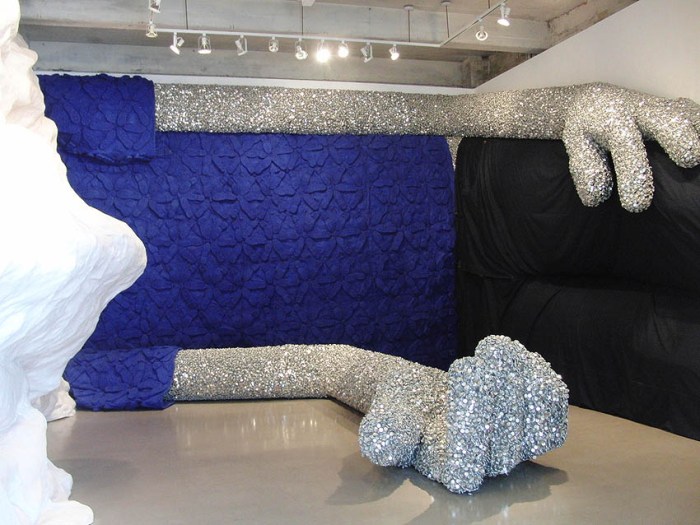
New York artist Will Ryman has taken a departure from his sculptures of giant roses that decorated the Park Avenue Malls in midtown last year here in NYC, and has now created two site-specific works: one a giant male figure, the other a giant bird. Presently, at both Paul Kasmin Galleries in Chelsea (the first artist to show in both at the same time) Ryman’s exhibit titled Anyone and No One consists of a 90-foot figure lying against the perimeter of the Tenth Avenue gallery walls, unclear whether he is sleeping or dying. The figure is made up of 250 pairs of shoes for the shirt and 30,000 bottle caps make up the arms, hands, and feet. The sculpture/installation, titled Everyman, seems to open up through the figure’s head into the next room where a labyrinth has been created out of 200,000 paintbrushes stacked on top of one another. I’m not sure if these organic structures are intended as a trip through the Everyman’s brain or not, but, in either case, this looks pretty amazing.

At the 27th Street gallery is Ryman’s Bird. This 12-foot high, 16-foot wide sculpture is made with 1500 actual and fabricated nails and weighs two tons. In the same way that the Everyman space becomes a box in which the huge man has been stuffed into, so, too, does the Bird’s gallery transform into its cage.

I think I’ll have to check this out in person soon. Both pieces will be up at both Paul Kasmin galleries through March 24th, 2012.

Photos courtesy of Paul Kasmin and Mark Rifkin’s flickr.

Thanks for the tip, Stephen!

Slinky Springs Bridge: Tobias Rehberger

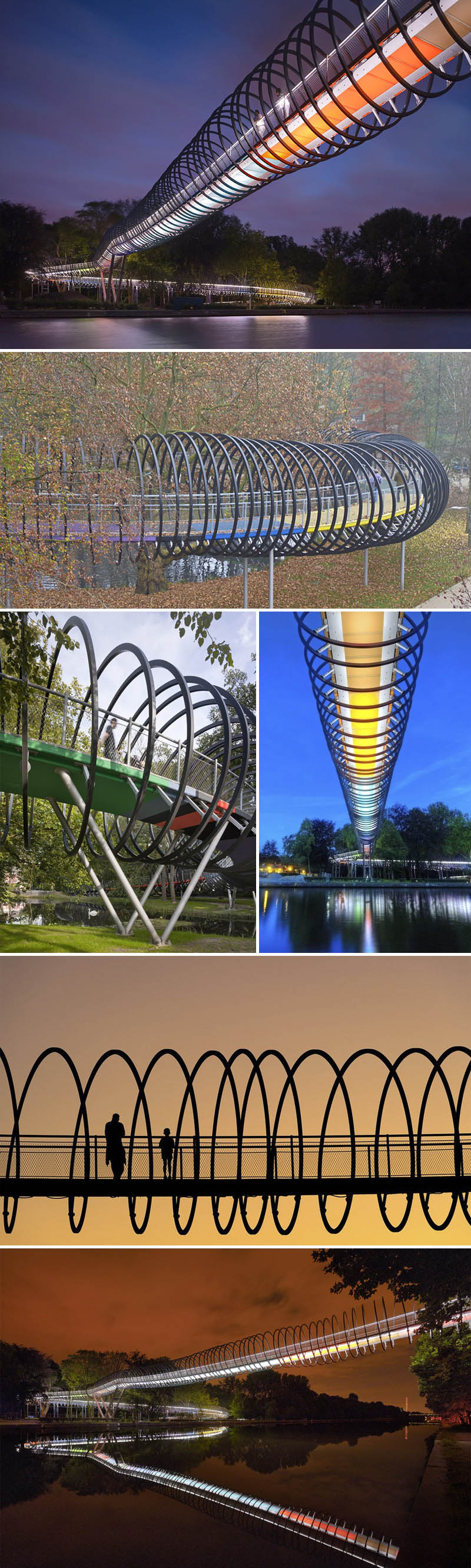
Slinky Bridge, New Bridge over Rhine_Herne Canal, Germany, in style of Slinky toy, collabcubedSlinky Bridge, New Bridge over Rhine_Herne Canal, Germany, in style of Slinky toy, collabcubedSlinky Bridge, New Bridge over Rhine_Herne Canal, Germany, in style of Slinky toy, collabcubedSlinky Bridge, New Bridge over Rhine_Herne Canal, Germany, in style of Slinky toy, collabcubedClick to enlarge

The Slinky Springs Bridge in Oberhausen, Germany, was completed this past summer. Designed by artist Tobias Rehberger, the inspiration for the bridge came from the iconic Slinky toy and the catchy phrase “Slinky Springs to Fame” which seems to be the way the bridge is referred to. Rehberger was able to recreate the light, wild and irregular quality of the toy in his vibrating spiraling bridge that almost looks thrown across the Rhine-Herne Canal. This was no easy feat, if I understand correctly from the not-always-easy-to-decipher google-translated German sites that I read. Apparently, the execution of artist Rehberger’s, (self-admittedly clueless about bridge design) vision was successfully accomplished through the collaboration with structural engineers Schlaich Bergermann and Partner. A bit of description from their website on the 406-meter-long bridge with 496 coils:

Following the design of the artist Tobias Rehberger, a colorful ribbon wrapped in a light, swinging spiral connects the two existing parks. The lightness of this design is due to the minimalist structural design of the stress ribbon bridge. Two steel ribbons made of high strength steel connect to the inclined supports across the canal. The resulting tension force is transferred into strong abutments through the outer vertical tension rods. The walkway consists of pre-cast concrete plates, bolted to the stress ribbon, to which the railing and spiral are attached. The springy synthetic pavement of the walkway as well as the colorful rhythmization of the concrete and coating amplifies the dynamic experience of the bridge.

The colorful pavement pathway was carefully selected by Rehberger who had very specific ideas on its look. Then the bottom of the bridge was made to exactly match the colors on top in a separate material. It’s great how the nighttime illumination really accentuates the colorfulness.

Seems to me that bouncing across the incredibly cool and unique Slinky Bridge could be a lot of fun, if maybe a little unsettling as well.

If you like this bridge then you’ll probably enjoy the Tiger & Turtle Walkable Rollercoaster and the Twist Bridge as well.

Photos: Dirk Jungholt’s flickr, Roman Mensing, Jens Stachowitz, and AP.

Winter 1972: Post-it Installation

cool post-it installation, post-its, paper, art installation, Winter 1972 Perfume, collabcubedcool post-it installation, post-its, paper, art installation, Winter 1972 Perfume, collabcubedcool post-it installation, post-its, paper, art installation, Winter 1972 Perfume, collabcubedClick to enlarge

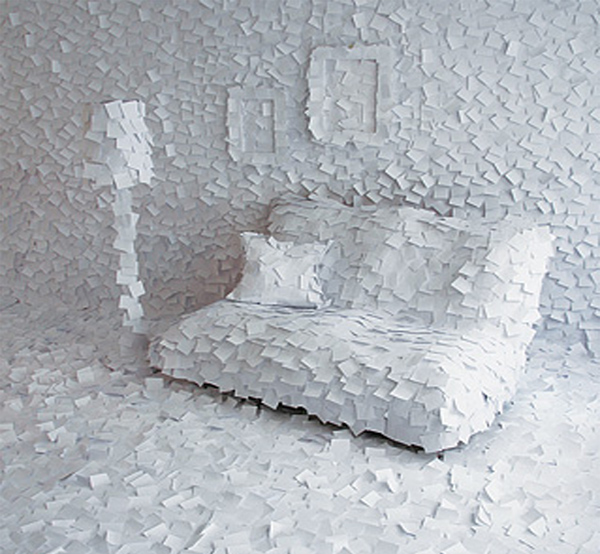
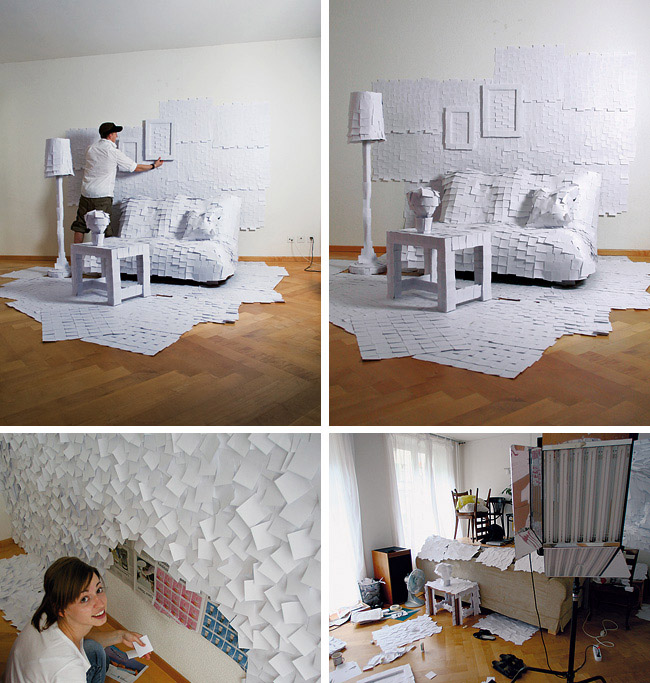
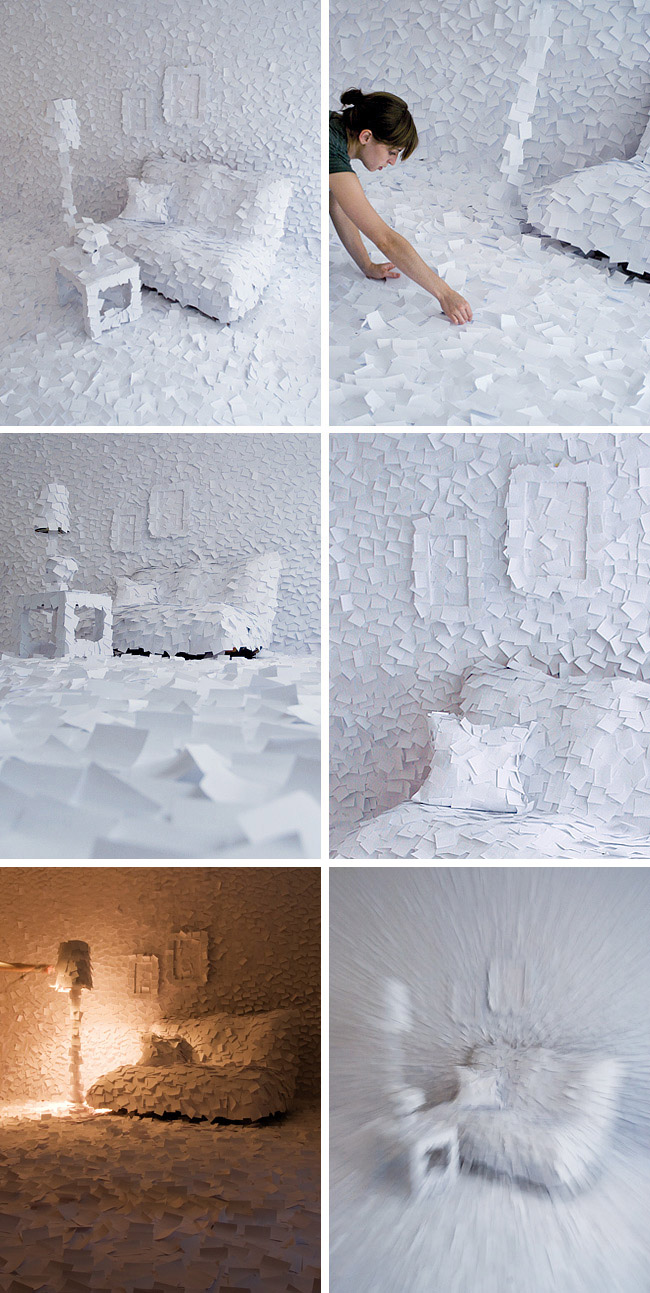
Swiss design studio I Never Kissed A Dog created a winter wonderland in a living room using thousands of white Post-its as part of a photoshoot for the perfume Winter 1972. Designer Adrian Merz painstakingly covered the entire room and then photographed it using different light sources and effects to add to the image…as if a room covered in white paper from top to bottom isn’t impressive and surprising enough!

via urbanpeek

Doug Aitken: Song 1 at the Hirshhorn Museum

Hirshhorn Museum, 360 degree exterior projections, cool installation, video, collabcubedDoug Aitken, Hirshhorn Museum, 360 degree exterior projections, cool installation, video, collabcubedDoug Aitken, new installation, video projection on 360 degree Hirshhorn MuseumAfter not thinking about the Hirshhorn Museum in years, right on the heels of finding out about the plans for a bubbled garden (see previous post) is now news of the upcoming Doug Aitken installation, turning the exterior of the circular museum into a 360-degree projection screen. The piece, titled “Song 1”, will consist of 11 high-definition projectors streaming multichannel yet-to-be-disclosed images in conjunction with the song “I Only Have Eyes for You” with covers created and performed by several artists including Beck, and James Murphy of LCD Soundsystem, specifically for Aitken’s work.

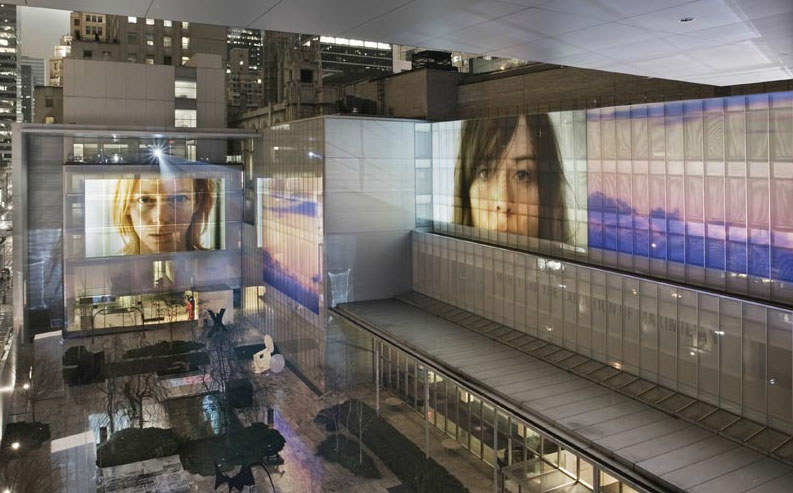
I’ve enjoyed everything I’ve seen by Doug Aitken, including his video installation Sleepwalkers at MoMA back in 2007 (where does the time go?!) which was also projected on the building’s façade (bottom photo). Based on past experience, this should be worth checking out. Maybe a trip to D.C. combining cherry blossoms and the Hirshhorn is in order this spring.

This impressive project will be on view from March 22nd to May 13th, 2012.

Renderings courtesy of the Doug Aitken Workshop. Bottom image courtesy of MoMA.

The Radical Camera: NY’s Photo League

New York's Photo League, photos of New York City 1936-1951, street photography, the Great Depression,Joe SchwartzNew York's Photo League, photos of New York City 1936-1951, street photography, Erika StoneNew York's Photo League, photos of New York City 1936-1951, street photography, great depression, WWII, Harlem, Lower East SideClick to enlarge

What a great surprise to walk into the Jewish Museum a week ago, not knowing what I was about to see, and experience one of the best photography shows I’ve seen in a long time. The Radical Camera: New York’s Photo League, 1936-1951 is a must-see for any lover of New York City, or of street photography in general. Some of the photos were familiar, but most were new to me. From the moment you enter the gallery, the parallels with the present are evident in the opening short film showing protesters in Union Square demanding unemployment assistance. It’s the 99% almost 80 years earlier. Of course, the contrasts are striking as well: these protesters look hungry, poor, all dressed in suits and skirts, and no one is smiling. There are no bed-ins or fun t-shirts as in the 1960s and today; clearly it was a different time, but it’s hard not to compare.

Apart from the protests and the poverty, the streets themselves also, in some cases, look exactly the same and in others are hard to recognize. It’s truly fascinating to look at every detail of each photo. Add to that, that the Photo League – a group of amateur and professional photographers who were politically progressive, believed in photography as an instrument for social change, and were later blacklisted during the McCarthy Era – leased 2,600 sq. feet of space in our very own building’s basement in the late 1940s as their gathering space, makes it all the more close to home.

One of the projects by the Photo League, and led by photographer Aaron Siskind, was the Harlem Document, an in-depth photographic overview of the black community. It made me smile to read that they collected ‘dozens’ of photos over several months of shooting; definitely not the digital age of today.

All photos are from The Jewish Museum’s website and The Financial Times. From top to bottom and left to right:
Joe Schwartz, Slums Must Go! May Day Parade, New York, c. 1936. ©Joe Schwartz
Erika Stone, Lower Eastside Facade, 1947. ©Erika Stone
Ruth Orkin, Times Square, from Astor Hotel, 1950. ©Estate of Ruth Orkin
Aaron Siskind, The Wishing Tree, 1937. ©Aaron Siskind Foundation / Courtesy Bruce Silverstein Gallery, New York
Ida Wyman, Spaghetti 25 Cents, New York, 1945. ©Ida Wyman
Ruth Orkin, Boy Jumping into Hudson River, 1948. ©Estate of Ruth Orkin
Morris Huberland, Union Square, New York, c. 1942. ©Estate of Morris Huberland / Licensed by VAGA, New York, NY
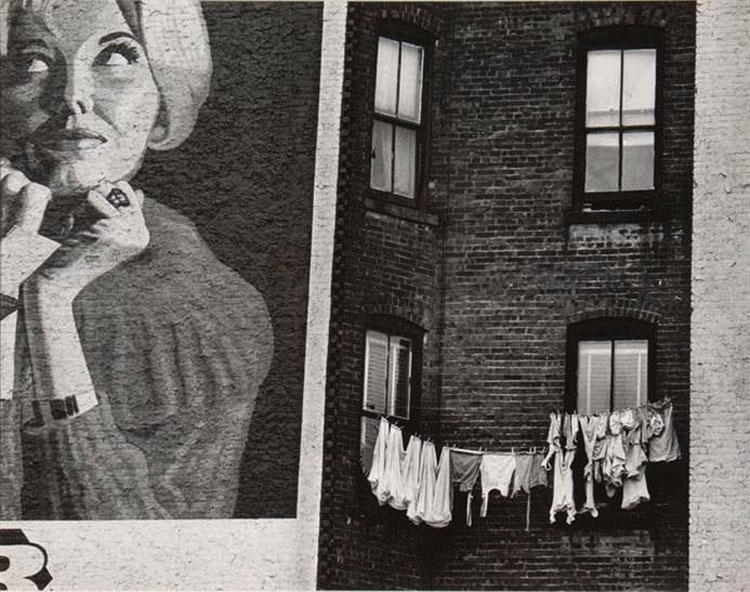
Arthur Leipzig, Ideal Laundry, 1946. ©Arthur Leipzig
Weegee (Arthur Fellig) Max is Rushing in the Bagels to a Restaurant on Secont Avenue for the Morning Trade, c.1940 ©Weegee

On a different note, don’t you think the bagels-on-a-string delivery method has great potential for a comeback in a contemporary health code compliant version?

If you’re in NYC, I highly recommend this exhibit which will be at the Jewish Museum through March 25th, 2012.
Claude Lévêque: Dreamy Light Installations

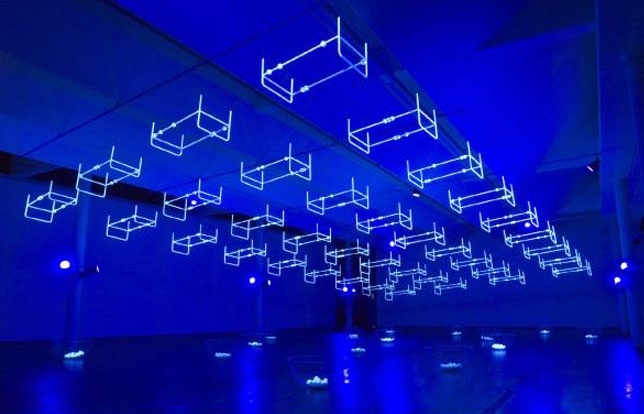
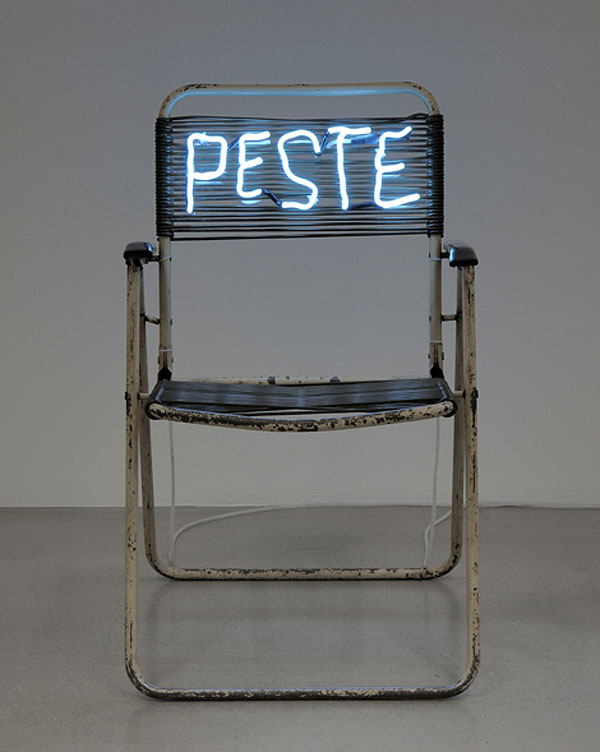
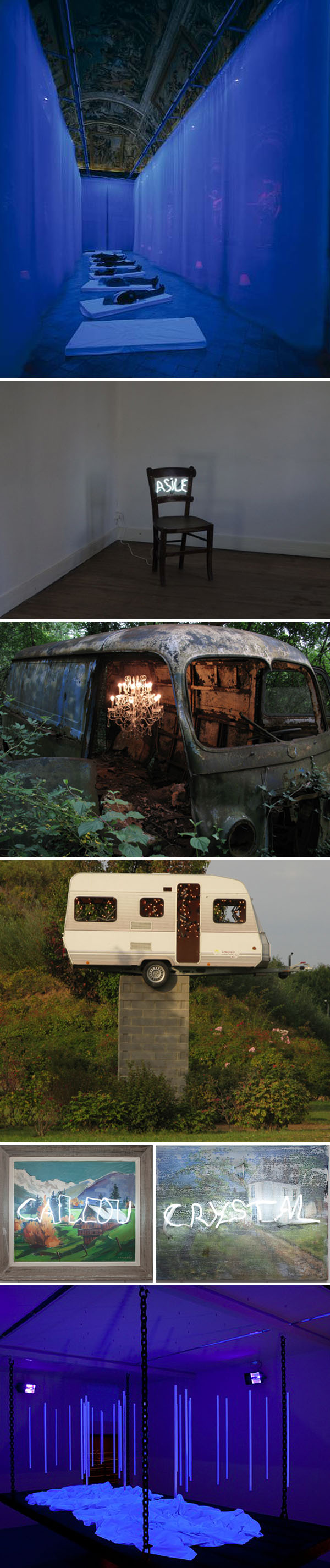
Light Installations, black light, upside down beds, beds, cool art installation, Contemporary art, collabcubedLight installation, neon, cool contemporary art, beach chair with neon, collabcubedLight installations, neon, cool contemporary art, lumen, trailer trucks with lights, collabcubedFrench artist Claude Lévêque has been creating light sculptures and installations since the ’80s. There’s a surreal quality to much of his work — upside down blacklit beds, abandoned trailers with chandeliers, or an elevated one with stringed lights inside, precariously balanced on cement blocks — as well as wit. I also like the way many of his neon signs are integrated with chairs or paintings, resulting in a strange juxtaposition.

Lévêque currently has a show at La Maison Rouge in Paris through May 20th.

via galerie kamel mennour 

Superflex: Copy Light Factory

Lamps, copies, make-your-own, DIY, classic lamps copied onto wooden cube framesLamps, copies, make-your-own, DIY, classic lamps copied onto wooden cube framesLamps, copies, make-your-own, DIY, classic lamps copied onto wooden cube framesClick to enlarge
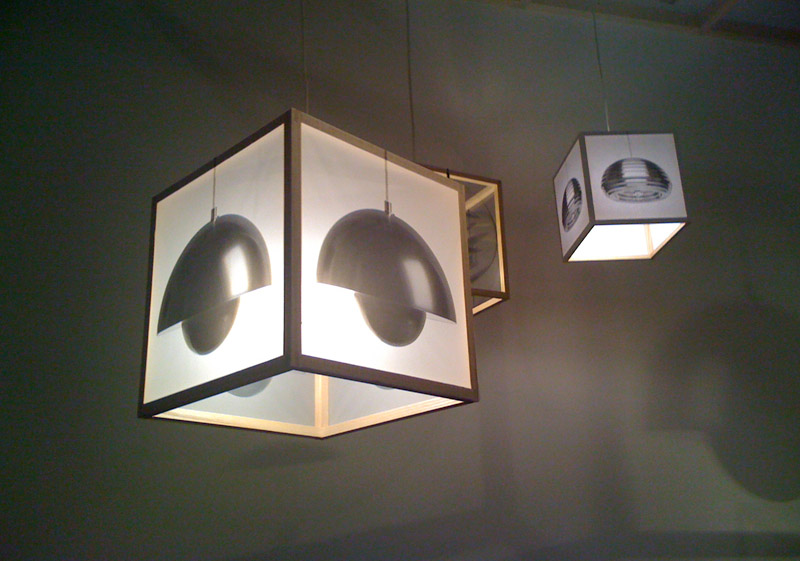
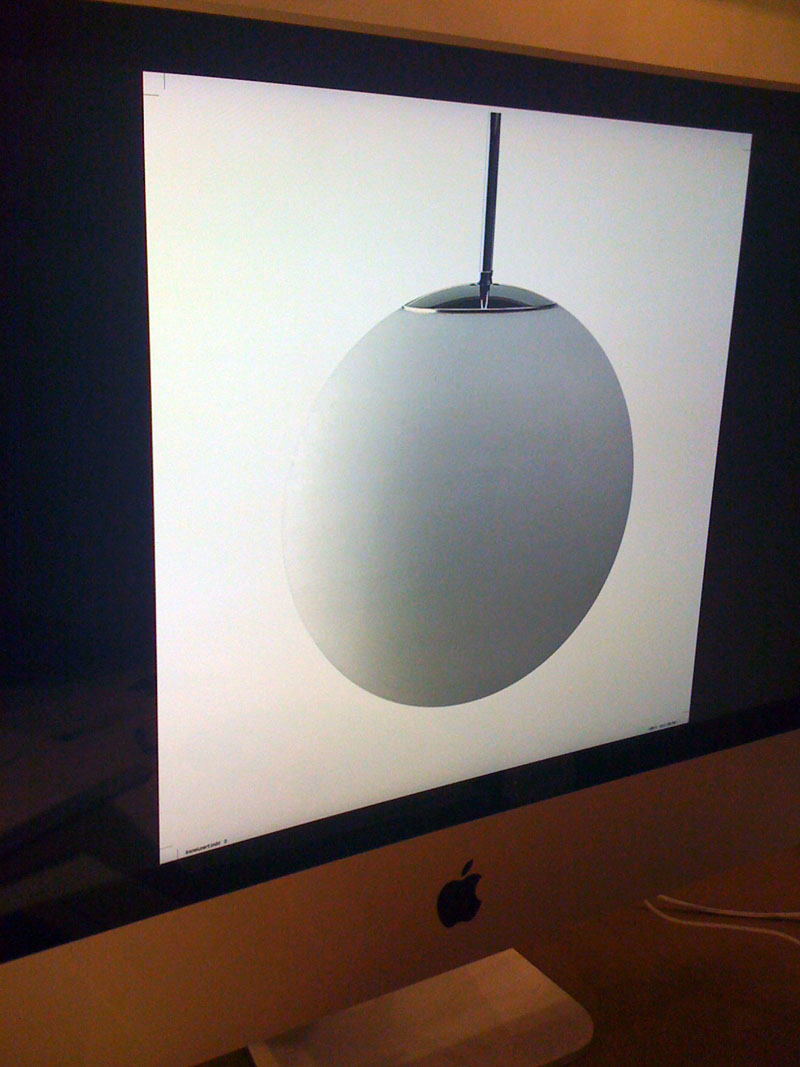
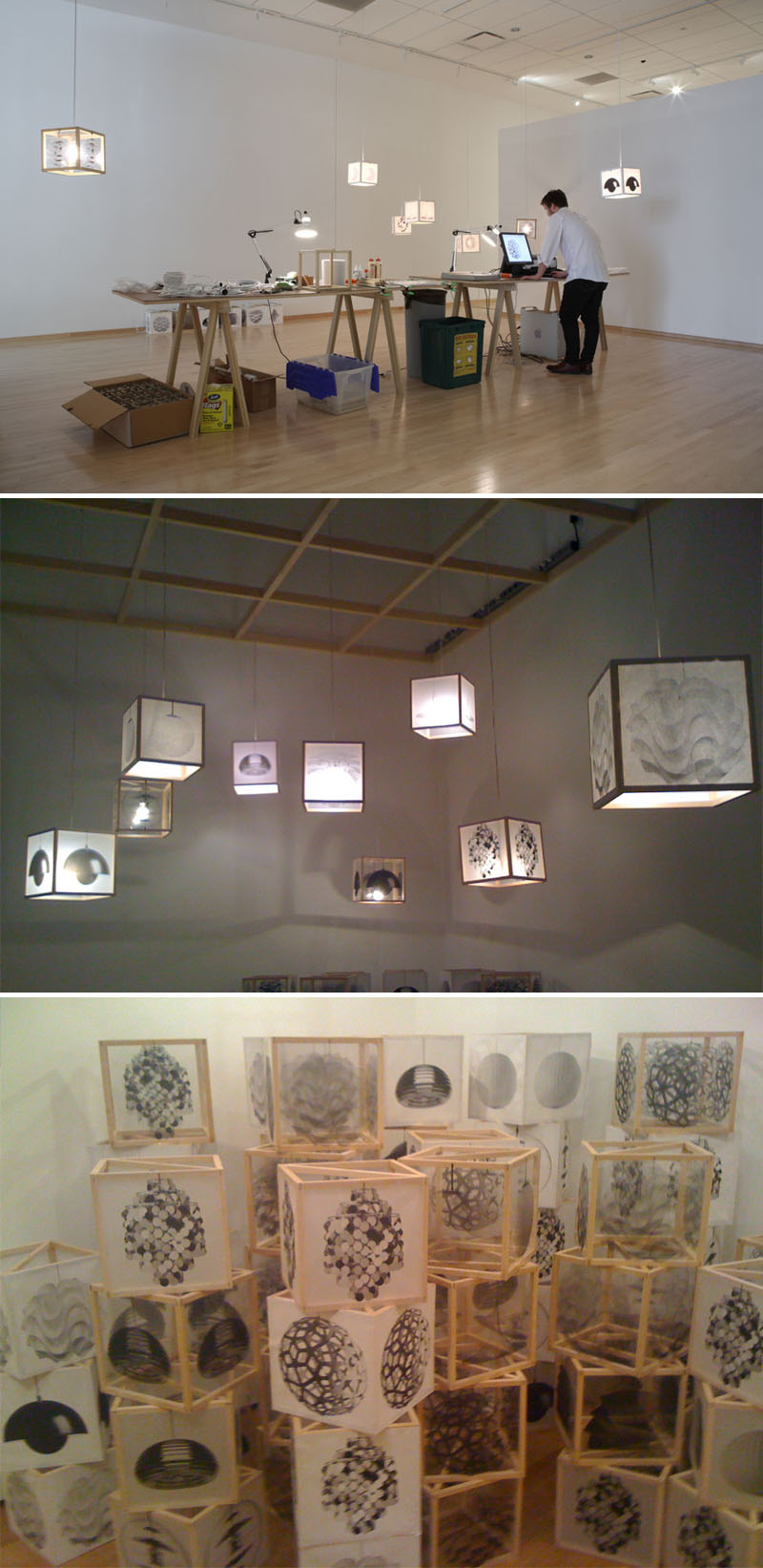
After going through Cindy Sherman’s (the queen of ‘selfies’) new retrospective at the MoMA this past Saturday—an interesting show in itself—I made a quick loop through their other major exhibit next door, Print/Out. Though met with mixed criticism, I have to say, it’s hard for me not to like rooms filled with colorful contemporary graphic prints, posters and books, much of which involve typography, so, I was pretty pleased. But one project that stood out was Danish design studio Superflex’s (coincidentally one of the collaborators on the previously mentioned Superkilen Park in Copenhagen) Copy Light Factory. In this workshop (I was there during non-workshop hours) lamps are created by copying images of well-known lamp designs onto translucent paper and then attaching them to wooden cubed frames. Here is how their website puts it:

Copy Light Factory is a workshop producing Copy Light – cube shaped lamps made of translucent paper with photocopied motifs of various well-known lamp designs. However, the owner is free to change the image to a lamp design of his/her own choosing. Thus Copy Light seeks the borders between the copy and the original. As a copy of a copy Copy Light turns into something new: an original lamp that communicates the problems of the current copyright system.

I loved this idea and will totally be making one for my next apartment.

You can visit Print/Out at the MoMA through May 14, 2012.

Table photo courtesy of Superflex; all others collabcubed.

Olga Diego: Interactive Inflatables

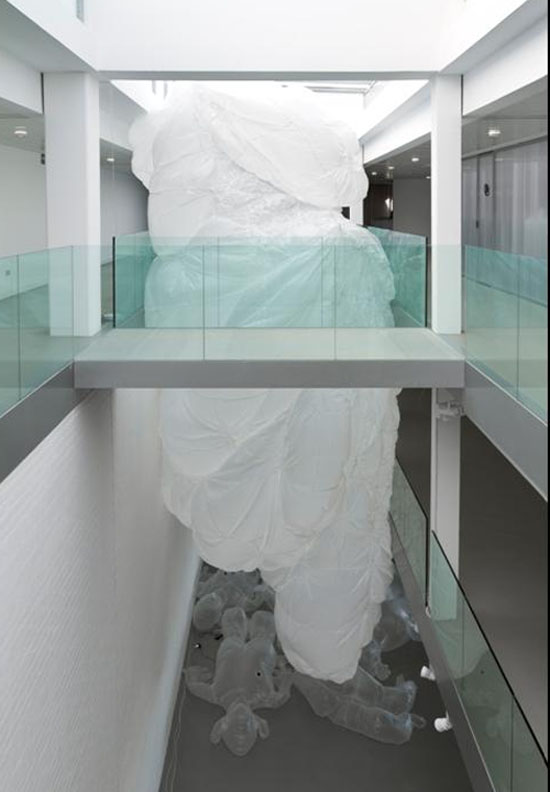
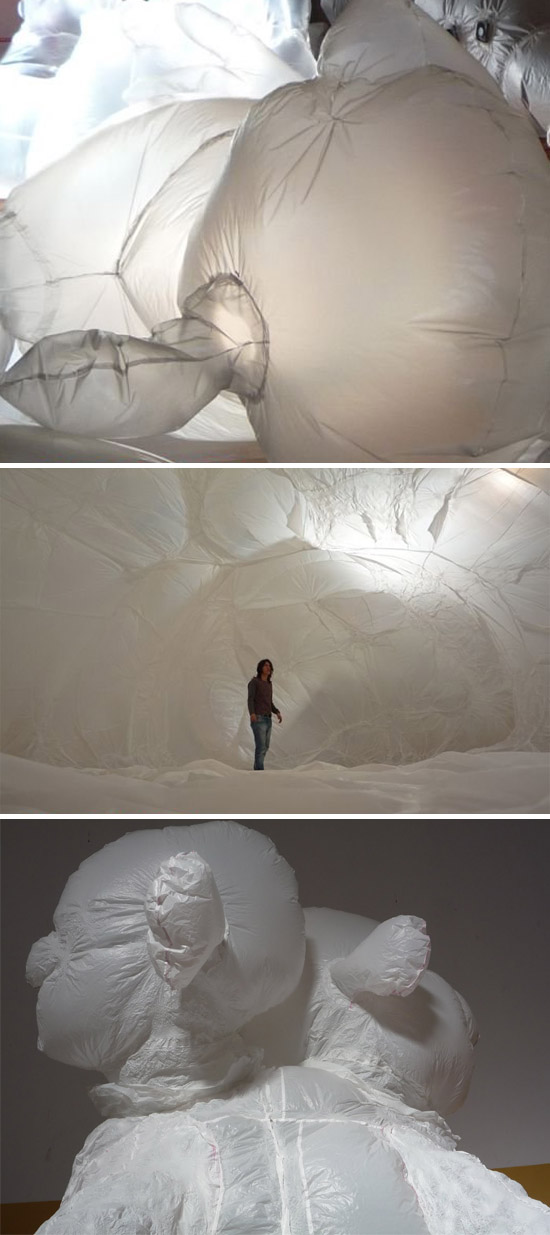
interactive, inflatable sculpture, hombre suspendido, hanging man, plastic bag sculptureinteractive, inflatable sculpture, plastic bag installation, Art from Spain, Mustang GalleryCool installation, inflatable sculpture, Olga Diego, collabcubedinteractive, inflatable sculpture, plastic bag installation, Art from Spain, Mustang GalleryWe certainly have posted our fair share of inflatable sculptures and installations, but somehow each one has its own personality and style. This exhibit, Aire (Air), a few months back at the Mustang Art Gallery, is an installation by Spanish artist Olga Diego. Working with plastic, both translucent and transparent, and plastic bags, along with electronic circuits that inflated and deflated each structure, Diego filled the gallery with six separate inflatable works that interact with each other and with those who viewed the show in its space. Some of the pieces allude to well-known images such as Duchamp’s The Bride Stripped Bare by her Bachelors, Even, and the hanging man to Christ. Some of her shapes are organic in form and complement the more figurative ones nicely.

The two bottom photos are from a previous exhibit by Olga Diego at Plataforma Petracos, Hábitos de Habitar (Habits of Inhabiting).

You can see the works in Aire being inflated in the video below, as well as their general movement and interactivity.

Photos by Álvaro Vicente and El Periodic.

via revista treintaycuatro via the multi-talented anA

Dimitris Polychroniadis: Church Slogan Art

Humorous Church sign slogan inspired contemporary sculpture, Dmitris Polychroniadis, collabcubedHumorous Church sign slogan inspired contemporary sculpture, Dmitris Polychroniadis, collabcubedHumorous Church sign slogan inspired contemporary sculpture, Dmitris Polychroniadis, collabcubedClick to enlarge
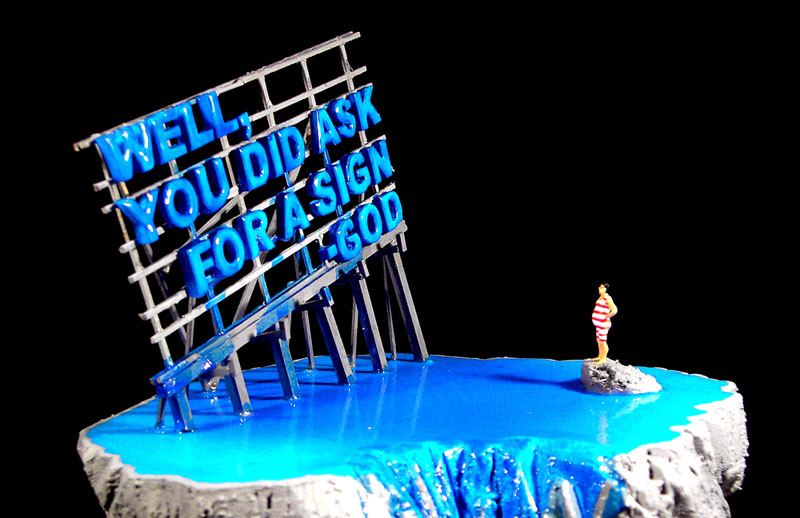
Architect and set designer Dmitris Polychroniadis from Athens has recently completed a series of humorous sculptures inspired by church sign slogans and relevant to the struggles that his country (as well as much of the world) is presently experiencing. The series is titled The Miracle of Fluo Colours.

From Polychroniadis:
Religion often serves as an emotional ‘lender of last resort’ in times of crisis. The idea for this series of maquette sculptures, comes from Christian church signs and billboards in the US. By stripping these religious quotes away from their physical and emotive context, the ‘message’ becomes more absolute, almost surreal. To emphasize this further, the text size has been exagerated in scale (compared to the figurines) and colour. The project is somewhat ‘street’ influenced by large scale advertising and slogan graffiti. The title of the series generates a contrast: The notion of God-sent miracles as an integral part of religious faith, against the marvels of man-made, modern age, industrial technology and it’s products such as fluoerscent materials and colours.

You might enjoy some of Polychroniadis’ architecture work as well. I especially like his use of type in his restaurant and store designs.

Photos: Michalis Dalanikas & Dimitris Polychroniadis

Tang Kwok Hin: Mixed Media Collage

mixed media, Contemporary art from Hong Kong, Tang Kwok Hin, collage, collabcubedmixed media, Contemporary art from Hong Kong, Tang Kwok Hin, collage, collabcubedmixed media, Contemporary art from Hong Kong, Tang Kwok Hin, collage, collabcubedClick to enlarge
I have been a fan of vellum since my early days as a designer. That sort of semi-matte quality really appealed to me and I found myself running it through the copier on a regular basis. Any comp looked better with a little vellum overlay.

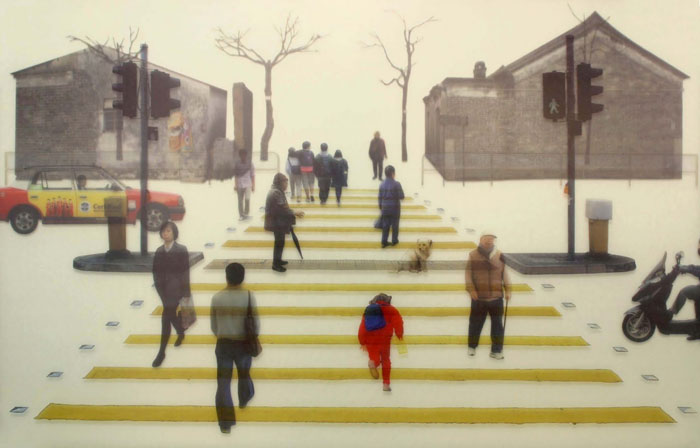
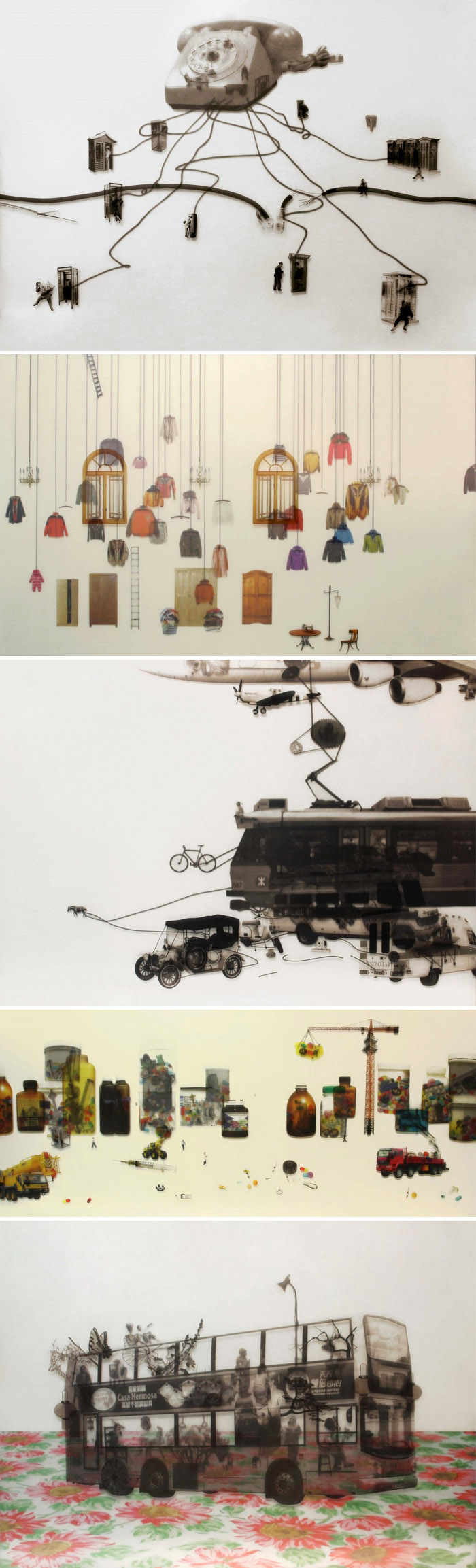
So, it’s not surprising that Hong Kong mixed media artist Tang Kwok Hins collages are right up my alley. These are created on layers of glass instead of vellum but, for me there is something reminiscent of that vellum effect.

Many of the collages pictured above are part of a series titled Containers as Evidence of Presence, 2010-now. This is what Tang has to say on the subject:

Every object cannot be self-existent in the form of flow and permanency. Books are stored on shelves; wine is put into glass bottles; water need to rely on coast to constitute river; even though air is such invisible element, we have the Earth as the storage. All these are the things possessing ability like protection and providing positions for the protected ones to exist. Positions are: something has to open for discovery, such as gift boxes and chests of treasure; something is concealed from our sight that we can percept through our experiences, such as roots in vases of flower and furniture in houses.

Tang Kwok Hin is attracted to the interdependence between containers and the things loaded. He uses photos that he takes as well as images from related searches on the internet. The photos are adhered to different levels of glass, resulting in a somewhat surreal effect.

via amelia johnson contemporary

Katya Malakhova: Russian Nesting Dolls

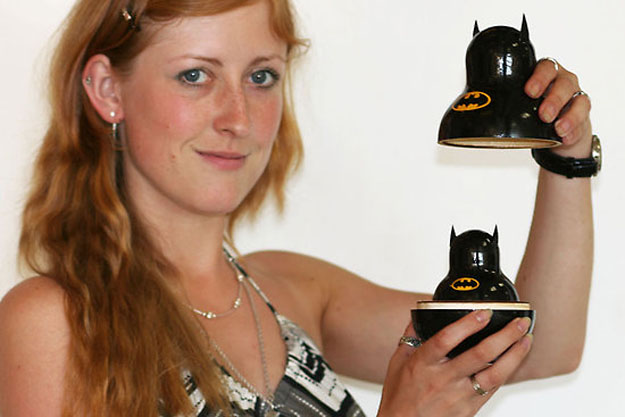
Matroyshka, Contemporary Russian Nesting Dolls, Toys, Batman, Russian Design, collabcubedMatroyshka, Contemporary Russian Nesting Dolls, Toys, Batman, Russian Design, collabcubedMatroyshka, Contemporary Russian Nesting Dolls, Toys, Batman, Russian Design, collabcubedRussian graphic designer and photographer Katya Malakhova, clearly an industrial designer as well, has put a spin on the traditional Russian nesting doll (matroyshka) concept in many directions, all a lot of fun. From Batman to a dominatrix, anatomical versions and bling, they all made me chuckle. Oh, and Gene Mutation has a nice surprise at its core.

These have got kidrobot written all over them, don’t you think?

via redbubble

Julia Davis: Headspace

Art out of Place, Cast Salt, Salt Sculpture, Australian Contemporary art, Perth Festival 2012Art out of Place, Cast Salt, Salt Sculpture, Australian Contemporary art, Perth Festival 2012Art out of Place, Cast Salt, Salt Sculpture, Australian Contemporary art, Perth Festival 2012Click to enlarge

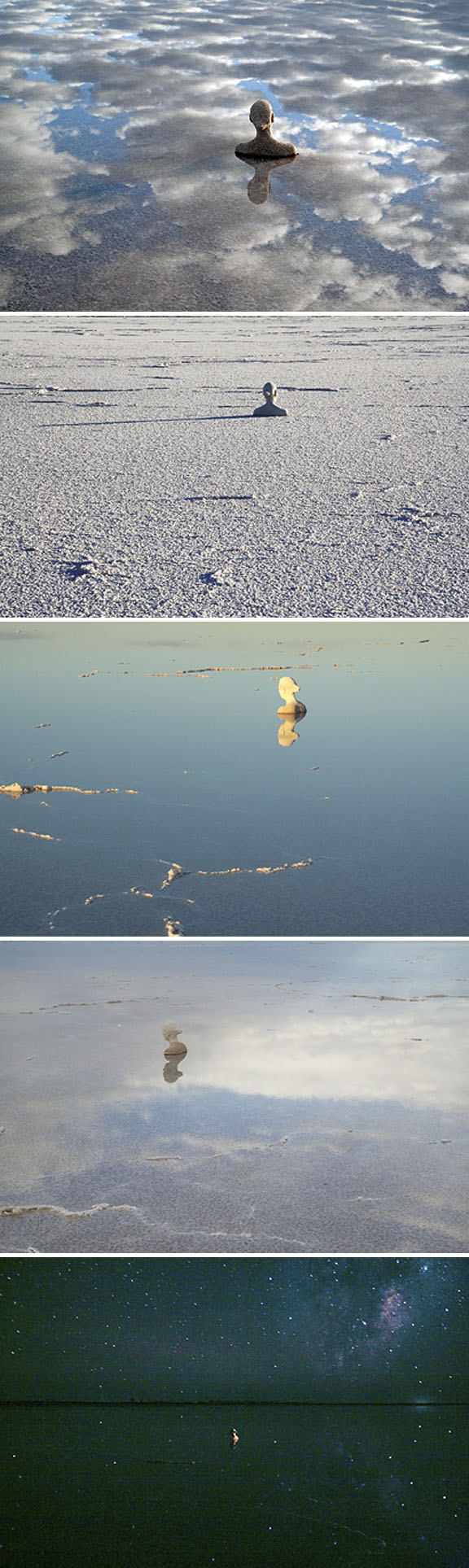
Sydney based artist Julia Davis focuses on the relationship between objects, places and spaces. With works installed in salt lakes, deserts, coastal precincts and parklands in addition to galleries, Davis explores the experiential as well as ideas of temporality and duration.

In Headspace, Davis used salt harvested from Lake Brown in Western Australia to create a cast of her head and shoulders. After, she reintroduced the sculpture to its original source and documented its dissolution over a 9 week period.

via Perth International Arts Festival