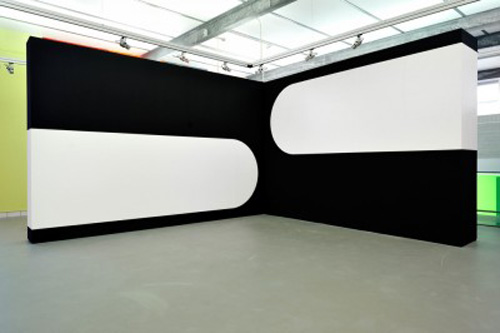
Magic Carpet: Sarah Crowley & David Brooks

Magic Carpet Brick Installation in Dockland's Australia by Sarah CrowleyMagic Carpet Brick Installation in Dockland's Australia by Sarah Crowley, David BrooksClick to enlarge

Australian architect Sarah Crowley, whose jewelry we posted about previously, joined forces with David Brooks on their winning entry for Austral Bricks Architectural Ideas Competition. The design challenge was to “design an experiential element for an urban space that reflects the future of brick.” Crowley and Brooks’ solution: a magic carpet installation made of bricks.

The Magic Carpet forms an undulating terrain providing ergonomic curves that serve as seating and lounging spaces, at the same time showcasing the extensive color range and texture of clay brick products.

Currently, it looks like the Magic Carpet will become a reality in the Docklands, Melbourne, Australia. Fun idea!

Nils and Sven Völker: Captured

art installation, inflating foil, colored lights, collabcubedart installation, inflating foil, colored lights, collabcubedClick to enlarge.

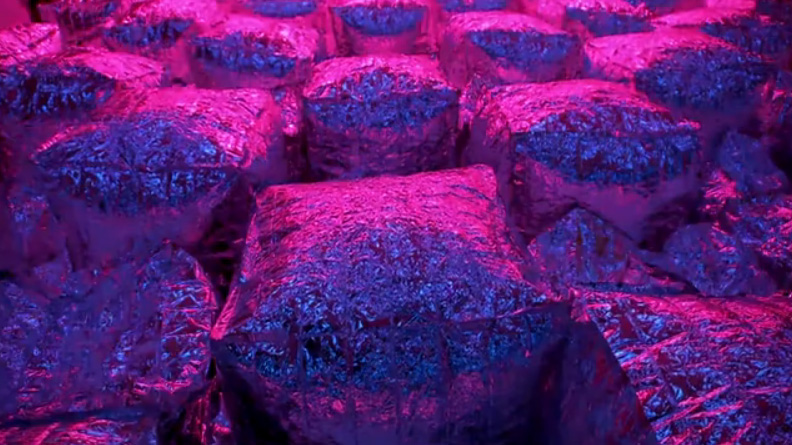
If you’ve ever popped some Jiffy Pop on the stove, it’s likely that that experience will come to mind while viewing Nils and Sven Völker’s recent installation, Captured: An Homage to Light and Air presented at MADE Space in Berlin.

The German brothers – Sven a graphic designer and Nils a machine artist (see our previous post) – collaborated by combining four walls with 304 framed graphic pages surrounding a field of 252 inflatable silver cushion-like air bags. The bags were programmed by Nils Völker to create sequences according to chapters of his brother’s “books on wall”. The inflating and deflating of the bags, along with the colored lighting system, create a very dramatic and intensified effect.

You can watch it in action below.

Ariana Page Russell: Skin Art

dermatographia, skin art, skin tattoos, Magnan Metz, photography, collabcubeddermatographia, skin art, skin tattoos, Magnan Metz, photography, collabcubeddermatographia, skin art, skin tattoos, Magnan Metz, photography, collabcubedEm pointed me to Ariana Page Russell‘s work a couple of months back and now I see that the Brooklyn-based artist is having a show at MagnanMetz Gallery, here in NYC, at the end of the month. Russell has dermatographia, a condition in which her immune system exhibits hypersensitivity through the skin, causing painless, temporary welts that emerge when lightly scratched. She exploits this condition in her artwork by creating patterns on different parts of her body and photographing them as the skin becomes irritated and swells. A sort of skin tattoo. She has also created different wallpaper patterns using c-prints of her skin in all its irritated shades.

From the gallery’s site:
Russell’s recent work continues to explore the possibilities of flesh, using her skin as both source material and an entry to go deeper into the body and its emotions. Images of Russell’s abdomen appear throughout the exhibit: covering the gallery window; in a photograph of her torso blanketed in triangular welts resembling raised sails; and as the temporary tattoo mask that she manipulates over her face in the video, Blouse. In this piece, she exhales sharply into the mask to produce a fleeting, gauzy window. A sudden inhale collapses the window to create a skin-tight barrier with each breath. Blouse comes to a close as Russell removes the tattoo, her unadorned face remaining interrogative but naked of the revelatory mask.

Maybe not for everyone, but definitely pretty unique.

Ariana Page Russell’s exhibit titled Blouse opens at MagnanMetz on October 21st and runs through November 19, 2011.

Christian DuCharme: Coffee Lamps

Chris DuCharme, cool lamps, coffee cups, filters, spoons, collabcubedChris DuCharme, cool lamps, coffee cups, filters, spoons, collabcubedClick to enlarge

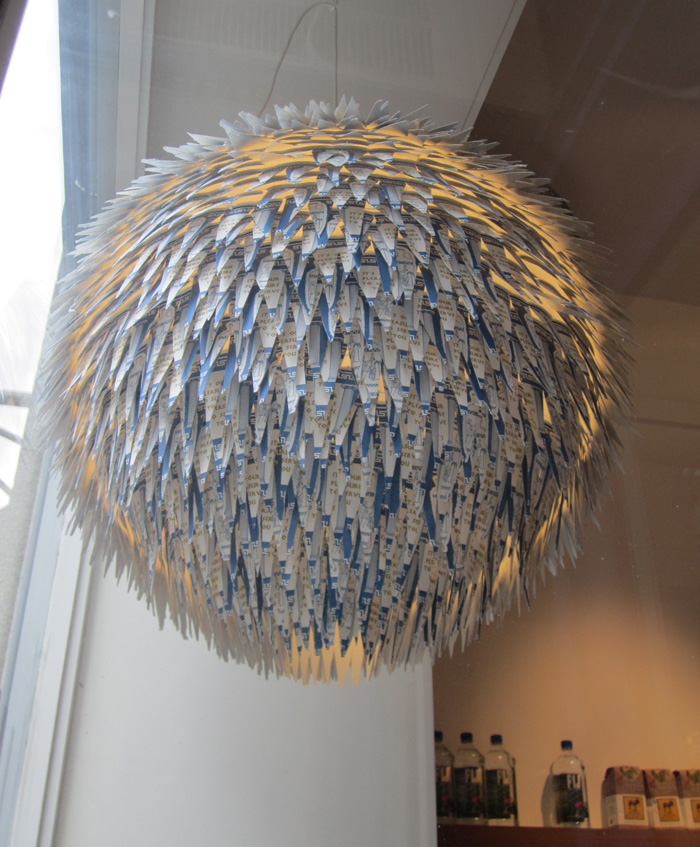
A couple of days ago, on a nice stroll up from Canal Street, a friend and I spotted an interesting structure in the window of the very cute Lafayette Espresso Bar + Market. Going in to explore further, and have a tea while at it, turns out the large sea urchin-like object was a lamp made from 300 of the classic “It’s Our Pleasure to Serve You” coffee cups, cut into slim triangles. The artist/designer behind the lamp? The multi-talented Christian DuCharme.  Previously a set designer and window display artist, the Swiss designer from Zurich now works as an interior and accessories designer. And, well, he also makes lamps. Very cool ones at that.

The top four images are the 300 Cups Lamp, presently on display at the previously mentioned espresso bar in NYC. The lamp that follows is made from plastic coffee spoons, and the two photos below that are another lamp made from coffee filters. Amazing!

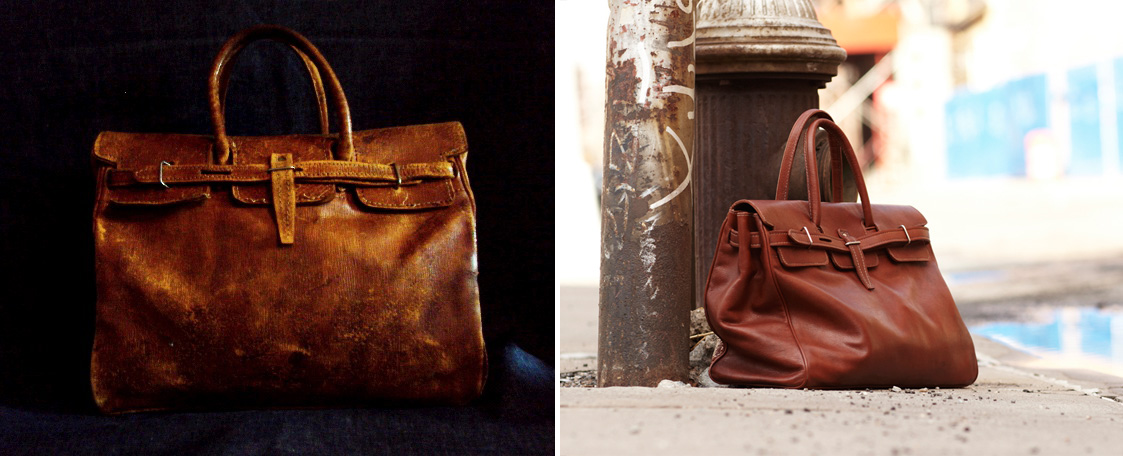
Two of Christian DuCharme’s beautiful bags are at the bottom of the photos. If you’re interested in purchasing Christian’s lamps or bags you can get in touch chrisducharme1@me.com.

Photos courtesy of Christian DuCharme.

Adidas Laces Signage: Turbocharged Type

Laces office building, Herzogenaurach, Germany, Typography, collabcubedLaces office building, Herzogenaurach, Germany, Typography, collabcubedLaces office building, Herzogenaurach, Germany, Typography, collabcubedLaces office building, Herzogenaurach, Germany, Typography, collabcubedClick to enlarge

The new Adidas Laces R&D building at the corporation’s headquarters in Herzogenaurach, Germany, is Kada Wittfeld Architektur’s latest project. In addition to the innovative communicative architectural ‘laces’ theme with criss-crossing connecting walkways — a metaphor for the Adidas sports shoe as well as the networked communications of the corporation — the ‘turbocharged’ typographic signage system by Büro Uebele leaps across walls, doors, and handrailings throughout the center. Words identify places as well as becoming colored surfaces and sculptures.

From the press release:
The building forms a loop. Suspended walkways cross the atrium space, “lacing” the building’s structure together like the laces of a sports shoe. The walkways connect individual departments within the building complex, making for greater proximity and preventing the disruptive effect of people walking through offices. The signage system supports this concept, providing directions at hubs and intersections. The names of the meeting areas are displayed on the glass balustrades, creating a subtly mobile effect as visitors look across the atrium, helping them find their way. The corporate typeface, a variation on FF DIN, is dynamically varied here. The outlines of letters and arrows are shifted vertically and repeated rhythmically, creating a dynamic, sporty effect. The shimmering characters – for all the world as if frozen in time-lapse photography – are combined in varying patterns, offering the viewer a varied and distinctive echo on the “laces” theme.

Truly spectacular inside and out.

Photos: Werner Huthmacher & Christian Richters

via e-architect and typetoken

Jan van der Ploeg: Wall Paintings

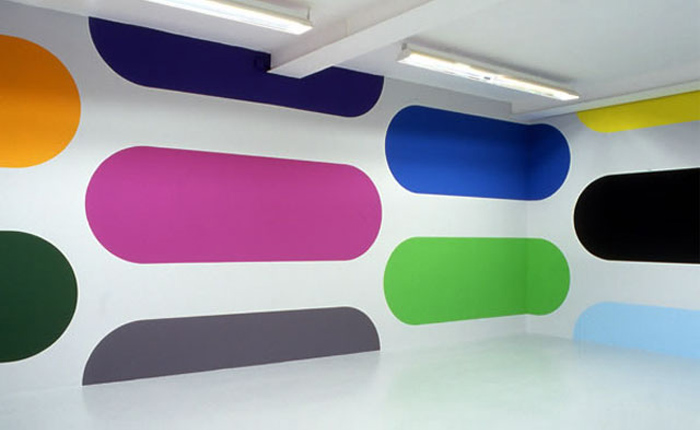
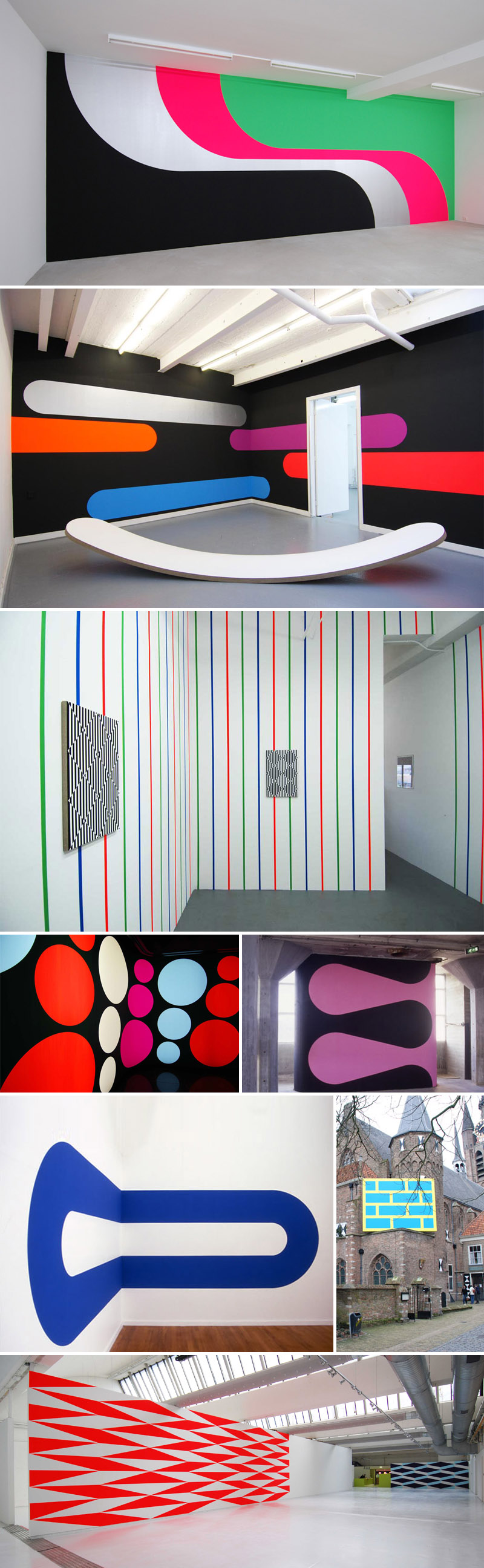
Jan van der Ploeg wall paintings, collabcubedJan van der Ploeg wall paintings, collabcubedJan van der Ploeg wall paintings, collabcubedDutch artist Jan van der Ploeg has been painting walls and large panels for a couple of decades. His colorful and precise geometric designs are mostly simple forms sometimes in black and white, other times in bright contrasting colors, but always producing a dramatic effect, in my opinion. Painted in multiple layers of acrylic to create a smooth, untextured finish, reinforces the notion that the color has been reduced to a mere surface.

Jan van der Ploeg is also a co-founder of PS Projects, an artist-run exhibition space in Amsterdam.

Photos courtesy of the artist, CCNOA, West and Minus Space.

Haus der Essener Geschichte

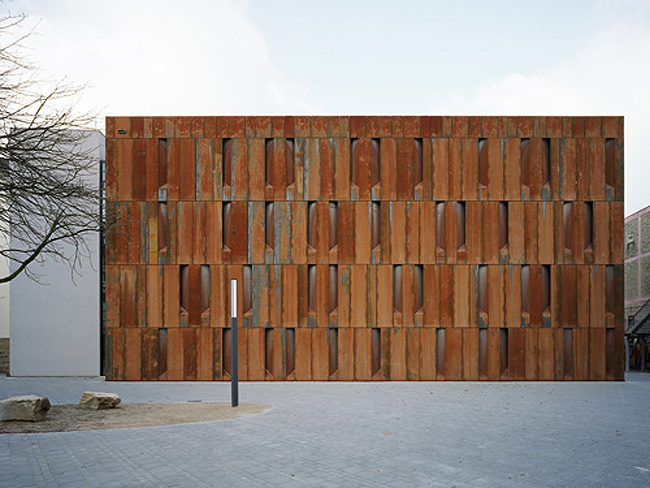
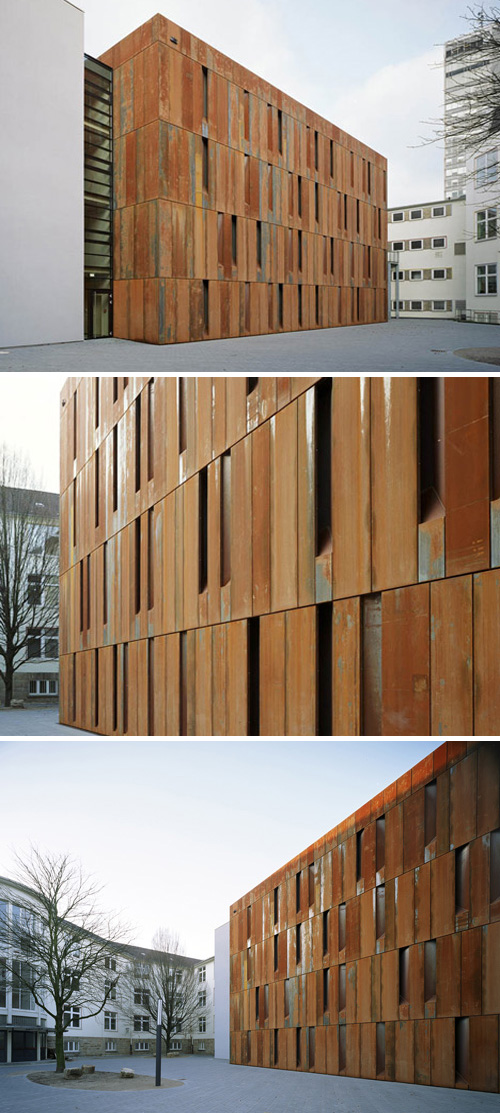
rusted facade building, Germany, weathered steel, Essen, collabcubedrusted facade building, Germany, weathered steel, Essen, collabcubedI’m a fan of rust.  Not so much on the inside of a toilet or behind a drippy faucet, but a nice slab of rusted steel à la Richard Serra offers such a great combination of rich color and texture.

Not surprising, then, that I really love this building by German studio Scheidt Kasprusch Architeckten. The four-story Haus der Essener Geschicte, in Essen, Germany, is clad in corten (weathered steel) which constantly alters and protects itself by corrosion. It demonstrates the change of time as well as alluding to the background of Essen. The building was built to house archives as an extension of the Luisesnschool which is used as a library and exhibition space.

Photos: Deimel & Wittmar

via e-architect

Anya Zholud: Minimalist Wire Sculptures

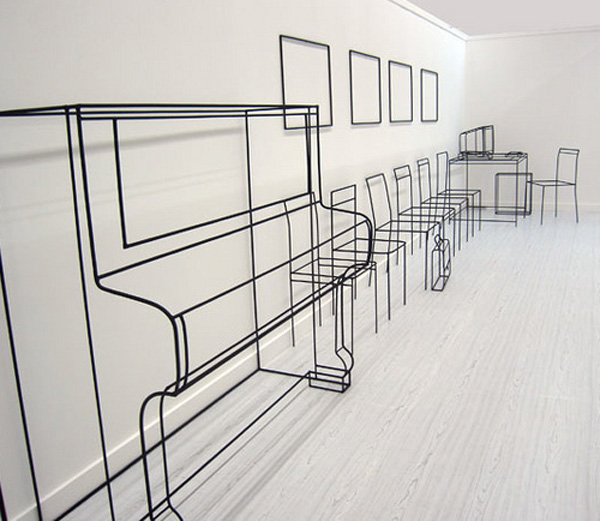
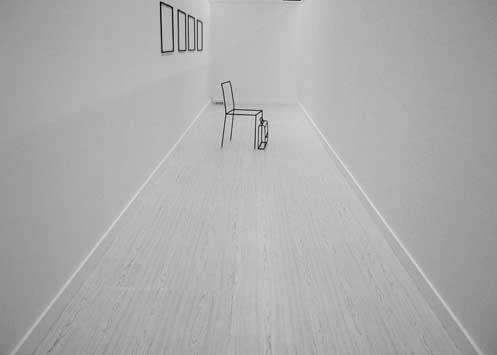
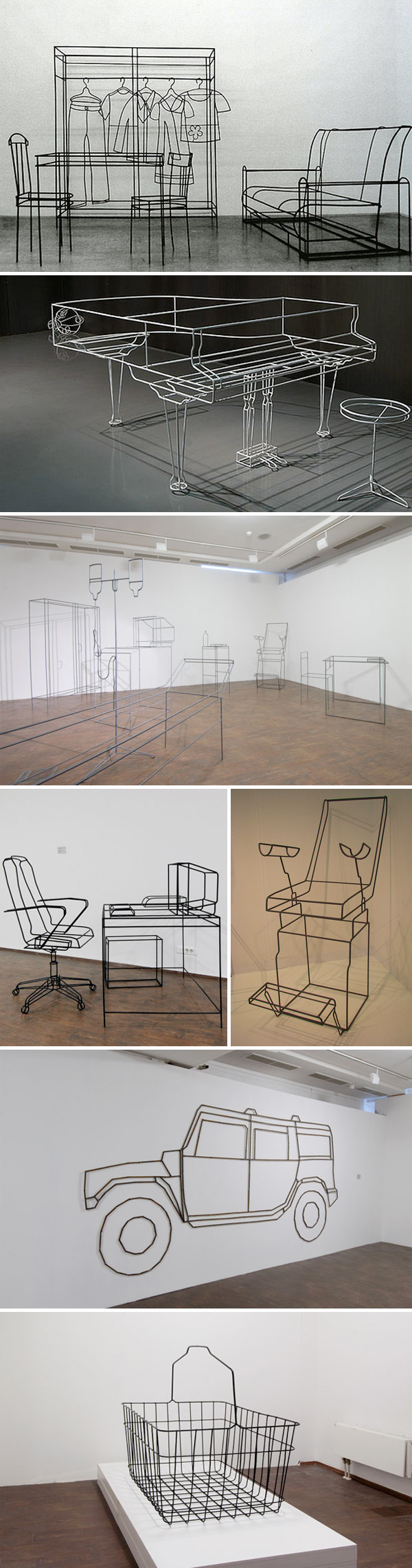
minimalist art, wire sculptures, Russian art, Moscow Gallery, collabcubedminimalist art, wire sculptures, Russian art, Moscow Gallery, collabcubedminimalist art, wire sculptures, Russian art, Moscow Gallery, collabcubedRussian artist Anya Zholud creates minimalist wire sculptures that appear almost as 3-dimensional line drawings. Their simple forms and often ‘interiors’ setup offer a back-to-basics and paring down view in the present world of excess. Proper lifestyles without luxuries.

I especially like the dramatic effect these have when placed in the starkness of a white or black gallery room, in the contrasting color of the sculpture.

Photos Aidan Gallery and oborte’s flickr.

via Aidan Gallery.

Bring to Light/Nuit Blanche 2011: Follow-up

Bring to Light Festival, nuit blanche, greenpoint, marcos zotes-lopez, eye, collabcubedBring to Light Festival, nuit blanche, greenpoint, marcos zotes-lopez, eye, collabcubedBring to Light Festival, nuit blanche, greenpoint, video, art installations, collabcubedClick to enlarge.

Last night, a night bookended by heavy rain showers here in NYC, fortunately offered a 2- to 3-hour precipitation-free window. Just enough time to ferry on over to Greenpoint and catch the Bring to Light Festival.

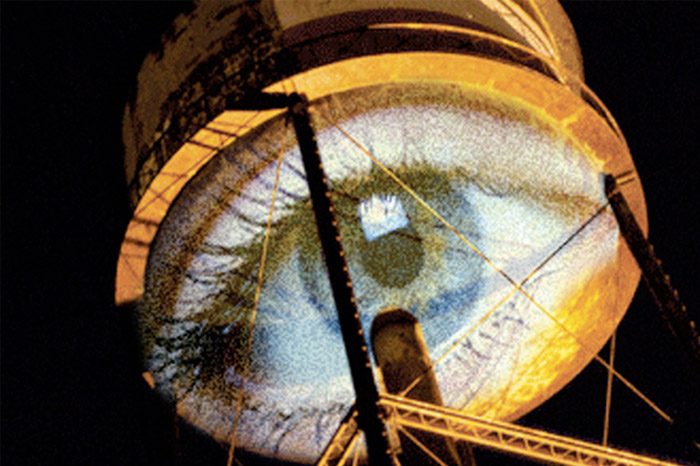
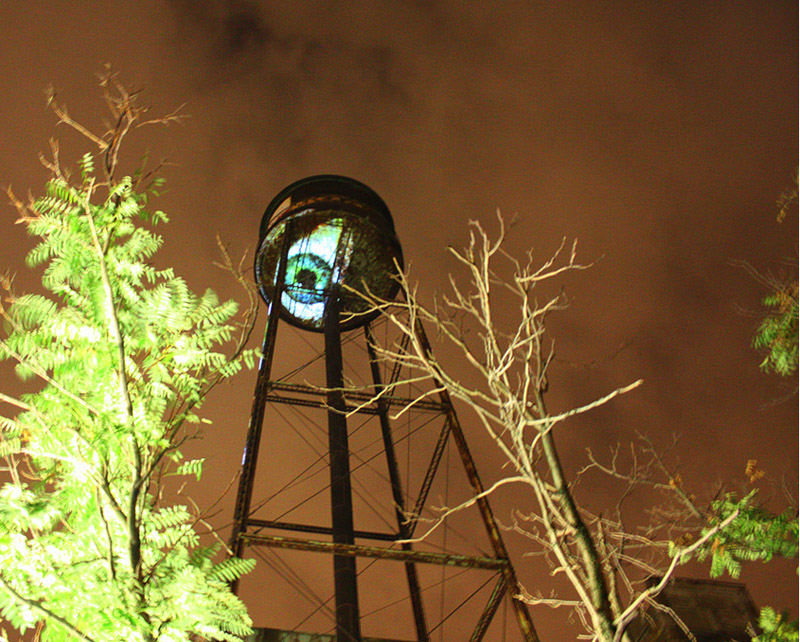
Though the ferry was quite empty, I was happy to see that the crowds obviously made it over by other means of transportation. It was one of those really nice NYC events, where everyone seemed so happy in sharing such a fun and unique experience. The brick and corrugated metal façades of the industrial warehouses on the Brooklyn waterfront made for the perfect backdrop and canvases for the various video projections and colorful light installations. There were over 50 works displayed, so naturally I can’t go over all of them here, and some I am not sure of the names or artists, but some of the highlights are pictured above starting with, possibly my favorite, a very Buñuelesque image:

Marcus Zotes-Lopez’s CCTV/Creative Control TV; a projection of an eye on the bottom of a water tower looking over the crowds.
Devan Simunovich & Olek, Suffolk Deluxe Electric Bicycle.
Not sure of this but possibly Colin Snapp, Sylvania.
Jason Peters, Structural Light.
BOB, Columbia Architecture Students, inflatable structure (left and right pics, outside and in).
Glowing pedestrians walking around in self-made light costumes.
Not sure about the colored bulbs.
Camilled Scherrer, In the Woods, interactive projection converting people’s shadows into creatures.
Chakaia Booker, Shadows, silhouettes on installation.
Others include a bench with light emanating from the slats and a person lying down within (à la Vito Acconci): projections of hands morphing into latex gloves; a glowing lung-like object that breathed; and Raphaele Shirley’s Light Cloud on a Bender, a glowing mist sculpture.

It was all very bright, colorful, and animated. You can watch the short video clips below for a better sense of the atmosphere. Next year, I’ll at least hang a glow stick around my neck before heading over.

Top photo courtesy the artist, Marcus Zotes-Lopez. Second photo from Alix’s flickr. All other photos taken by collabcubed.

Bring to Light Festival

Light Festival, Nuit Blanche, Greenpoint, Art, InstallationsLight Festival, Nuit Blanche, Greenpoint, Art, InstallationsIf you’re in NYC, you might want to check out the Bring to Light Festival tonight in Greenpoint, Brooklyn. Taking place simultaneously with “nuit blanche” events in other cities around the world, the festival will showcase site-specific installations of light, sound, performance and projection art from emerging, as well as established, artists re-imagining public space. The streets and waterfront of Greenpoint will be transformed.

Sounds like something that shouldn’t be missed.

The ferry schedule will be extended till midnight from East 34th St. Pier in Manhattan and N. 7th St in Williamsburg. You can see more on how to get there here. And more about the festival and artists here.

It all starts in 6 hours and 5 minutes…. 4 minutes…

via Flavorpill and NPR

Muffin Pouffe by Matteo Bianchi

The Muffin Pouffe (looks a little more like a cupcake to me) was showcased by Italian designer, based in East London, Matteo Bianchi this week at TENT London 2011. A humorous take on the classic ottoman, the Muffin Pouffe’s seat is covered with leather cushioning that looks like chocolate. The pouffe comes in two models, the ‘standard’ model and the ‘storage’ model that has a removable muffin top (always the best part) that reveals a hollow interior for stashing, well, whatever you want.

via Hungeree

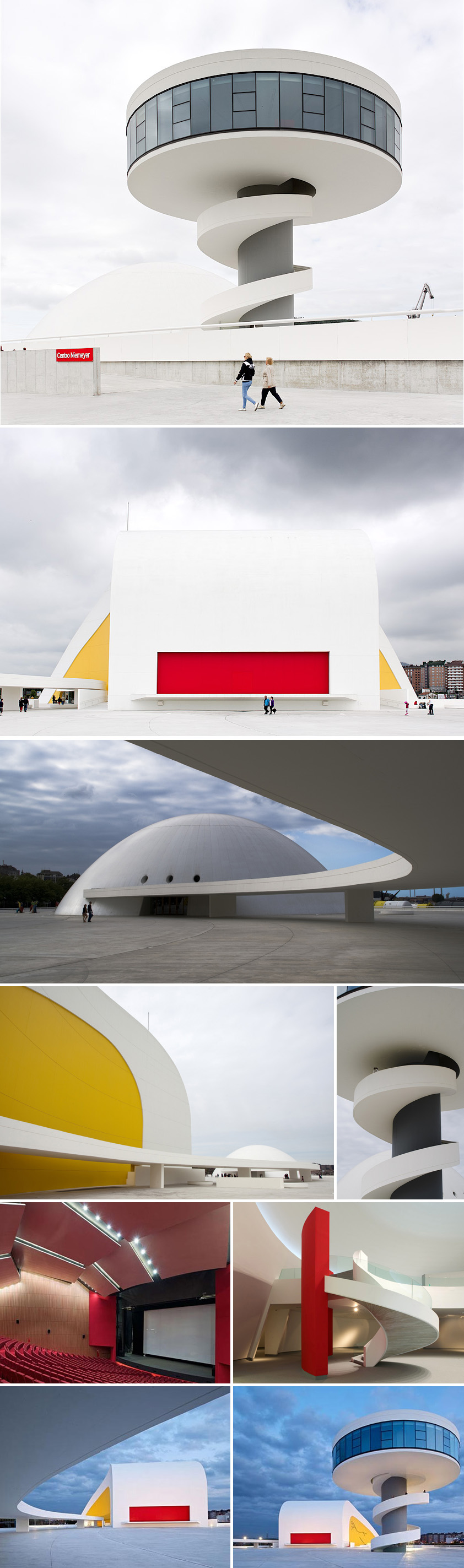
Centro Cultural Oscar Niemeyer

Oscar Niemeyer, Asturias, Aviles, Spain, Architecture, collabcubedOscar Niemeyer, Asturias, Aviles, Spain, Architecture, collabcubedClick on images to enlarge.

Brazilian architect Oscar Niemeyer is probably best known for his public office buildings in Brasilia, as well as the UN Building in NYC. A pioneer in using reinforced concrete for aesthetic purposes, emphasizing curves and contrasting volumes with empty spaces, Niemeyer donated the design for the Oscar Niemeyer International Cultural Center in Asturias, Spain in gratitude for having been awarded the Prince of Asturias Award of Art in 1989. The center opened this past spring, clearly thrilling photographers for the opportunity to take some beautiful shots.

Photos courtesy of Centro Niemeyer, Avilés, Spain, by Oscar Niemeyer, Photography by © Inigo Bujedo Aguirre, © David Busto Méndez, and enemigo_80’s flickr.

via e-architect

Andrei Molodkin: Transformer No. V579

Light sculpture, Light installation, Lumen, London, Art Sensus, collabcubedLight sculpture, Light installation, Lumen, London, Art Sensus, collabcubedLight sculpture, Light installation, Lumen, London, Art Sensus, collabcubedClick to enlarge

Oh how I wish I were in London to see this!  Russian artist Andrei Molodkin has created a site-specific installation titled Transformer No. V579. The exhibit consists of three galleries: the first, a monumental corridor of transparent acrylic tubes filled with light and oil; the second gallery, shows a video with details of the installation’s construction; and the last, is a ‘laboratory’ of drawings and photographs that outline the project’s development.

Visitors are encouraged to interact and walk through the six cubed modules and corridors. The effect of the bleeding oil and its glowing white light counterpart is reminiscent of blood coursing through the human body.

From the gallery’s site:
While the oil and light represent simple dichotomies of life and death, purity and greed, the dissimilar substances unite to highlight the interchangeability of these labels. Oil is both a natural substance of an ancient earth and yet the fuel of urban, technological and unnatural power. It is Molodkin’s intention that visitors will directly experience an unlikely physiological affinity to this substance and will find themselves « true revolutionaries » upon exiting the installation, « capable of achieving a variety of mutually exclusive goals »

Hard not to be reminded of my last trip to London and one my favorite light exhibits ever.

Transformer No. V579 will be on view at Art Sensus in London through December 17, 2011.

via ArtSensus and Frame

Rafaël Rozendaal: Internet Art

Interactive art, internet art, domain name art, collabcubedInteractive art, internet art, domain name art, collabcubedClick to enlarge.

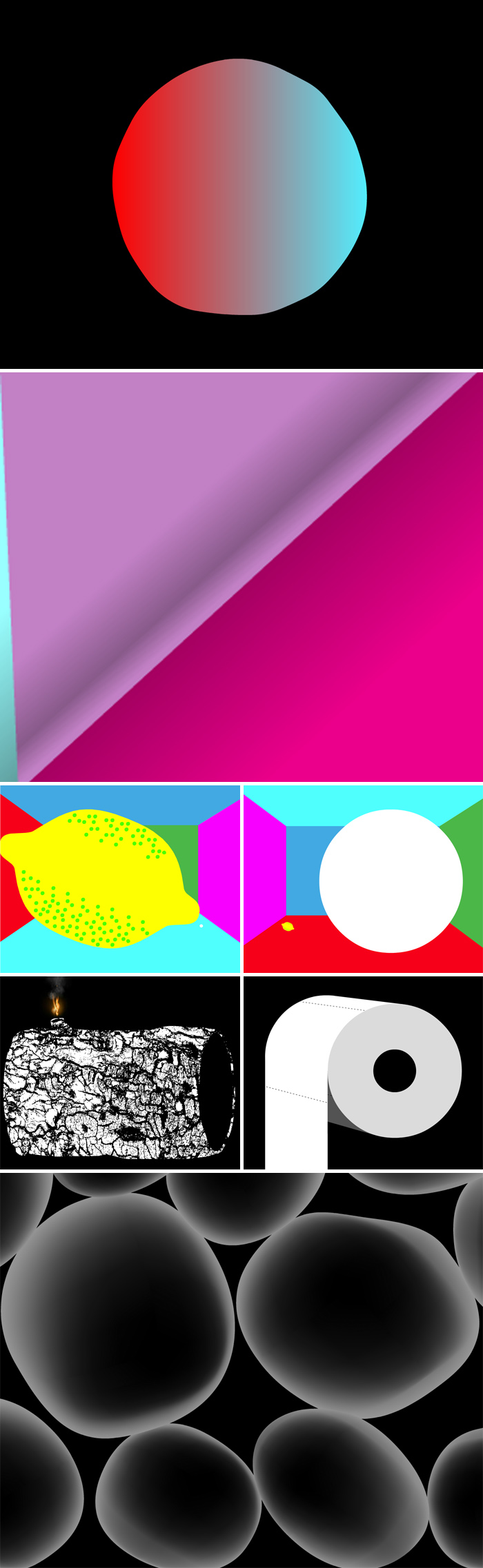
Dutch-Brazilian, world-traveling artist Rafaël Rozendaal uses the internet as his canvas, in addition to the more traditional installations, drawings and writing. Much of his art, however, is in the form of websites. Mostly interactive, these sites are playful and many times simple in their execution; each with their own URL. As a result the URLs of Rozendaal’s art are for sale.

Rafaël Rozendaal is also the creator of Bring Your Own Beamer, an international series of one-night exhibitions where artists bring their own laptop and/or slide projector (beamer) to show their work. Anyone can make a BYOB exhibition, according to Rozendaal’s website: 1) find a space; 2) invite many artists; 3) ask them to bring their projectors. Upcoming BYOB cities includ Sao Paolo, Portland, Maine, Darwin, Australia, Milan and Melbourne. You can check the calendar here.

Above are stills from a few of Rozendaal’s websites. The individual names link to their respective URLs and are definitely worth checking out in their interactive mode.

From top to bottom and left to right:
Carnal Fury (x2); Color Flip; Tossing Turning (x2); Flaming Log; Paper Toilet; The Persistence of Sadness.

via +81

Jean Nouvel: Jane’s Carousel in DUMBO

Jean Nouvel, Jane Walentas, Brooklyn Bridge Park, Dumbo, collabcubedJean Nouvel, Jane Walentas, Brooklyn Bridge Park, Dumbo, collabcubedClick to enlarge.

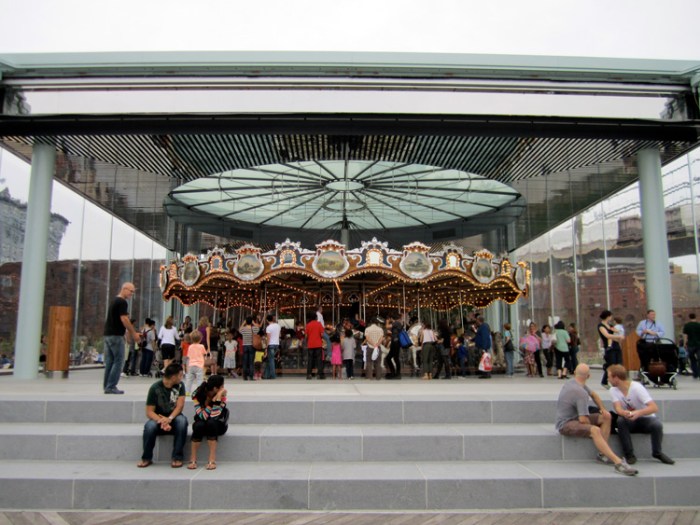
I went over to the DUMBO Arts Festival in Brooklyn last Saturday and visited many an open studio, as well as new (to me) designy shops, the crazy sale at Desigual’s Pop-up Shop, and the large bubble-making contraption in the tobacco factory. All were fun to see, but the star of the festival was the recently opened Jane’s Carousel housed within a pavilion designed by architect Jean Nouvel, as he describes it: the jewelry box for the precious jewel.

The carousel and its box are a gift to the city from the Walentas family. Jane Walentas had been restoring the exceptionally elaborate 1922 carousel since 1984. Positioned on the edge of the East River between the Manhattan and Brooklyn Bridges, the views from the carousel are priceless, whether direct with the retractable doors folded open, or through the impressively thick acrylic walls that add a wavy, almost drippy, distorted quality to the Manhattan skyline. At night, the box acts as a magic lantern with curtains that come down and become screens, allowing the projectors in the middle of the carousel to project the horses’ shadows onto all four sides of the pavilion. I would imagine that to be a lovely sight from either bridge, the water, or Manhattan.

I have to confess that I was not initially impressed by the design when I saw it in the NY Times, but after speaking with one of the structural engineers involved in the project (Gilsanz Murray Steficek) I was assured that the photos did not do it justice. That may be the case here as well, so if you happen to be in NYC, I highly recommend taking a stroll over to Brooklyn Bridge Park and experiencing the size and majesticness of the carousel in person. If nothing else, you’ll get a spectacular view of both bridges and the skyline across the way.

Stéphane Malka: Urban Study Installations

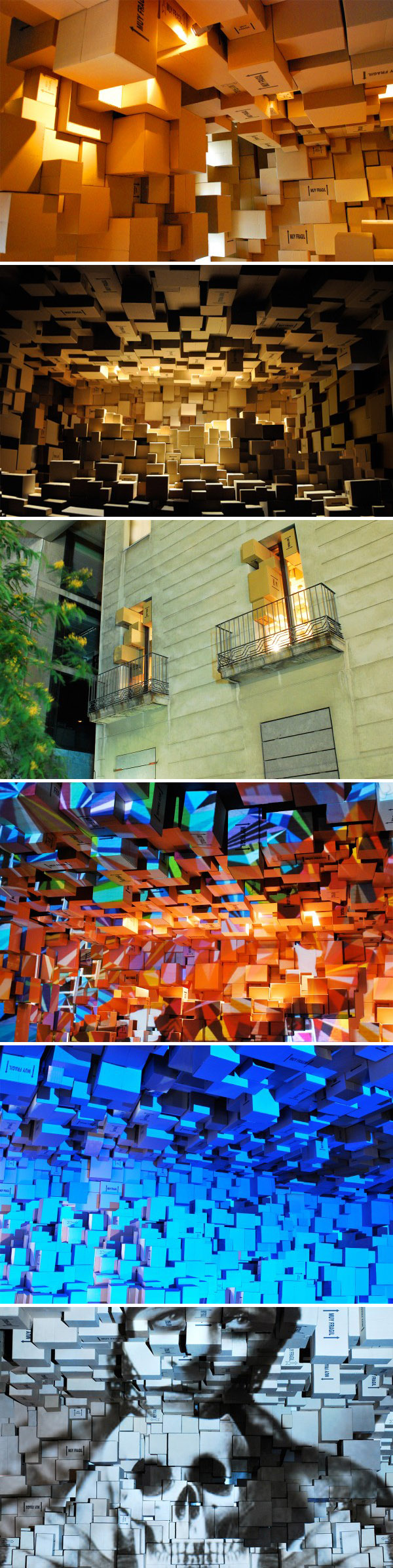
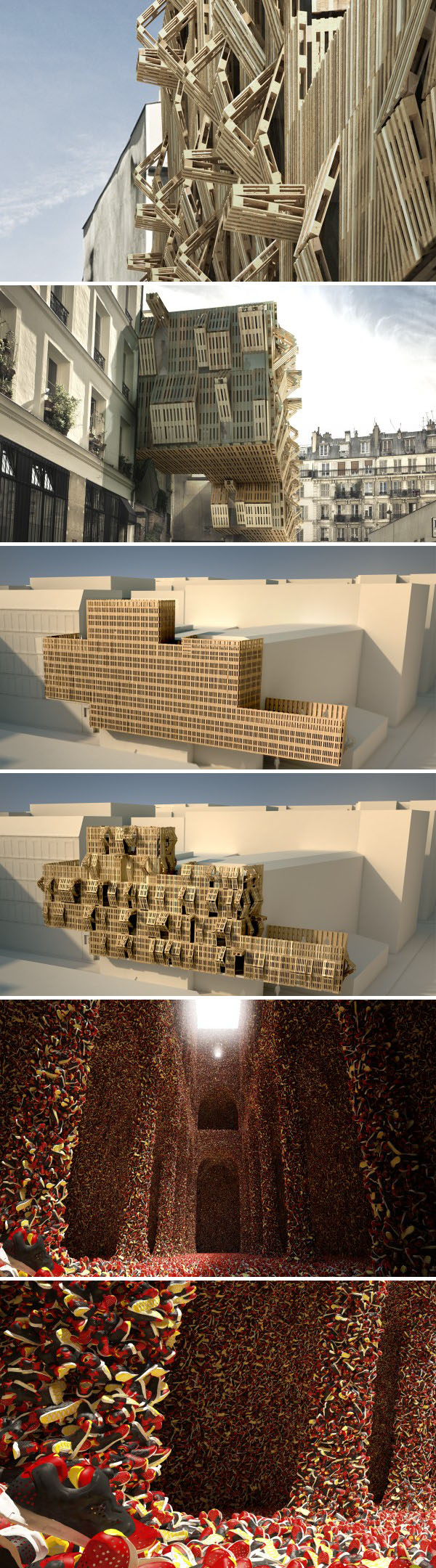
Malka Architecture, installations, art, BoomBox, Fury, Ame-lotMalka Architecture, installations, art, BoomBox, Fury, Ame-lotMalka Architecture, installations, art, BoomBox, Fury, Ame-lotThis is where the line between art and architecture blurs. French architect Stéphane Malka started as a graffiti artist in his younger life. Through that experience Malka discovered the city and its untapped potential. He has a strong taste for ‘soft’ resistance and lives in continuous quest for abandoned spaces that offer the possibility for “creating new urban vitality.”

Consequently, Stephane Malka has amassed an impressive body of work, from installations and other completed projects, to elaborate studies and proposals for urban projects, to impressive competition entries. The similar theme throughout his work includes reuse and reappropriation of materials; recycling the existing without additional processing.

Above are his most recent projects.

From top to bottom: Boombox Space Invader, Moscow; Boombox-luz, Barcelona (with light projections); Ame-Lot On the Blind Walls, Paris (a study on housing and avoidance of deconstruction but rather superimposing interventions onto built buildings.);  The Temple of Fury for NYC, a study for an installation made of Reebok Fury Insta-Pumps. A criticism of today’s excessive consumption and desire over need.

via archdaily