Urban Daddy Cycling Classic

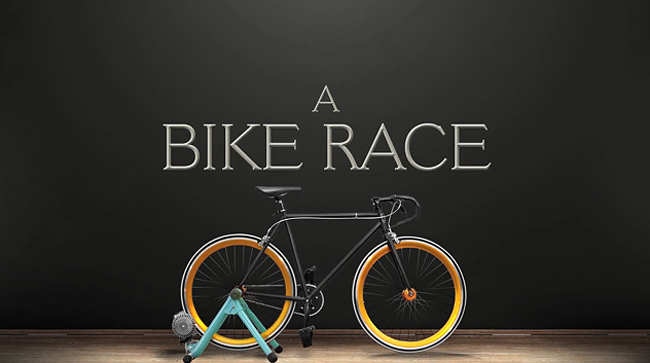
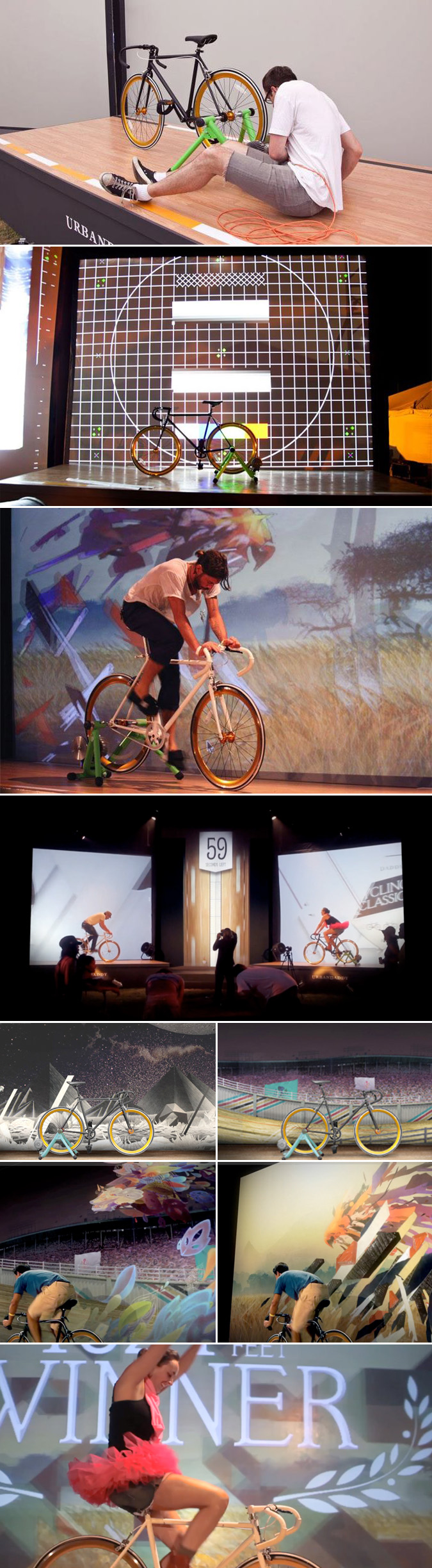
E2NY Festival, Urban Daddy, Cycling Classic, East Hampton, Interactive DesignE2NY Festival, Urban Daddy, Cycling Classic, East Hampton, Interactive DesignE2NY Festival, Urban Daddy, Cycling Classic, East Hampton, Interactive DesignThis looks like it must have been a lot of fun. As part of the E2NY Festival this summer in the Hamptons, Red Paper Heart – a collective of artists and coders who make music videos, installations and games by combining interactivity and animation –was asked to create an installation for UrbanDaddy. They proposed a head-to-head bike race with a design focus, mapping forests, foxbears and orbs to the speed of the bikes, giving the rider a sense of their speed. The rides lasted 60 seconds. The faster the cyclist the farther they got unlocking multiple environments. Some even made it to space.

Here’s a video worth checking out for a better sense of the event as well as the added treat of listening to a Collabcubed favorite: Ed Sharpe & the Magnetic Zeros’ song “Home”.

I think they should implement something like this in my spin classes…

via TagoArtwork
Punched Sofa

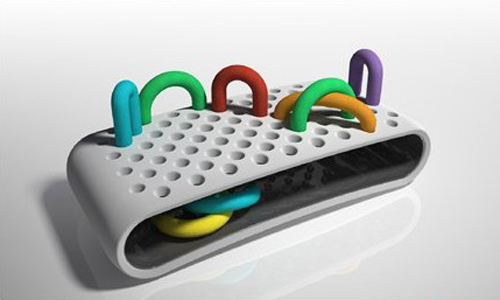
furniture design, cool unique sofa, couch, contemporary designHere’s a very fun couch for the right room. The Punched Sofa designed by Serbian-born and Canadian-based designer Danilo Cvjetkovic, is an “interactive” sofa. The bendable plastic bars are covered with soft foam and colorful fabric (they remind me of those pool noodles) and get inserted into the punched holes of the fiberglass shell base functioning as the backrests. Different heights and angles are possible and adjustable by the user. Manufactured by Furnituredesignmarket.com in Norway.

via designspotter

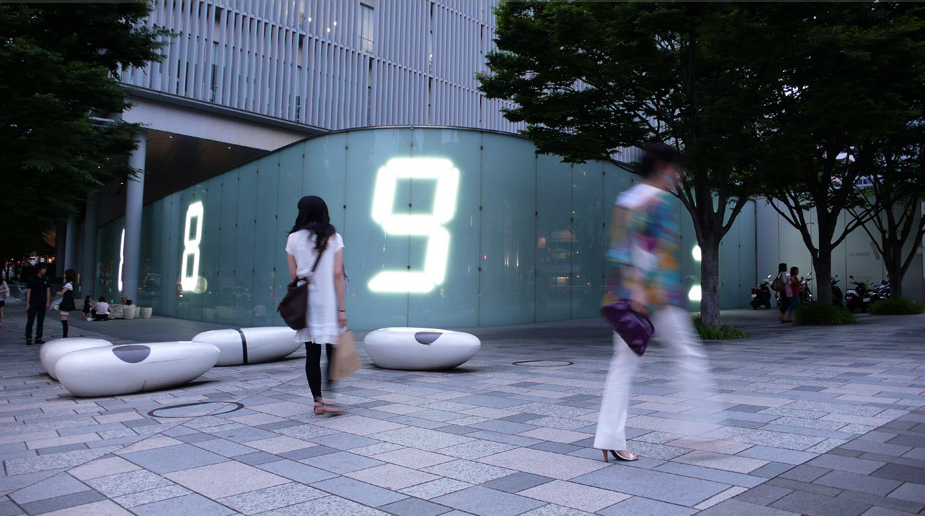
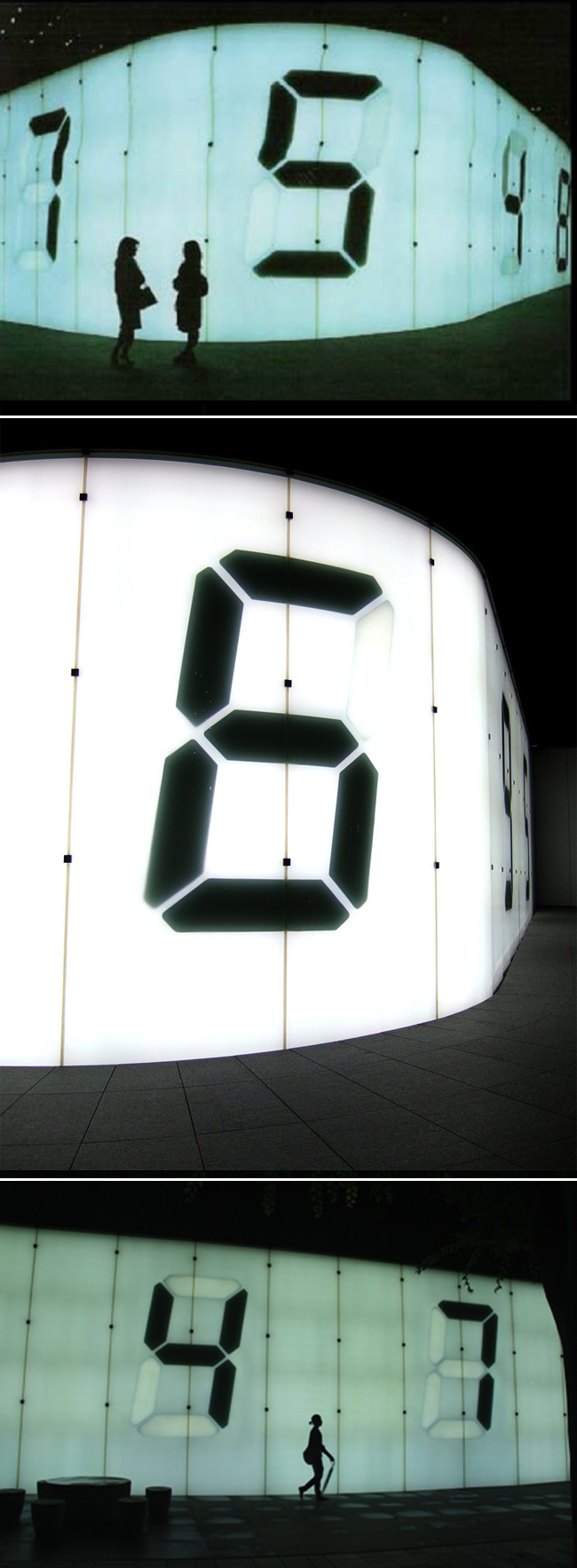
Tatsuo Miyajima: Counter Void in Tokyo

Counter Void, Installation, Tokyo, Tatsuo MiyajimaCounter Void, Installation, Tokyo, Tatsuo MiyajimaClick to enlarge.

At first glance the 3-meters-plus digital wall in Roppongi Hills, Tokyo, appears to be a clock but, upon further inspection, it becomes clear that the randomness of the numbers and the speed in which they change, has little to do with time. Artist Tatsuo Miyajima created this work titled Counter Void which, instead of time, according to the artist, shows the contrast of “Life” and “Death”.

The piece displays the numbers differently in the day vs. the nighttime. During the day, the background’s neon light is turned off and the digital counters are displayed in white neon light. At night, the numbers drop out black from the white neon lit background. In both cases the digital counters keep counting from 9 to 1  with each counter counting at a different speed.

I’m pretty sure I’d enjoy seeing this live.

Photos: Local Japan Times; Kico’s flickr; Lu Yee

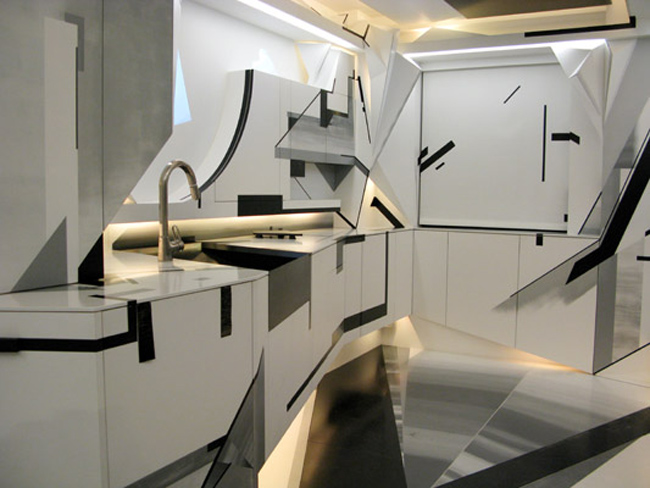
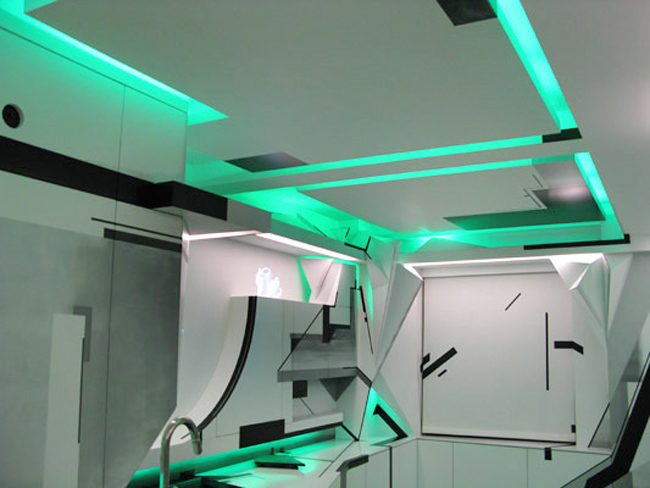
The Kitchen Project

cool, futuristic kitchen design, yoes, sounds, lightcool, futuristic kitchen design, yoes, sounds, lightcool, futuristic kitchen design, yoes, sounds, lightClick images to enlarge.

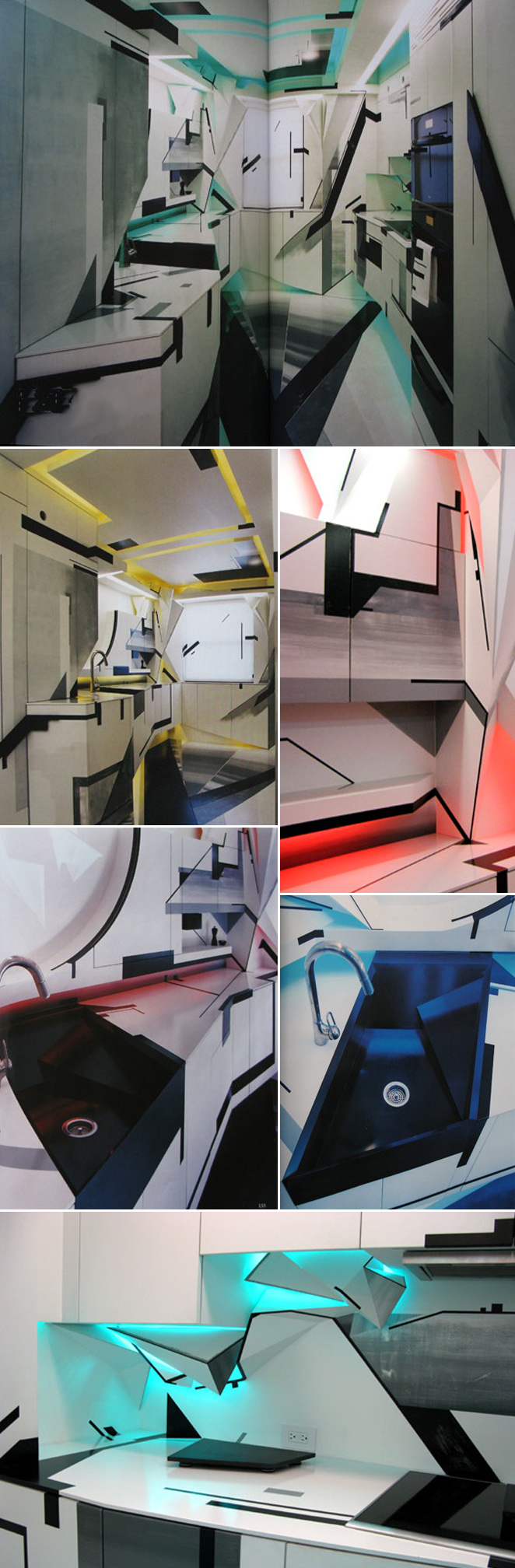
I would imagine that cooking in the Kitchen Project – an actual kitchen in an apartment on West 67th St. in NYC — is a semi-surreal experience. With changing-color lighting, Cubist-feeling cabinets, and varying sound effects upon opening every door, this is not your mother’s (or father’s) kitchen. A collaborative project by artist Amy Yoes (commissioned by the client to create a kitchen that was a work of art and would give them the sense of living inside her video Rear-View Mirror) with Slade Architecture and Bronze Hill Inc.

The kitchen includes: LED lights that are programmed to cycle through the color spectrum at varying speeds; Stop-motion animations projected within the cabinetry; and cabinet doors and drawers that trigger amplified sounds when opened (see this short video to see it in action.)

Photos: Amy Yoes and Annie Schlechter for The World of Interiors

MIT FAST Light

Festival of Art, Science Technology, MIT 2011, Light FestivalFestival of Art, Science Technology, MIT 2011, Light FestivalFestival of Art, Science Technology, MIT 2011, Light FestivalMIT (Massachusetts Institute of Technology) celebrated its 150th anniversary this year with 150 consecutive days of special activities and festivities. A major part of these celebratory events occurred during the Festival of Art, Science and Technology (FAST) which culminated in May with the FAST Light festival. On May 7th and 8th the open house featuring installation projects by faculty and staff took place around the MIT campus. Though all the projects are very interesting and worth checking out, for the purposes of keeping this post a reasonable length, I’m only posting about four of these installations.

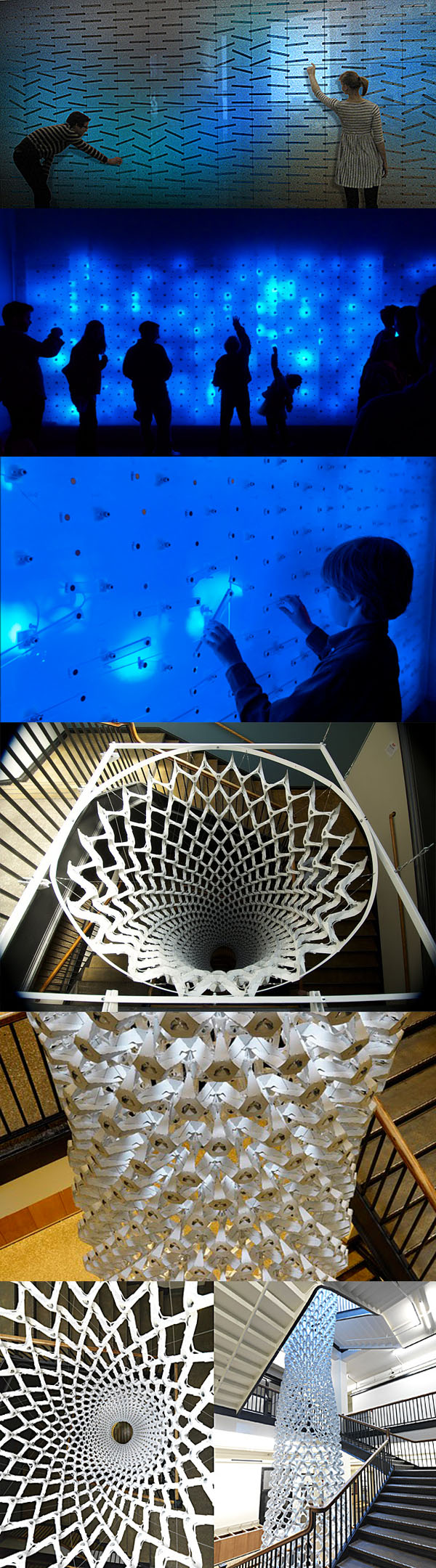
From top to bottom:
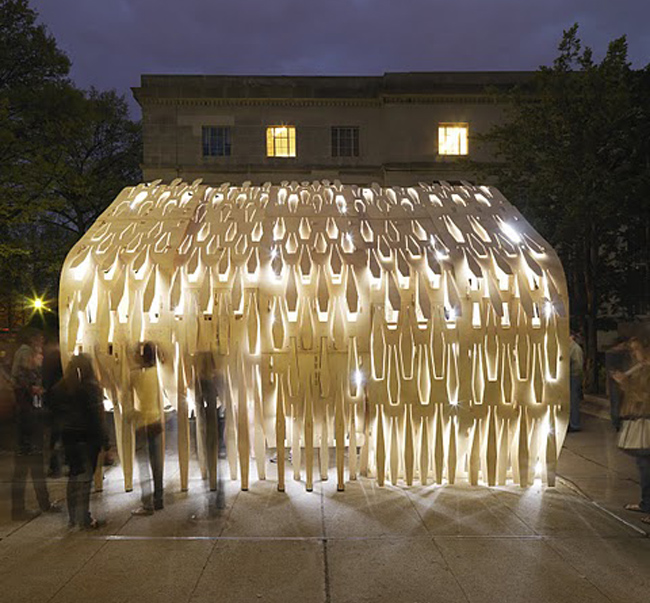
Unflat Pavilion / Feather-Weight Houseby Nick Gelpi: A pattern cut into flat plywood stock transforms into a three-dimensional, freestanding pavilion. Architectural features appear as flat sheets are bent, unfurling into skylights, columns, buttresses, windows and vents.
Night of Numbers by Anna Kotova and Praveen Subramani: a dynamic lighting installation that tells the story of MIT’s past with projected numbers and phrases (that are relevant and meaningful to MIT students and alumni) on buildings around campus.
Maxwell’s Dream: Painting with Light, by Kaustuv De Biswas and Daniel Rosenberg. On display in the Infinite Corridor Community Lounge: An art installation that allows observers to play with a magnetic field to create patterns in light.
Dis(course)4, by Craig Boney, James Coleman and Andrew Manto: A stairwell transformed by a shimmering conduit designed to inspire delight, wonder and communication between floors.
Photo credits: Arts at MIT; caromk’s flickr; courtesy MIT.

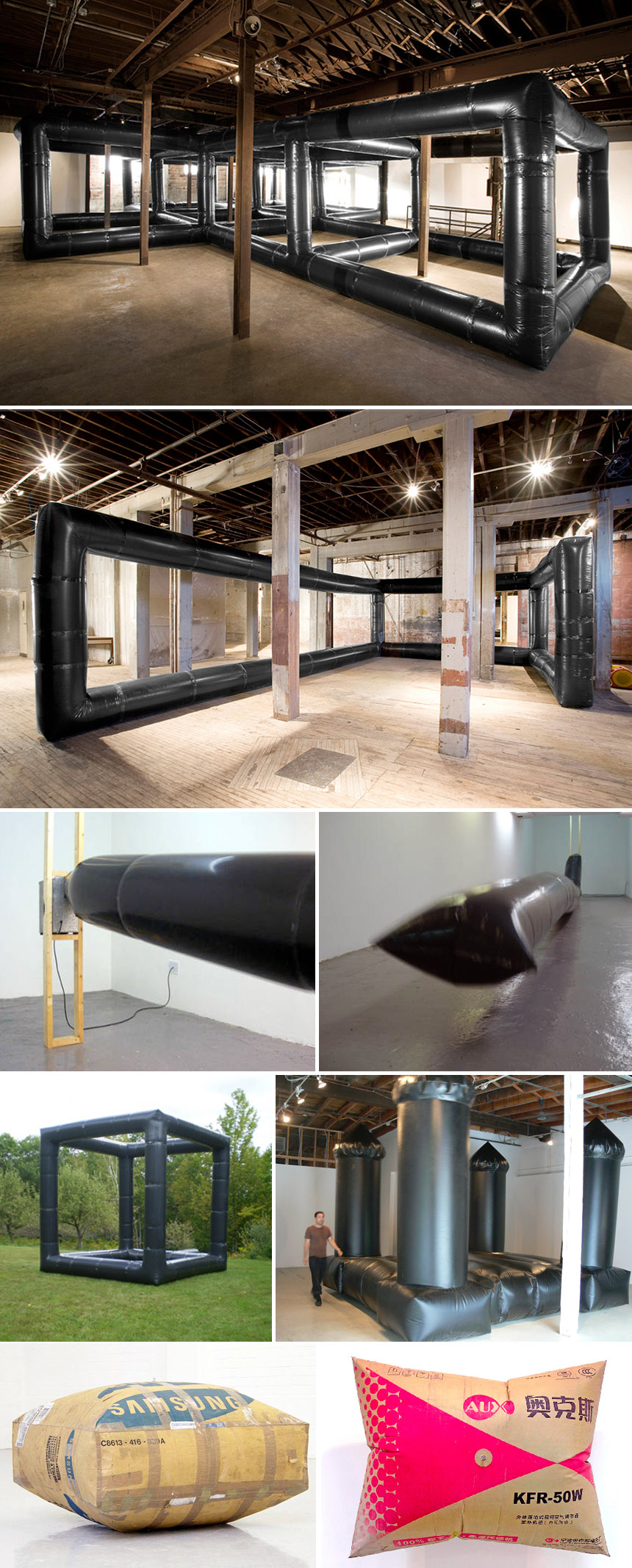
Clive Murphy: Inflatable Sculptures Plus

inflatable art installation, contemporary art, collabcubedinflatable art installation, contemporary art, collabcubedinflatable art installation, contemporary art, collabcubedClick images to enlarge

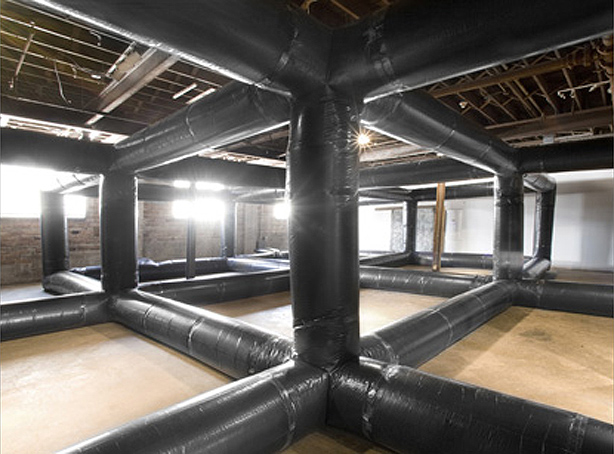
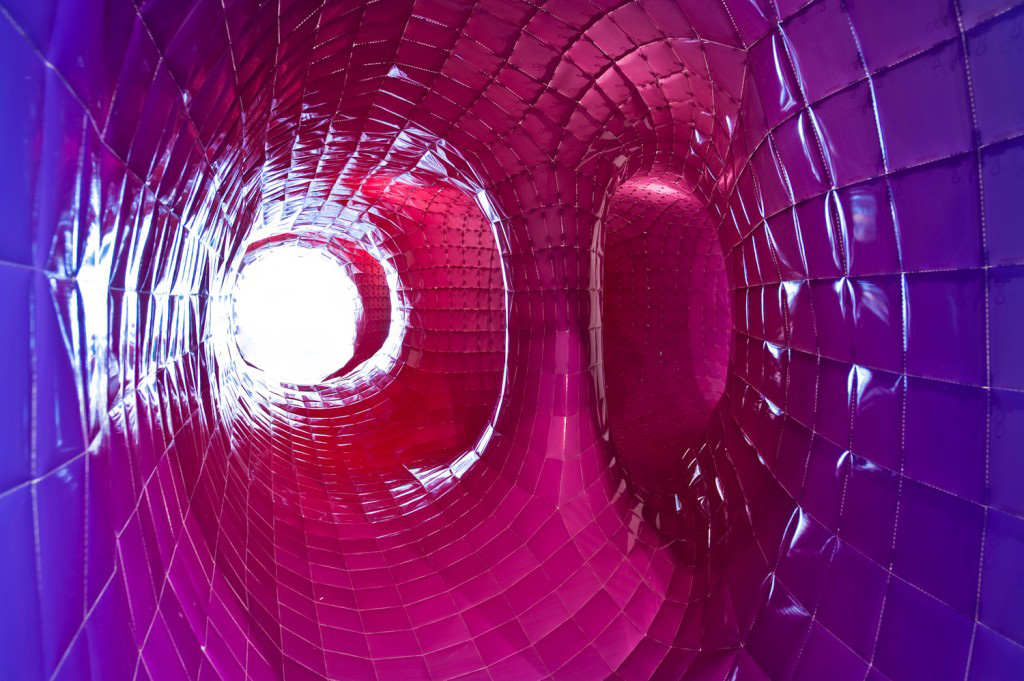
Irish artist Clive Murphy creates installations and sculptures that deal with – in his words — site and surface. From his site specific inflatable installations – made from duct-taped black garbage bags filled with air by electric fans – to his DIWIF (Demonic Intervention With Ikea Furniture) series and smaller sculptures, Murphy tends to work in a lo-fi manner embracing low-brow culture.

I am especially a fan of his DIWIF (Demonic Intervention With Ikea Furniture) sculpture. The monstrous-like work would make anyone smile who has attempted to put together the infamous flat-packed furniture. The sculpture comes complete with Murphy’s humorous diagrammed instructions on how to assemble.

From Murphy:
‘In my work I’m constantly interested in examining the peripheral, insignificant and sometimes seemingly ridiculous as a means of illustrating a sense of interconnectivity and also rebutting certain hierarchical value systems, so in this context building an architecturally orientated inflatable from plastic seems appropriate.’
From top to bottom: Almost Nothing, site specific inflatable structure at the Soap Factory, Minneapolis; MONO, site specific kinetic inflatable single tube sculpture, Pallas Contemporary Projects, Dublin; Inflatable Trash Bag Cube, MagnanMetz Gallery; Pneutopia, Inflatable Bouncy Castle, MagnanMetz Gallery; Inflatable Box Series x2; DIWIF (Demonic Intervention With Ikea Furniture) complete with instructions by the artist, MagnanMetz; Neon Toaster; Untitled (Ice Sculpture). Photos courtesy of Pallas Projects, the Soap Factory, and MagnanMetz Gallery.

City Leaks: Urban Spaces/Moments

Urban, installation, artUrban, installation, artCity Leaks, a group of artists/street artists that describe themselves as “An Urban Investigation of Inventive Dwelling.” Recently this Melbourne based group created PlayMo (top images) and Hotel Facebook,  (bottom 3 images) both collaborative projects, the second via Facebook photo uploads as “check in”.

They have a sort of manifesto on their facebook page and seem to stick by it.

On PlayMo:

PlayMo was born from the intention of inventing a space that turns into a place where people meet, spend time and play. Its name comes from “playmobil”, a Lego styled child’s creative play toy. Using milk crates was like playing with big Lego pieces.Milk crates are a fantastic material for many reasons; they are structural, light, modular and they have an iconic role in Melbourne’s cafe image and laneways. We believe that familiarity to a material plays an important role in engaging with it.PlayMo uses 3 different types of crates. Black = platforms, Grey= stairs, Green=moveable. The green crates provide the undefined random element; people rearrange their seats or even build small stairs themselves. There hasn’t been a single day where we found them in the same place.
Finally, PlayMo is designed to grow and adapt. People are encouraged to leave things behind and to add to the structure. We found artworks, plants, toys, pillows, new crates and received hundreds of letters. We even found that people had constructed a bin so that it could be kept clean.


via sub-studio

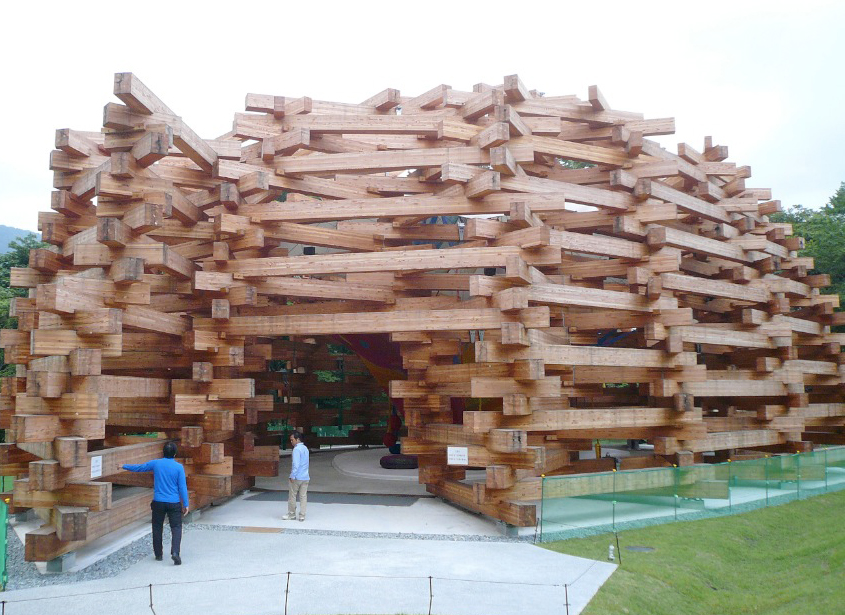
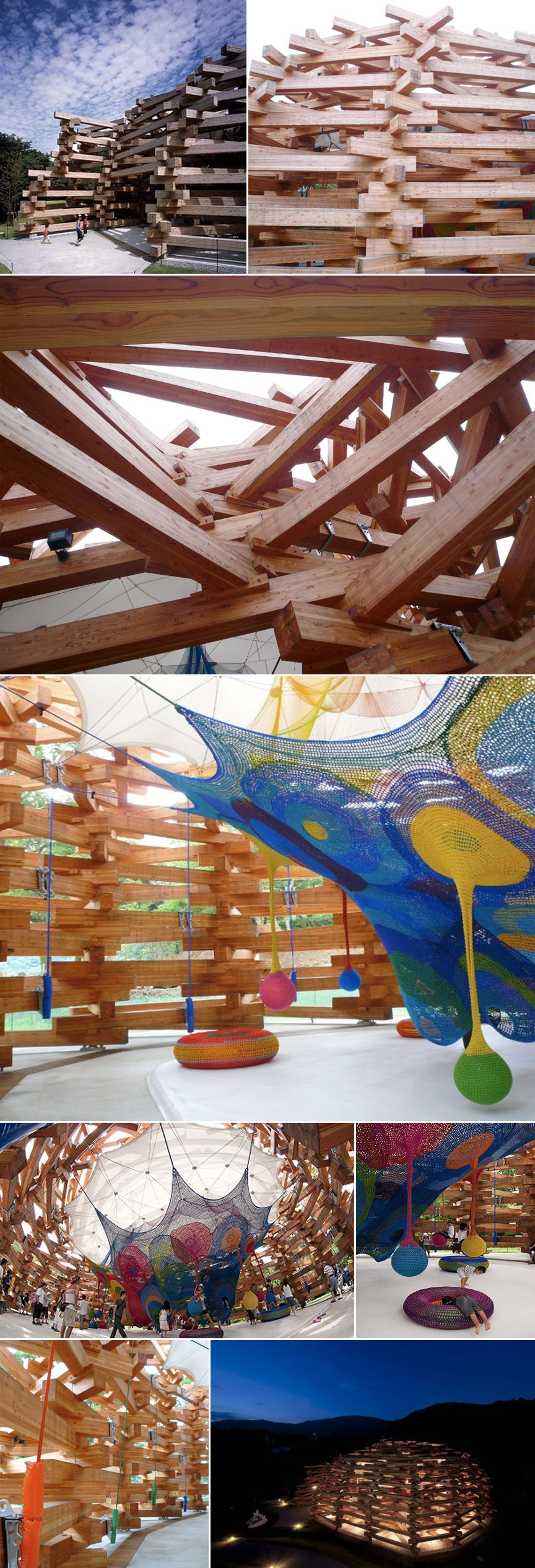
Hakone Open Air Museum Pavilion

Hakone Open Air Museum, architecture, wood constructionHakone,Tetsuka, architecture, wood construction, cool playgroundClick to enlarge.

The Timber Pavilion, or Woods of Net, at the Hakone Open Air Museum was designed by Tezuka Architects in Tokyo. Composed entirely of wooden beams without any metal parts, the structure is built with 589 pieces of timber using ancient temple construction techniques to build this, ironically, futuristic form. The total floor area measures 528 square meters. Dramatically hanging from the interior is a huge colorful climbing net reminiscent of Ernesto Neto’s art installations, designed by artist Toshiko Horiuchi Macadam.

Inside and out, a very cool structure.

via Spot Cool Stuff.

Ed Osborn: Sound Art Installations

Cool Art Installations, Sound, Video

Ed Osborn, originally from Helsinki, but due to an interesting story was relocated to Philadelphia to live in a Quaker household via a witness relocation program. Having attended many Quaker religious ceremonies marked by long periods of silence, Ed learned to pay close attention to the smallest of sounds. He attributes this to leading him down the Sound Art path. Most of his sound installations are rather minimalist with speakers being the focus of the installation. I found these to have an eerie transfixing quality that in a strange, abstract way feel almost poetic.

You can see more of Ed Osborn’s work here.

Jerzy Goliszewski

art installation, sculpture

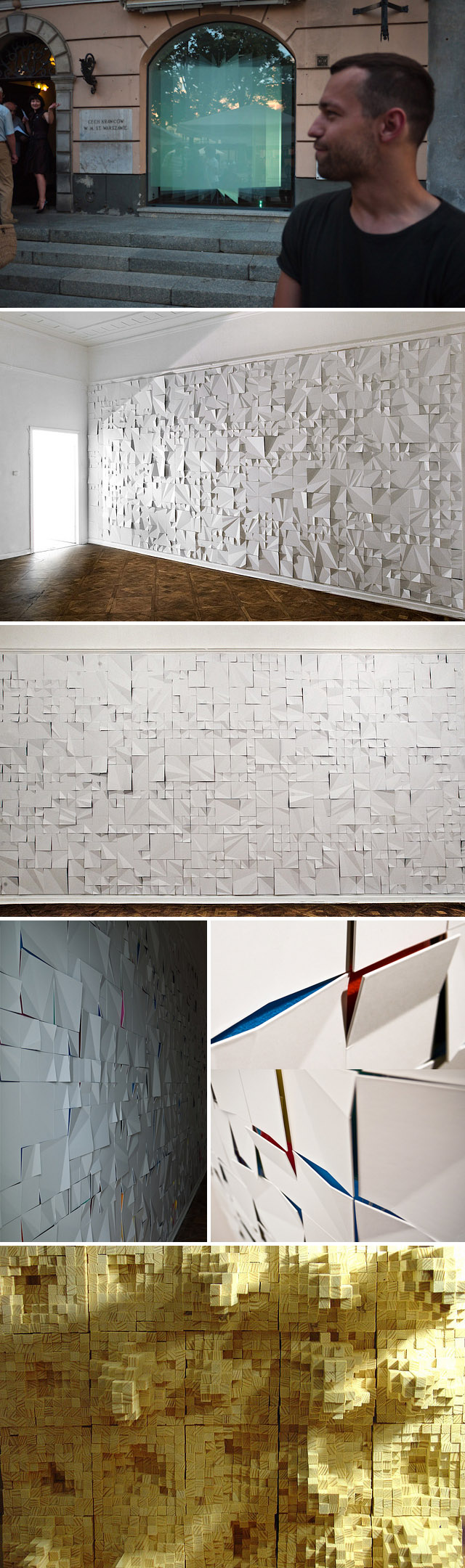
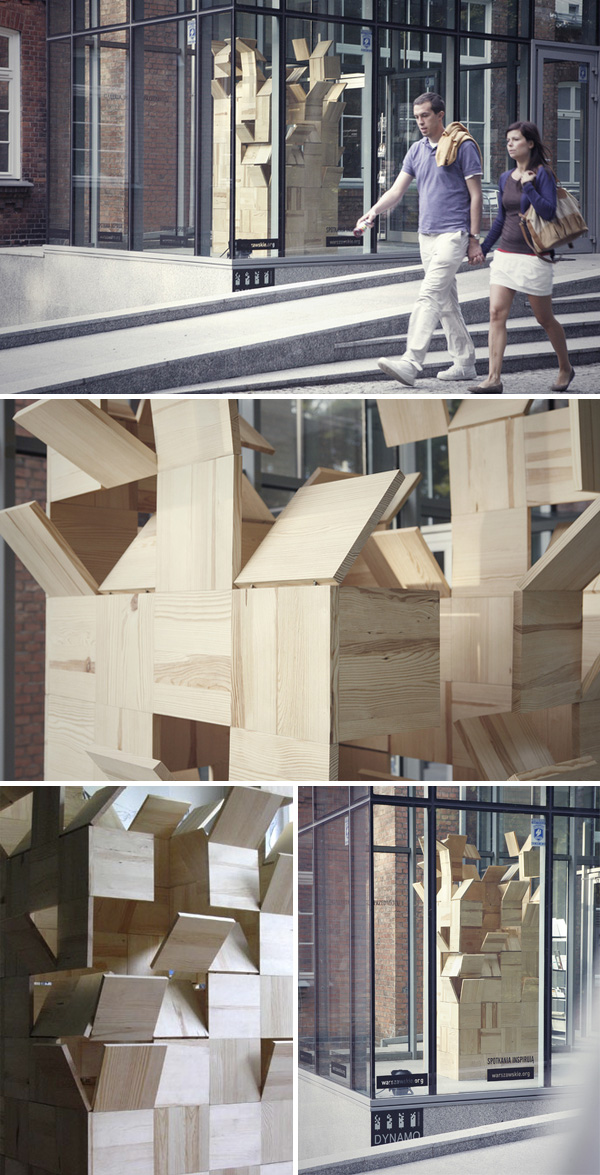
art installation, sculpture, Polish artist, collabcubedart installation, sculpture, Polish artist, collabcubedJerzy Goliszewski is a Polish artist living and working in Warsaw. His body of work is comprised of installations, paintings, drawings and graphics. His focus is on making complex structures using simple and natural materials.

From top to bottom:  We’re Going Out, Jerzy Goliszewski’s newest work made for the closing of a gallery in Warsaw. Using simple means (semi-transparent vinyl and rear projection) Goliszewski created this revolving door style, computerized-looking effect without a computer. To see it in action watch the video.The photo that follows is of the artist in front of the gallery with the artwork in the window. Kai, another installation, takes its cue from the classic fairy tale “The Snow Queen.” Kai was inspired by structures, such as the crumbling sheet of ice, the cracked ground and the cracked mirror which broke into pieces distorting the world, in the story. Next image down is from Lac Bleu 02, a wooden installation made of thousands of bits of wood and, lastly, Dynamo, another wooden installation representing force and power in its name and at the same time the block’s transparency removes the stability and exposes its fragility like a house of cards.
You can see more of Jerzy Goliszewski’s work on his website, as well as his flickr set of installations.
eCLOUD

art installation, interactive artart installation, interactive artart installation, interactive artClick to enlarge

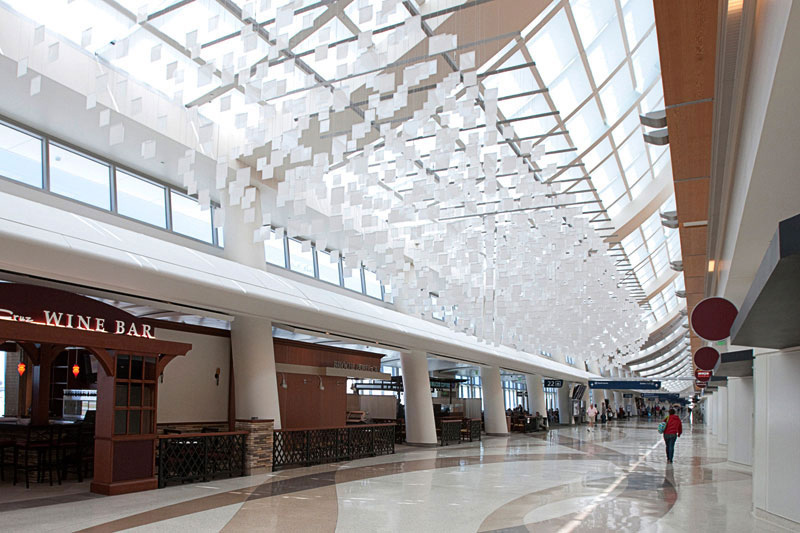
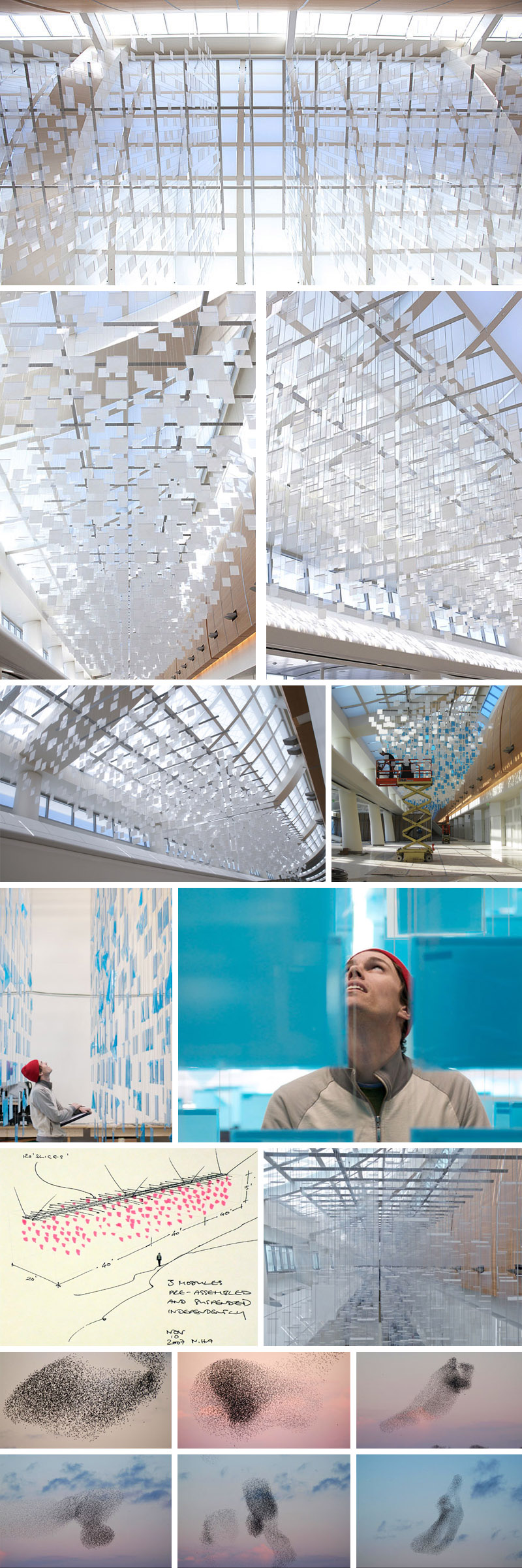
The eCloud is a digital sculpture designed by UeBersee as a permanent installation for the Norman Y. Mineta International Airport in San José, California. The thousands of small square panels of electrically switchable laminated plexiglass act as pixels which imitate the behavior, as well as the volume, of an idealized cloud. The plexiglass (or Smart Glass) has the ability to graduate opacity with the transmission of an electrical charge. The panels are opaque in their neutral state and can become transparent with the charge.

108ft long and 16ft wide, the panels are arranged to simulate a cloud suspended from the ceiling from a tensile structure. The animations that move through the eCloud are based on actual weather data via a live feed of conditions for all airports in the U.S. (see bottom photo.) You can see a video of the eCloud in action below.


(indirectly) via LovelyPackage
Photos: Spencer Lowell

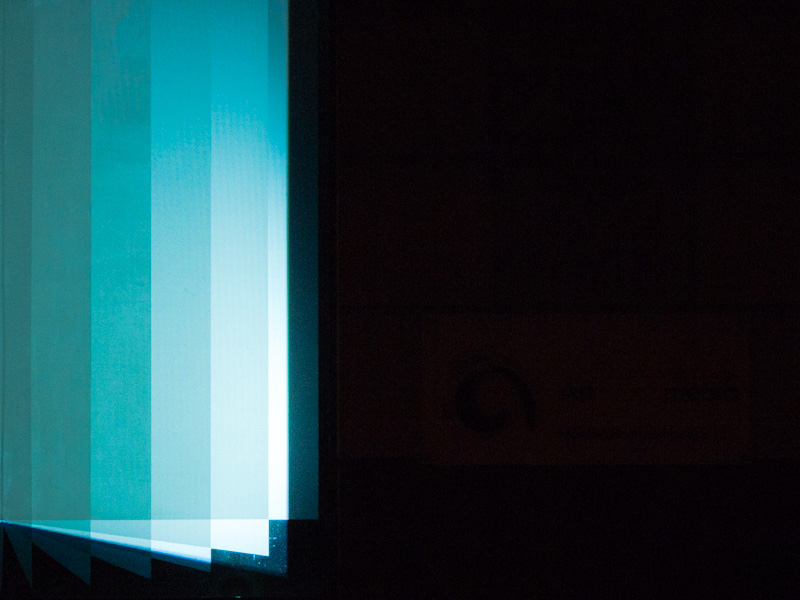
Ayse Erkmen

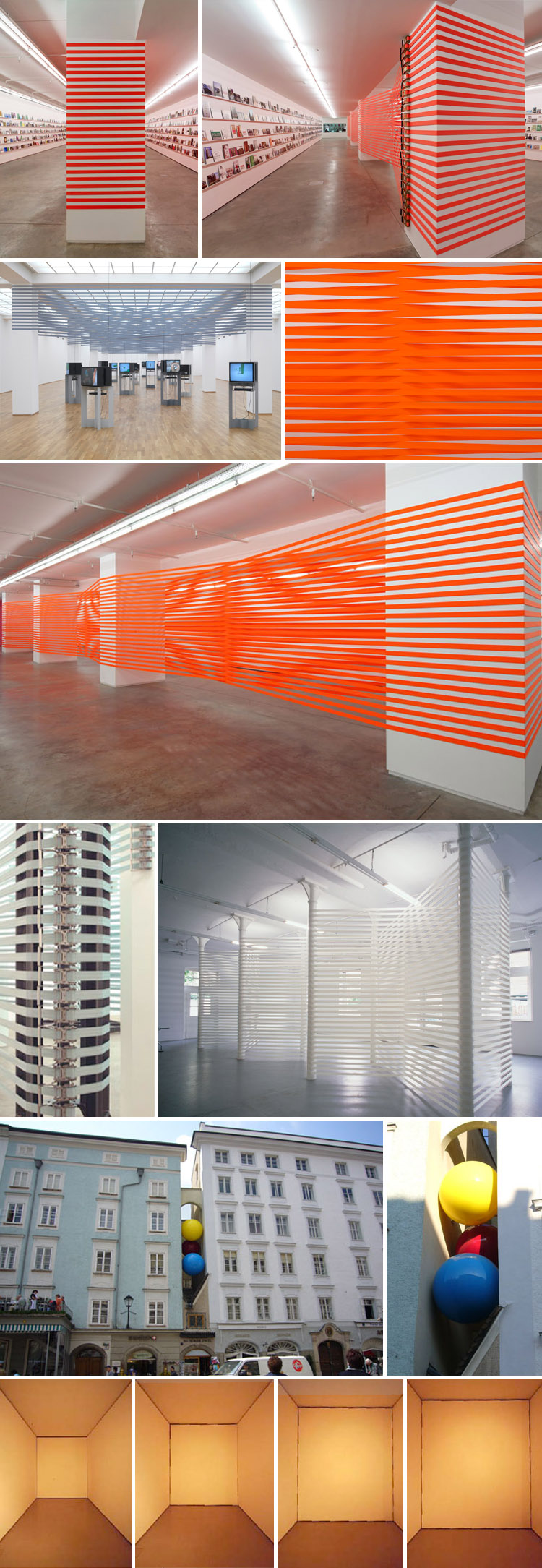
Ayse Erkmen Art InstallationArt Installations Turkey GermanyAyse Erkmen Bluish Art InstallationGermany-based Turkish artist Ayse Erkmen has been creating interesting installations for years. She is currently exhibiting a piece called Plan B in the Turkish Pavillion at the Venice Biennale. Earlier this year she had a show, On Its Own, at Rampa in Istanbul that at its center featured the above, quite dramatic, orange seat belt installation, Easy Jet.

Erkmen is impressively prolific and all her work is worth a look, but above is a sampling.
From top to bottom:
Easy Jet – Rampa, Istanbul, 2011
Gezeiten – Weggefaehrten, Berlin, 2008
Tidvatten – Konsthall Magasin, Stockholm, 2004
The Gap – Kontracom06, Salzburg, 2006 (love this!)
9’45”- Kunsthalle Museum, Kassel, Germany, 1999 (a long corridor whose rear wall moves slowly towards the viewer, electronically, and the procedure lasts nine minutes and forty-five seconds, hence the name.)
Bluish – Kunstuerien Freiburg, Freiburg, 2009

You can see more of Ayse Erkmen’s work on her site as well as additional work at Rampa’s site.
via ArtAsiaPacific

Juan Astasio: 100 Smiles Project

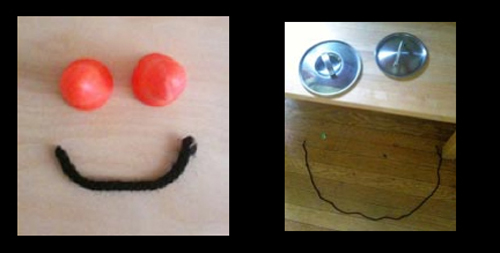
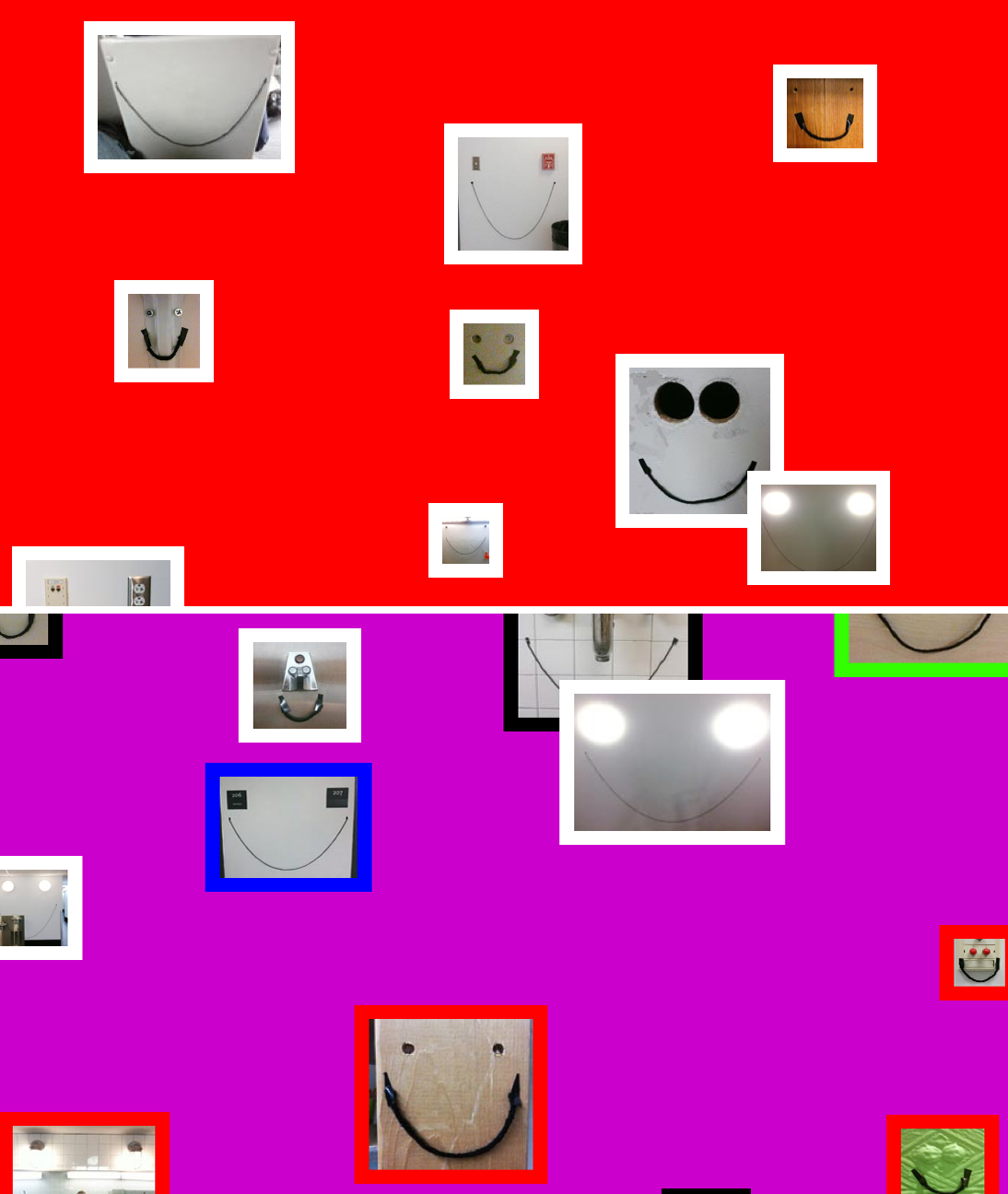
100 Smiles Project Graphic Design Student Yale100 Smiles Project Yale Graphic Design Michael Bierut ClassI saw the charming, funny, and smart Juan Astasio (who just finished his MFA in Graphic Design at Yale) speak last night at the AIGA Fresh Blood event. Many of Astasio’s projects combine a playful wit with an interesting interactive aspect. The photos above are from his 100 Days project (I believe this is a Michael Bierut assignment) called 100 Smiles. Juan made a smile a day from found objects, every day for 100 days and photographed each one. They have all been placed on a website and scroll to the song Always Look on the Bright Side of Life by Eric Idle.

The rest of his site is worth checking out as well. Some of my favorites include: Issues, a personal project showing our insensitivity towards powerfully disturbing images; One Minute of Silence Project where you can write epitaphs for things you’ve lost; and Weather Escapes.

Rolling Bridge: Heatherwick Studio

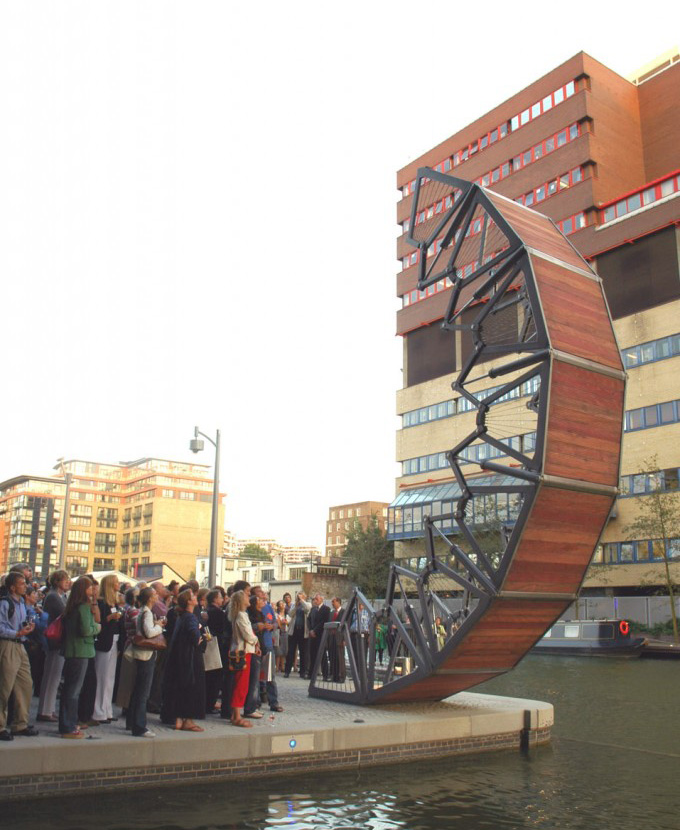
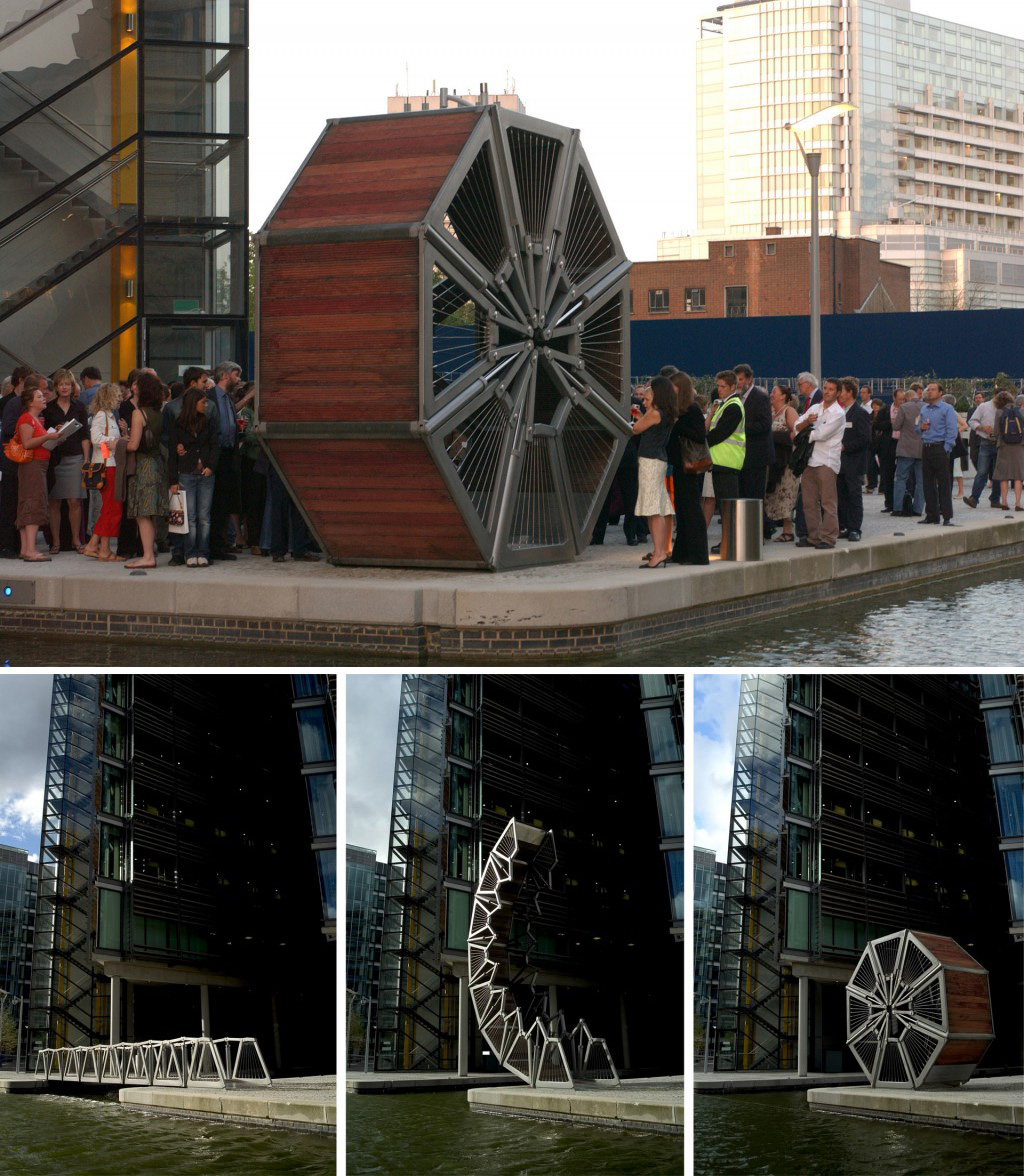
Heatherwick architects Rolling Bridge London Paddington BridgeHeatherwick Rolling Bridge Architecture Paddington BridgeHeatherwick Studio is probably best known, recently that is, for their spectacular Shanghai Expo UK Pavilion which, quite deservedly, received a lot of attention. We are also familiar with their impressive staircase at the Longchamps store in Soho, NY but, all their projects are worth checking out. The Rolling Bridge at the Paddington Basin in London is no exception.

Completed in 2004, Heatherwick’s challenge was to design a pedestrian bridge to span an inlet providing an access route for pedestrians while at the same time lifting to allow access for the boats in the inlet.

From the Heatherwick website:
The aim was to make the movement the extraordinary aspect of the bridge. A common approach to designing opening bridges is to have a single rigid element that fractures and lifts out of the way. Rolling Bridge opens by slowly and smoothly curling until it transforms from a conventional, straight bridge, into a circular sculpture which sits on the bank of the canal.
The structure opens using a series of hydraulic rams integrated into the balustrade. As it curls, each of its eight segments simultaneously lifts, causing it to roll until the two ends touch and form a circle. The bridge can be stopped at any point along its journey.

You can watch a video of the bridge in action here. To see it open live, you need to be there any Friday at midday.

via our buddy Nils!

Rainbow City at the High Line

U P D A T E : See our post-visit post here for the latest on Rainbow City.

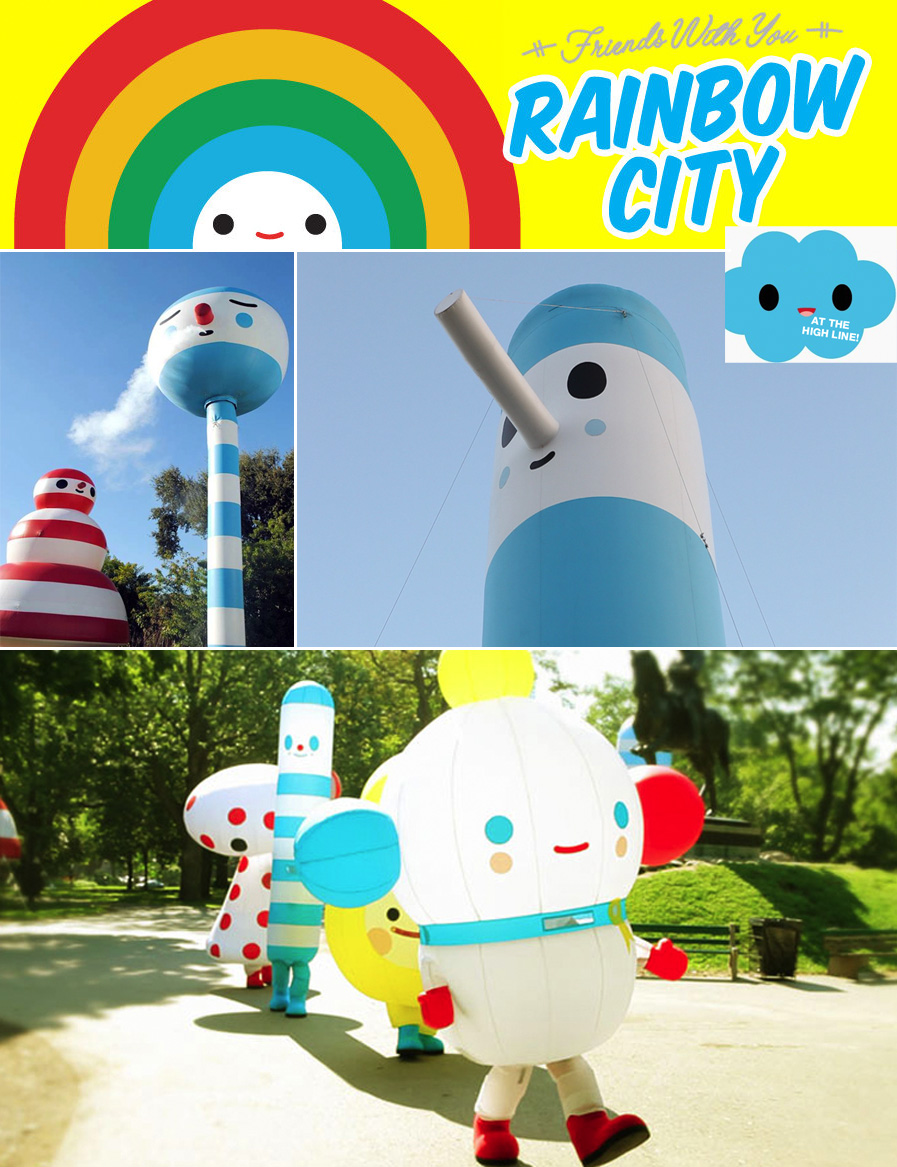
This looks like fun! Em just read about this upcoming event on the Friends With You  site (you may be familiar with their collaborations with KidRobot, among other things.) In celebration of the opening of the second section of the High Line, FriendsWithYou (sponsored by AOL) will be showcasing their forty piece installation Rainbow City.

FriendsWithYou presents a vibrant collection of mutable, air-filled sculptures. Inaugurating in the art district of Chelsea during the month of June, this will be FWY’s first large-scale installation in New York City. This happy city is made up of intensely colored balloon pieces, encouraging visitors to be active and explore the giant 16,000 square foot playground. Built for adults and children alike, the installation allows for interaction with each art object, making the experience unforgettable.

According to the article in the New York Times, the installation is part of a “pop-up plaza” at 30th Street and Tenth Avenue. There will be a 350-seat bar run by Colicchio & Sons, as well as a variety of fashionable food trucks offering a range of edibles from lobster rolls to ice cream.

The installation and festivities open on Wednesday, June 8th, 2011 and run through July 5th. Worth checking out for sure.

SOFTlab

Click images to enlarge

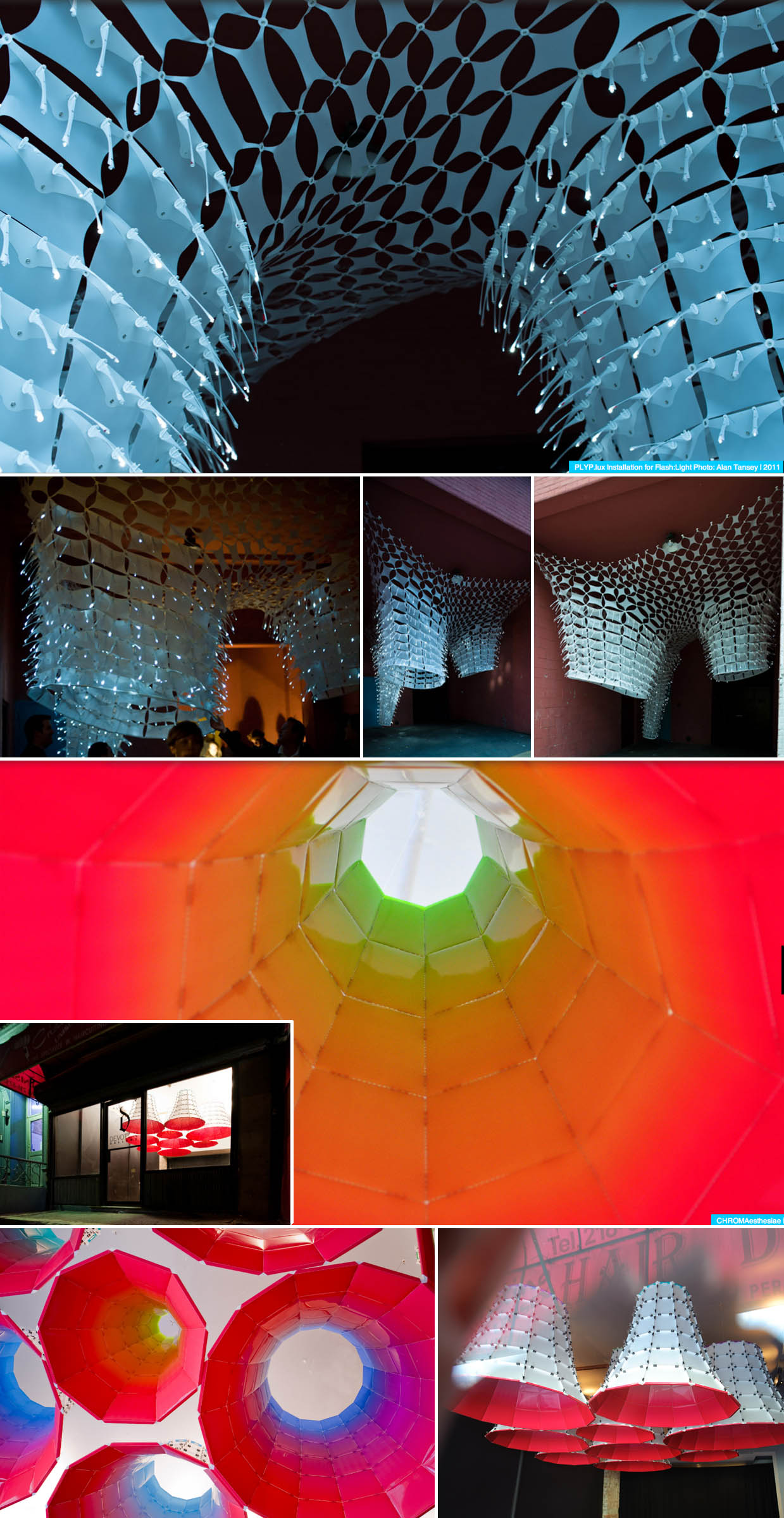
In my next life, I want to work at SOFTlab. These guys look like they have a great time doing everything they do. And what they do is everything. For them “a good idea does not discriminate between any medium or any type of project, it just works for everything.” That includes design of furniture, a website, a brand, a video, a gallery installation, a store display, and pretty much anything else that can be designed. Their approach is to make design customizable; it should allow for change, or growth, and be adaptable.

Just visiting their site is an immensely entertaining experience beginning with the computer animated video on their home page. Unknowingly, I was already familiar with (and a fan of) some of their work such as the colorful taped projection mapping of the New Museum as part of Festival of Ideas for the New City.

Above are just four of SOFTlab’s projects.
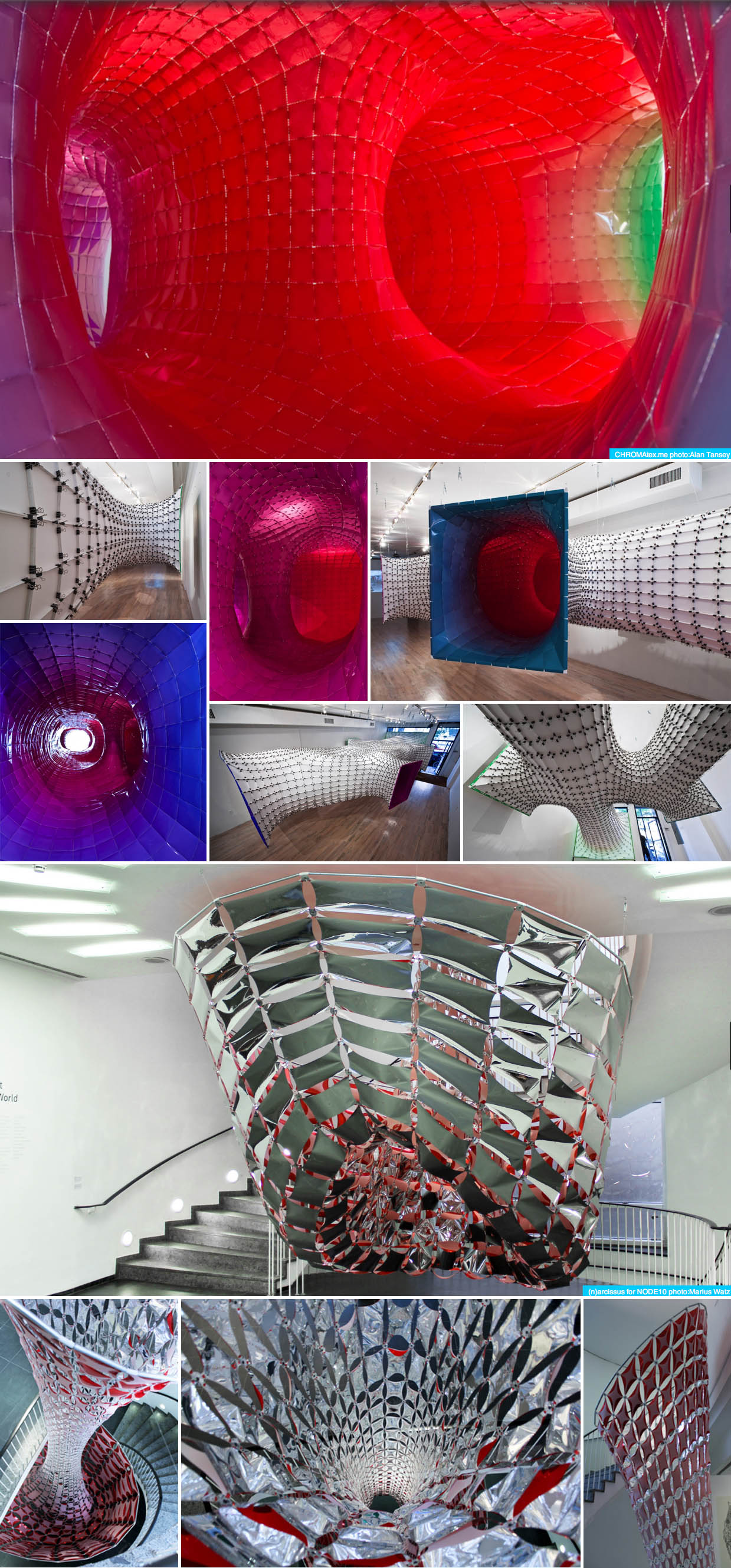
From top to bottom: CHROMAtex.me, a site specific installation for the bridgegallery, LES, New York. Photos: Alan Tansey
(n)arcissus, a site specific installation for NODE10 at the Frankfurter Kunsteverein in Frankfurt, Germany. Photos: Marius Watz.
POLYP.lux, a hanging installation for School Nite, part of the Festival of Ideas for the New City, NYC. Photos: Alan Tansey
CHROMAesthesiae, an installation for Devotion Gallery in Williamsburg, Brooklyn. Photos: Alan Tansey

There are plenty more interesting projects on their website.

via fourthfifthdesign

Port Authority Bus Terminal Goes Graphic

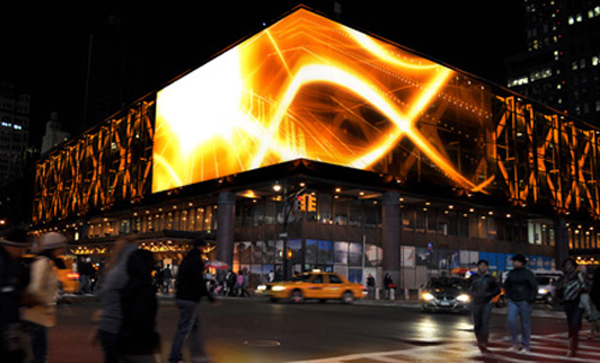
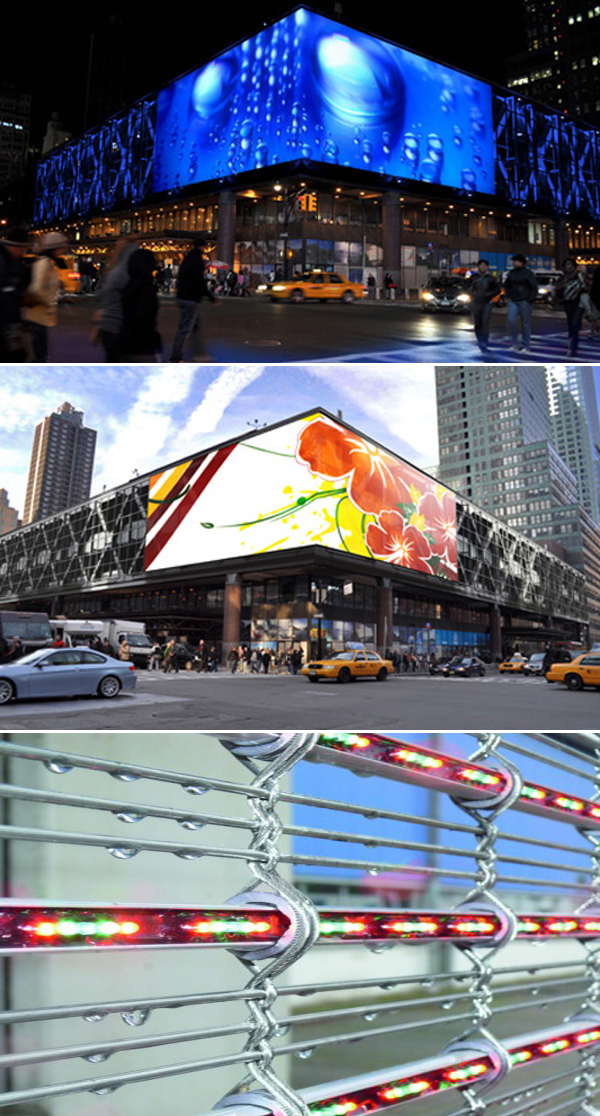
Come the end of this month, the Port Authority Bus Terminal here in NYC will be covered with a 6,000 sq.ft. LED-embedded mesh which, from the interior is transparent, but from the exterior provides a fabric for high-resolution graphics wrapping around the corner façade. The MediaMesh appears opaque during the day (see rendering above).

Hopefully the façade will be used as a medium for art though, unfortunately, unlike the renderings, it’s likely that advertising will be displayed instead. It would be great to be wrong.

via notcot, via Architect’s Newspaper

TypeClock

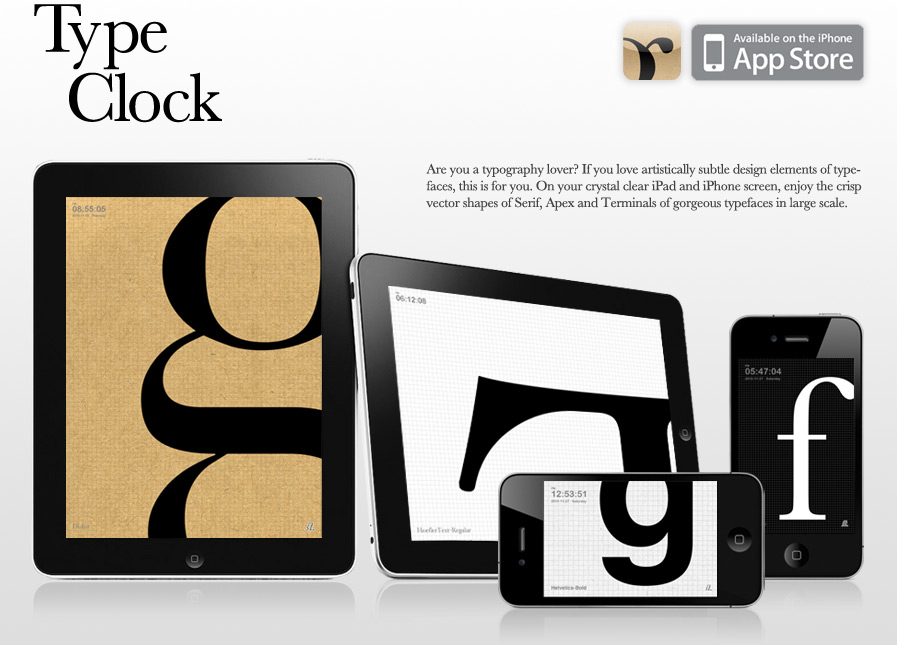
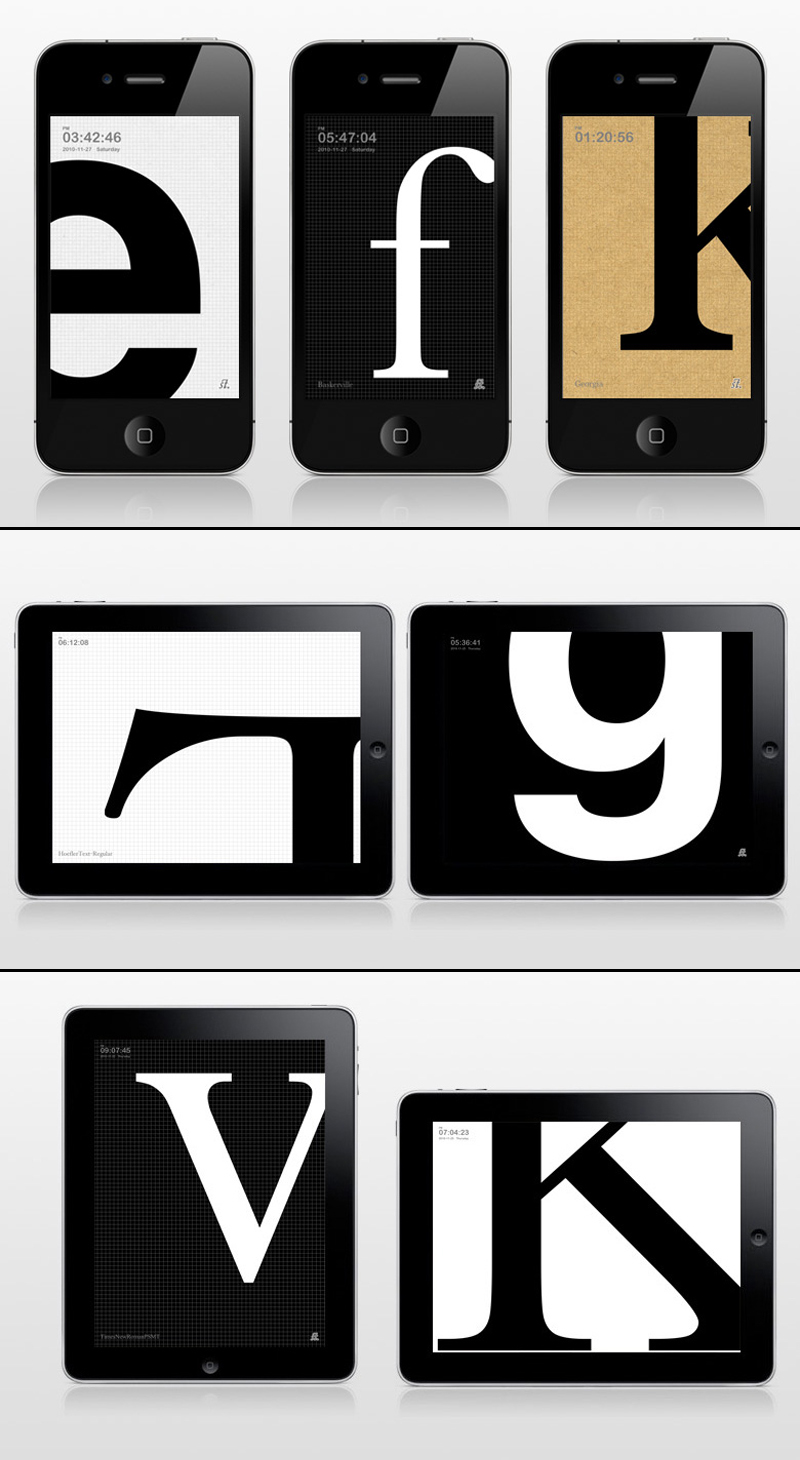
I met Dong Yoon Park on a typography tour of Staten Island last fall. Yes, strange but true. On the tour I had briefly chatted with him and he had shown me, on his iPhone, some of the things he was working on at Parsons as a grad student and teacher in their department of Design & Technology. Later, I visited his website and was really impressed with the rest of his work as well. Today I checked his site to see what he was up to and, sure enough, there waiting, was this lovely app for typography lovers! So simple and beautiful. What could be better than having a blown up letter of your choice on the screen of your phone or iPad?

From the iTunes AppStore:

Are you a typography lover? If you love artistically subtle design elements of typefaces, this is for you. On your crystal clear iPhone screen, enjoy the crisp vector shapes of Serif, Apex and Terminals of gorgeous typefaces in large scale. You can set own character set, type size and transition speed.

TypeClock can be purchased here for $0.99 and you can see more information here and a video here.