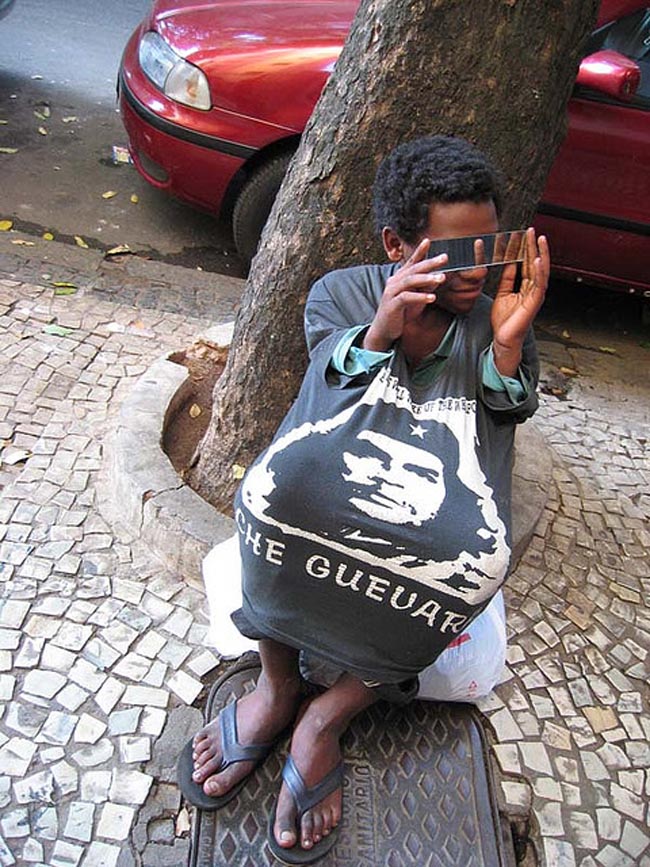
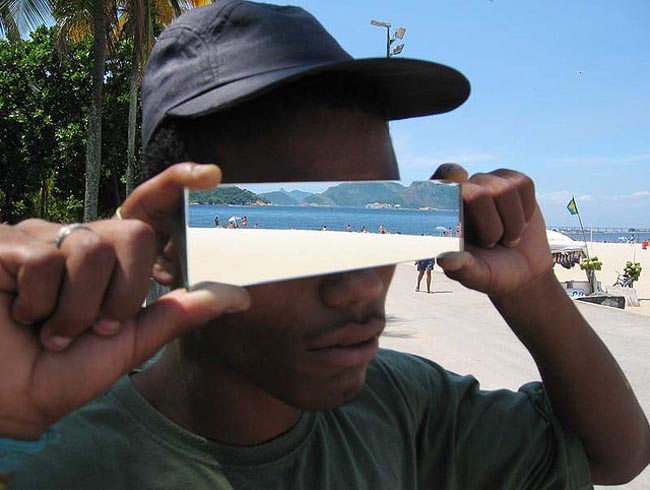
 I happened upon this set of photos on flickr titled Identidade (Identity) by Brazilian artist Claudia Hersz and really love them. Such a simple idea leading to such a great effect. Hersz has always felt that those big black bars placed over children’s eyes in photos to preserve their identity, in many ways have the opposite effect: they rob them of their identity. By symbolically placing a mirror in place of the black bar, she feels that the reflection returns a little of the stolen identity.
Category Archives: Stuff We Like
Phlegm in New York

 Click to enlarge
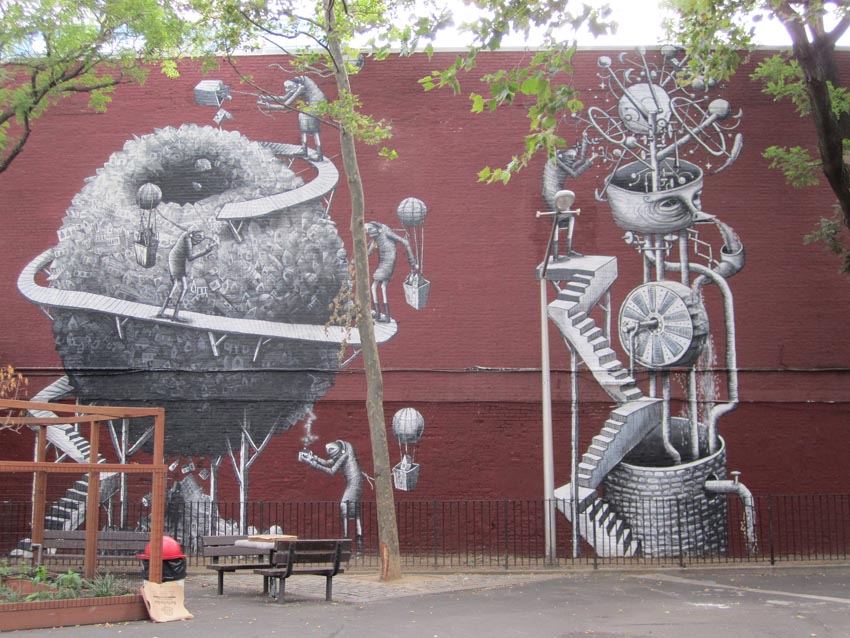


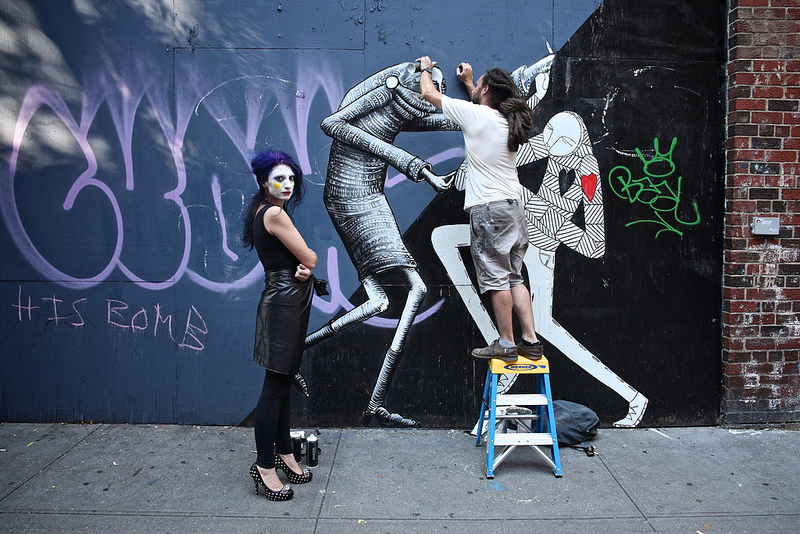

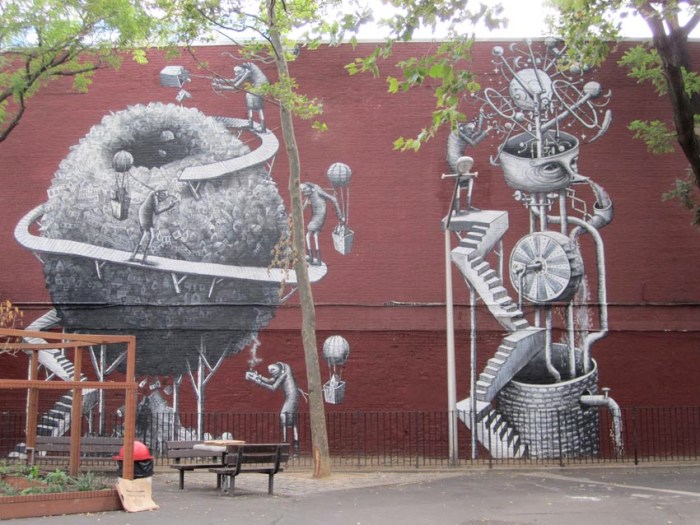
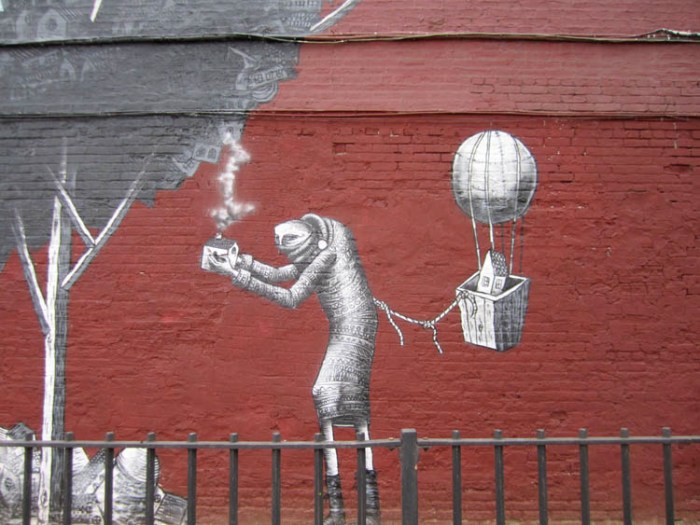
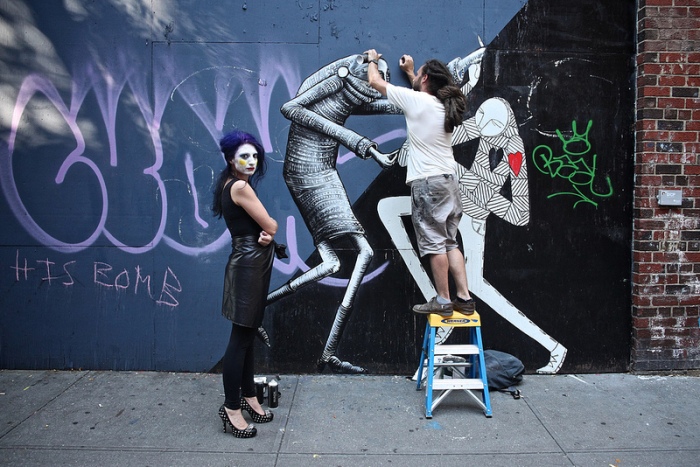
I passed a large mural on my way to Chelsea and the Meatpacking District twice this week and the second time I decided to take photos and research who was behind the elaborate 3-part work. Turns out UK street artist Phlegm was visiting New York City this month and completed his first three murals in the U.S. right here in Manhattan—the other two in the East Village—and one of them an addition to an existing work by Know Hope (second from bottom.)
You can see a video of the bottom mural in progress here.
Bottom two photos by Matthew Kraus. All other photos by collabcubed.
NYC Culture on the Cheap: Weekend 7/13
 Click to enlarge

If you’re in New York City this summer weekend, there are more free and cheap things to do than time to do them. Here are just a few that look especially interesting to us…too bad we can’t be in more than one place at a time.
1. Art – The Yayoi Kusama Retrospective opens at the Whitney Museum. Friday nights from 6-9pm admission is pay-what-you-wish, otherwise general admission is $18. Can’t make it this weekend? Don’t fret, the exhibit runs through September 30th. And if you’re downtown be sure to check out the lawn installation at Pier 45, Hudson River Park.
2. Art/Film – Christian Marclay’s The Clock opens July 13 through August 1 at the David Rubenstein Atrium at Lincoln Center. FREE. Prepare for long lines. 24-hour video collage.
3. Music – Eleanor Friedberger with Ex Cops. Friday, July 13th at 7pm; Pier 17 at The Seaport. FREE.
Also: for a more Latin evening: Calle 13/Ana Tijoux/Ritmo Machine at the Prospect Park Bandshell in Brooklyn. Friday, July 13 at 7pm. FREE.
4. Theater – Shakespeare in the Park(ing) Lot – “The Merry Wives of Windsor” July 12 to 28. Municipal Parking Lot at the corner of Ludlow and Broome. Thursday – Saturdays at 8pm. FREE.
Also: Twelfth Night presented by New York Classical Theatre at Castle Clinton, Tues through Sun, till July 22th at 7pm. FREE.
5. Art/Architecture/Music – Warm Up at PS1, Saturday July 14 at 3pm with Terrence Parker, D3, Ron Morelli, Jeremie Delon, and Steve Summers. Check out Wendy, see Lara Favaretto’s exhibit Just Knocked Out, and dance the evening away. $15. Free for MoMA members.
6. Graphic Design – Now in Production is Cooper-Hewitt and Walker Art Center’s exciting exhibit exploring some of the most vibrant sectors and genres of graphic design today. Open weekends through September 3, 2012 in Building 110 on Governors Island. FREE.
7. Art – Tomas Saraceno’s Cloud City on the roof of the Met. (See our previous post) Through November 4, 2012.
8. Food – Paper Magazine’s Super Duper Market. July 13-15. Pop-up super-store bringing the coolest food artisans and innovators under one roof. 410 West 16th Street, between 9th and 10th Avenues.
9. Film – Persepolis on Pier 1 (Riverside Park near 70th Street), Friday, July 13, 8:30-10:30pm. FREE.
And you might be interested in contributing to Bike-In-Theater’s Kickstarter so that they can get their events going this summer as well.
Manuela Viera-Gallo: Pentagon


 Click to enlarge


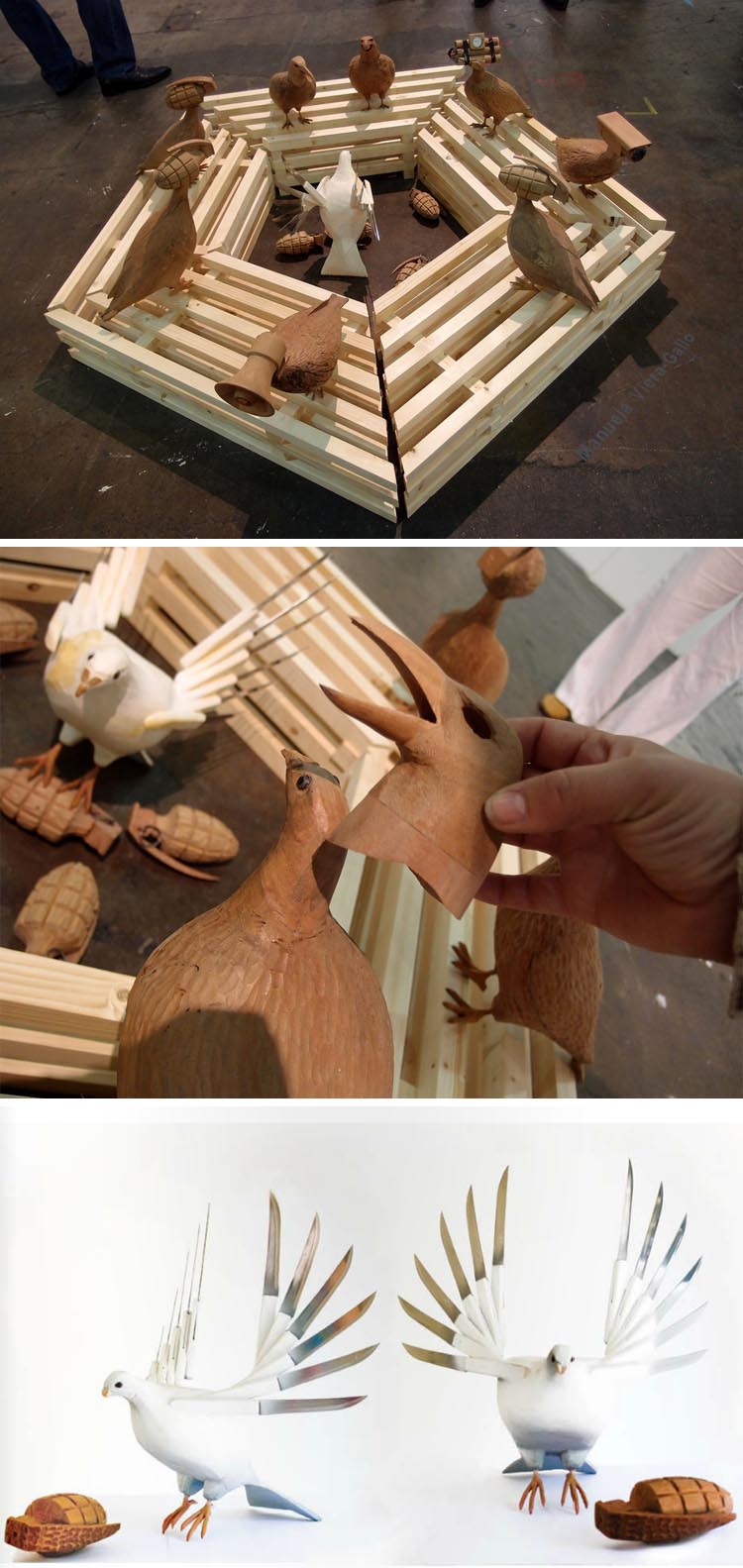
New York-based artist Manuela Viera-Gallo was born in Rome to politically-exiled Chilean parents, and later grew up herself in Chile. Her point of view has, since then, been strongly shaped by the social and political violence that has affected the history of most Latin American countries. One of her recent works titled Pentagon, consists of a “basket” of wooden pigeons with their heads replaced by explosives and megaphones standing on a pentagonal wooden coup. Viera-Gallo’s piece mocks the U.S. Department of Defense.
From the artist:
The birds are characters in evident confusion, realizing military operations, press conferences and damage control before an imminent, but unknown threat. It is a reflex of disconnection and perplexity before the chaos of a highly complex defense system, but which is dishonest and in a constant crisis. The are like blind birds defending a condemned nest.
I like the names of some of the individual pigeons, such as Kamikaze Pigeon and UN Peace. This post goes out to Emma, a true fan of pigeons.
Photos courtesy of the artist and 7_70’s flickr
via arte al limite
Holmenkollen Ski Jump: JDS Architects
 Click to enlarge
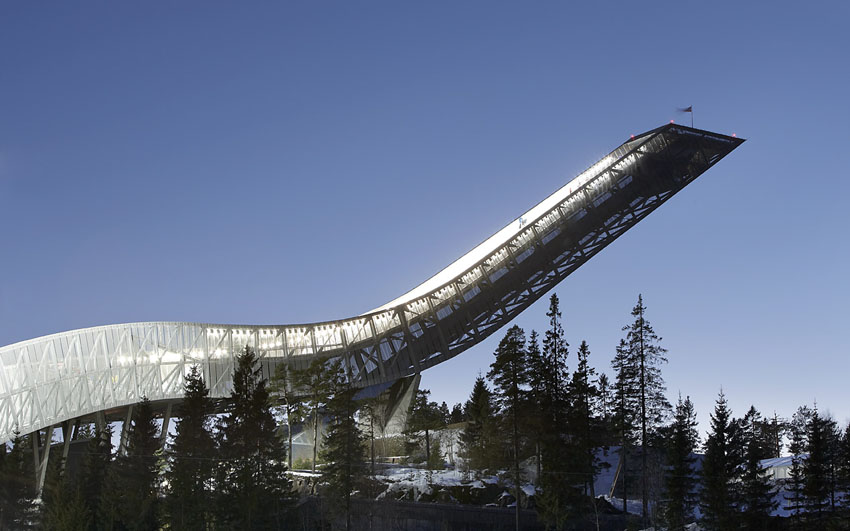
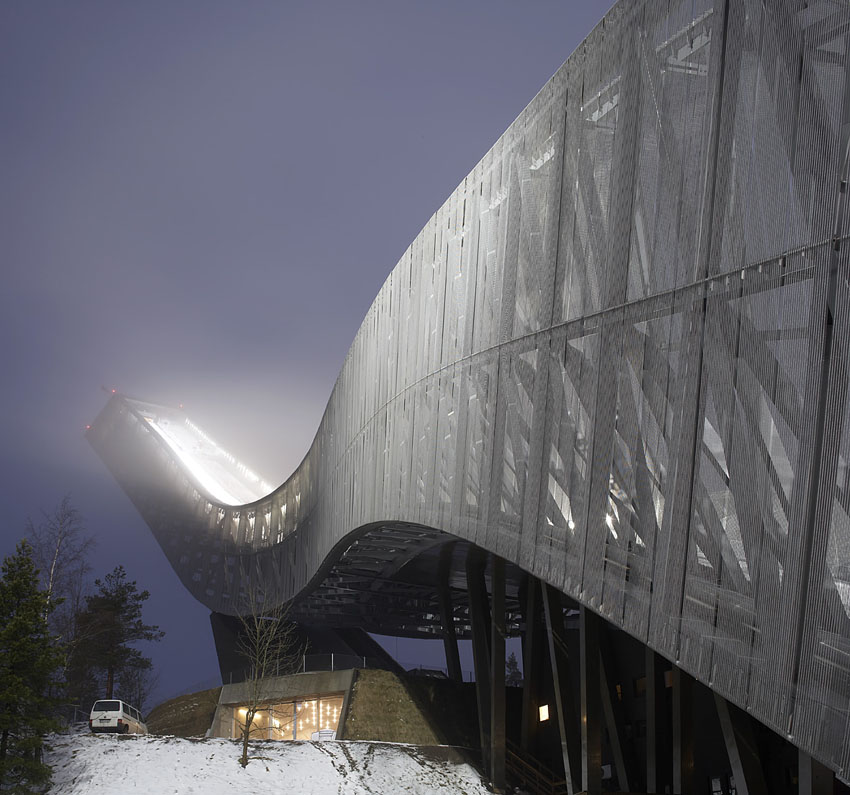
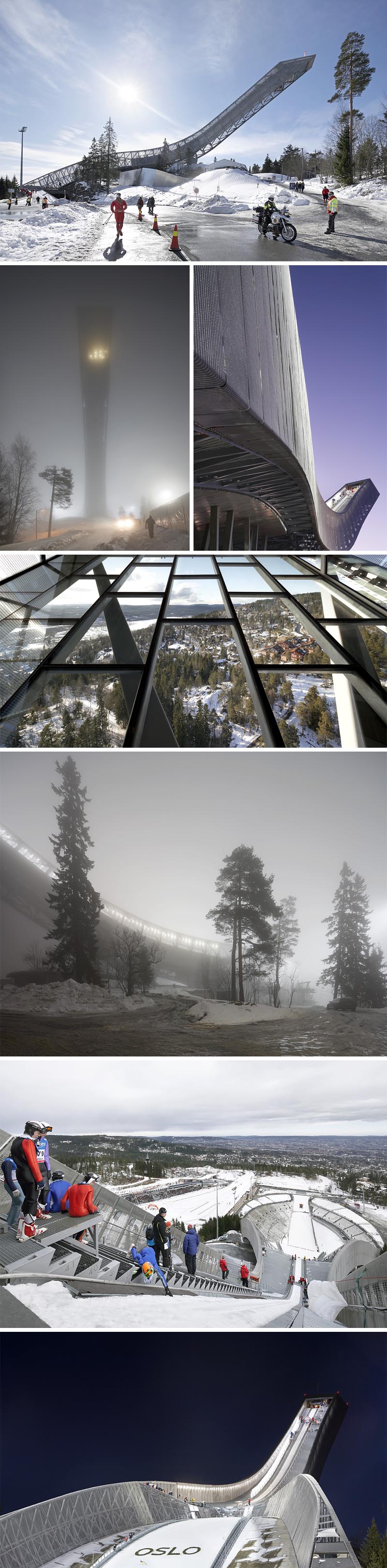
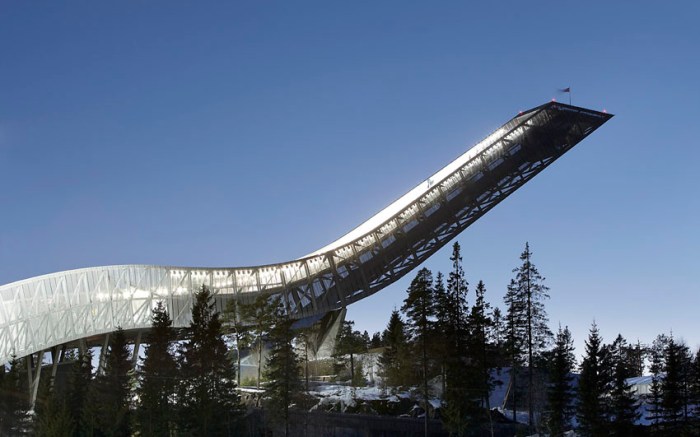
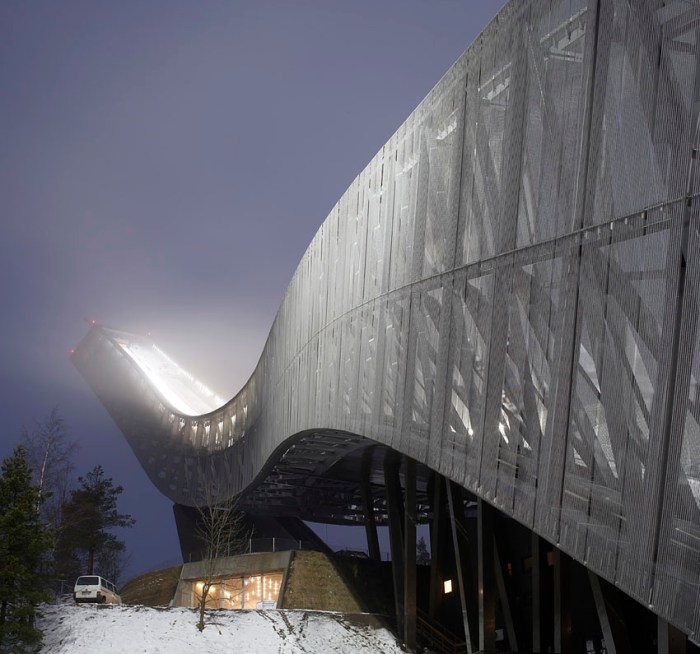
Holmenkollen near Oslo, Norway, has a history of hosting legendary ski jumping competitions, but after their ski jump was deemed too small in 2005, a competition was held to build a new jump. JDS Architects, based in Copenhagen, were the winners out of 104 entries. Their dramatic design is clad in a mesh of stainless steel with a 69-meter cantilever that rises 58 meters in the air.
From the JDS’ website:
Rather than having a series of dispersed pavilions on site, our design unifies the various amenities into one holistic diagram. The judges booths, the commentators, the trainers, the Royal family, the VIPs, the wind screens, the circulations, the lobby, the entrance to the arena and the arena itself, the lounge for the skiers, the souvenir shop, the access to the existing museum, the viewing public square at the very top, everything, is contained into the shape of the jump. The resulting simplicity of the solution improves the experience of the spectators and brings clear focus to the skiers jumping.
Some of these shots alone give me vertigo. I can’t even fathom plunging down on skis, being that I barely make it down a bunny slope.
All photos by Hufton + Crow
via frame
Leeds Street Tree Grates: HeineJones
 Click to enlarge


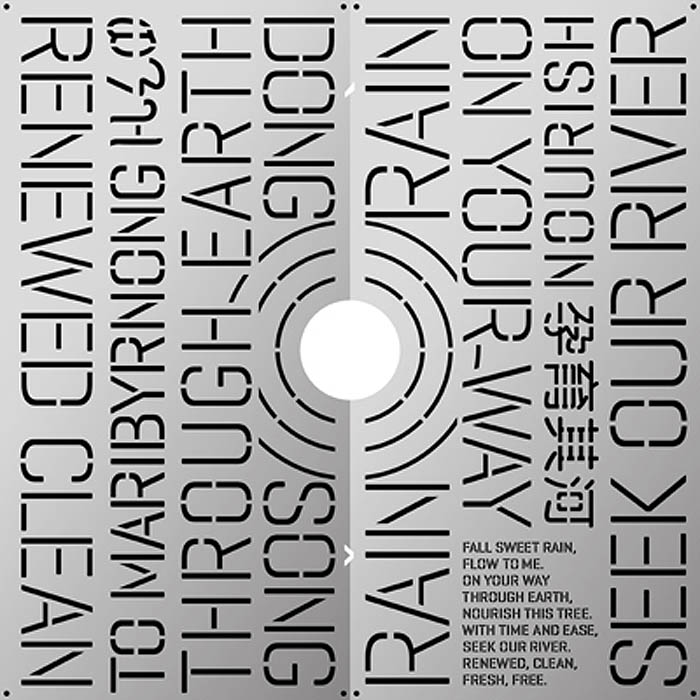
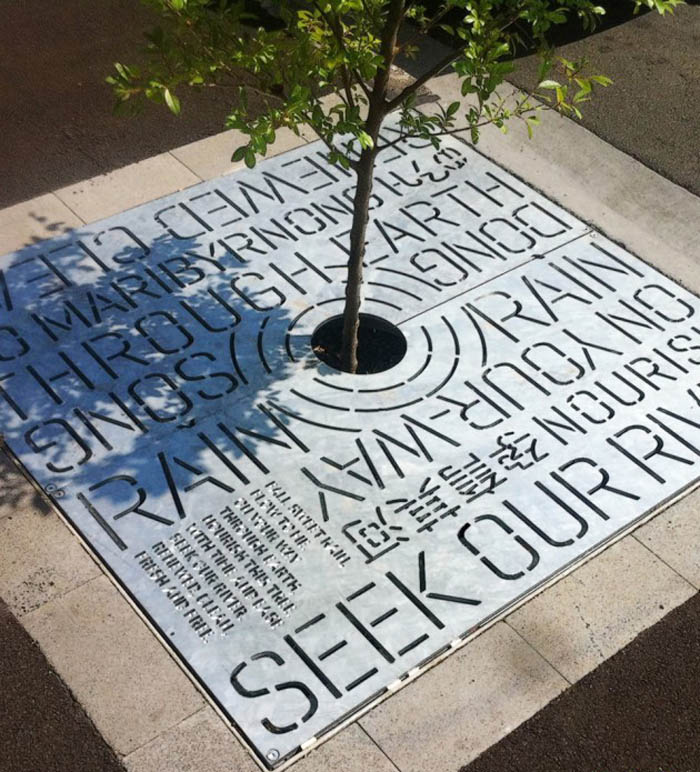
HeineJones, an interdisciplinary design consultancy based in Melbourne, was approached by the city council of Footscray to design an interpretive solution describing the function and intent of a new “rain garden” installed as part of a streetscape redevelopment for Leeds Street. HeineJones’ solution presented the function and intent of a water garden as a piece of poetry, laser cut though the 10mm steel plate of the tree grates. Presented in different scales and languages, the urban poems include large words that form abstract snippets of information about the rain garden, with the poem in its entirety reproduced in smaller type.
The intent of the design is to engage the public in an emotive and legible way, whereby the passage and movement of the water into the system is through the information itself.
via segd
Beatriz Leyton: Family Life


 Click to enlarge


In her work titled Family Life, Chilean artist Beatriz Leyton creates large tableaus illustrating the rooms in a typical home—kitchen, bathroom, bedroom, living room—using pins. Why pins? To depict the fragility of the home and family as well as the illusion of the ‘American Dream’.
Leyton uses thousands of pins against black fabric which give these pieces a glow-in-the-dark type of effect. The perspective alone is impressive.
via macro museo
Cildo Meireles: Fontes (Fountains/Sources)
 Click to enlarge
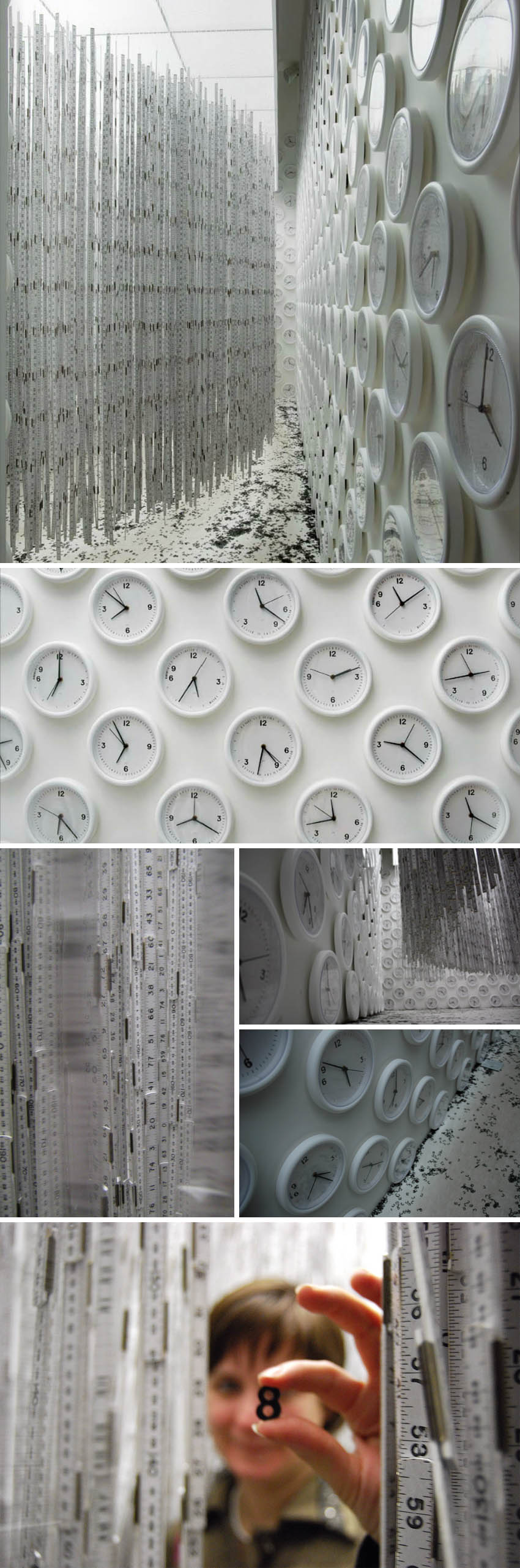
Brazilian artist Cildo Meireles wasn’t always a fan of conceptual art, but in the 1970s he started to create works in protest of Brazil’s military dictatorship. These interactive/performance works carried political messages in a poetic way.
Meireles reflects:
…When a work of art kidnaps you for a fraction of a second, it takes you to another time …I realized that, of all the movements that I had studied, conceptual art was the only one that didn’t use any of the things linked to art: inks, brushes, canvases. It could be made from anything. It gave complete freedom. It is the most democratic way to produce art that has come up. That is something that deserves credit.
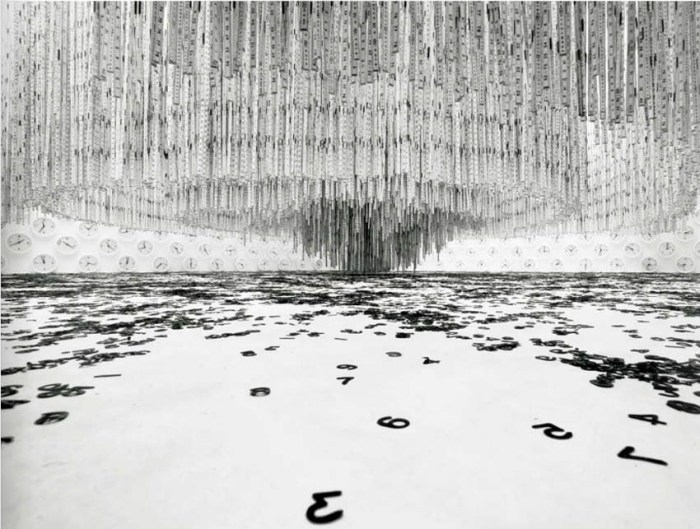
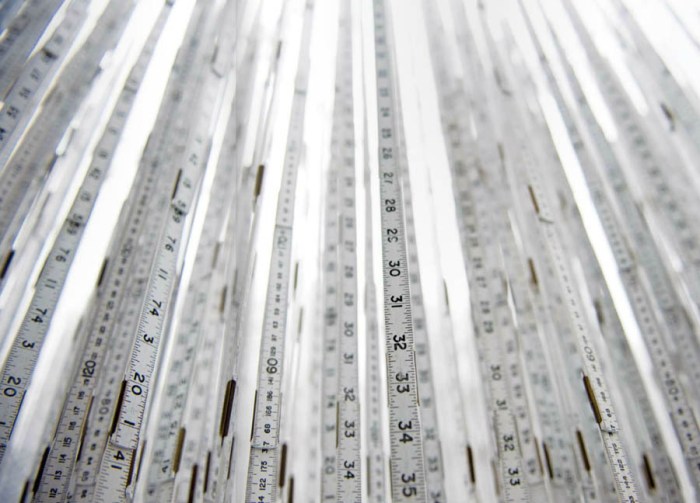
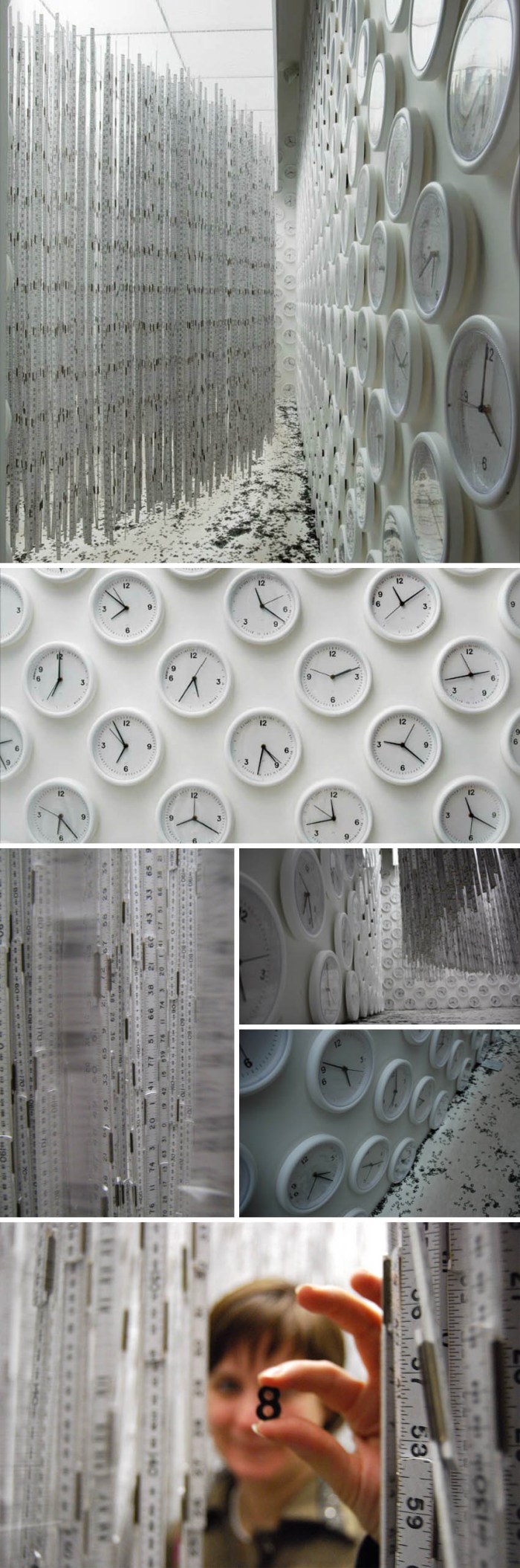
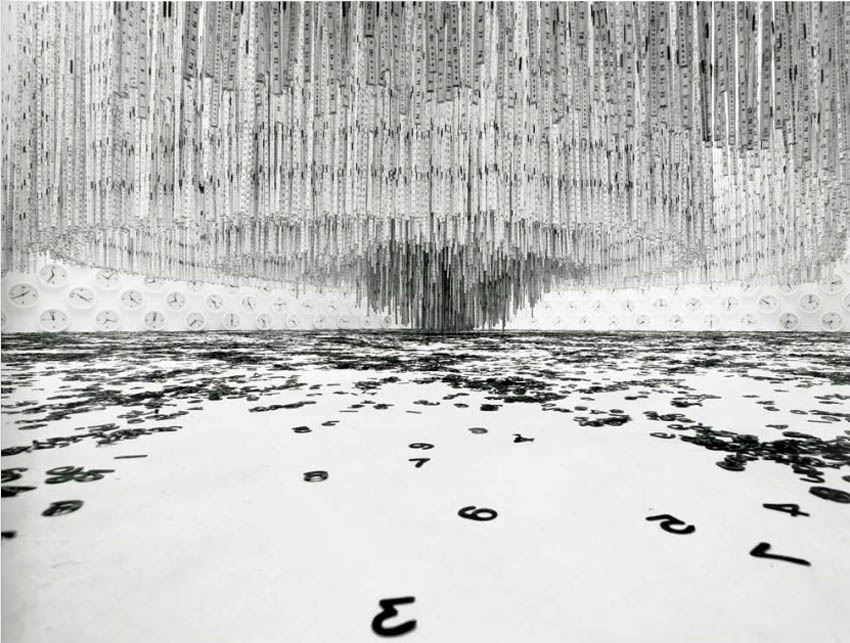
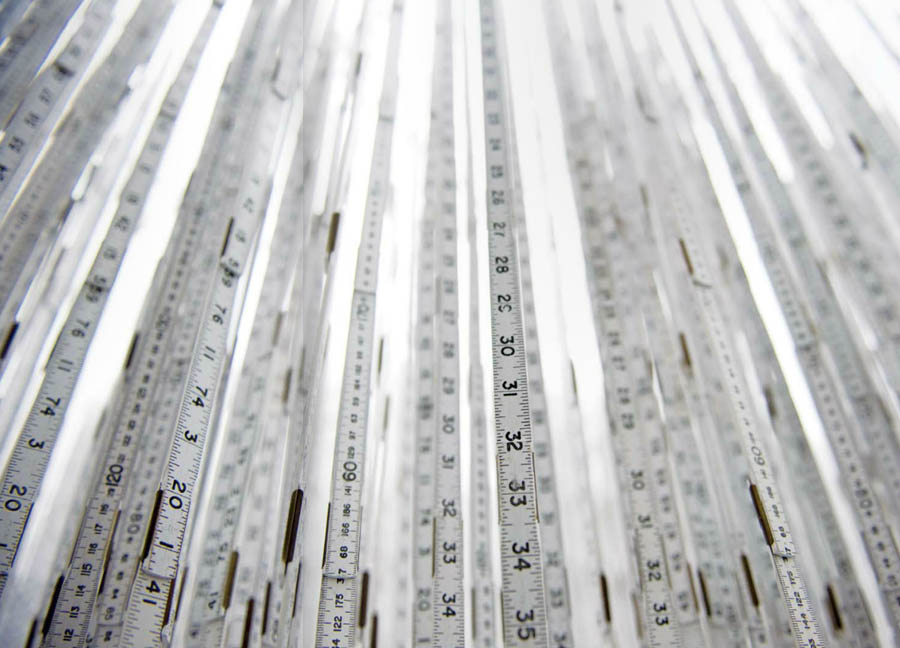
Meireles’s works typically revolve around space, dimension, and time. His installation Fontes (Fountains/Sources) is a perfect example. Using 6,000 rulers, 1,000 clocks, and 500,000 vinyl numbers, along with a soundtrack, Meireles invites spectators to interact with the work, circulating through the paths created by the hanging rulers.
Here’s a video from a first person perspective:
Photos: Ihall’s flickr; Jock303’s flickr; Penny Jones’ flickr; and the artist.
via arte al limite
Pascal Broccolichi: Sound Installations


 Click to enlarge

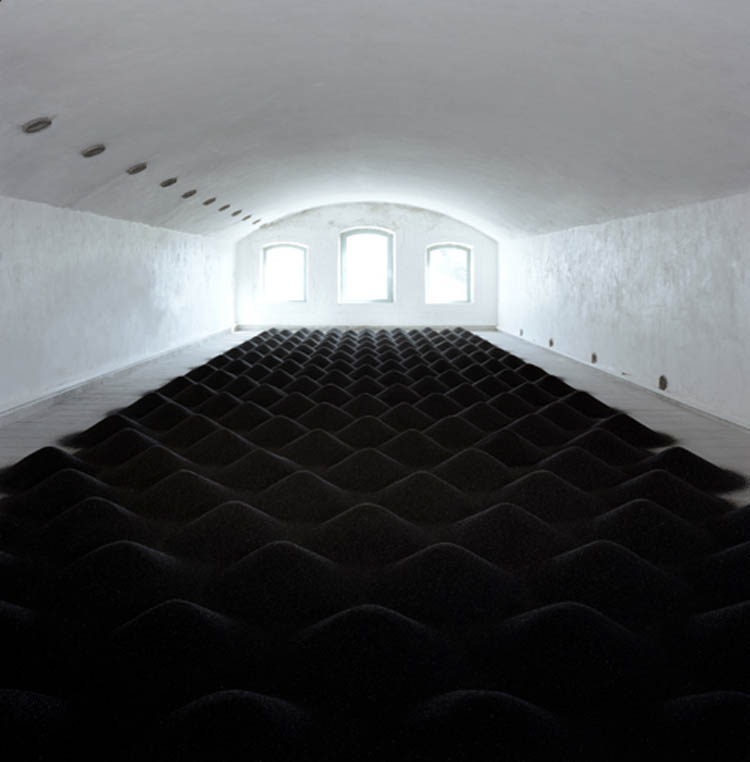

French sound and visual artist Pascal Broccolichi creates installations that envision sound as a vocabulary of forms, but whose focus is on listening. In his piece Raccorama (top four photos) Broccolichi takes mica dust and places it in identical heaps, following a specific pattern which is then emphasized by iodide spotlights. Loudspeakers play a sound piece simulating the patterns of sound flux in motion.
In a more recent work, and variation on the Raccorama theme, Broccolichi creates similar mica dust heaps, this time placing a loudspeaker in the center of each creating a crater. This installation titled Table d’harmonie (bottom photo), also plays a sound piece simulating sound flux in motion.
via LABoral
Jitish Kallat: The Cry of the Gland


 Click to enlarge
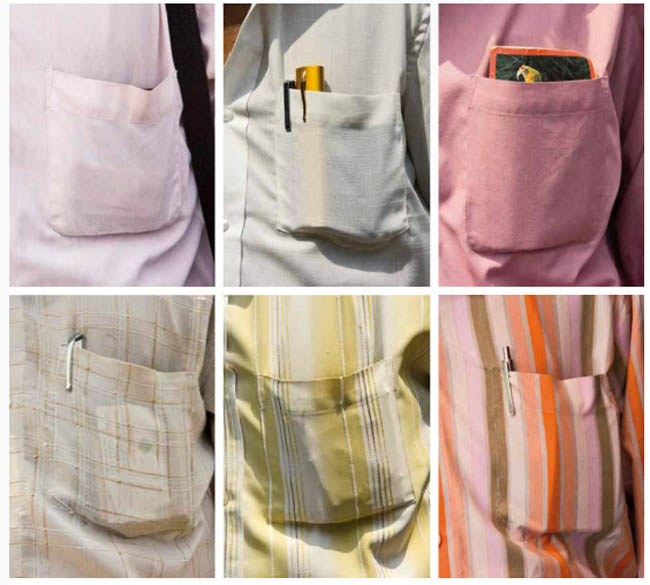

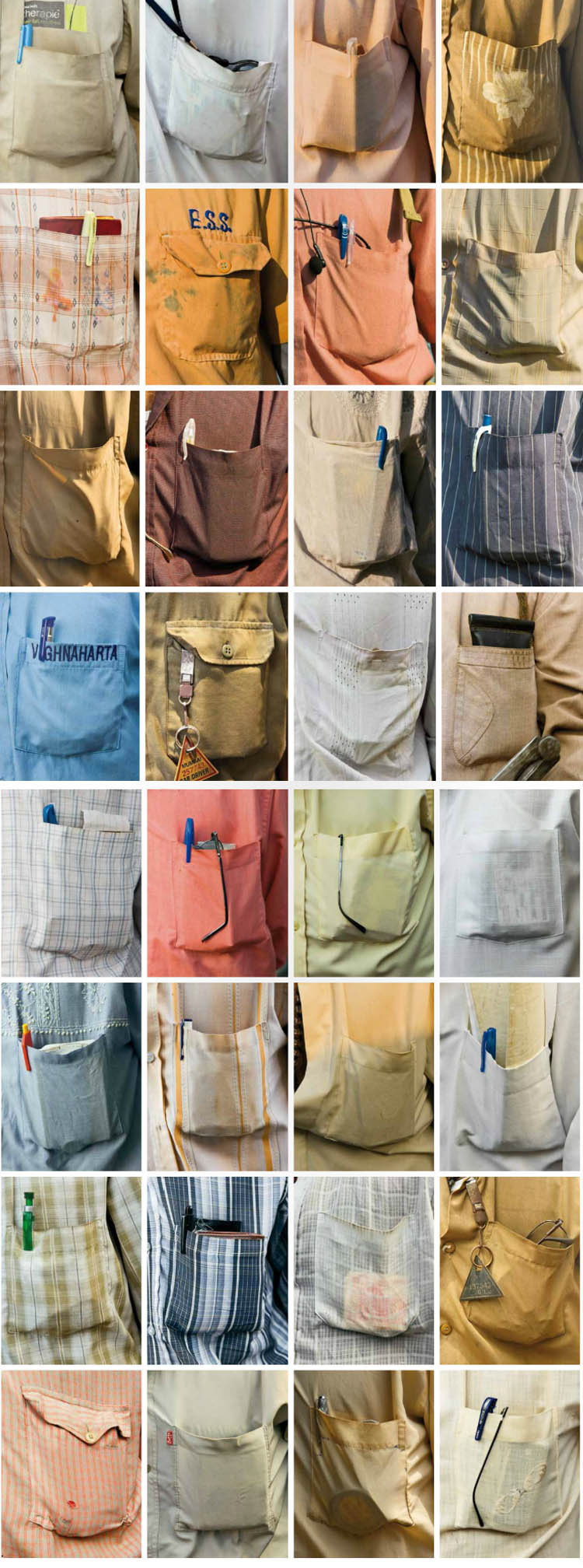
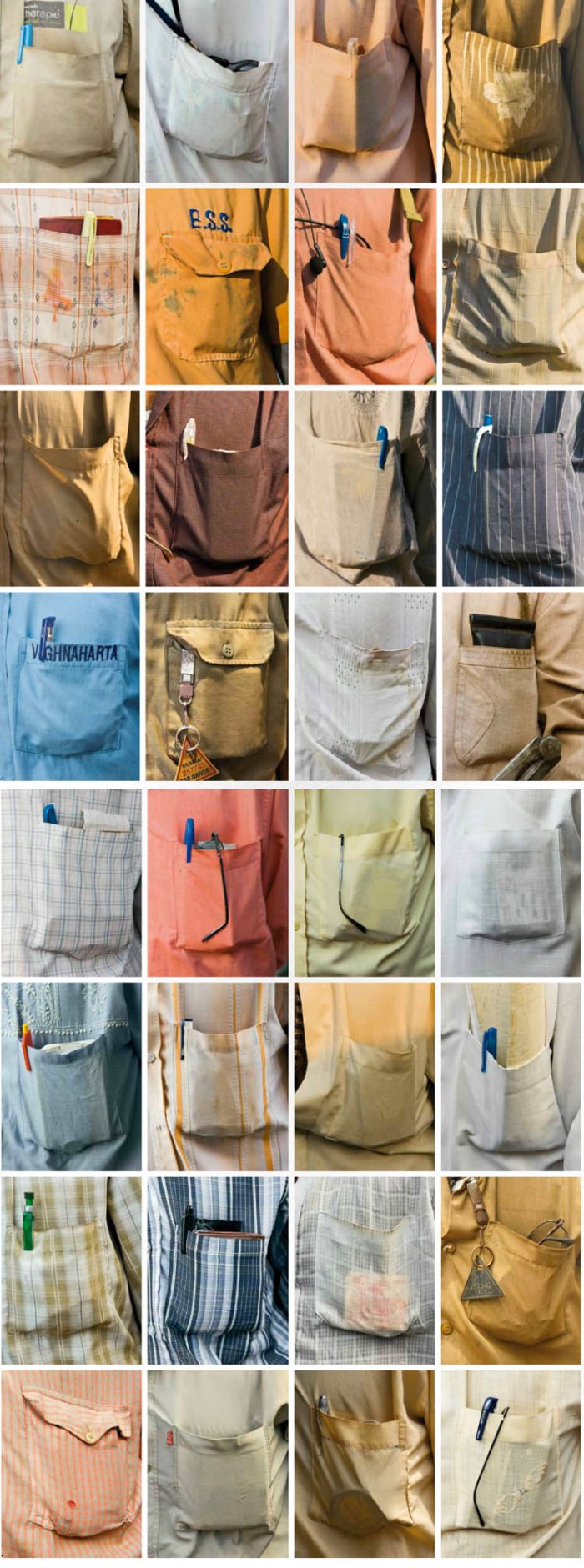
Jitish Kallat is an Indian artist who works in varied media and is based in Mumbai. His installation The Cry of the Gland, made up of large photographs focusing on male shirt pockets and their content, is in essence a sociological study of modern India. Interesting to see the range of colorful Madras and cotton shirts, fabrics typically exported from India, some pressed and clean, others worn and torn, but all depicting a middle class. There’s an overwhelming quality to the floor-to-ceiling installation that seems to reflect the massive population of over one billion, as well.
via Else
Jonas Etter: Ephemeral Burnt Sugar Art

 Click to enlarge


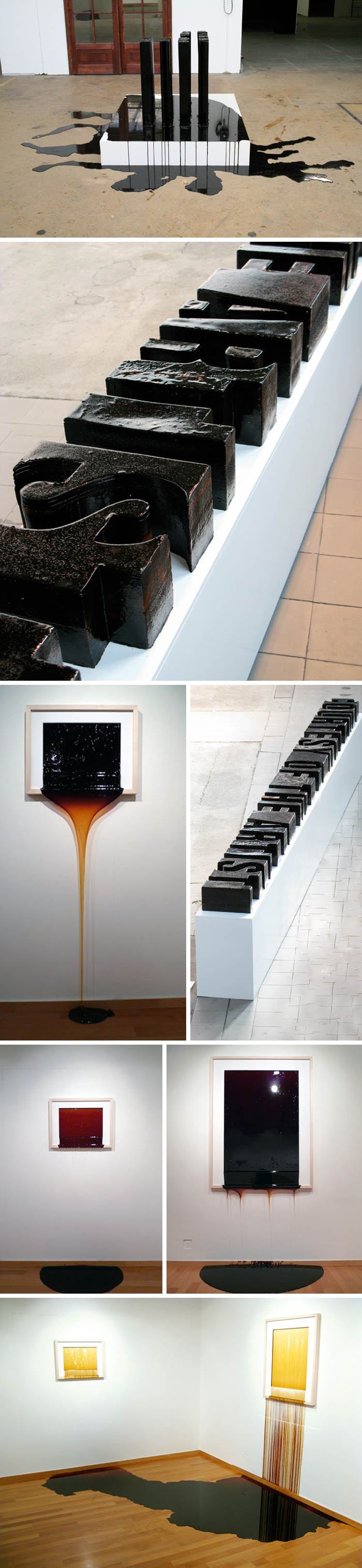
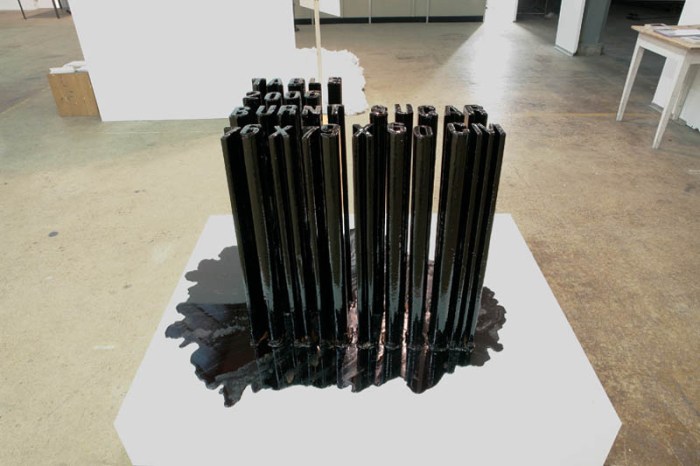
Swiss artist Jonas Etter, based in Zurich, works in many mediums, including burnt sugar. These typographic sculptures and framed wallpieces are all made using the aforementioned substance. The burnt sugar melts due to heat and air moisture, turning the pieces into a sort of performance. The typographic sculptures are their own self-defining captions. As they melt and spread over the base, the works transform and invade the viewer’s space with their sticky puddles. The Wallpiece I-III are put on the wall immediately before the opening reception and the content slowly starts to flow out onto the ground.
via eye
Kamppi Chapel: K2S Architects
 Click to enlarge
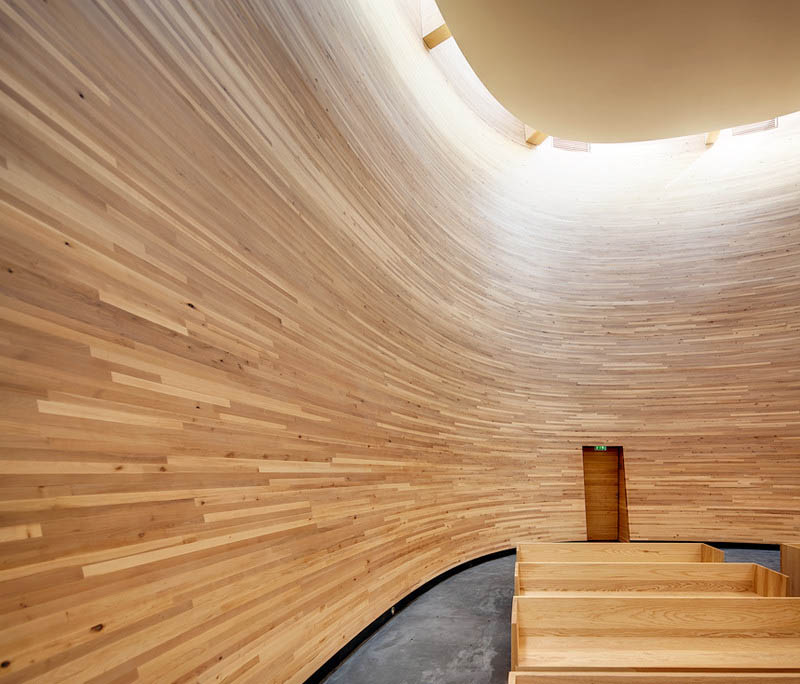
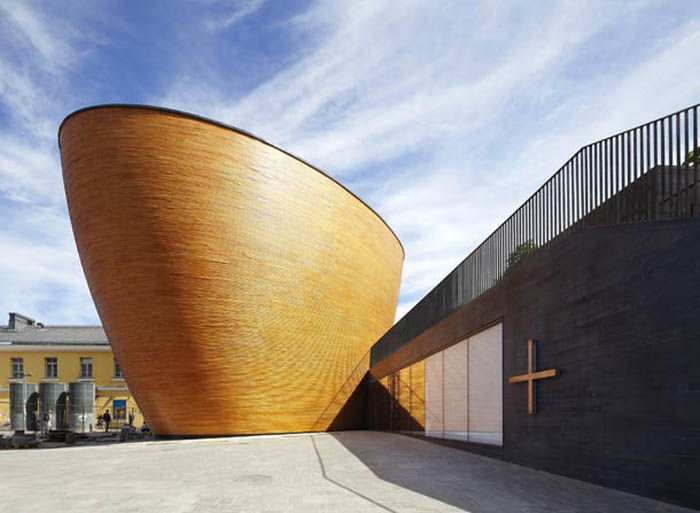
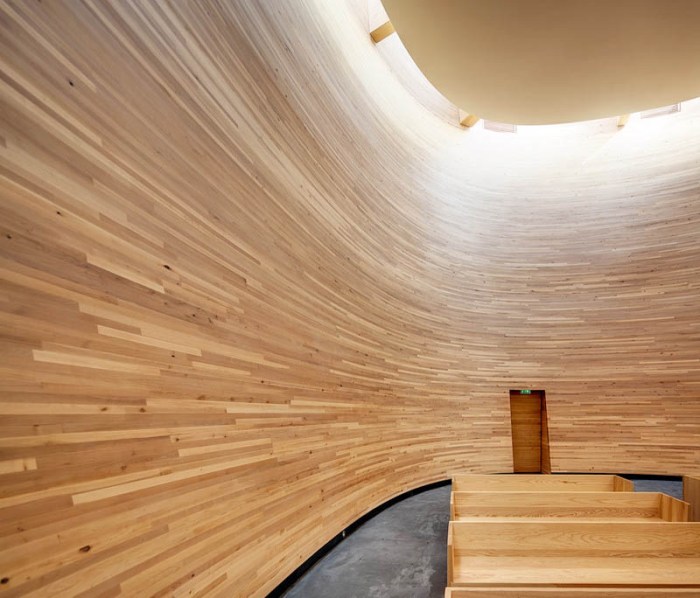
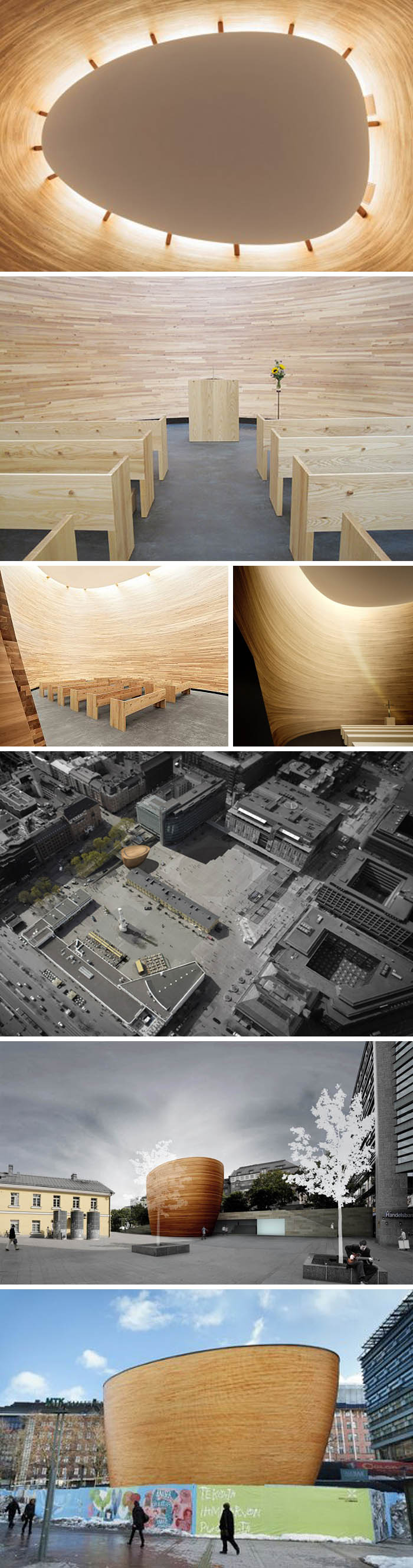
Well, this is certainly an interesting design for a chapel. The Kamppi Chapel of Silence, designed by Finnish studio K2S Architects, is a small wooden tub of a structure supplying a bit of silence and peace from its urban surroundings in Helsinki’s commercial center. The wood tones in this sculptural volume exude a natural warmth which is only amplified by the indirect sunlight that enters through the top.
Images: Tuomas Uusheimo, Marko Huttunen, Mika Huisman, and K2S Architects.
via A10
Aisha Zeijpveld: What Remains

 Click to enlarge


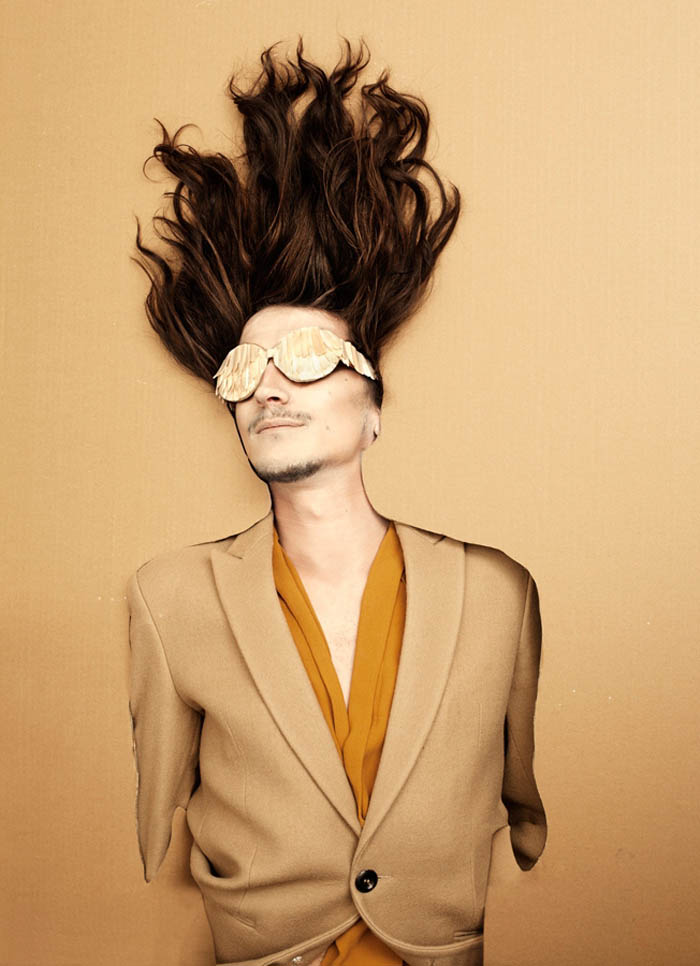
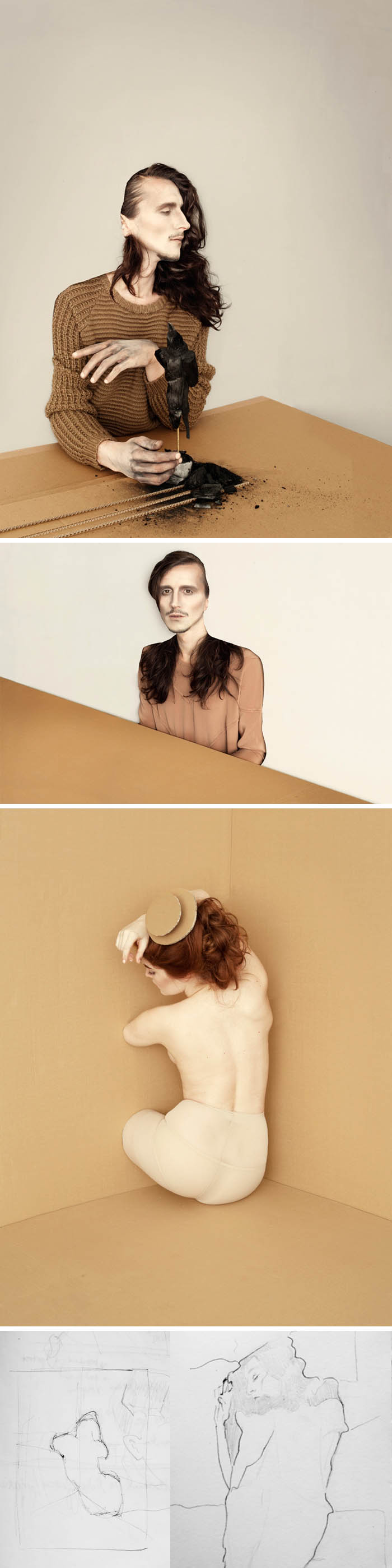
Dutch photographer Aisha Zeijpveld lives and works in Amsterdam as a freelancer for a variety of commercial magazines. In her personal work she likes to experiment and focuses on people’s vulnerabilities as well as on the absurd.
In her series What Remains, Zeijpveld was inspired by Egon Schiele’s sketches and paintings of ‘unfinished’ figures. She transforms this way of sketching into her photographs by cutting out silhouettes in cardboard and having her models pose with arms, shoulders, and faces disappearing into their background. First, however, she works on pencil studies (see images at bottom.)
via new dutch talent
Plaza Mirador El Tossal Community Center
 Click to enlarge
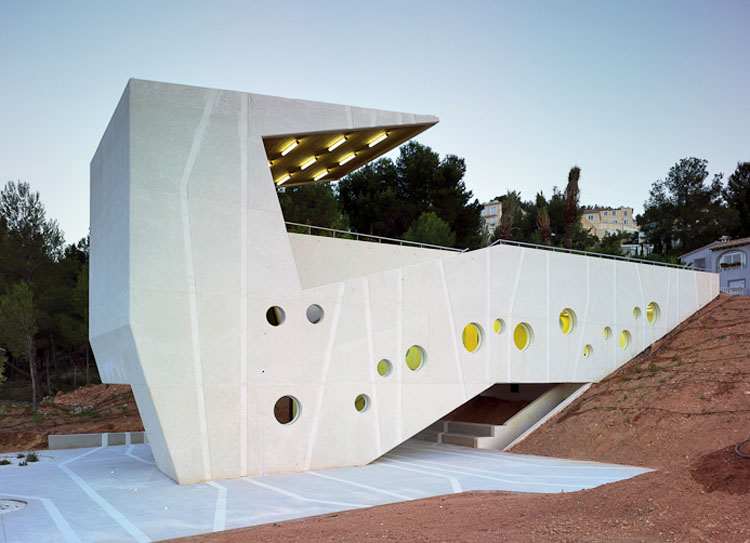
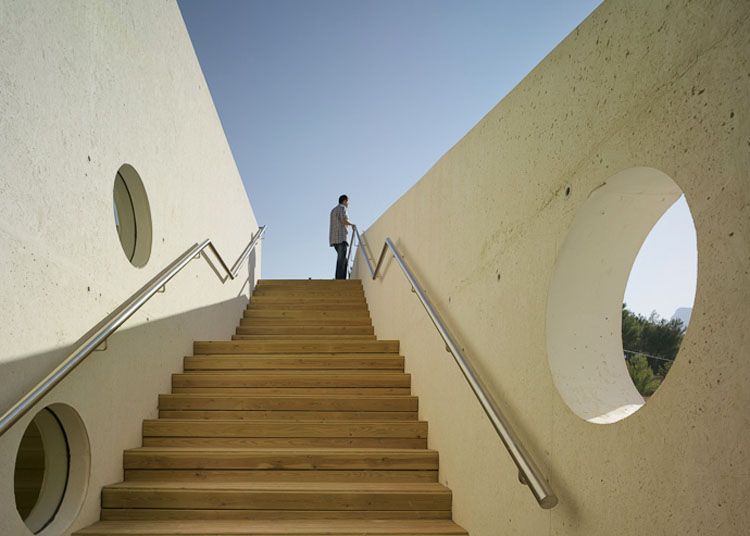
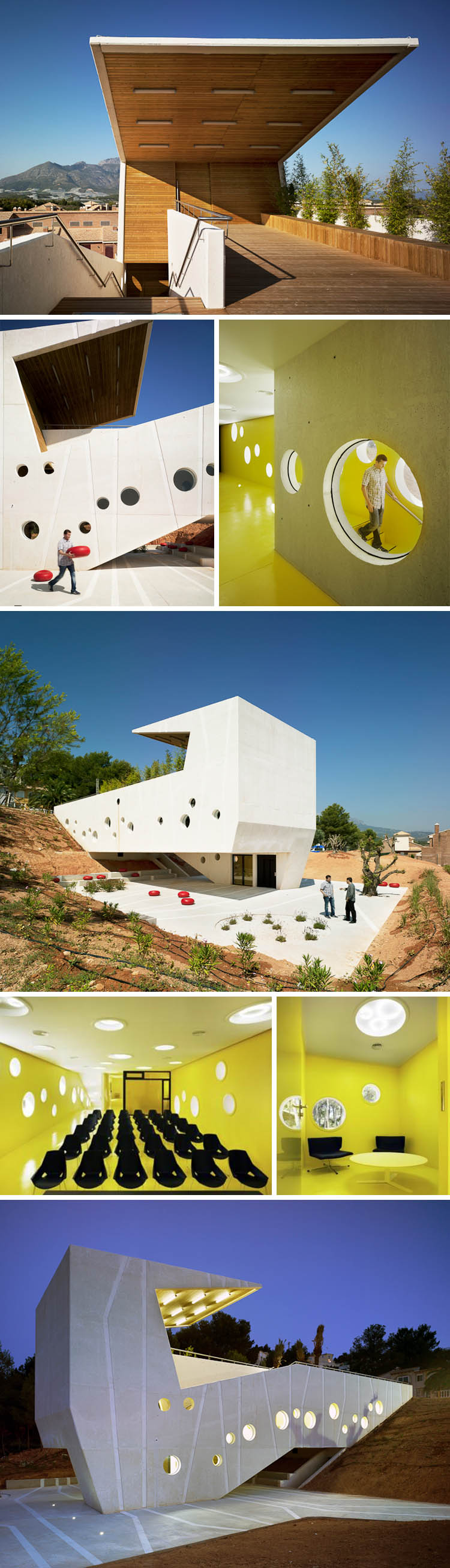
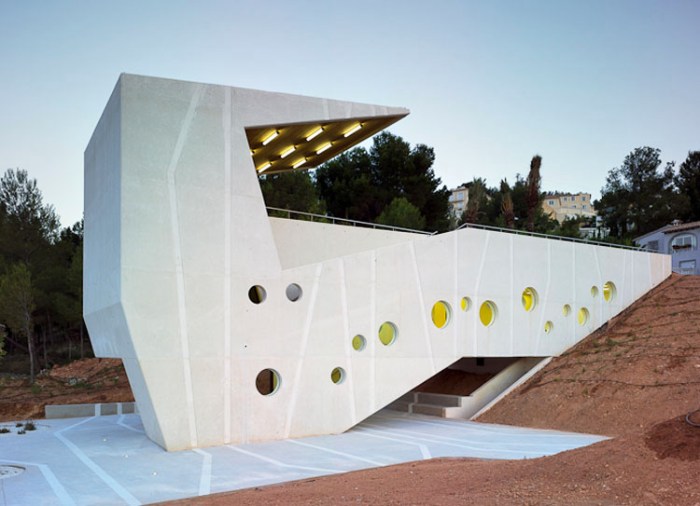
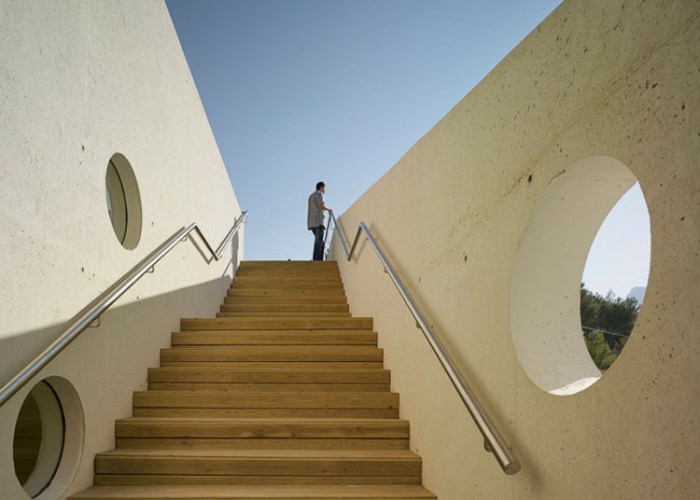
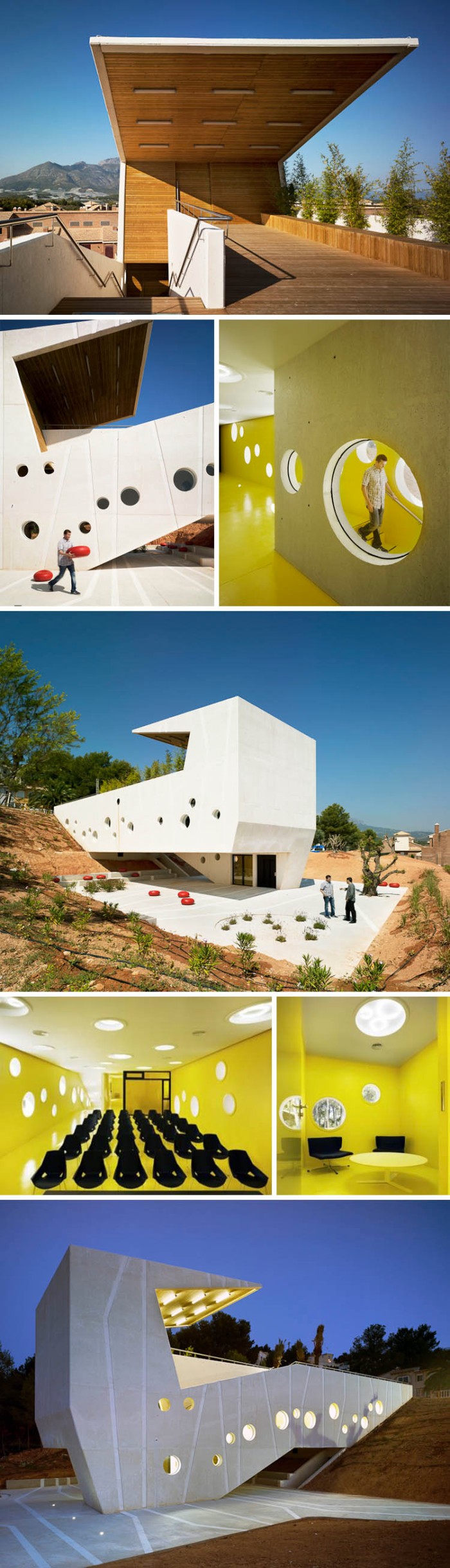
Located in Alicante, Spain, the Plaza Mirador El Tossal Community Center, designed by Crystalzoo Architects boasts beautiful views of the mountains and pine forest as well as being part of the contemporization of the countryside landscape. A neighborhood community center, the unique and elegant building includes an outdoor meeting square and an auditorium inside. Love the circle theme throughout.
Photos by David Frutos
via A10
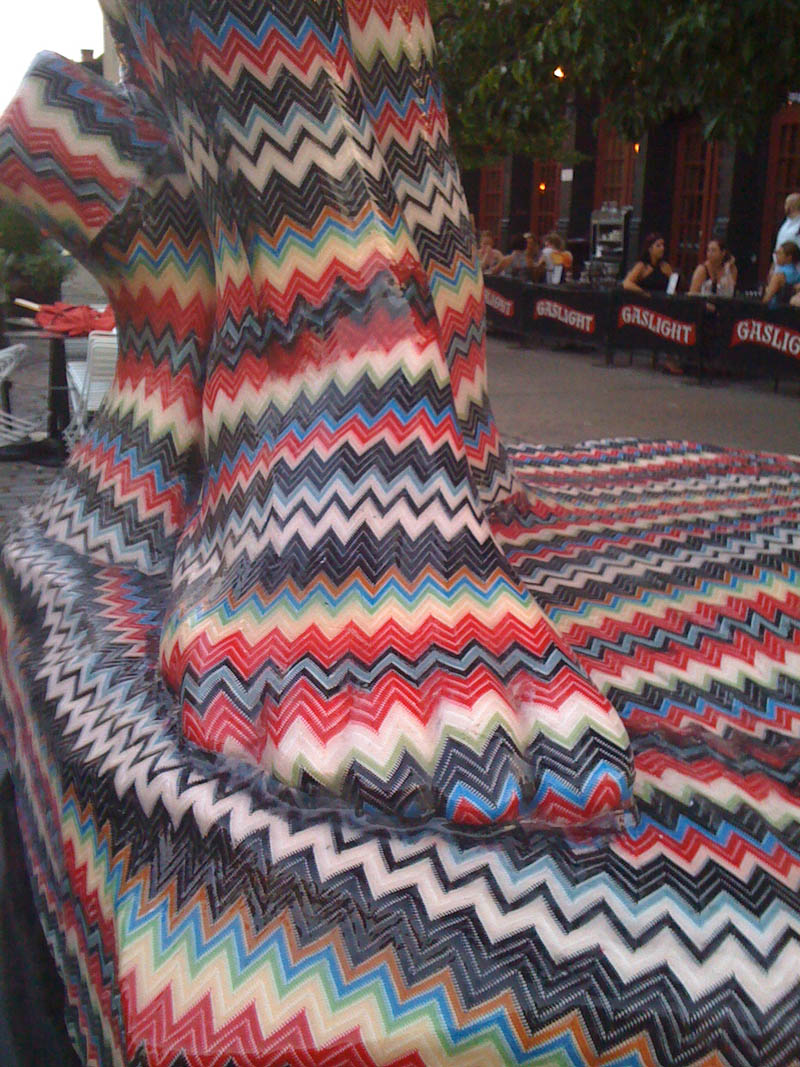
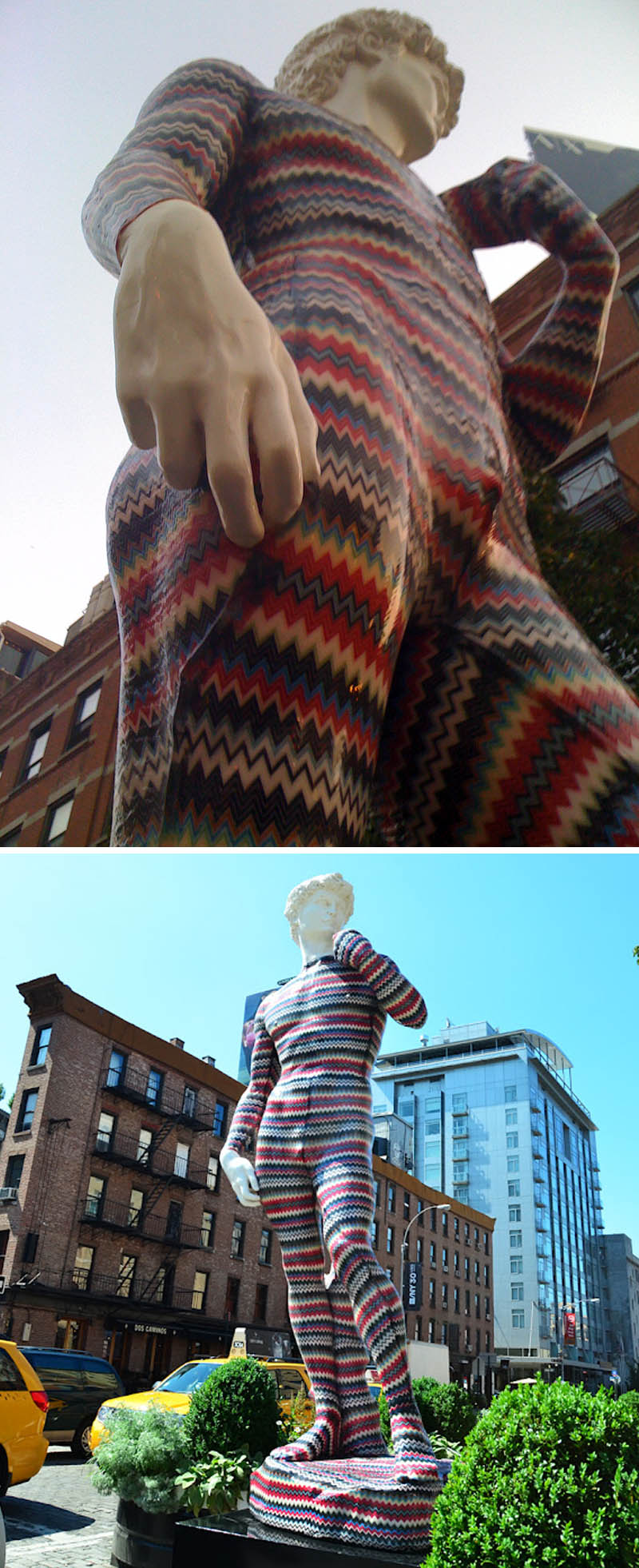
Michelangelo’s David à la Missoni
Click to enlarge
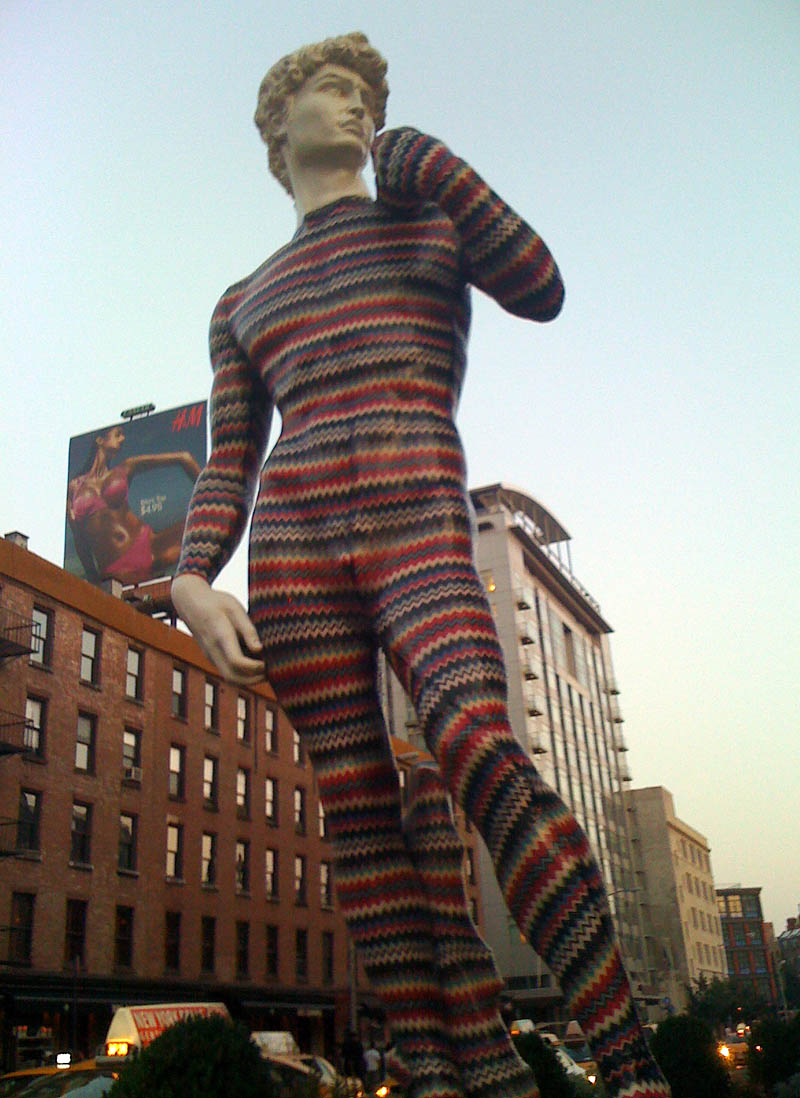
This past Saturday, on our way over to the High Line for an evening stroll, Daniela and I spotted a large — yet much smaller than the original — 5-meter tall version of Michelangelo’s David plopped down, smack in the middle of 9th Avenue and 14th Street sporting a classic Missoni zig-zag skin. Right in the heart of the Meatpacking District, this surprising sight was not missed by many. There was no sign or explanation attached, but upon googling I discovered that the statue is the creation of, and collaboration between, Spanish artist dEmo and Luca Missoni. Originally installed in front of the Missoni store in Madrid, Spain back in 2010 with a larger zig-zag patterned outfit, for their Fashion’s Night Out, the statue seems to have made an appearance in Barcelona as well, and is now in NYC until September 2012.
You can watch a video of the statue’s installation in Madrid, here.
Bottom photo solifestyle; all others collabcubed.
Ottó Vincze: Identified Flying Objects


 Click to enlarge
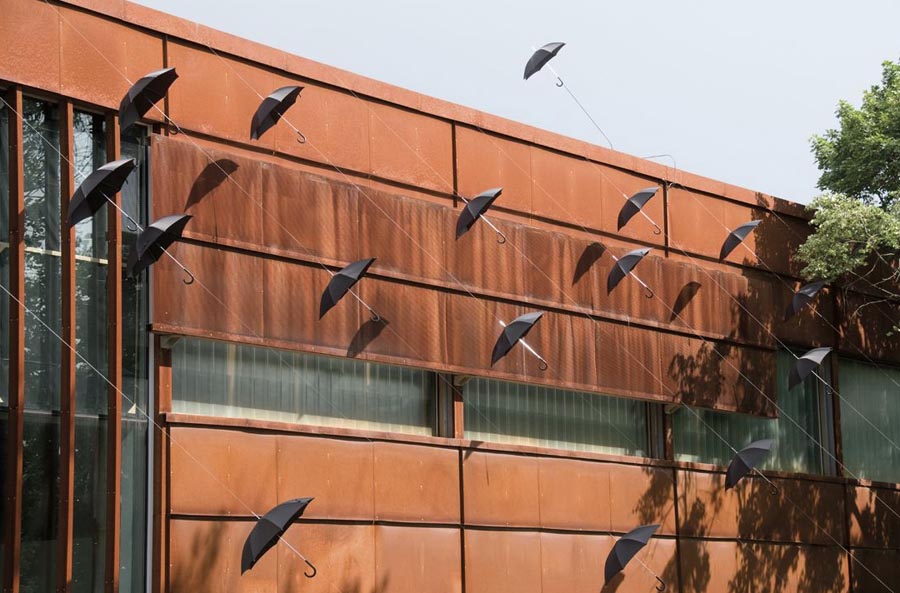


Hungarian artist Ottó Vincze lives and works in Szentendre. Most of his works are installations, some with movement, others static. Many give the illusion of objects flying, and at least three of them involve umbrellas.
From top to bottom, the four installations above are:
Facade-Makeup for the Occasion
Sinking Centres of Gravity
Cognitive Save
Pioneer Progress
More Gyula Várnai: Now I Know
 Click to enlarge
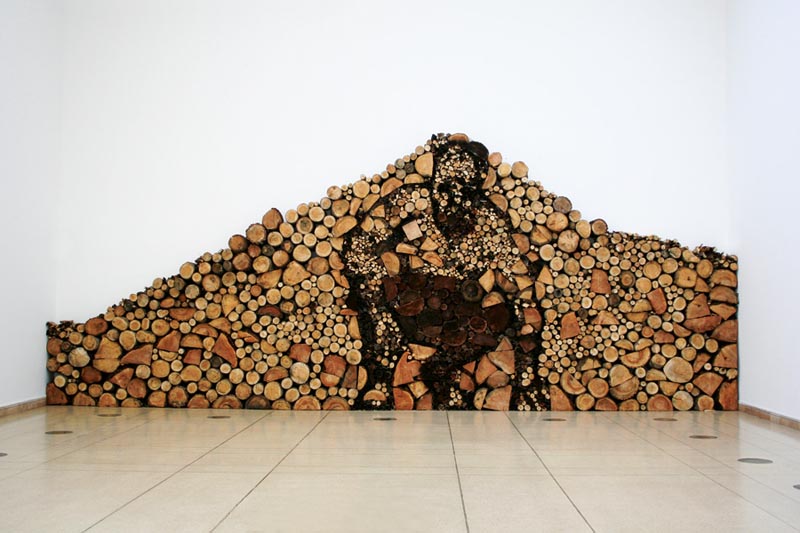

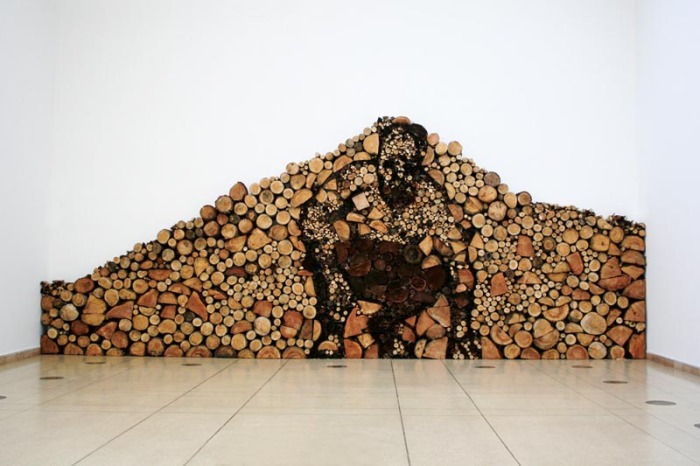
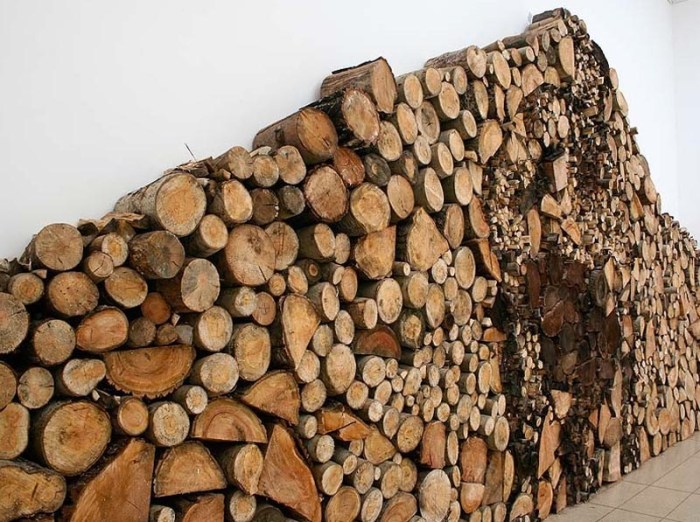
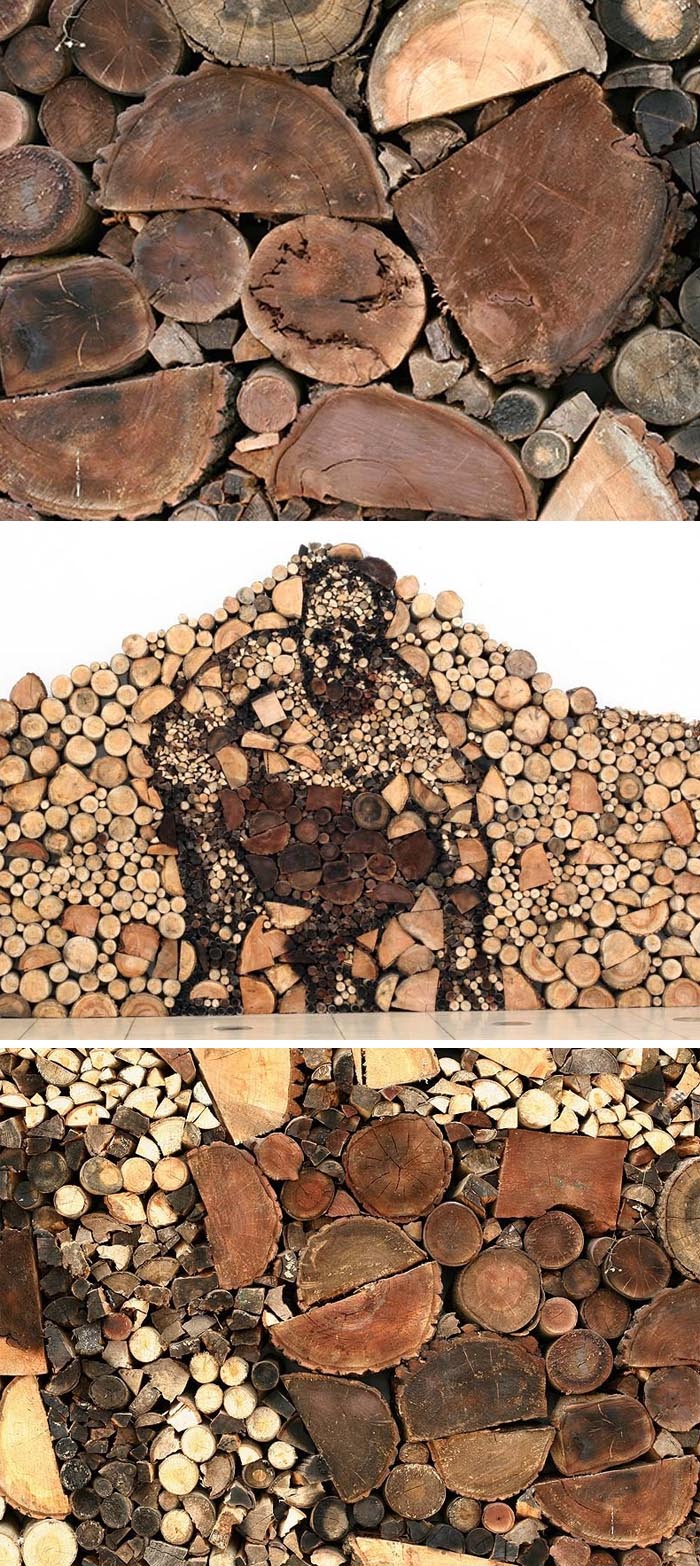
Hungarian artist Gyula Várnai (previous post) also created this installation titled Now I Know, for the What’s Up? Hungarian Contemporary art exhibit in 2008, using logs and branches of different sizes and wood colors, illustrating a crouched man in the center of the pile. This kind of thing always amazes me.
A Memorial Bowing: Snarkitecture


 Click to enlarge


Last month when I was on Snarkitecture’s website getting information on their recent Odin Pop-Up Shop project, I noticed this project earlier in 2012. Alex Mustonen and Daniel Arsham, the Snarkitecture duo, reconstructed the 10-foot letters from the old Miami Orange Bowl and whimsically scattered around the east plaza of the new Marlins Ballpark. Created as a sort of memorial to the stadium that was demolished in 2008, A Memorial Bowing feels like a mix of ruins and renewal, with some of the letters submerged and others standing tall.
The alignments of the letters spell out new words and are a nice complement to the new stadium, which can be viewed through the type at different points.. Really, you can’t go wrong with monster-large type.
 CollabCubed