Liliana Porter: Objects & Installations

miniatures, contemporary art, objects, installation, knitting, collabcubedminiatures, contemporary art, objects, installation, knitting, collabcubedminiatures, contemporary art, objects, humor, installation, collabcubedClick to enlarge

My parents have had a Liliana Porter print/collage on one of their living room walls for close to 30 years. It may, at times, have been on a different wall or maybe even in a different room, but it’s been in their apartment for a long time. I’ve always been more intrigued by the background of how that print ended up in their possession than the print itself, not because I dislike the print, I don’t, but because I’ve always found it curious how Argentineans who immigrated to New York in the 60s all seem to know each other, even if indirectly. They are all friends of friends, or cousins of friends, or went to the same university, or frequented the same café. I don’t remember the exact connection here, but I believe it involved a friend of a friend inviting them to a small art show.

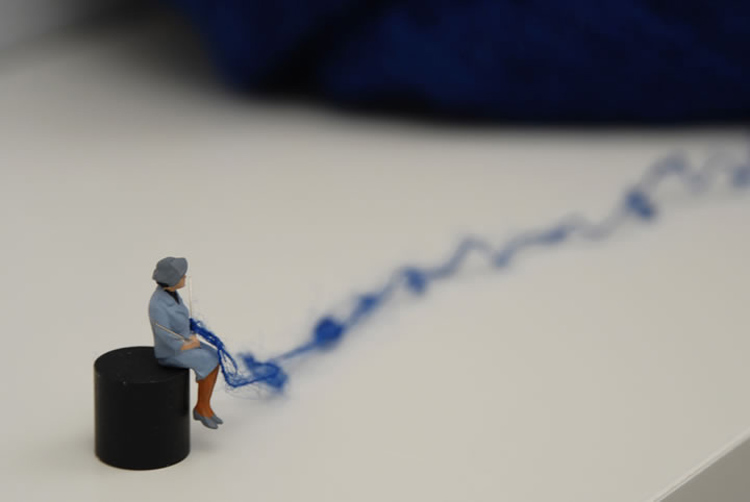
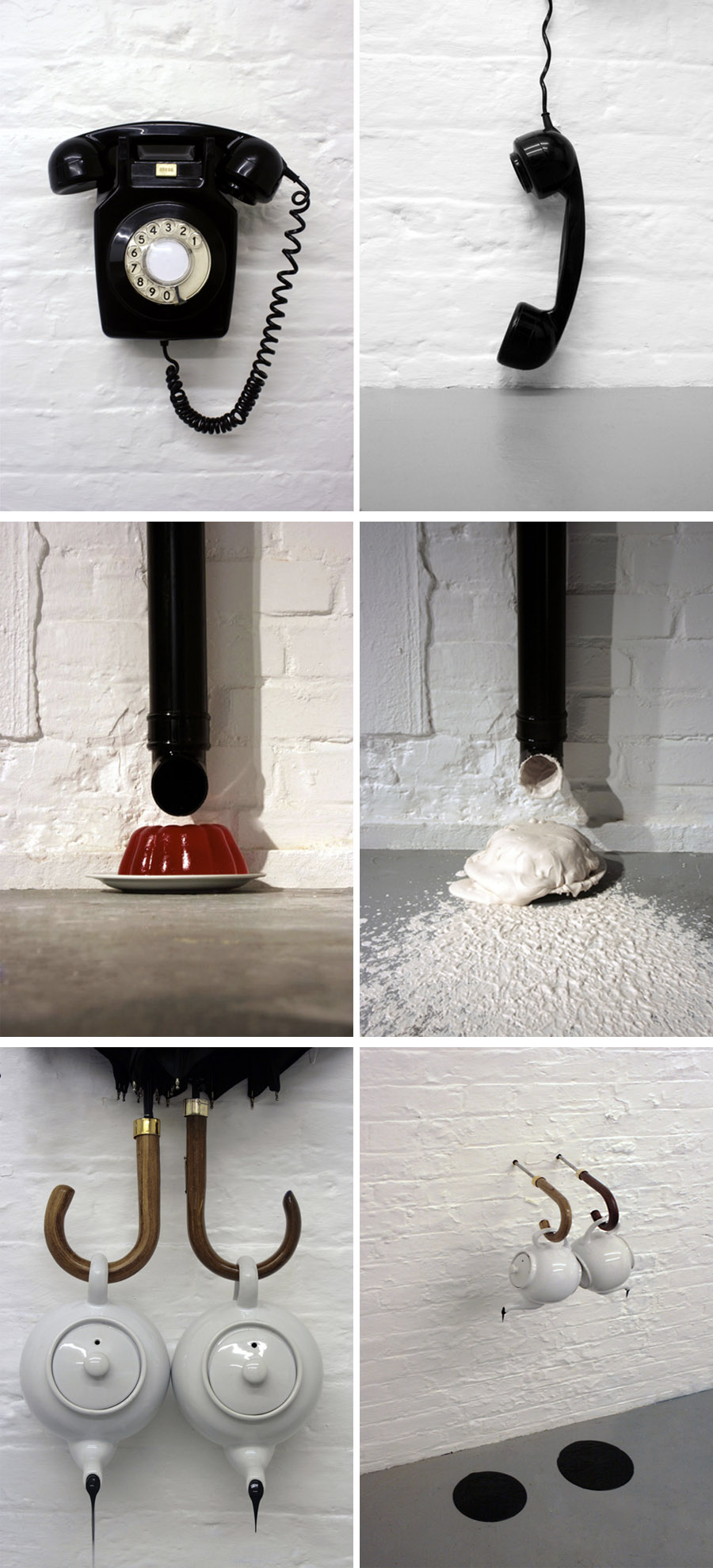
Recently, I came across the image of the miniature man hammering a seemingly huge nail and it made me smile. Upon checking who the artist was, I was pleasantly surprised to recognize Liliana Porter’s name. Visiting her site revealed this collection of objects & installations. I love them. They’re charming and humorous, and maybe it’s just me, but I find them a little touching. Though these are new to me, clearly it’s not the case for many others. Porter’s work is included in numerous museum collections including the TATE, MoMA and Met.

To see many more of these miniature installations, as well as the rest of Liliana Porter’s work including prints, collages, photographs, video and public art, be sure to visit her website.
via la maquina en el museo

IXXI: Photo Walls

pixelated wall images, photo wall, modular photo system, ixxipixelated wall images, photo wall, modular photo system, ixxiDeveloped by Dutch designers Eric Sloot, Paulien Berendsen and
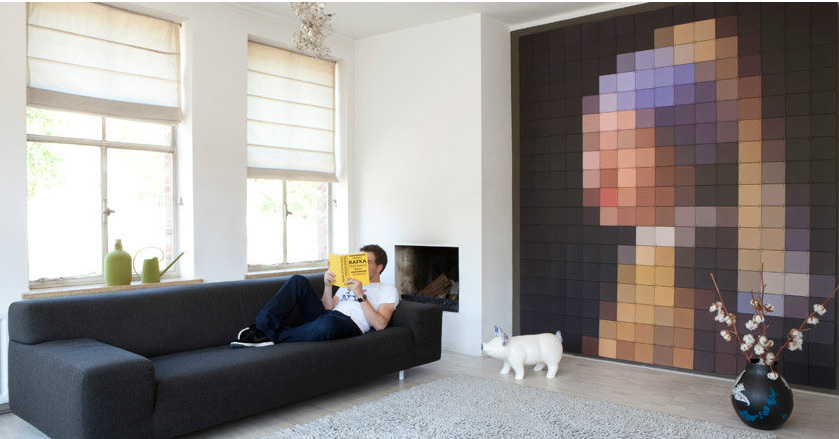
Roel Vaessen, ixxi is a modular wall-hanging system made up of square photo cards connected by plastic x’s and i’s. It allows you to make your own photo enlargements, photo collages, pixelated images, or any other creative ideas you can come up with. Oh, the possibilities!

See more on the ixxi site.
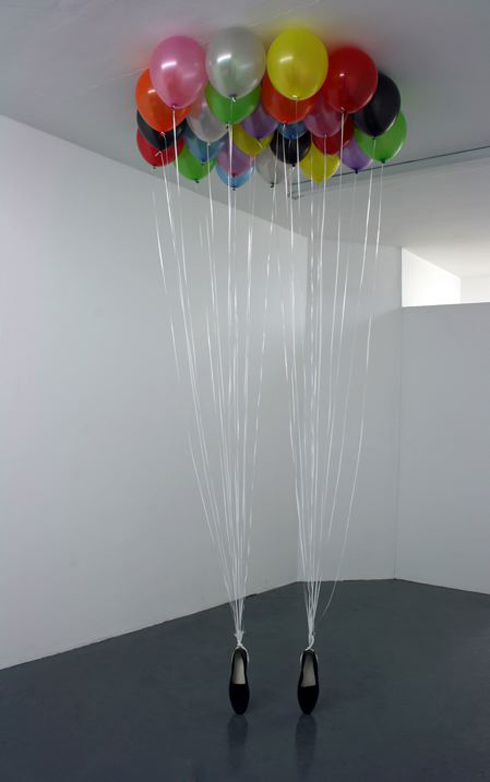
via bb

De Tafelwip: Marleen Jansen

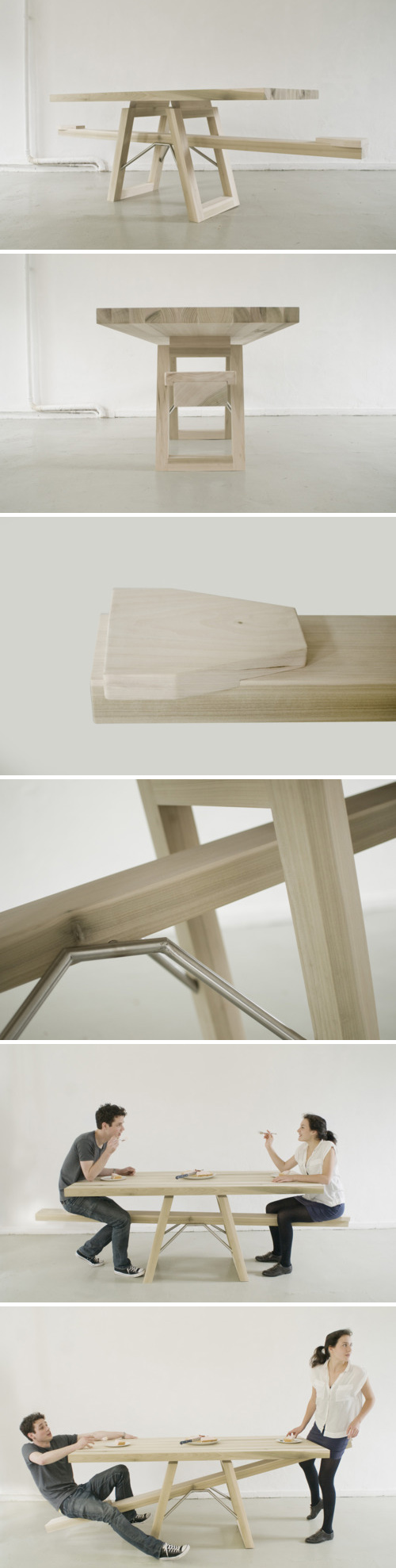
Dutch product design, table, seesaw, DDW, fun furnitureDutch product design, table, seesaw, DDW, fun furnitureThere’s a reason you don’t see many see-saws in playgrounds anymore; it could be safety issues or maybe just a complete loss of faith in see-saw partnerships. After all, there’s a lot of trust involved on the see-saw. One person gets off unexpectedly and the other one can go flying…or more accurately, crashing.

Dutch designer Marleen Jansen clearly still has faith in the see-saw and the unspoken contract that is entered when both parties mount one. De tafelwip, a project developed after her dissertation entitled ‘Being Forced Voluntarily’ (Ongedwongen moeten) on the subject of table manners, prevents people from walking away from the table during dinner. The see-saw seating forces the two people to stay at the table because, as she points out: “If one leaves the table, the other diner ends up on the floor! Definitely not a charming thing to do!”
Emily Post would be proud.

via ddw

J. Mayer H.: Rapport

Berlin, J. Mayer H. Installation, Berlinishe Galerie, collabcubedBerlin, J. Mayer H. Installation, Berlinishe Galerie, collabcubedClick to enlarge

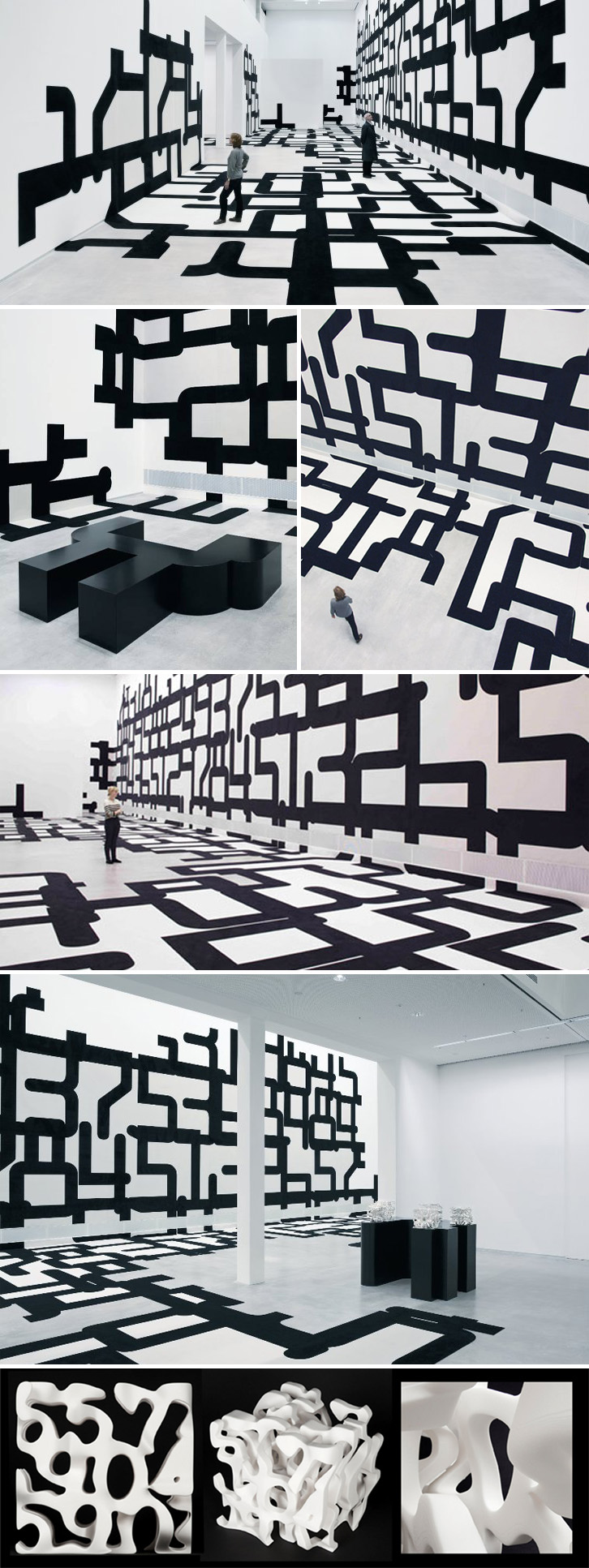
The German architectural firm J. MAYER H., founded by Juergen Mayer H., has designed an installation for the Berlinische Galerie titled Rapport: Experiments with Spatial Structure. Data security patterns have been printed in an unimaginably large point size on carpeting which adorns both the floor and walls of the museum’s 10-meter high entrance hall. The large, somewhat abstract shapes created by the oversized numbers, results in a flickering impression and transforms the rigid white cube into a playful scenario negating its strict geometry.

The word “Rapport” has multiple interpretations and is meant to be ambiguous.

From the architects:
As a specialist German-language term from textile manufacturing, it refers to the serial pattern of the installation. On the other hand, in the military field the term “Rapport” means a “dispatch”, while in psychology it describes a human relationship in which those involved convey something to the others. In this sense it also refers to the starting material of the installation: data security patterns, which are used, for example, on the inside of envelopes. In this case, they stand for confidential communication between two parties.

The installation will be up through April 9, 2012 at the Berlinische Galerie, in Berlin, of course.

via city vision

Alfabeto Graffiti: Graffiti Alphabet

graffiti alphabet, type, street art, art book, collabcubedgraffiti alphabet, type, street art, art book, collabcubedalfabeto graffiti, street art, typography, alphabetClick to enlarge

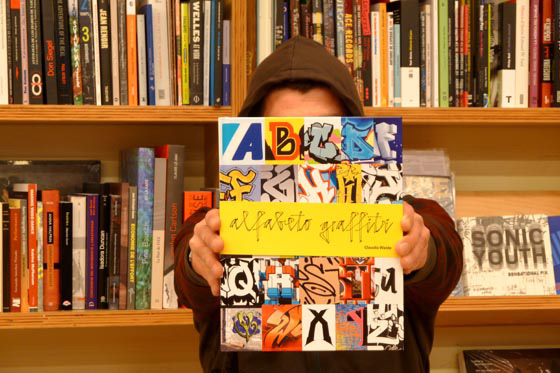
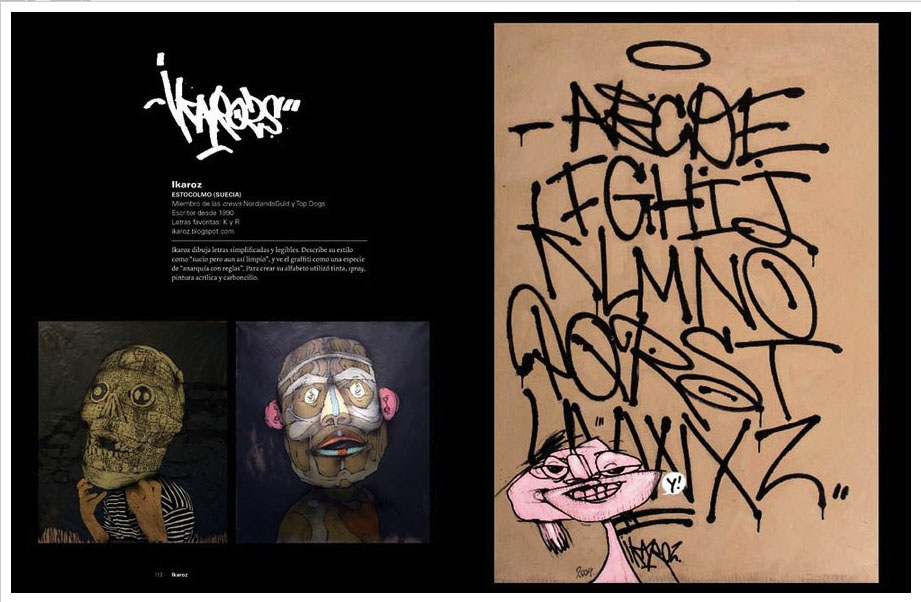
Attention type lovers and street art aficionados: this may be just the book for you. Claudia Walde, author of Alfabeto Graffiti, spent over two years collecting alphabets by 154 street artists from 30 countries. The brief given to each artist was to “design all 26 letters of the Latin alphabet within the limits of a single page of the book.” The result: Alfabeto Graffiti.

Though I haven’t seen the actual book, the spreads on the publisher’s page look like the perfect combination of street art photos and fun (complementing) typography.

via Editoral Gustavo Gil and available here. 319 pages with text in Spanish.

Marilene Oliver: Medical Imaging Sculpture

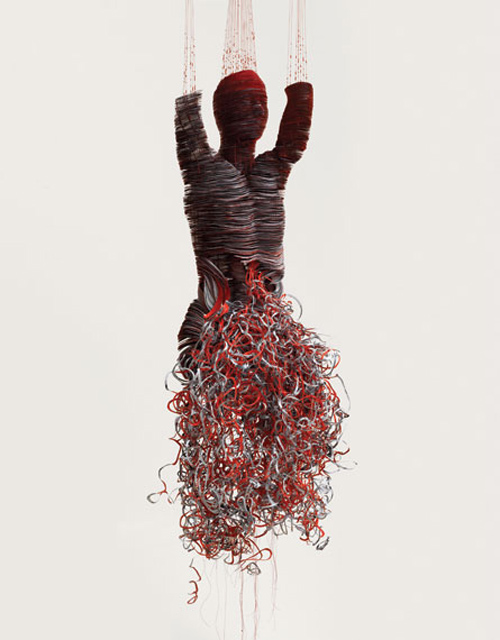
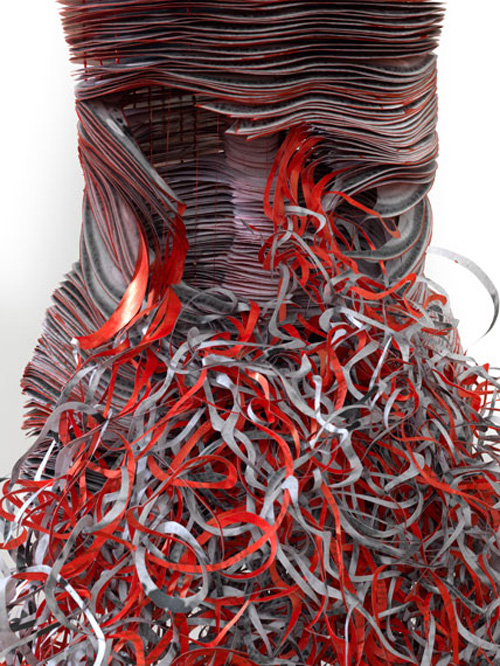
medical imaging sculpture, talking wounds, political sculpturemedical imaging sculpture, talking wounds, political sculpturemedical imaging sculpture, talking wounds, political sculptureBrazilian artist Marilene Oliver uses medical imaging (MRI and CT scans) to create sculpture. Concerned with the human condition in a digitized world – medical imaging fragments the body, genetics become code, interactions have been reduced to email and texts: digital media breaks the body down into bytes — Oliver uses her art as a way to reclaim the body.

In her work, Oliver experiments with the power of a wound, scar, and dissection to bring forth political issues. She works with materials that range from laser-cut acrylic, to foam rubber, to shredded cardstock.

Photos courtesy of the artist and Beaux Arts Gallery.

via the future can wait

Scott Campbell: Cut Currency

Currency art, tattoo art, skulls, dollarsCurrency art, tattoo art, skulls, dollarsCurrency art, tattoo art, skulls, dollarsClick to enlarge

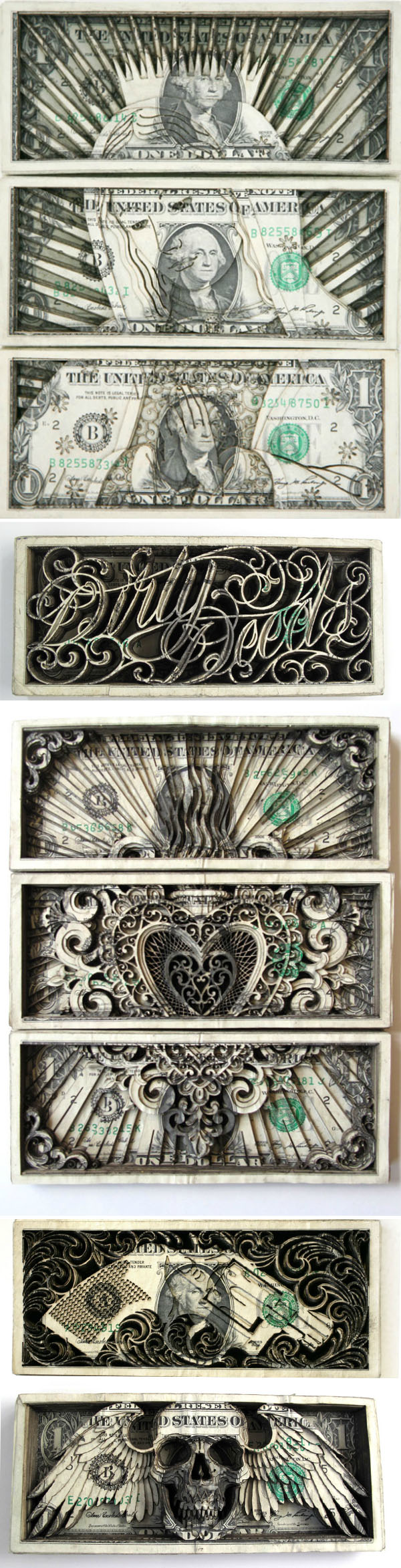
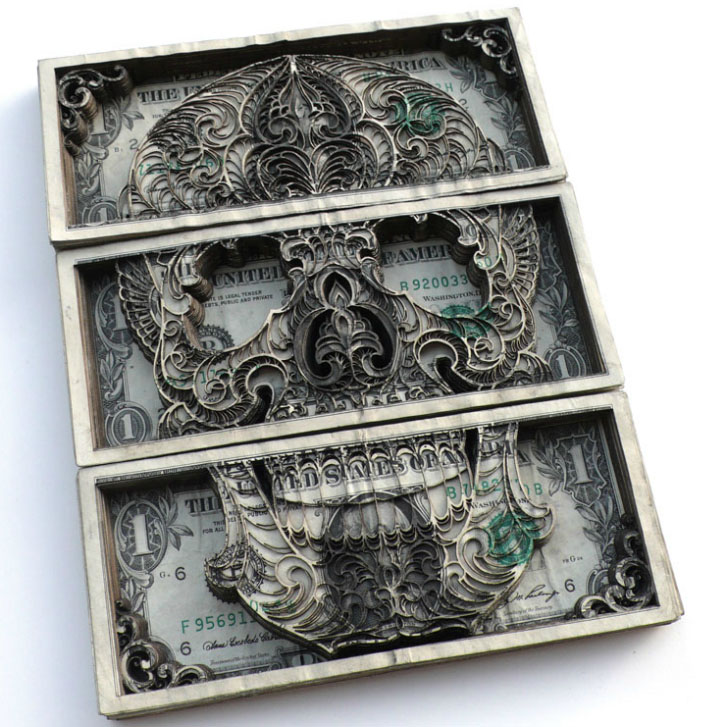
Originally from New Orleans, but now living and working in New York, Scott Campbell studies and chronicles working-class iconography commonly found in tattoo culture. His work highlights the irony within much of that imagery.

In Campbell’s cut currency works, he sources uncut sheets of dollars directly from the U.S. Mint and creates intricate sculpture-like pieces with a sunken relief effect by laser cutting the stacks of bills.

You can see more of Scott Campbell’s work on his site as well as schedule an appointment for a tattoo.

Thanks Rachael!

Tsang Kin-Wah: The Seven Seals

Dynamic projected type installations, Mori Art MuseumDynamic projected type installations, Mori Art MuseumClick to enlarge

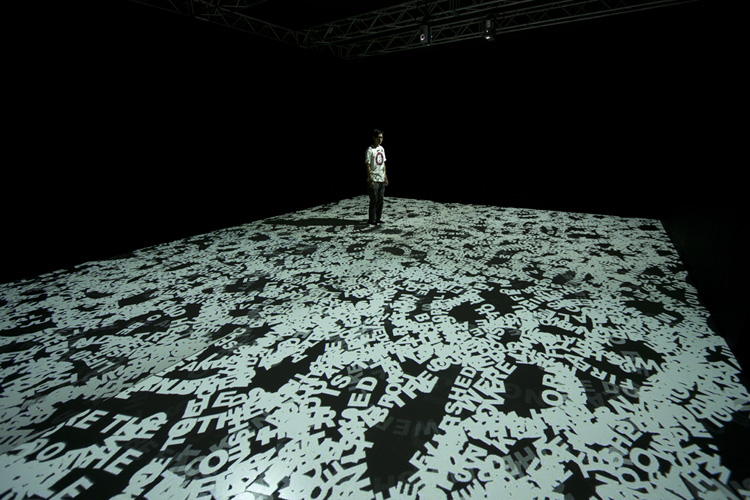
Oh yes, this is right up my alley. Hong Kong based artist Tsang Kin-Wah incorporates text and type to create dynamic installations. From painted floral-like wall patterns that upon closer inspection are made up of letters and Chinese characters, to his ongoing video installation series titled The Seven Seals, Kin-Wah envelops the viewer in type. The texts formed by that type pose questions on existence drawing from biblical, political and philosophical writings, in many cases meant to provoke a range of feelings from the spectator reminding us of issues like war, terrorism, revolution, death, murder, suicide, self-denial, etc.

Presently the latest installation in The Seven Seals, The Fifth Seal – HE Shall Deliver You Up To Be Afflicted And Killed As HE Was, is being shown at the Mori Art Museum in Tokyo through January 15, 2012.

via Mori Art Museum

Bar Code Shopping Center Building

humorous architecture, russia, Bar code building, collabcubedhumorous architecture, russia, Bar code building, collabcubedClick to enlarge

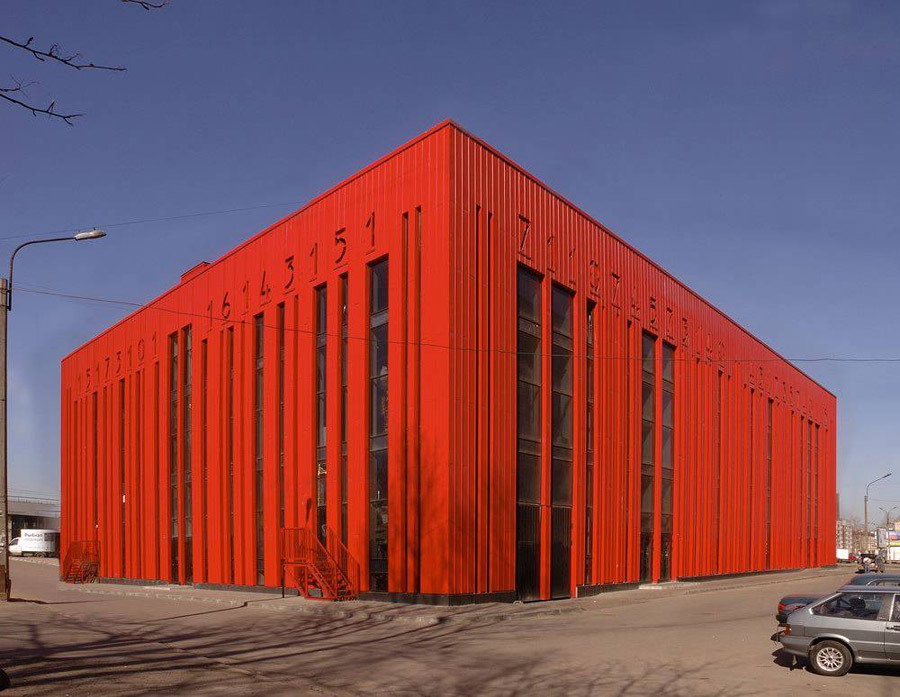
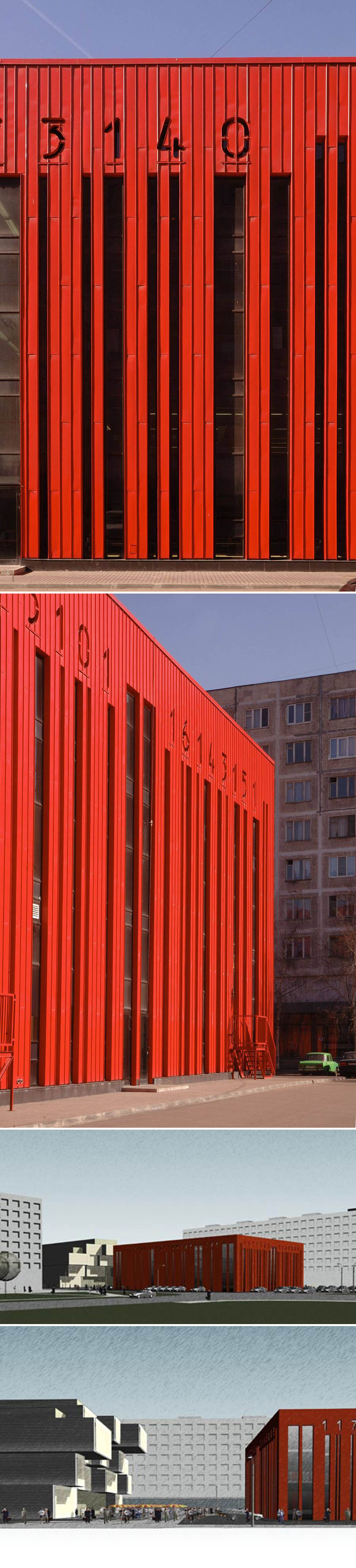
First we find a bar code sculpture and now a building! Not just a building but, more accurately and appropriately, a shopping center. The architects behind the building are the Russian firm Vitruvius and Sons. The Bar Code building or Shtrikh Code, which houses shops and offices, is located on the bank of the Neva River in St. Petersburg. Its bright red façades are hard to miss among the mostly gray landscape. Though completed in 2008, the building was recently entered in the Wan Awards 2011 under the ‘color’ category.

Flow by Carlo Viscione

installation, Heathrow Terminal 5, contemporary art, Boarding Passinstallation, Heathrow Terminal 5, contemporary art, Boarding Pass

Click on images to enlarge

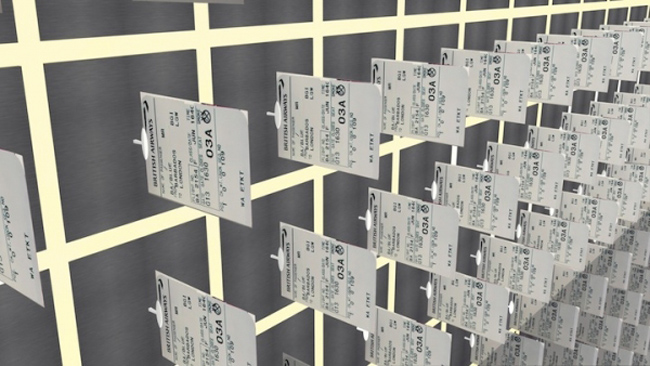
London based spatial designer Carlo Viscione proposed a design, in collaboration with Amy Harris, for an interactive installation, titled Flow, to be placed in Terminal 5 at Heathrow airport. Made up of 4,000 ‘pixels’ measuring 10 sq cm each with a discarded boarding pass ticket stub protruding from the center of each square, the responsive wall reacts to the movement of passers-by. Triggered by ultra-sonic sensors hidden in the ceiling, the installation creates flowing motion by moving the ticket stubs in a synchronized movement across the wall.

From the artist:
The idle state represents a coral reef movement; flow swinging softly left and right. When people are passing by, it reacts to speed, group size and proximity and tracks the people along the 20m length of the installation. The computer assessing the information triggers different algorithms that create different responses to the people passing – from a simple wave to repeating patterns.

We hoped that this little intervention creates a little smile on people’s faces and creates an experience that positively links back to visiting London.

Watch the video above for the full effect. And visit Carlo Viscione’s website to see more of his work.

Ernesto Neto: Faena Arts Center

art installation, Ernesto Neto, Buenos Aires, contemporary artart installation, Ernesto Neto, Faena Arts Center, contemporary artClick to enlarge

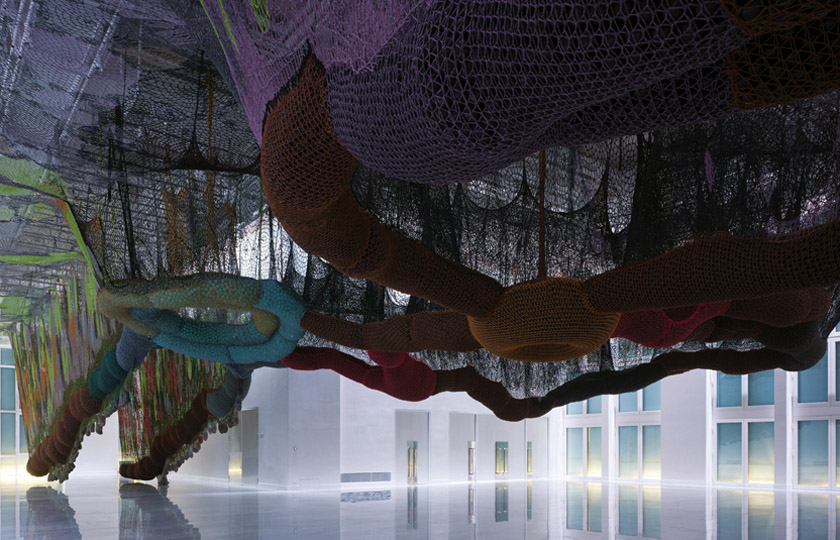
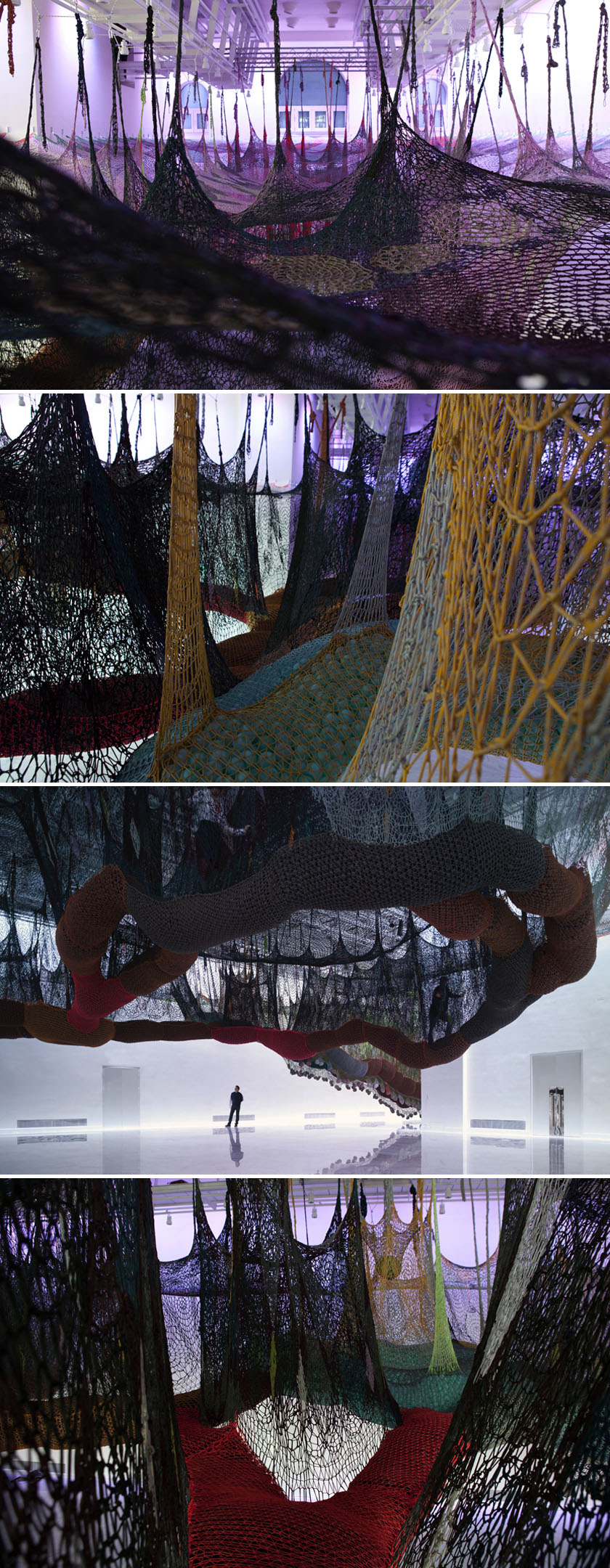
Brazilian artist Ernesto Neto creates installations placing the spectator at the center of the action, making the interaction a key part of his art. His abstract constructs often take up the whole exhibition space creating spatial labyrinths from yarn, rope, fabric and polythene foam as well as spices, such as saffron and cloves, tucked into pouches that hang down at various points. The spectator typically is invited to touch, smell and enter the space.

Neto’s current exhibit at the Faena Arts Center in Buenos Aires fits the profile perfectly. The hundred-year-old Faena Arts Center was one of the country’s first big mills producing close to a thousand tons of wheat a day. Having retained the structure’s original ceiling height, as well as its generously proportioned windows and arches, it certainly provides a spectacular setting for Neto’s latest impressive and imposing sculptural installation.

Ernesto Neto’s exhibit will be up through November 2011.

More Espluga + Associates: Clonography

architectural images, photographs, photoshopped, cloned images, designarchitectural images, photographs, photoshopped, cloned images, designarchitectural images, photographs, photoshopped, cloned images, designClick to enlarge

Also from Espluga + Associates, the Barcelona based graphic design and communications firm (see previous post), an experimental side project that started by chance while doing research for a client: Clonography.

From their site:
Clonography is, at least for us, something beautiful, aesthetically and complex looking but simple at the same time. This duality between complexity and simplicity, between reality and fiction, is what makes it appealing. Clonography is somewhere between photography,  graphic design, architecture and the  cognitive perception theories. Clonography make us react in front of a strange object  despite being familiar at the same time. It contains known shapes and objects disposed in a different way. The virtual image that we are looking at is made of real parts. And is this moment of doubt what attract us.

Many more images have been developed since that first accidental one, resulting in a compilation of images using photographs from Amsterdam, Barcelona, Benidorm, Buenos Aires, Helsinki, Honningsvag, London, Moscow and Tallinn.

A new website is in the works and coming soon.

All images courtesy of Espluga + Associates.

m_lab: Espluga + Associates

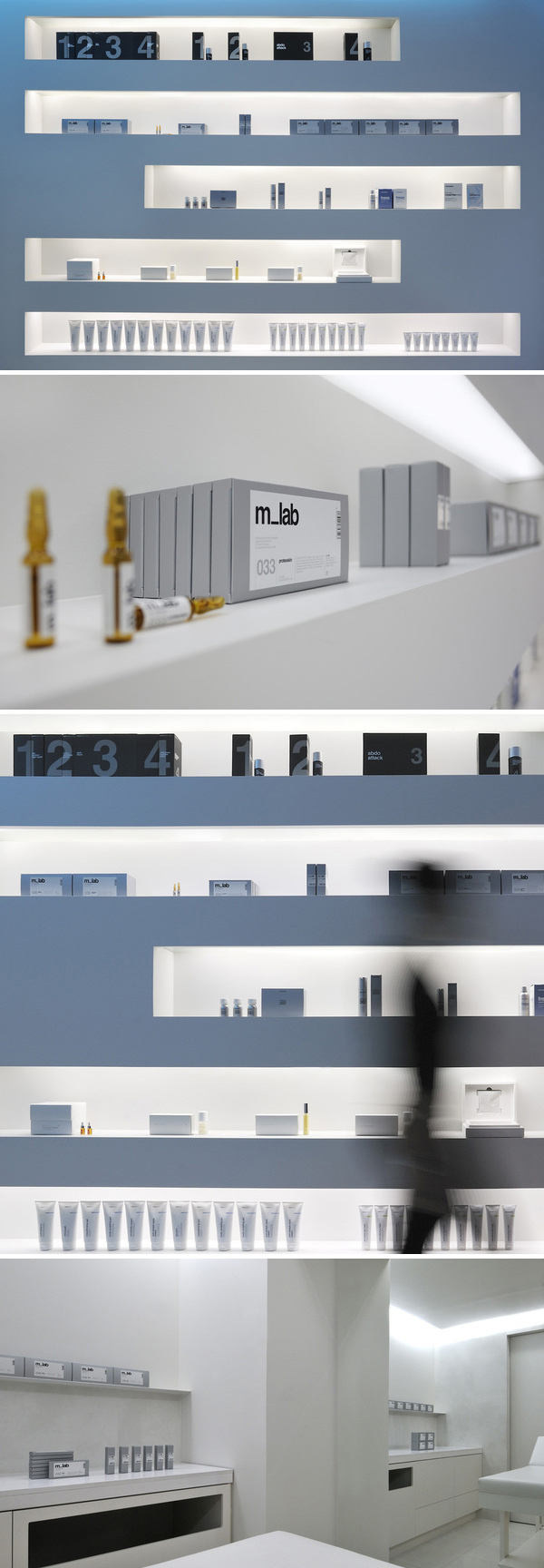
interior design, naming, packaging, retail design, espluga+associates, collabcubedinterior design, naming, packaging, retail design, espluga+associates, collabcubedinterior design, naming, packaging, retail design, branding, collabcubedThe Spanish design firm Espluga + Associates, based in Barcelona, is one of those companies that does it all: graphic design, branding, advertising, naming, and, as they say on their website, lots of other things that end in ‘ing’.

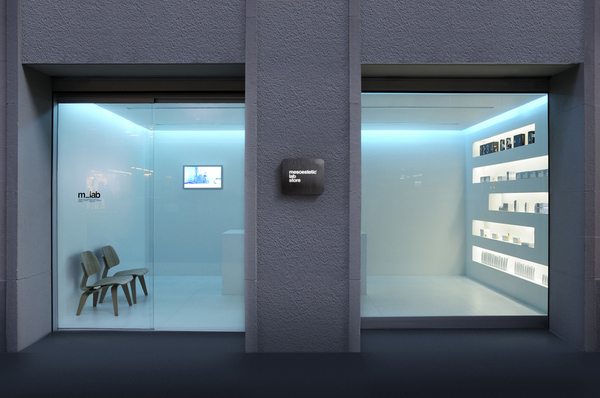
One of their recent projects involved several of these capabilities rolled into one. m_lab, Mesoestetic’s ( a company/laboratory specializing in the development of products for the treatment and care of skin) first lab store in Europe, includes interior design, naming, visual id, and packaging by Espluga + Associates. The white, minimalist design with its recessed blue-tinted lighting along with the Helvetica-driven signage and packaging creates the perfect cool and sterile lab-like feel. Nice!

You can see more of Espluga + Associates work here.

And stay tuned for our next post on a completely different project by this talented studio.

Paul Caporn: Level Compositions

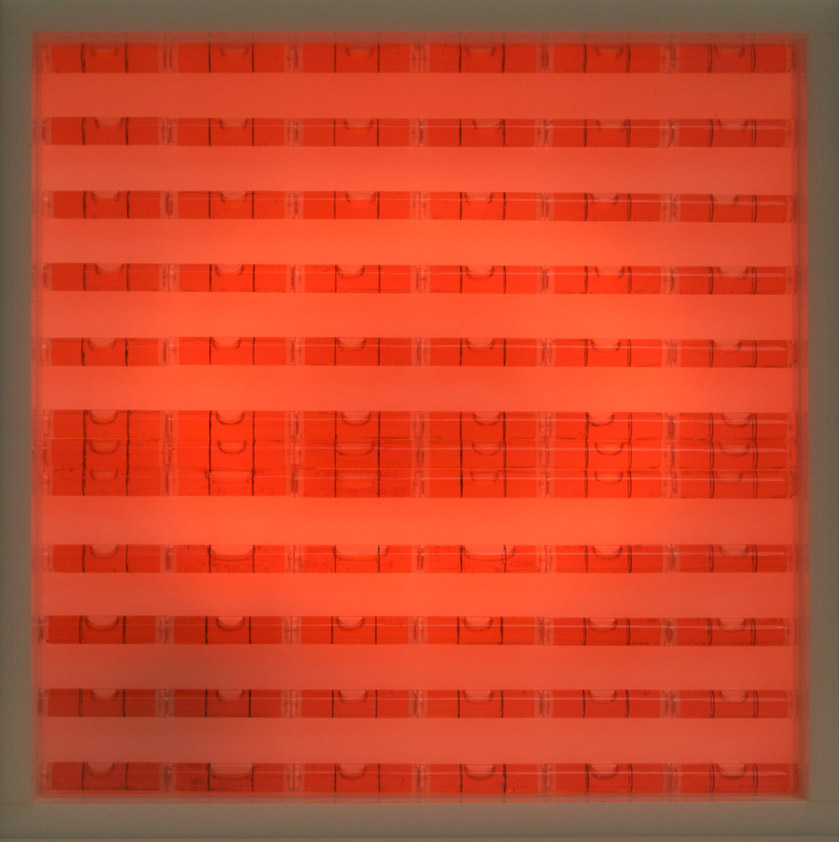
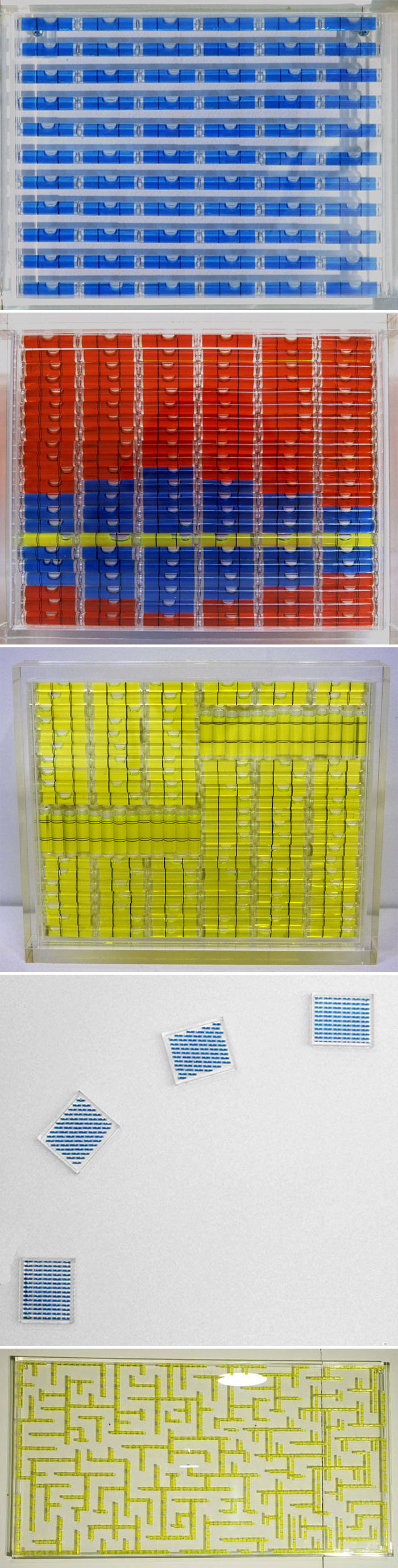
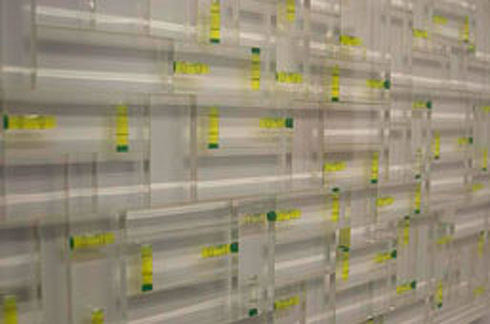
Levels, contemporary art, abstract, australian artist, neon, level compositionslevels, contemporary art, Perth, Turner galleries, Australian art, color, lightLevels, contemporary art, abstract, australian artist, neon, level compositionsPaul Caporn is a Perth, Australia based artist who creates sculptural and installation works, some of which incorporate light. The objects used are familiar but he pushes them in new directions. In his Level Composition Series, Caporn takes an ordinary construction measuring tool – the level – along with light and color, sometimes neon, and makes these contemporary tableaux. I’ve always found levels with their moving, and ideally centered, bubbles to be beautiful objects in themselves, so these pieces really appeal to me.

You can see more of Paul Caporn’s work here.

Images courtesy of Turner Galleries and the artist.

Appau Jnr Boakye-Yiadom

conceptual art, humor, video, installation, photography, contemporary artconceptual art, humor, video, installation, photography, contemporary artClick to enlarge

These photos and videos by London born and based artist Appau Jnr Boakye-Yiadom made me chuckle. Using everyday objects as characters, Boakye-Yiadom creates performance environments in his studio. Essentially creating humorous/absurd experiments, Boakye-Yiadom then documents the (very brief) acts through film, photography and installation. It’s worth watching a few of the short videos below to get the full effect.

via the future can wait

Scott Jarvie: The Clutch Project

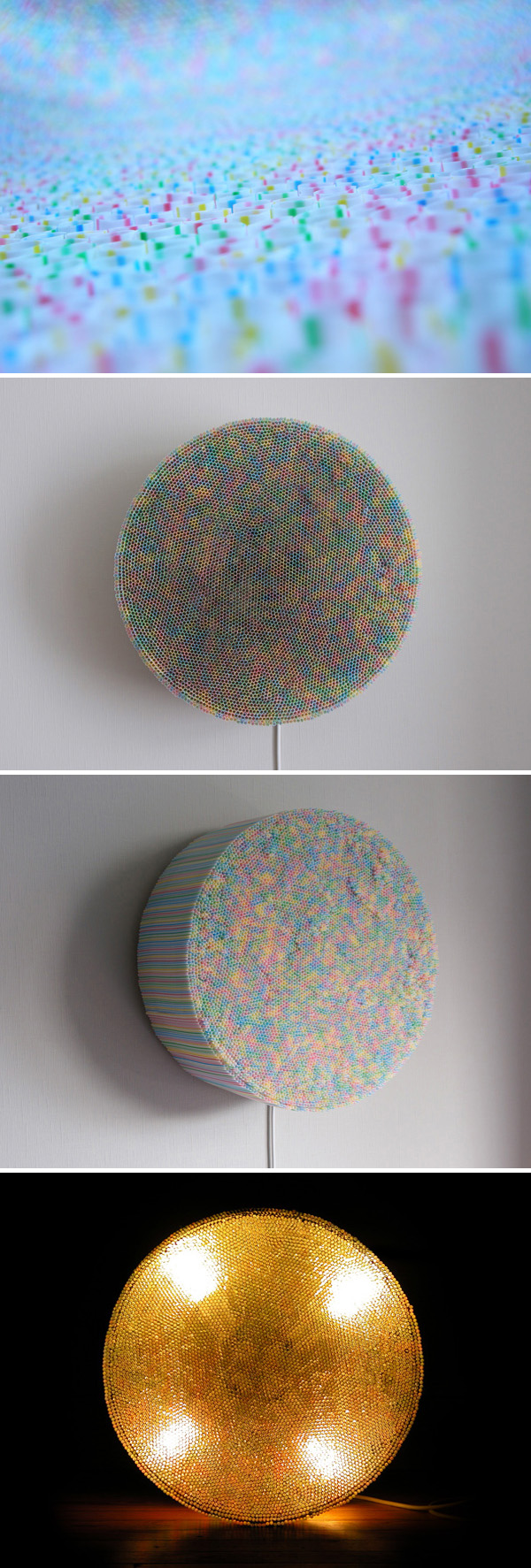
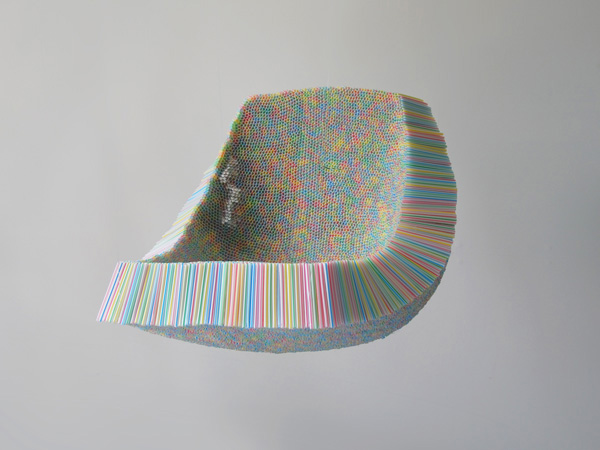
straws, drinking straws, chair, research piece, Noise Festivalstraws, drinking straws, chair, research piece, lamp, cool designI happened upon Scottish designer Scott Jarvie’s website and his Clutch Project. The Clutch Chair is an experimental research project made from 10,000 drinking straws. In the Clutch Lamp, the straws are grouped together and transformed into a spot light. The inner surface of the straws reflect the light in a jewel-like manner creating a unique effect.

Instantly reminded me of one of my favorite artists, Tara Donovan’s Haze installation: thousands of clear drinking straws stacked on a wall creating an effect that doesn’t even look like the straws that it’s made up of.

You can see more of Scott Jarvie’s interesting work here.