Haffenden House: Para-Project

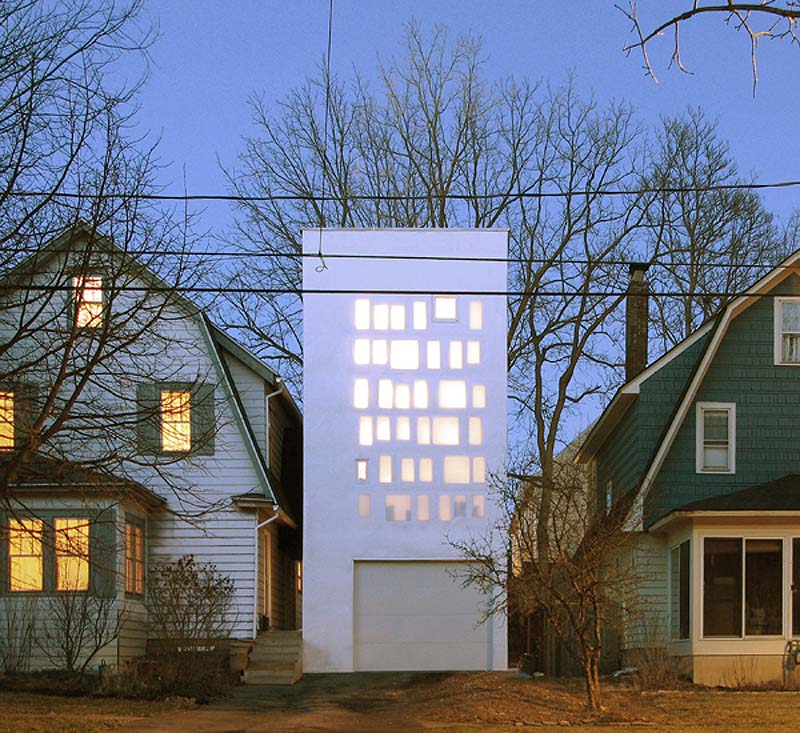
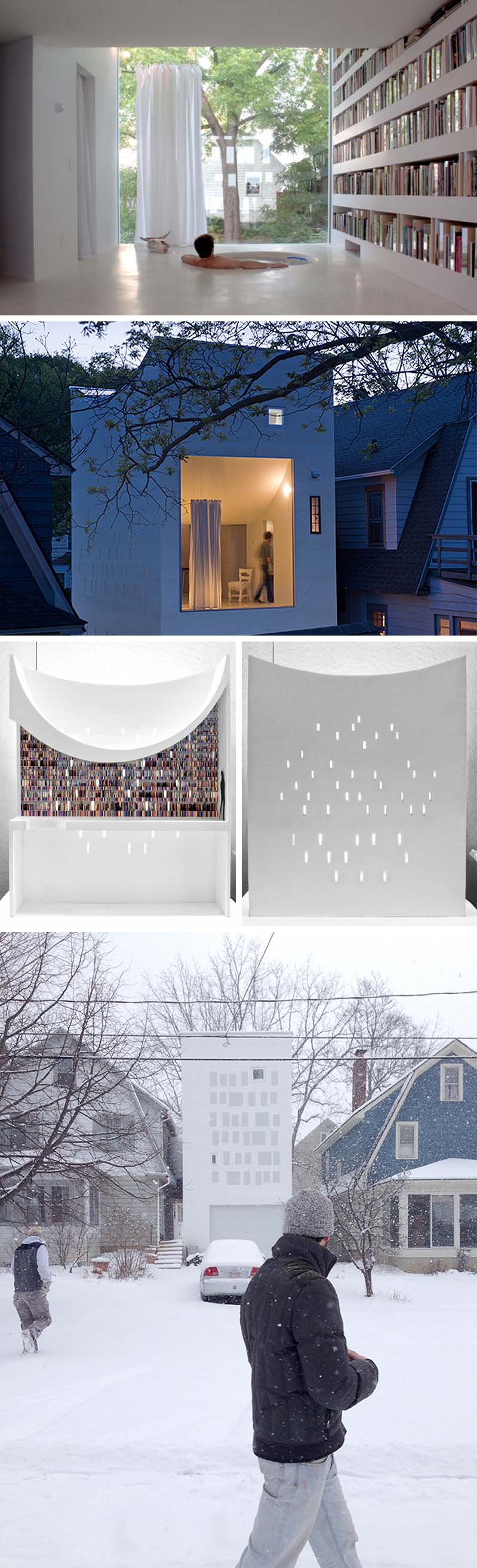
Haffenden House, Syracuse, Para-Project. Contemporary architecture. House in SyracuseHaffenden House, Syracuse, Para-Project. Contemporary architecture. House in SyracuseHaffenden House, Syracuse, Para-Project. Contemporary architecture. House in SyracuseDesigned by Brooklyn-based firm Para-Project, the Haffenden House in Syracuse, NY, departs from the traditional “house”, breaking the repetitive suburban landscape. The house, designed for two poets, includes a library and writing space on the second floor, a curved reading room above that, and a garage at its base. The 1,125 sq. foot building is wrapped in a white fabric made with silicone-impregnated fiberglass. The fabric adheres to the façade with the exception of the glass windows. The space between the glass and fabric create a fuzzy quality, allowing light in, yet providing a certain amount of privacy from the street. The back windows are not screened, offering an open view to the backyard.

All images courtesy of Para-Project.

via archrecord
Home Street Home: Le Projet FMR

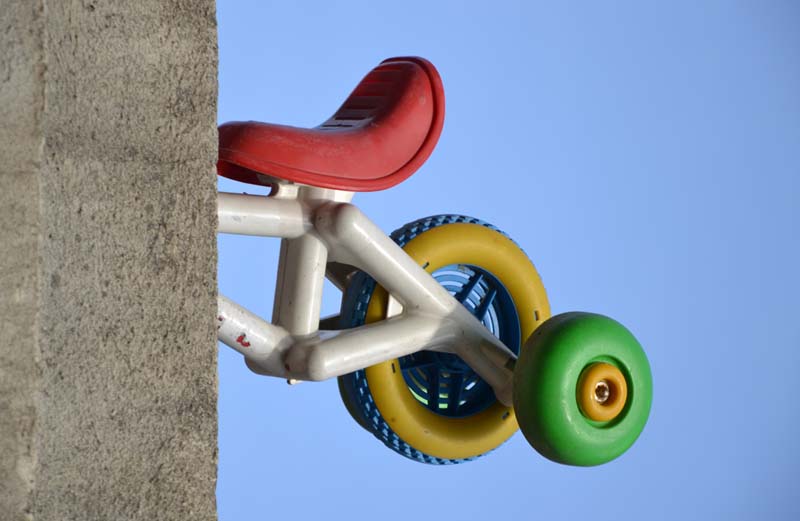
Home Street Home, Le Projet FMR's street art exhibit in a Montpellier Villa pre-destruction, in FranceHome Street Home, Le Projet FMR's street art exhibit in a Montpellier Villa pre-destruction, in France. BMX, Levalet, Depose, Kashink, Leo & Pipo, Mme Moustache, Yuri Hopnn Home Street Home, Le Projet FMR's street art exhibit in a Montpellier Villa pre-destruction, in France. BMX, Levalet, Depose, Kashink, Leo & Pipo, Mme Moustache, Yuri Hopnn Last month, continuing in the tradition of converting pre-demolition or abandoned sites into an opportunity for a temporary street art show – Tour Paris 13, Rae’s Word of Mouth Bodega, and Surplus Candy being prime examples – Le Projet FMR organized the exhibition Home Street Home in a villa doomed to destruction in Montpellier, France. Coralie & Tom, former lawyers who started the project, had a week to set the place up with the help of local and international street artists. Some of these include: Mr. BMX’s bikes; Levalet and the incorporated cables; Baubô in the bathroom; Mme. Moustache; Yuri Hopnn; Stoul in the kitchen; Depose’s graffiti walls; and Souredj’s sculptural street art, to name just the ones in the photos above. Home Street Home was up and open to the public from January 17th through the 19th. You can see many more photos on Le Projet FMR’s website and facebook page, and you can get a virtual tour with some artist interviews in French in the video below:

via lustik

Coffin as Solarium: Younes Baba-Ali

Coffin as sunbed, ending your life under the sun, Younes Baba-Ali, contemporary sculpture, Moroccan art, Belgian art, suntan bed as coffinCoffin as sunbed, ending your life under the sun, Younes Baba-Ali, contemporary sculpture, Moroccan art, Belgian art, suntan bed as coffinCoffin as sunbed, ending your life under the sun, Younes Baba-Ali, contemporary sculpture, Moroccan art, Belgian art, suntan bed as coffinWinter is a time of migration to warmer climate, not only by birds, but, in the past generation or two, among many of the professionally retired in western societies. And right about now, in the midst of our fourth or fifth snowstorm here in NYC — I’ve lost count — the thought is completely understandable and immensely appealing. Moroccan-born visual and sound artist Younes Baba-Ali, who splits his time between Brussels and Casablanca, has an interesting take on the phenomenon of “migratory flux”. His installation/sculpture titled Ending Your Life Under the Sun converts a coffin into a tanning bed, or is it the other way around? Who hasn’t associated those sun beds with coffins at some point? If you can get past the slightly morbid aspect, there’s definitely wiggle room for a chuckle.

via Sabrina Amrani Gallery

Veranda Café: Tihany Studio

Veranda Cafe, Tihany Design, Adam Tihany, Kuwait City, Harvey Nichols, The Avenues Mall, contemporary architecture, restaurant designVeranda Cafe, Tihany Design, Adam Tihany, Kuwait City, Harvey Nichols, The Avenues Mall, contemporary architecture, restaurant designVeranda Cafe, Tihany Design, Adam Tihany, Kuwait City, Harvey Nichols, The Avenues Mall, contemporary architecture, restaurant designOne would imagine that the new Veranda Café in Kuwait City might have upped their usual insurance policy. The striking mirrored design by Adam D. Tihany of the NYC-based Tihany Studio makes for a fun house hall-of-mirrors quality that looks like it could confuse even the sharpest person as they ascend or descend the staircase. Made using pieces of steel shaped into fractal geometric forms and then covered with a mirror finish, the entrance to the restaurant continues up the walls and onto the ceiling all the way to the reception area. Probably makes for some fun photos, seeing oneself in multiple panels at the same time. Once inside the restaurant, the design continues in a slightly warmer style that also envelopes the space, but this time in undulating pieces of wood. Quite dramatic all the way around.

via interni

Jon Burgerman: Head Shots

Head shots by Jon Burgerman, a series of photographs staged in front of violent movie ads and spewing bloodHead shots by Jon Burgerman, a series of photographs staged in front of violent movie ads and spewing bloodHeadshots by Jon Burgerman, a series of photographs staged in front of violent movie ads and spewing bloodThe always-wacky usually-less-bloody Jon Burgerman (previously here) has a an ongoing series of interventions staged in front of film and television ad panels, photographing himself perfectly situated as the target of the pointed gun, arrow, or other weapon of choice in each poster. These Head Shots, as the series is called, are then digitally manipulated, adding splattered blood in a Tarantinoesque fashion. Definitely a departure from the cute characters he usually draws, but still, somehow, very Burgerman.

You might like his Korean Subway series, too.

Michael Johansson: Model Kit Sculptures

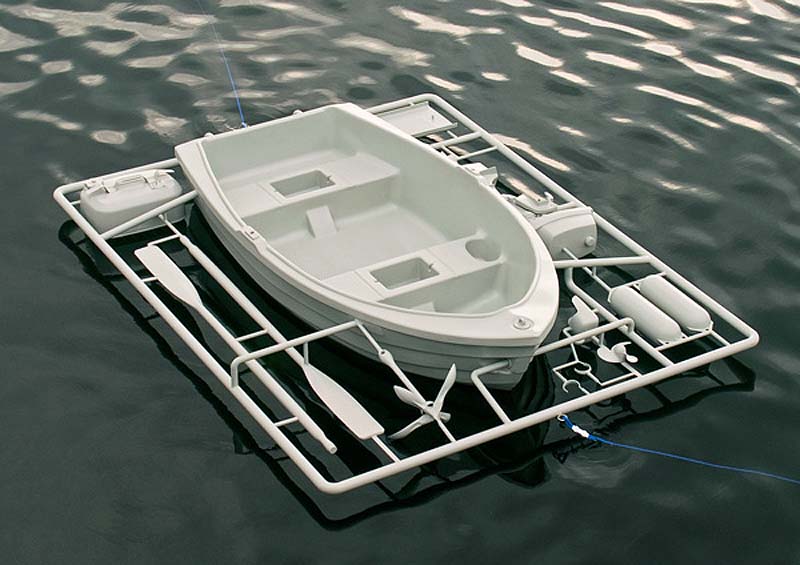
Michael Johansson, everyday objects and toy-model-like sculptures, contemporary, humorous, sculpture, dinghyMichael Johansson, everyday objects and toy-model-like sculptures, contemporary, humorous, sculpture, dinghyMichael Johansson, everyday objects and toy-model-like sculptures, contemporary, humorous, sculpture, engine bought separatelySwedish artist Michael Johansson takes everyday objects apart and rejoins the pieces in a welded metal frame, coating them with a unifying layer of plastic, ultimately simulating the look of a snap-apart model kit, something Johansson is very familiar with having spent much of his childhood making toy models. There’s obvious humor in these, but the titles such as Toys’r’Us – Dingy Scale 1:1 and Engine Bought Separately leave it completely unambiguous.

And then there’s this aspect of his work…

via thetreemag

Onion Skin: Olivier Ratsi

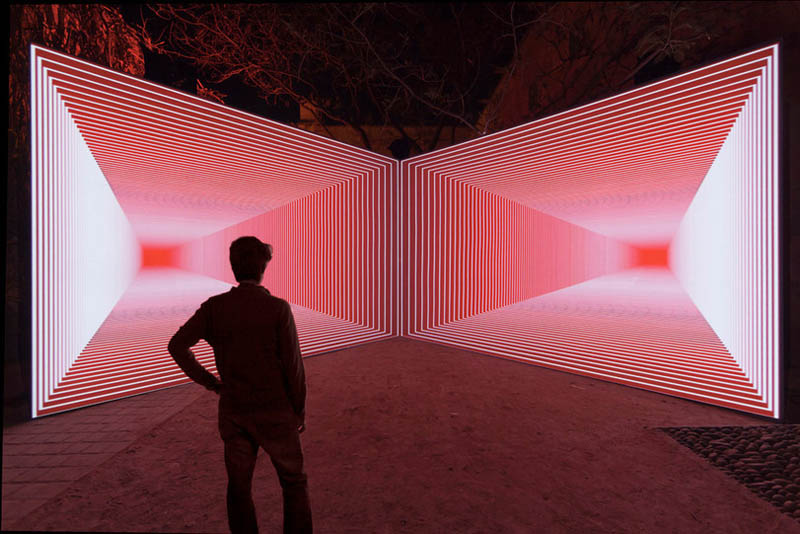
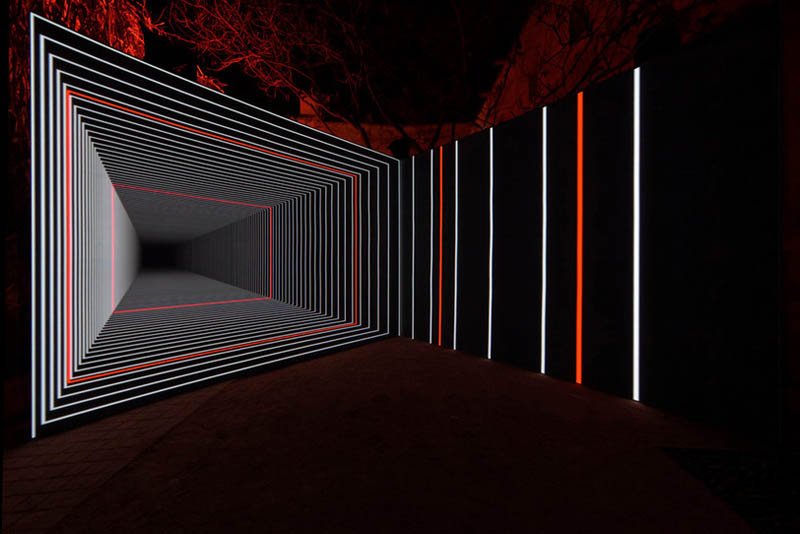
Olivier Ratsi's Onion Skin, audio-visual immersive installation, time and space through perspective gameOlivier Ratsi's Onion Skin, audio-visual immersive installation, time and space through perspective gameOlivier Ratsi's Onion Skin, audio-visual immersive installation, time and space through perspective gameOlivier Ratsi is a French visual artist whose work is mainly based upon representations of space’s perception and the experience of reality. His audiovisual immersive installation, Onion Skin, offers the viewer a changing perspective of space and time. Consisting of two walls set up perpendicular to each other and serving as canvases on which a series of animated geometric shapes are projected—along with sound—a new dimension is slowly revealed. Using repetition and scale, the anamorphic visuals play tricks on the viewer, having what initially seemed flat, suddenly delineate a new space, consequently altering their perception of depth all the while having a hypnotic effect. The illusion appears as the “onion skins” seem to peel away and leave their physical surface behind. Here’s a video:

via rooms magazine

NONEON: Fabian Thiele

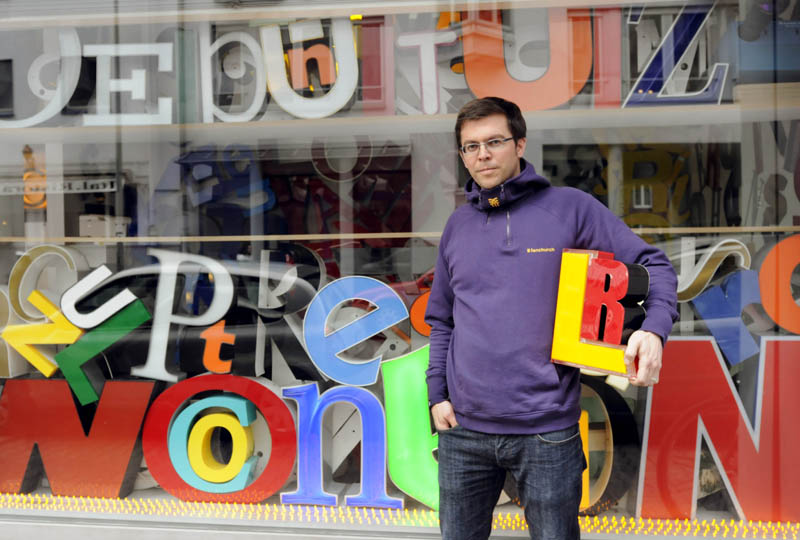
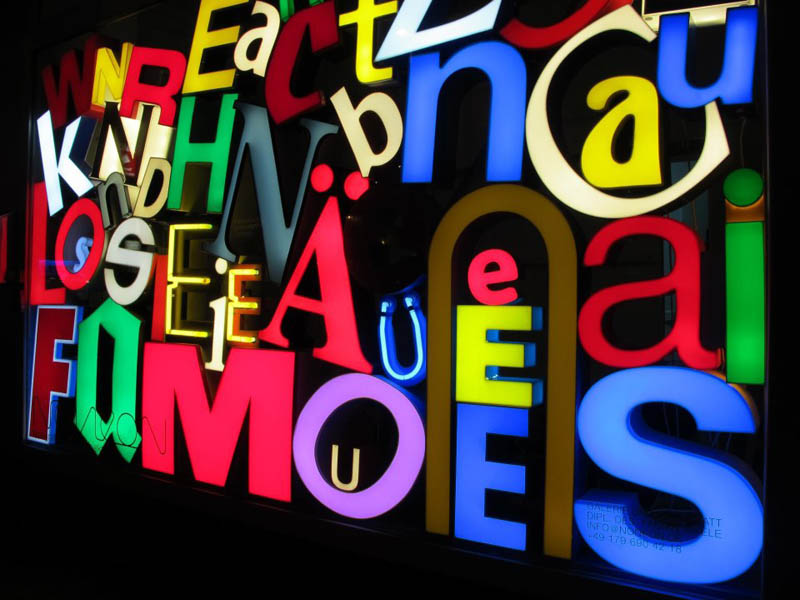
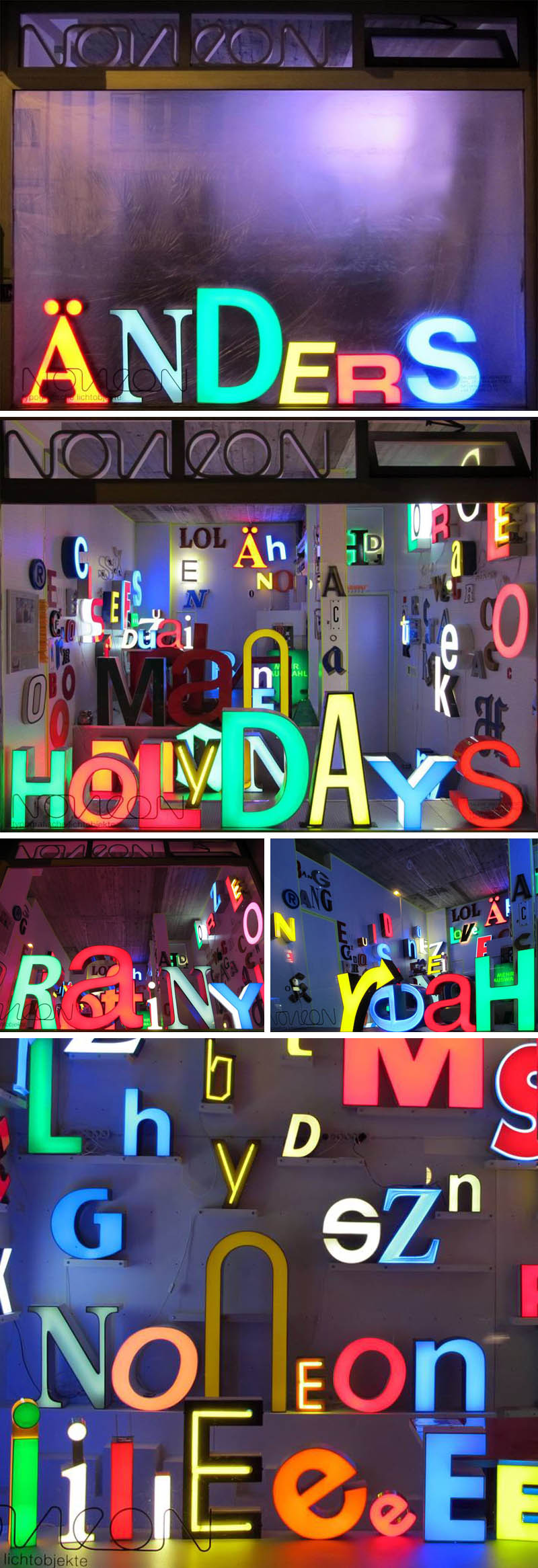
Noneon, recycled sign letters converted into lights by Fabian Thiele. FrankfurtNoneon, recycled sign letters converted into lights by Fabian Thiele. FrankfurtNoneon, recycled sign letters converted into lights by Fabian Thiele. FrankfurtI certainly know where I’ll be headed if I find myself in Frankfurt. NONEON is a small shop/gallery run by designer Fabian Thiele who has been collecting letters from old signs and fixing them up, making them into lights, all, apparently, affordable to boot. Just seeing these piles of illuminated type makes me happy. The shop is only open on Fridays and Saturdays so, if this appeals to you next time in Frankfurt, make sure to plan accordingly. Recycling at its best.

via luminapolis

Icepop Generator: MELT

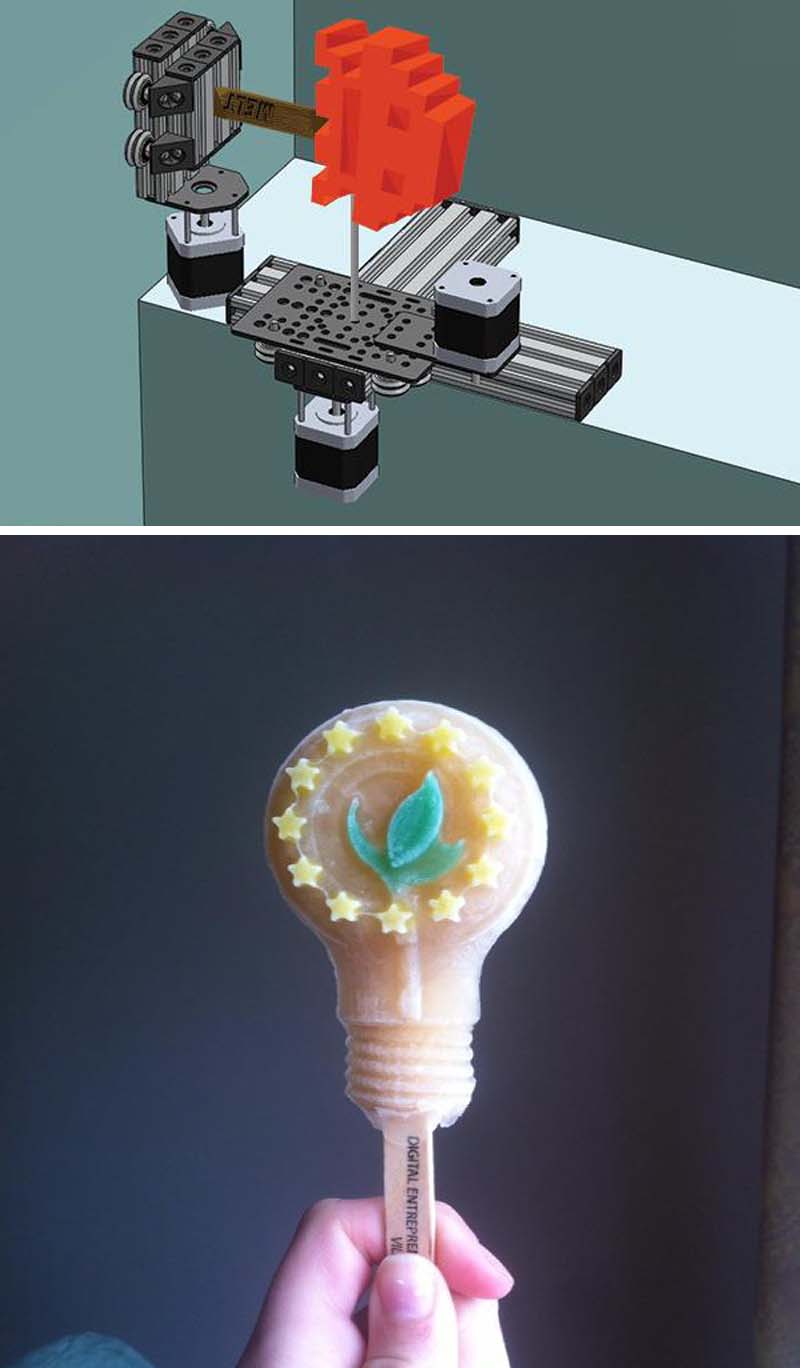
Icepop Generator concept by MELT. 3D printed icepops. Self-portrait icepopsIcepop Generator concept by MELT. 3D printed icepops. Self-portrait icepopsIcepop Generator concept by MELT. 3D printed icepops. Self-portrait icepopsIt was only a matter of time before 3D printing turned to food, or vice versa. There have been some spectacularly beautiful pieces (actually, too beautiful to put in your coffee!) made with sugar, and now there is talk of Hershey teaming up with 3D Systems to create, I assume, some amazing things with chocolate. So, it shouldn’t come as a big surprise that Dutch company MELT is creating an the Icepop Generator to bring personalized ice pops to the public while educating them in 3D design technology. It appears, however, that the Icepop Generator works more on a carving and chiseling process rather than actually 3D printing an ice pop from frozen water but, it’s amazing nonetheless. Starting with a block of ice, the generator (which looks like many 3D printers with the twist of doubling as a freezer) has a sort of drill that moves back and forth along three axes, carving out the designated design, in effect, functioning as a mechanical sculptor. The Icepop Generator was just funded yesterday on Voordekunst—a Dutch funding platform similar to Kickstarter—so these pops are likely to be at a street fair or festival near you in the not-so-distant future. In the meantime the creative team at MELT has made several a pop, some in their own image. You can see how it works in this video:

via notcot and 3ders

Nakhlak Confectionery: Fatourechiani Arch

Nakhlak Confectionery, Tehran, Iran. Interesting building renovation with a prismatic facade made of woodNakhlak Confectionery, Tehran, Iran. Interesting building renovation with a prismatic facade made of woodNakhlak Confectionery, Tehran, Iran. Interesting building renovation with a prismatic facade made of woodNakhlak-Confectionery_Fatourechiani-Architecture-Studio_Tehran-Iran_plan_collabcubedWell, this is quite a transformation. Majid Fatourechiani and Hamid Fatourechiani of Fatourechiani Architecture Studio in Tehran, Iran, have recently completed a new storefront for Nakhlak Confectionery in their own city. By attaching a sculptural prismatic patterned wooden louver to the upper part of an existing—and rather unremarkable—building (see 4th photo from top), in addition to renovating the interior and rest of the exterior, Fatourechiani Studio has made the building virtually unrecognizable. What was once generic is now strikingly contemporary. It almost looks like giant exploding triangles of milk chocolate…but maybe that’s just me. The stainless steel signage slab adds to the modernity and gives an element of sleek elegance. Definitely interesting and daring.

If you like this, you might also enjoy this Iranian snack bar design.

via contemporary architecture of Iran

Upside Down House: Moscow

upside down house at the VVTs All-Russia Exhibition Center in Moscow. Visitors walk through and see themselves upside down.upside down house at the VVTs All-Russia Exhibition Center in Moscow. Visitors walk through and see themselves upside down.upside down house at the VVTs All-Russia Exhibition Center in Moscow. Visitors walk through and see themselves upside down.upside down house at the VVTs All-Russia Exhibition Center in Moscow. Visitors walk through and see themselves upside down.At the VVTs All-Russia Exhibition Center in Moscow last week, an upside down house had visitors in a tizzy. Similar in concept to Jean-François Fourtou’s Tombée du Ciel, this house (not sure who the artist/designer behind the project is) is larger and even includes a car hanging from the driveway. The multi-room structure was built upside down as a tourist attraction and was fully fitted with furnishings, kitchen, bath, and even food on the dining room table, all hanging from the ceiling, or, rather, floor…wait. It appears that at least in one of the rooms a video camera was inverted inside a cabinet (see third photo down) projecting the room live and right side up on a tv screen and, consequently, its visitors upside down. Confusing and fun.

via gizmodo

Thanks Ramon and Eugene. (GMS)

DipJar: Ryder Kessler

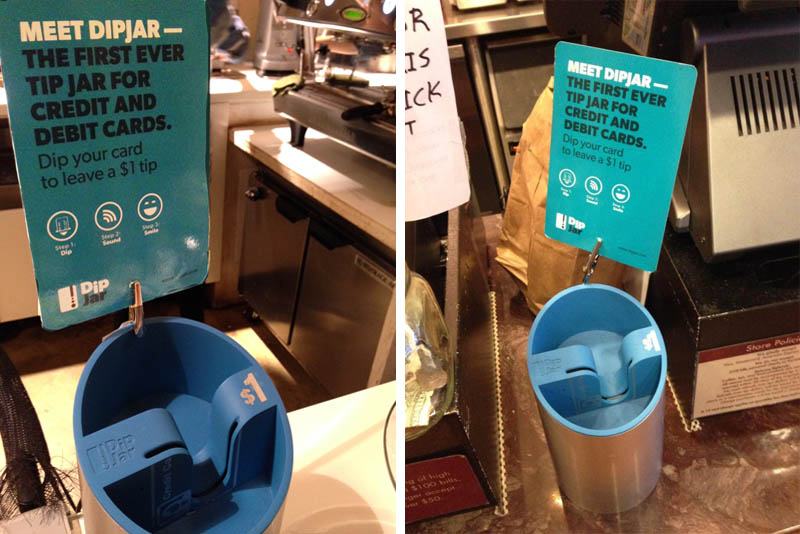
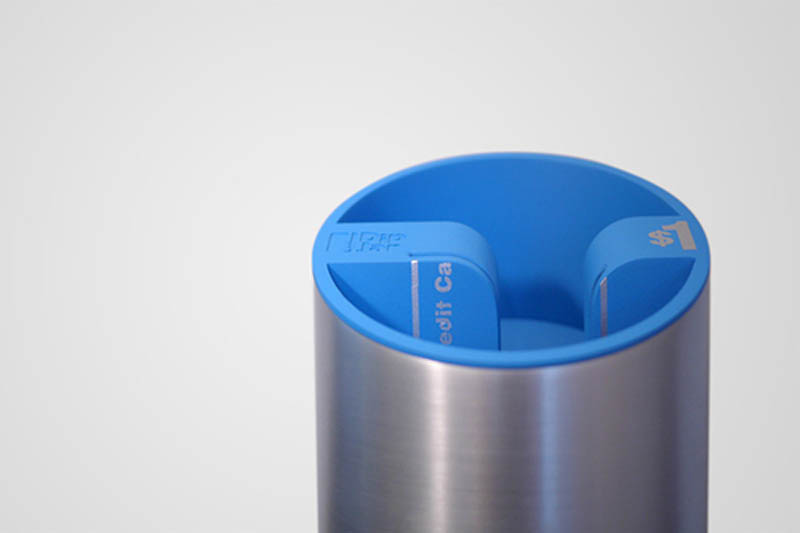
Credit card tipping gadget DipJar by Ryder KesslerCredit card tipping gadget DipJar by Ryder KesslerCredit card tipping gadget DipJar by Ryder KesslerThe other day I passed by Fresco Gelateria/Café and was reminded of the last time I was in there with a friend who noticed an interesting gadget on their counter. “Meet DipJar—” as the sign reads, “the first ever tip jar for credit and debit cards.” This nicely designed (by industrial designer Simon Enever) stainless cylindrical vessel charges your credit card a dollar tip with one quick swipe or, more precisely, “dip” of your card. This clever product is the brainchild of Ryder Kessler who, after chatting with several baristas, learned that along with the uptick of credit and debit card use for small purchases came the plummeting of cash jar tips. In a world where printed currency is fast becoming a thing of the past, replaced by credit and bitcoins, this is just another example of smart design following in the footsteps of Square and the less successful waving-of-cell-phones for subway entry. This is good news for industrial designers! Bad news for cheapskates: not having change or singles is no longer a valid excuse to avoid tipping.

Sarah Oppenheimer: Spatial Confusion

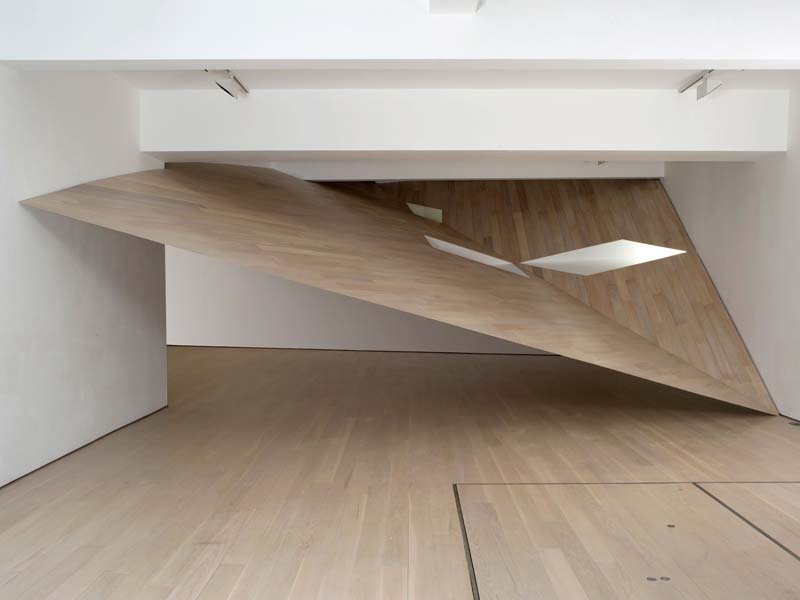
Sarah Oppenheimer's Amazing Gallery Installations with tricky and dramatic holes, doorways, and windowsSarah Oppenheimer's Amazing Gallery Installations with tricky and dramatic holes, doorways, and windowsSarah Oppenheimer's Amazing Gallery Installations with tricky and dramatic holes, doorways, and windowsNYC-based artist Sarah Oppenheimer‘s work blurs the line between sculpture and architecture. Her amazing installations usually involve moving walls, slanting floors, and creating apertures—sometimes symmetric, sometimes asymmetric, and often with mirrors—that would mesmerize (and confuse) the most resistant of gallery/museum guests. Much in the way James Turrell or Doug Wheeler can create spatial confusion with light, and Richard Serra can take over a space with his torques, Oppenheimer makes the gallery itself—and the experience of walking through it—the art. All her works are identified by  letters and numbers such as D-33 (second photo from top) making them all the more abstract. Each work is meticulously planned with mechanical drawings and engineered load tests, then executed with precision. I can’t wait to see one of these in person.

via ppow gallery

FlipBooKit Moto

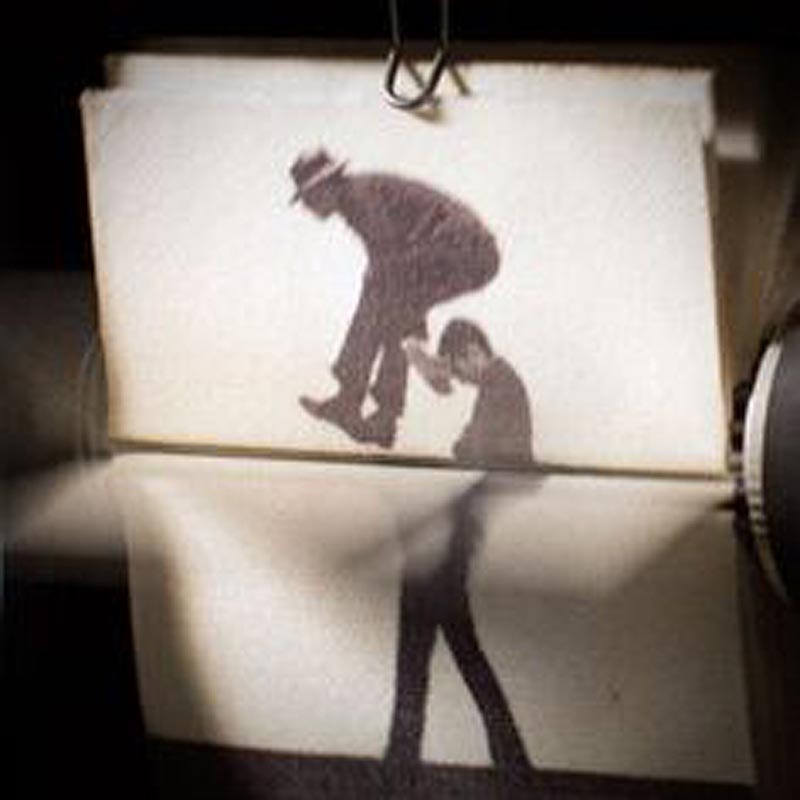
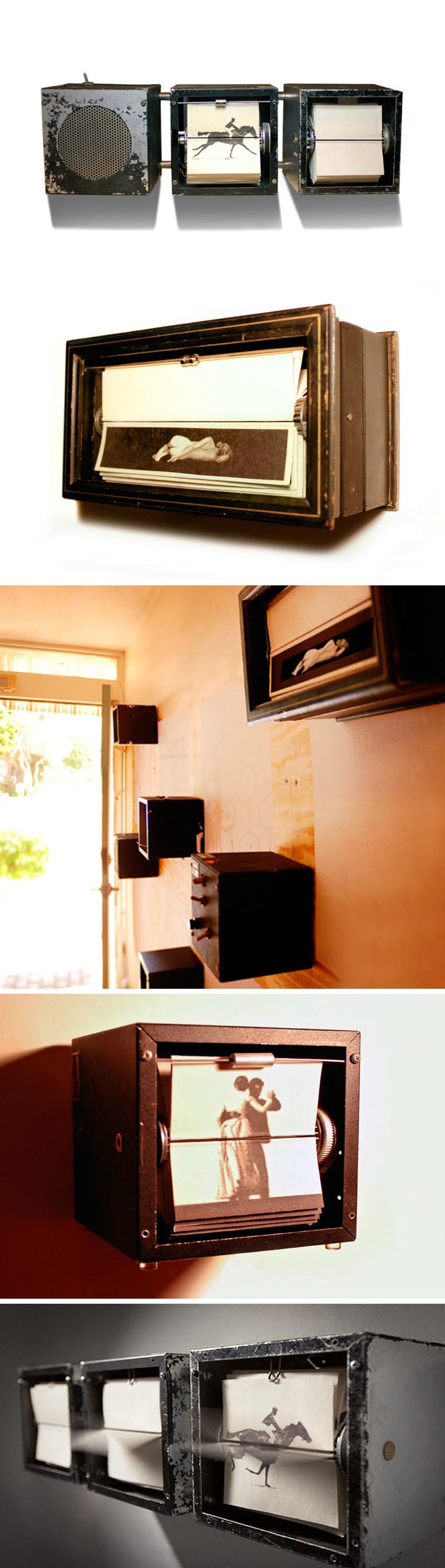
FlipBooKit Moto by WEndy Marvel & Mark Rosen, Kinteic ArtistsFlipBooKit Moto by WEndy Marvel & Mark Rosen, Kinteic ArtistsFlipBooKit Moto by WEndy Marvel & Mark Rosen, Kinteic ArtistsWho doesn’t like a good flipbook, right? And your very own? Even better. A few years back I made a couple of flipbooks of my kids when they were little via flipclips which were a hit, but now kinetic artists Wendy Marvel and Mark Rosen have taken the concept to a whole new level with their FlipBooKit Moto, a motorized animated flip book. Based on their own artworks inspired by the motion studies of Eadweard Muybridge, the duo applied the same techniques they use in their sculptural mechanical flipbooks to a DIY kit. It’s easy to assemble— you’ll only need a screwdriver—and will take less than an hour to complete. You can use the included art or use your own images, the possibilities are limitless! Looks like a great gift idea. You can hear more about it in the video below and you can purchase it here.

via swissmiss

Chameleon Cabin: White Arkitekter

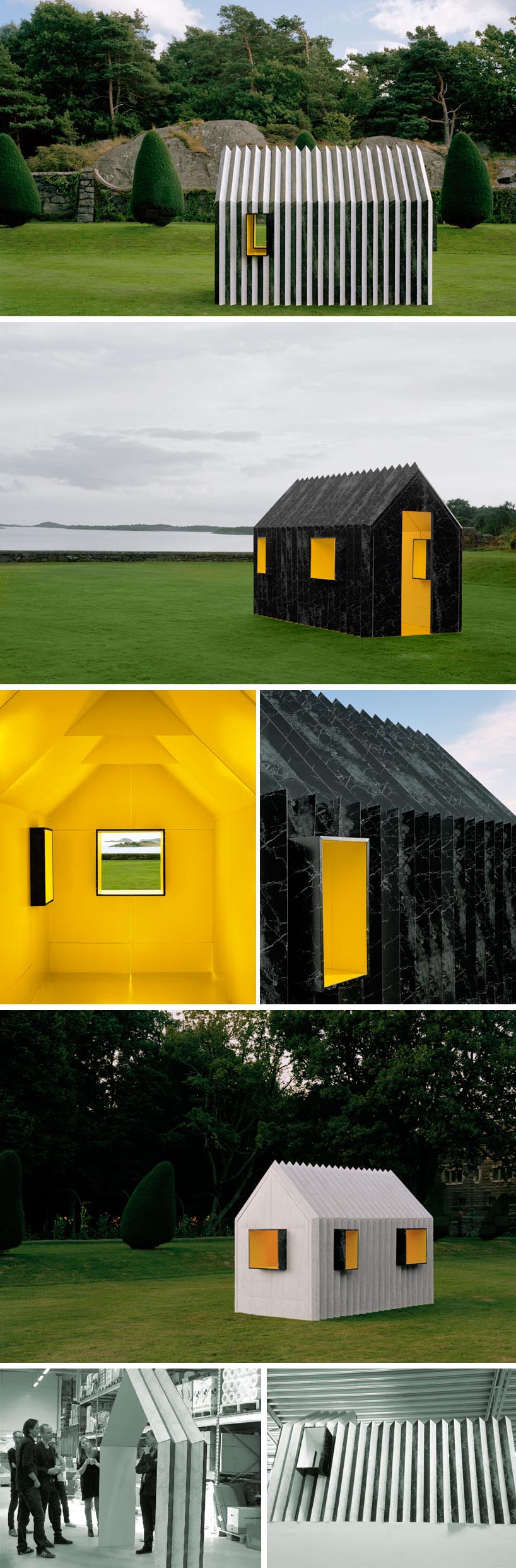
Chameleon Cabin, White Architects, Sweden, reversible paper cabin, white marble from one side, black marble opposite sideChameleon Cabin, White Architects, Sweden, reversible paper cabin, white marble from one side, black marble opposite sideChameleon Cabin, White Architects, Sweden, reversible paper cabin, white marble from one side, black marble opposite sideThe Scandinavia-based architecture firm White Arkitekter has created a tricky all-paper cabin titled Chameleon Cabin. Made of corrugated paper and weighing roughly 100 kilos, looks like white marble from one angle and black marble from the opposite one. Using a simple system of tabs and slots, 95 paper modules—printed in white on one side and black on the other—were attached to form a cabin the proportions of which were based on those of a Swedish friggebod, a shed that can be built without planning permission. The modular system could be used to create longer structures as well. The bright yellow interior is a great glowing touch.

Photos by Rasmus Norlander

via designboom

Blaqk: Greg Papagrigoriou & Simek

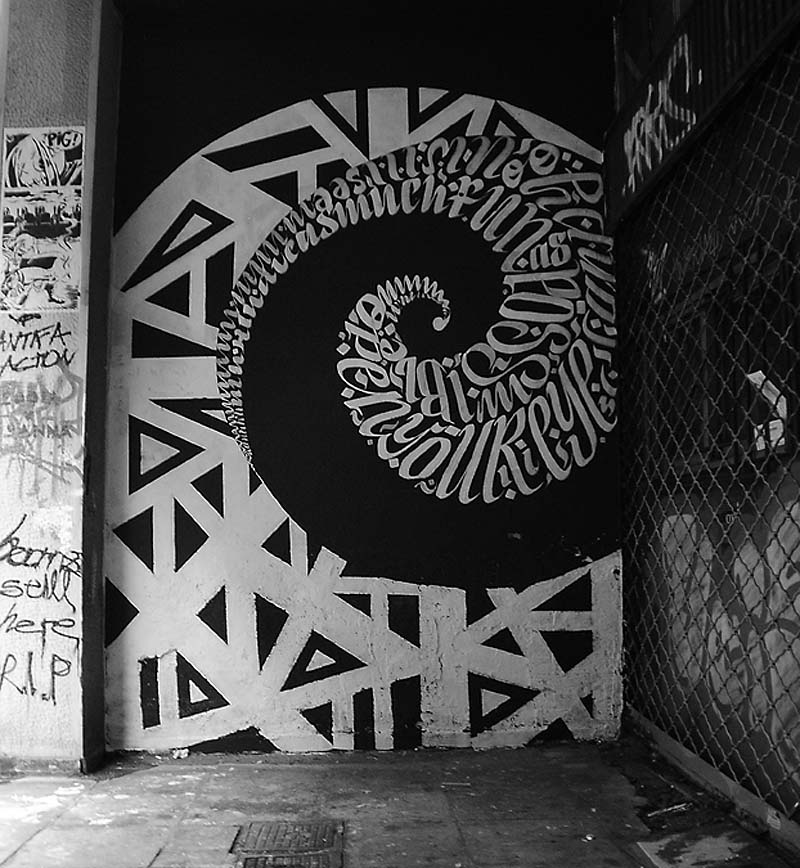
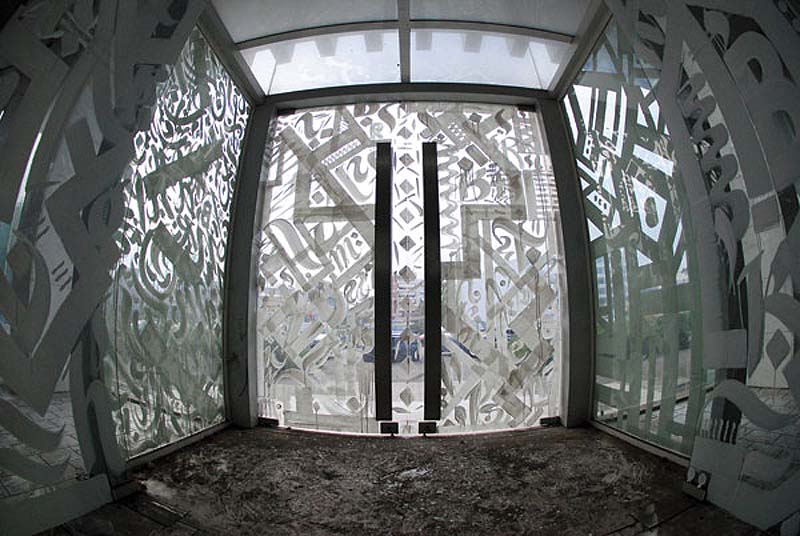
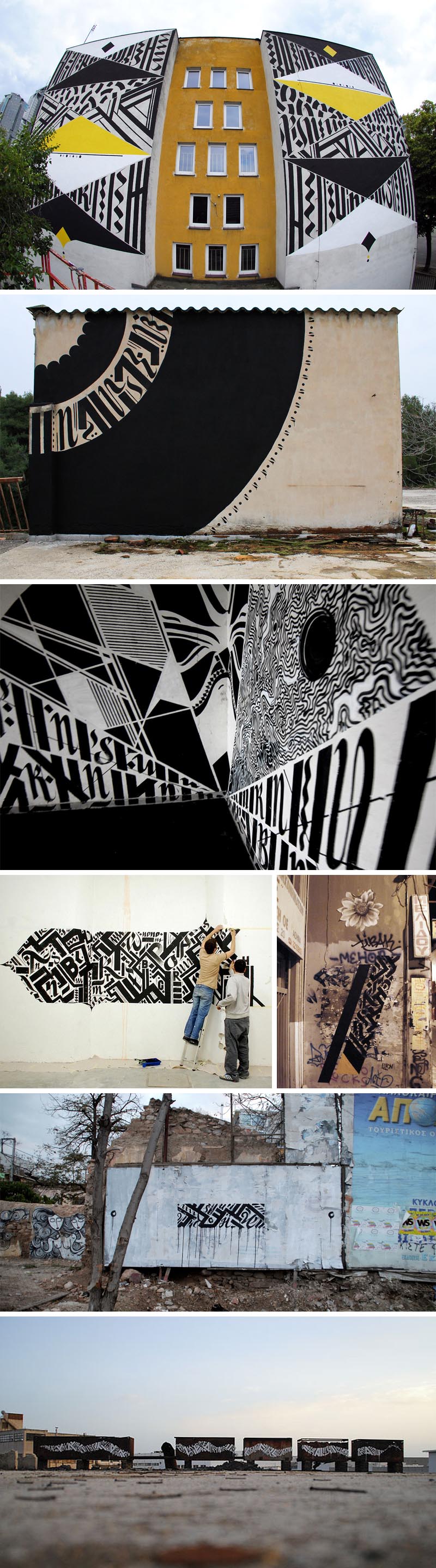
Blaqk Greg Papagrigoriou and Simek Athens street art, typography, calligraphy, black and whiteBlaqk Greg Papagrigoriou and Simek Athens street art, typography, calligraphy, black and whiteBlaqk Greg Papagrigoriou and Simek Athens street art, typography, calligraphy, black and whiteBlaqk is a collaboration between Athens-based design duo Greg Papagrigoriou and Chris Tzaferos who goes by Simek. Their street art mixes geometric forms with typographic letterforms—much of which is calligraphy. Whether black on white or white on black, on gallery walls, building façades, or abandon lots, their graphic style definitely pops. You can see much more of their work on their site.

via IdN

Plasti-Scenes: Movie Scenes in Plasticine

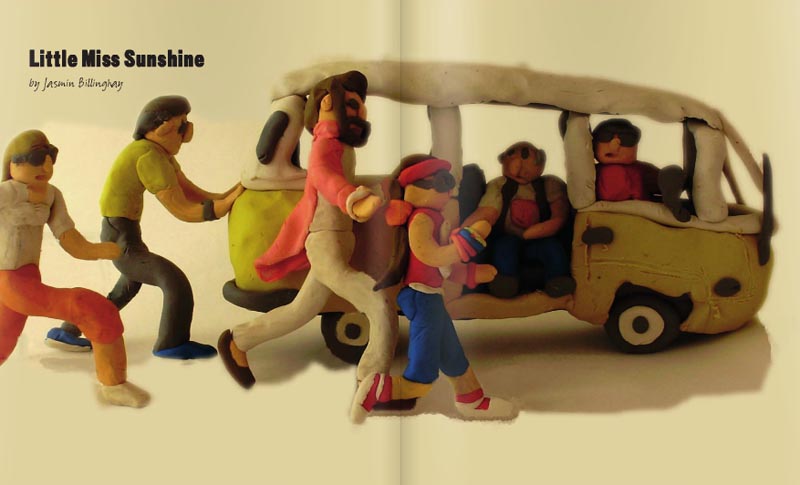
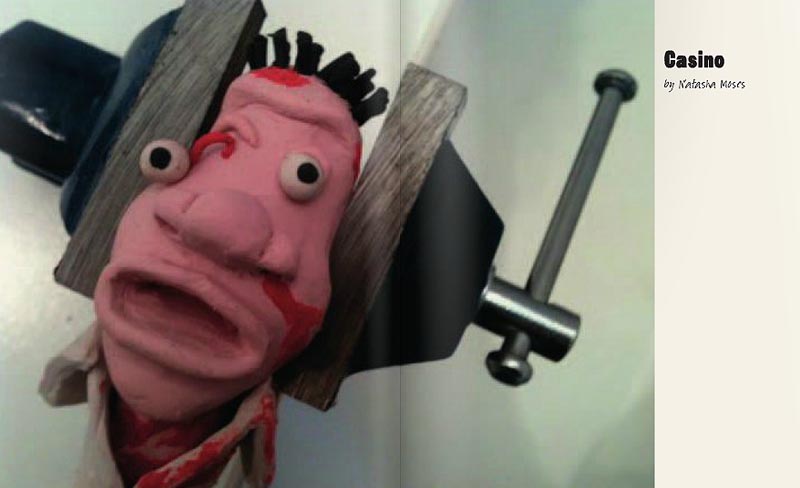
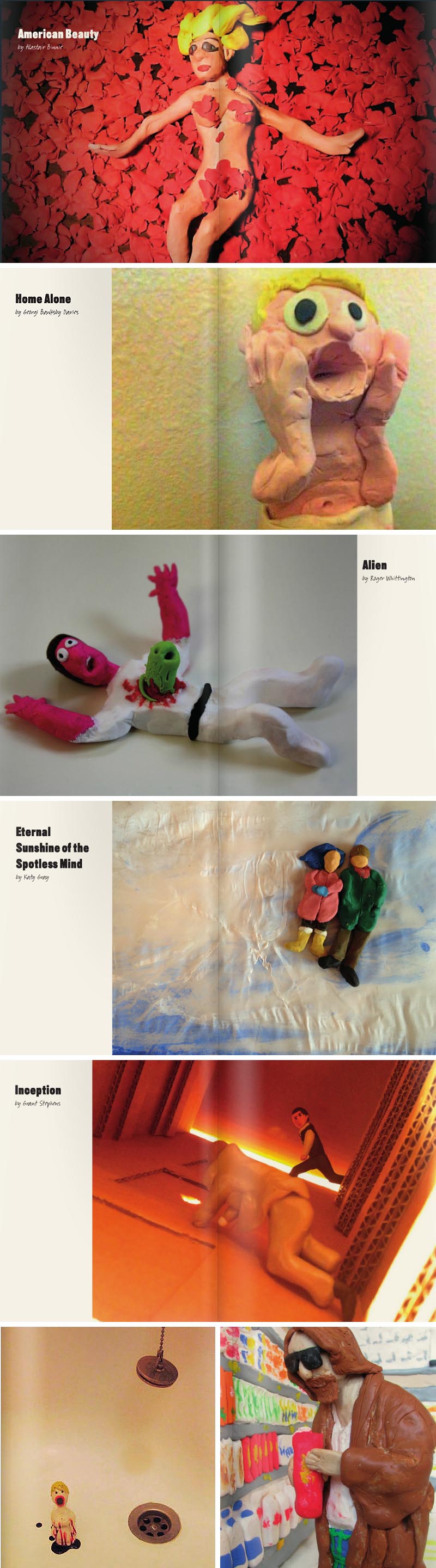
movie scenes made out of plasticine, modelling clay, little miss sunshinemovie scenes made out of plasticine, modelling clay, casinomovie scenes made out of plasticine, modelling clay, casinoI came across a contest on Little White Lies magazine from a while back that made me smile. The creative brief asked that participants “recreate an iconic movie scene out of modelling clay” also known as plasticine, hence their title Plasti-Scene…yes, it’s clever. I’m not sure if the entries are exclusively from artists, or non-artists as well. Some of the entries were very slick and well done but, honestly, some of my favorites tend to be the less perfect ones. All the films and creators are identified next to their piece except the bottom two which are scenes from “Psycho” by Sarah Randell and “The Big Lebowski” by Gordon Shaw. These are just a sampling from the 60 entries. You can see the rest here and the winners here.

3D Printed Prosthetics: Bespoke Innovations

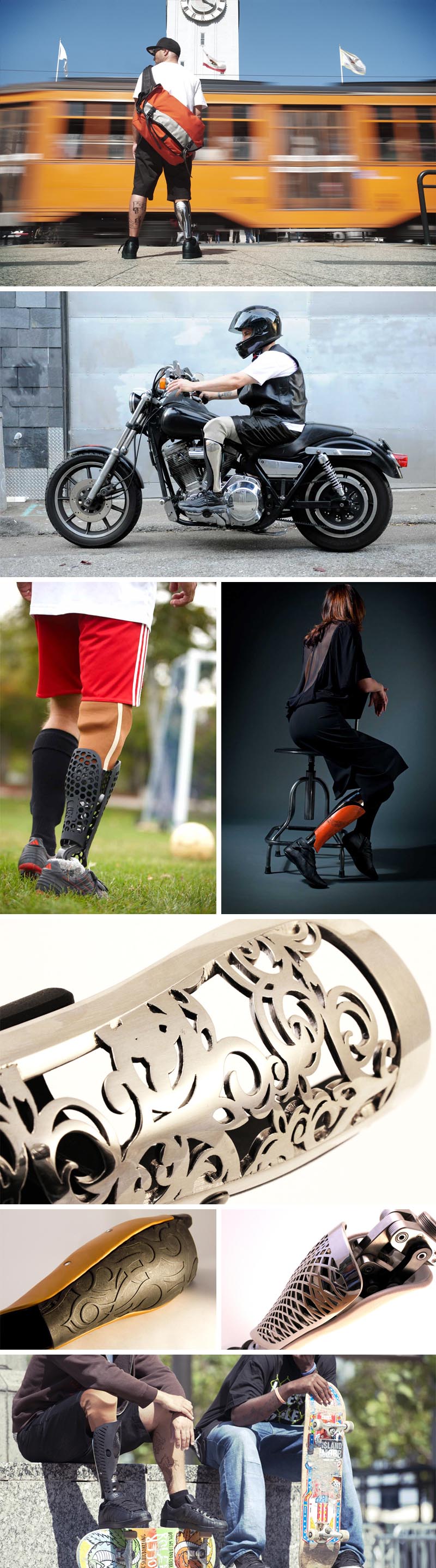
3D printed Prosthetic fairings by Bespoke Innovations, Scott Summit. Design, Industrial design3D printed Prosthetic fairings by Bespoke Innovations, Scott Summit. Design, Industrial design3D printed Prosthetic fairings by Bespoke Innovations, Scott Summit. Design, Industrial designThe three of us have been fascinated by 3D printing since we first saw a demo a few years back, and the fascination keeps growing as the possibilities keep expanding. Sure, we’ve seen all kinds of jewelry, housewares, sculptures, even a bikini, but these prosthetic fairings (coverings that surround an existing prosthetic leg) are lovely pieces of design serving a decorative as well as personalizing function. Industrial designer Scott Summit joined forces with orthopedic surgeon Kenneth Trauner, MD and founded Bespoke Innovations with the mission of bringing more humanity to people who have suffered the loss of a limb. The process and design are individualized by using 3D scanning technology to capture images of a person’s sound leg as well as their prosthetic one. The wearer is given their body symmetry back by superimposing the sound leg shape onto the prosthetic one. Customization of the Fairing is overseen by the user who can pick and choose materials and patterns to achieve a personalized result. It’s all so smart and impressive.

via formfiftyfive