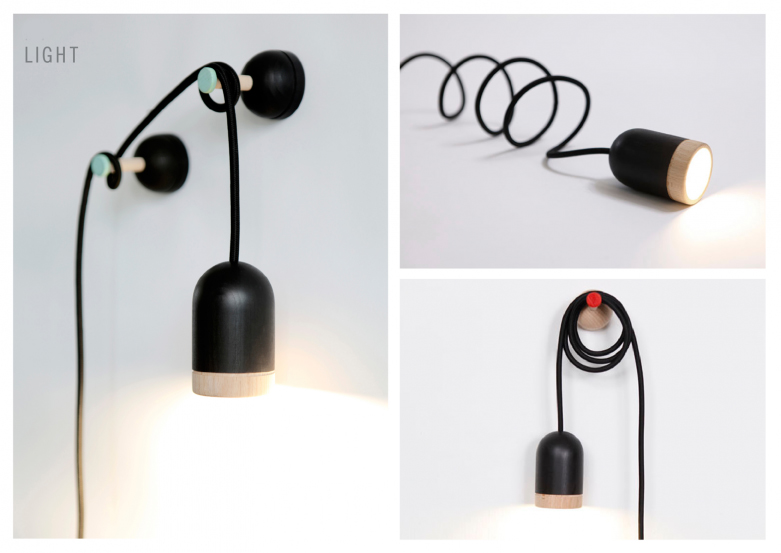
 Beautiful minimalist industrial design in SupaFrank’s Creature Collective. Their products are inspired by nature, paring down elements to capture the spirit of the original creatures.
Cute, elegant, simple, and lovely!
See the rest here.
via Lustik
Beautiful minimalist industrial design in SupaFrank’s Creature Collective. Their products are inspired by nature, paring down elements to capture the spirit of the original creatures.
Cute, elegant, simple, and lovely!
See the rest here.
via Lustik
 Click to enlarge.
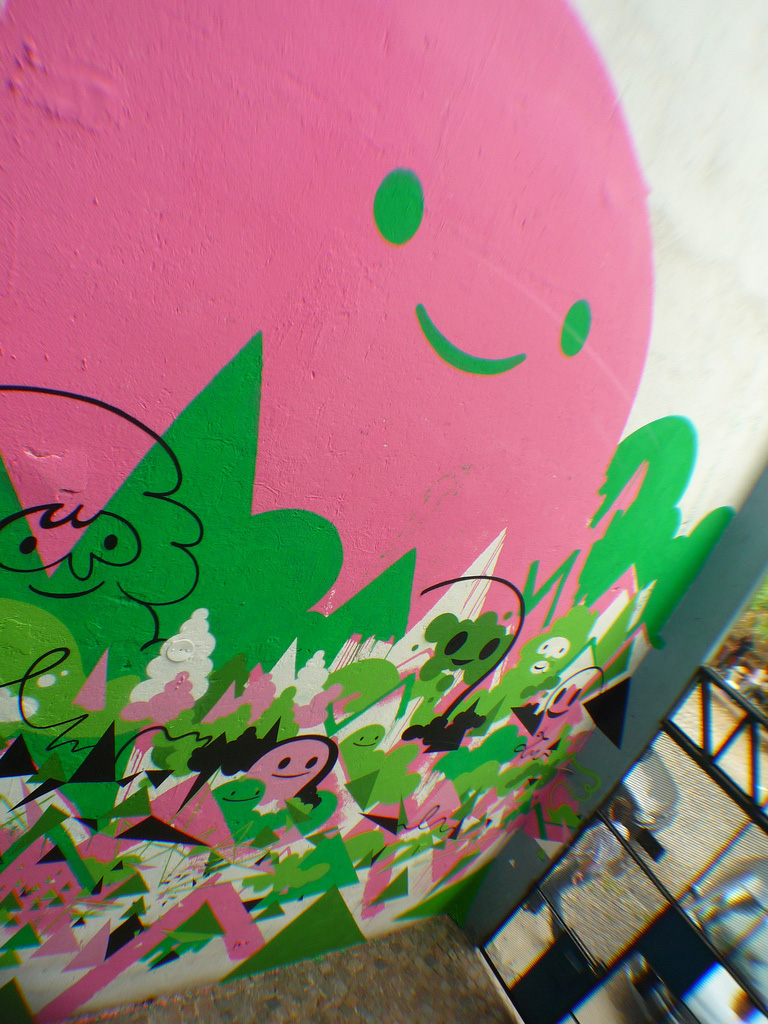
Recent work from Argentine street artist Chu (aka Julian Pablo Manzelli.)
You can see more of Chu’s earlier work as well as studio work on his site and flickr.
via graffitimundo

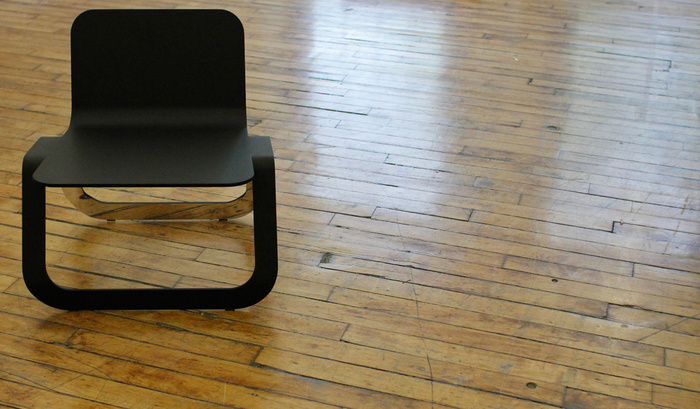
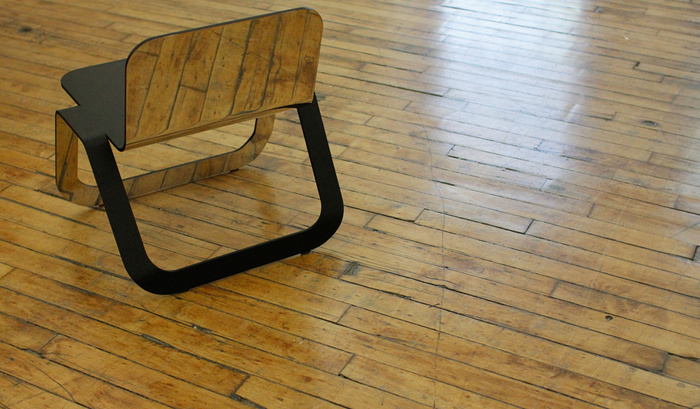 Norwegian industrial designer Marius Myking’s Pow Pow Chair is the first in a family of furniture loosely inspired by the famous Brooklyn based electronica band LCD Soundsystem and their song: “Pow Pow”. The front part, or seating area, of the chair is powder coated, while the outside is mirror polished, reflecting the environment surrounding it. Made out of one aluminum sheet.

Ed Osborn, originally from Helsinki, but due to an interesting story was relocated to Philadelphia to live in a Quaker household via a witness relocation program. Having attended many Quaker religious ceremonies marked by long periods of silence, Ed learned to pay close attention to the smallest of sounds. He attributes this to leading him down the Sound Art path. Most of his sound installations are rather minimalist with speakers being the focus of the installation. I found these to have an eerie transfixing quality that in a strange, abstract way feel almost poetic.
You can see more of Ed Osborn’s work here.

 Since the age of 10, Victor Enrich has been creating unreal cities; first with pencil on paper, later with computers and 3D software. Using a combination of photography and 3D architectural visualization, the Barcelonian Enrich modifies and deforms existing buildings from Tel Aviv, Barcelona, Helsinki, as well as other locations, with impressive precision so that they fit perfectly into the landscape and picture.
Victor Enrich sells prints of his works on his site.
 Click to enlarge
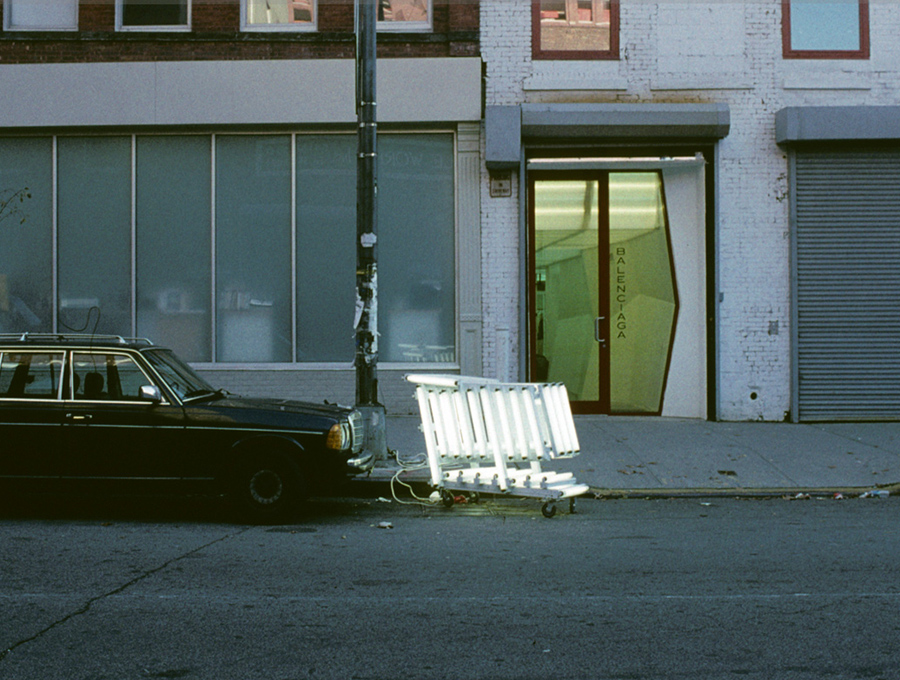
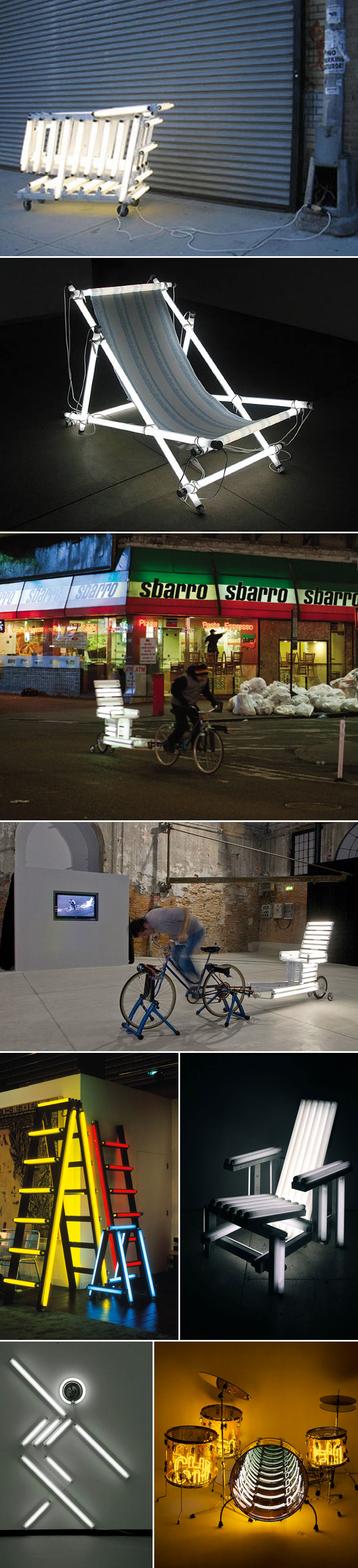
We recently met Ivan Navarro at a couple of end-of-year graduation parties and learned that he is an artist who creates fluorescent light sculptures. After looking up his work, I was excited to see that I recognized some of it from this year’s Armory Show (the Armory Fence) as well as having seen some pieces online. I love all of it.
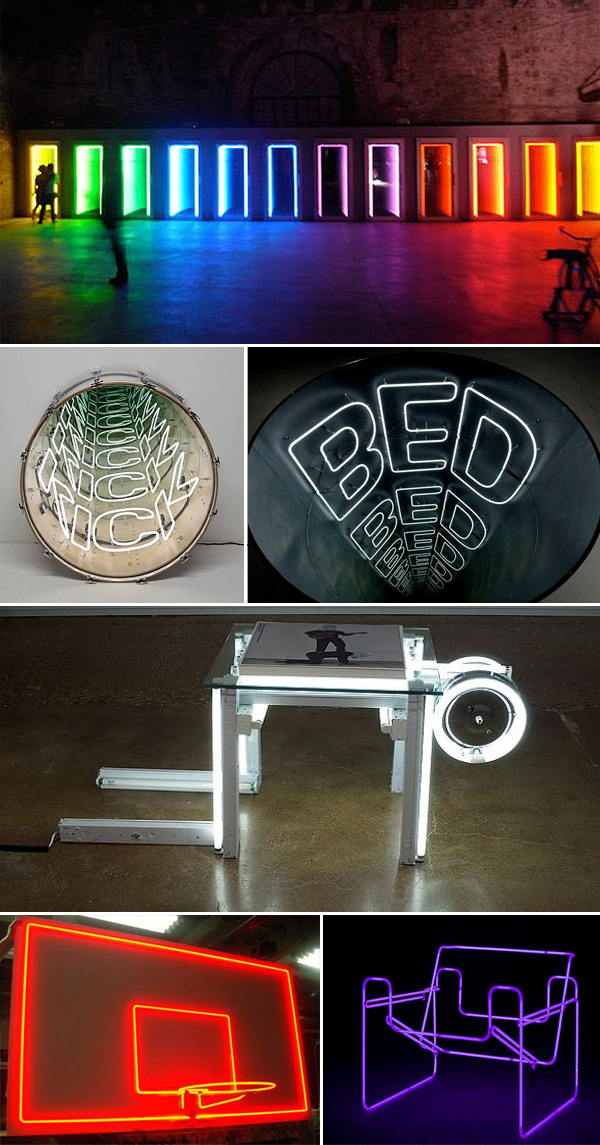
Originally from Chile, Navarro’s work Threshold was presented in the Chilean Pavilion at the 2009 Venice Biennale, consisting of three separate pieces: ‘Resistance’ (the chair attached to a bicycle which illuminates by pedaling the bike); ‘Death Row’ (thirteen doorways with colored neon lights inside repeated or reflected to give an endless appearance); and ‘Bed’ (the circular sculpture with half the word ‘bed’ in neon and reflected to create the full letters as well as repeated to create an infinite tunnel effect.)
This past March, Ivan Navarro had a show at the Paul Kasmin gallery in NYC called “Heaven or Las Vegas” where the light structures were based on the footprint of famous skyscrapers, including the twin towers creating a moving negative effect as infinite holes in the floor. (See video of exhibit below.)
There is an underlying social and political commentary present in Navarro’s work – from capital punishment, and homelessness, to the reign of Pinochet, torture, and more – that makes these sculptures as meaningful as they are beautiful.
Ivan Navarro currently lives and works in Brooklyn, NY.
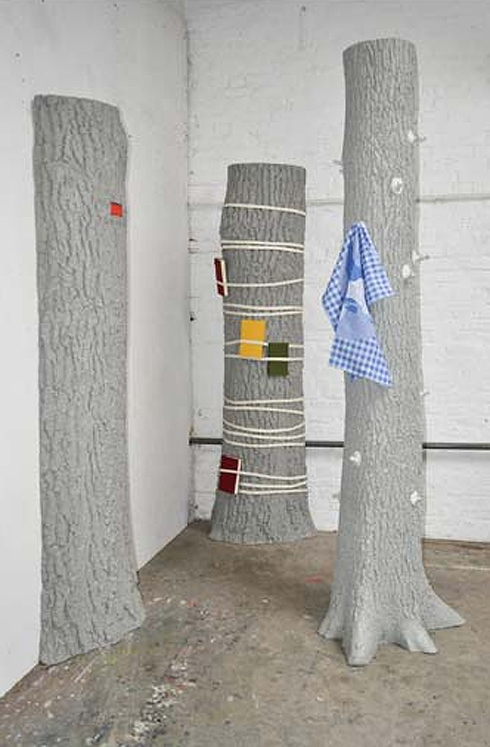
 These Product Trees by Dutch artist/designer Theda Schoppe made me chuckle. Imagine having one of these trunks in your home as a coat rack or bookcase/magazine rack? Definitely wouldn’t go unnoticed.
Made of acrylic plaster, the individual trees each have their own name: Tree O’clock, Gummibaum, and Hang Up Tree.
You can see more of Theda Schoppe’s work on her site.
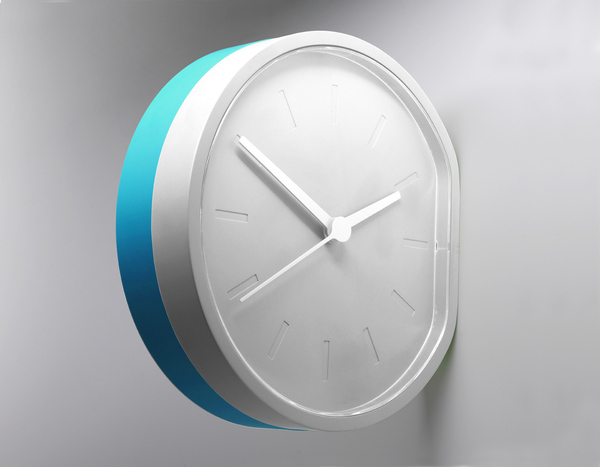
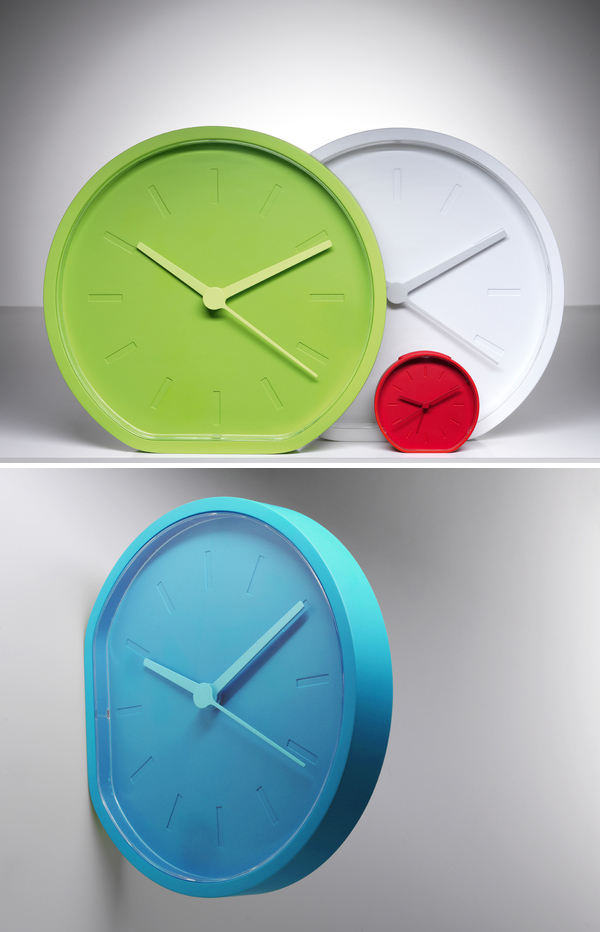 Really love the smushed side of the Side/Beside Clock designed by Ludovic Roth and Alexandre Dubreuil.
via Muuuz

 Click to enlarge.
I have to admit that the Australian skincare company Aesop is completely new to me. Not until the plywood went up across the street from our place here in NYC with the “Coming Soon” signs was I aware of its existence. But I’m not here to discuss the company or their products, instead about the very interesting and cool kiosk that they have unveiled in Grand Central Station.
The architect behind the stand – built out of 1,800 back issues of the New York Times – is Jeremy Barbour of Tacklebox. In solidarity with the newspaper-reading commuters, Barbour stacked and pressed the papers into chunky blocks and combined the blocks with complementing powder-coated steel blocks and countertops. Apparently, there will be a similar design in the upcoming Nolita store. It will be interesting to see what they come up with for the third NYC shop that will be going up in our Greenwich Village neighborhood.
You can see more of Tacklebox’s work here and the fabrication process on their blog.
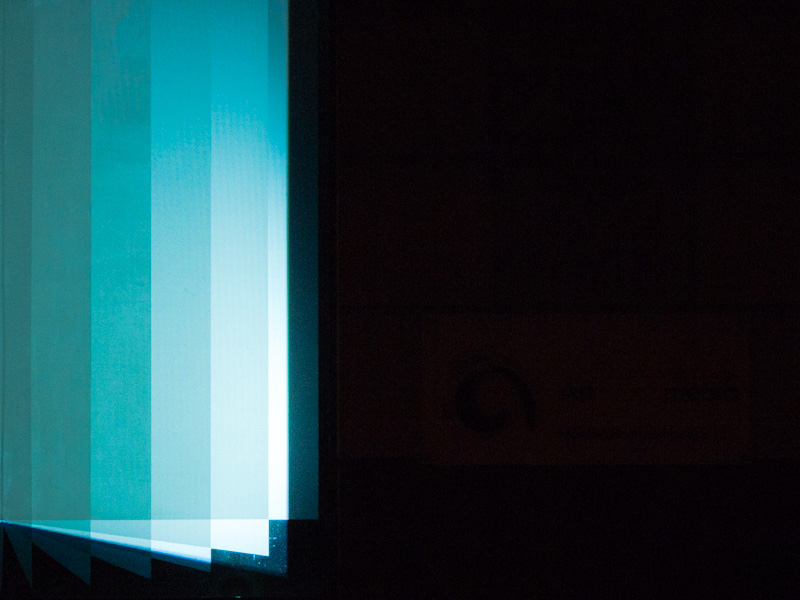
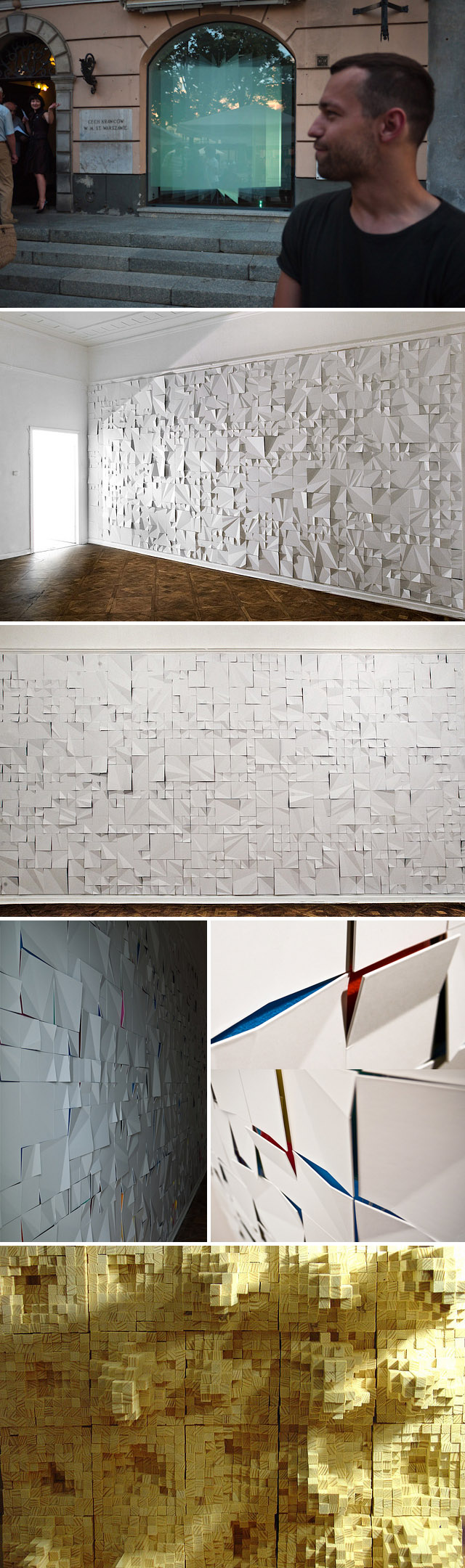
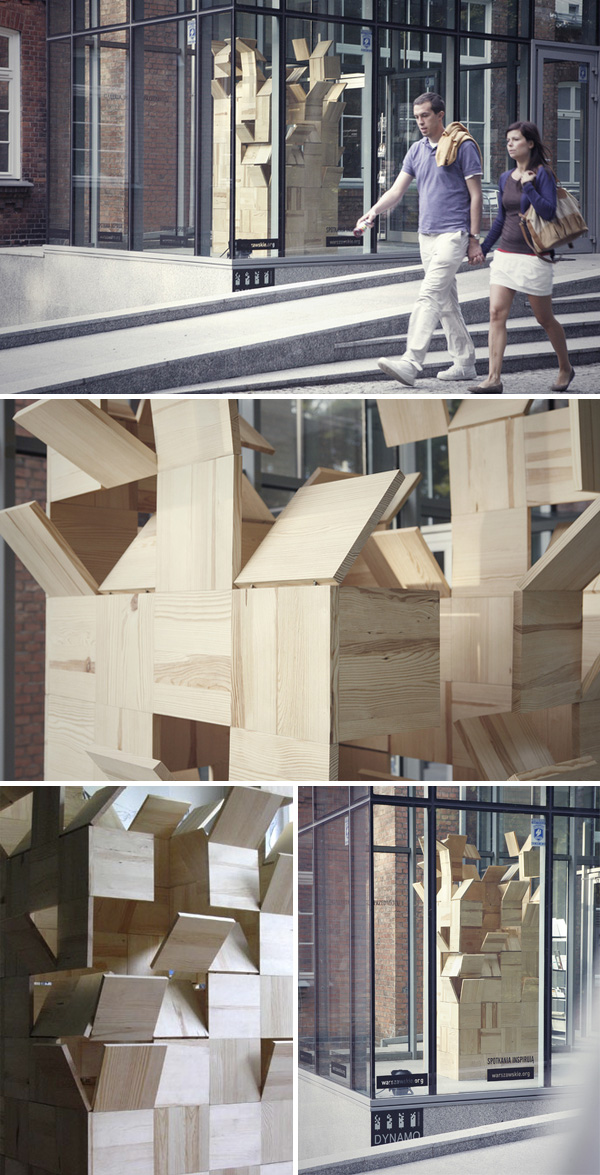 Jerzy Goliszewski is a Polish artist living and working in Warsaw. His body of work is comprised of installations, paintings, drawings and graphics. His focus is on making complex structures using simple and natural materials.
From top to bottom: We’re Going Out, Jerzy Goliszewski’s newest work made for the closing of a gallery in Warsaw. Using simple means (semi-transparent vinyl and rear projection) Goliszewski created this revolving door style, computerized-looking effect without a computer. To see it in action watch the video.The photo that follows is of the artist in front of the gallery with the artwork in the window. Kai, another installation, takes its cue from the classic fairy tale “The Snow Queen.” Kai was inspired by structures, such as the crumbling sheet of ice, the cracked ground and the cracked mirror which broke into pieces distorting the world, in the story. Next image down is from Lac Bleu 02, a wooden installation made of thousands of bits of wood and, lastly, Dynamo, another wooden installation representing force and power in its name and at the same time the block’s transparency removes the stability and exposes its fragility like a house of cards.
You can see more of Jerzy Goliszewski’s work on his website, as well as his flickr set of installations.
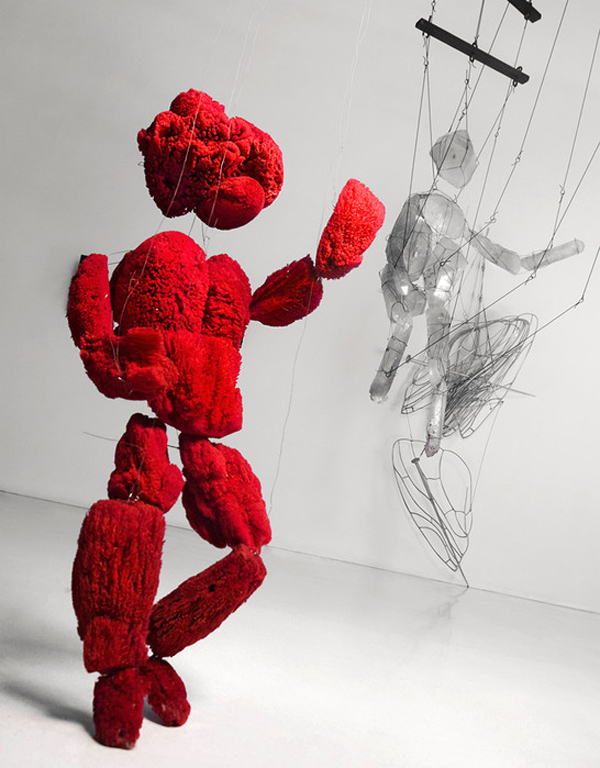

 Brazilian artist Tunga, nee Antonio José de Barros Carvalho e Mello Mourao, has been creating sculptures and installations since the 1970s. Currently he has an exhibit called Presolaires at Galerie Daniel Templon in Paris. As part of the exhibit he has produced a series of marionettes made of iron, bottle glass, and crystal – materials often found in Tunga’s work – as well as pearls, sponge and amber. The puppets are offset by a collection of iron containers housing pieces of resin, silicon and steel.
You can see more of Tunga’s work at the gallery’s site.
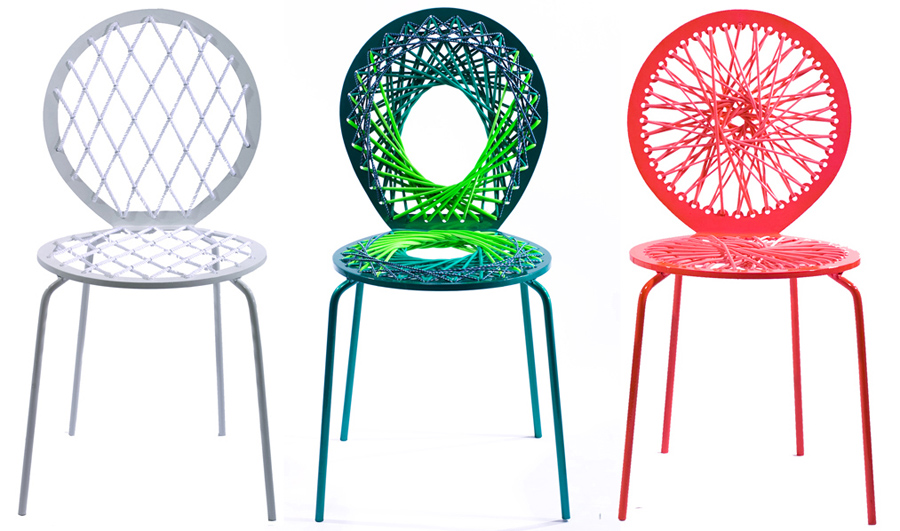
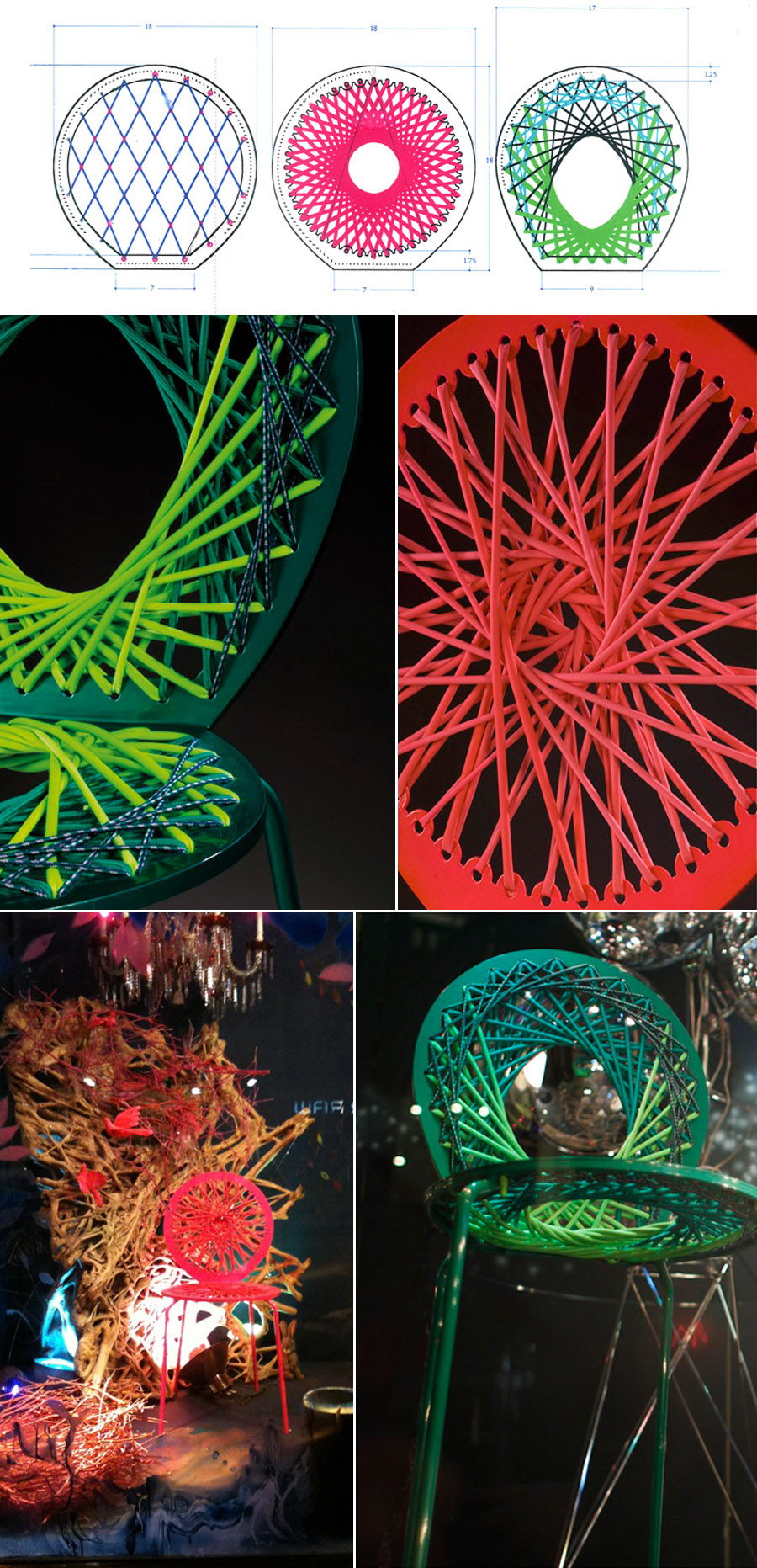 We were reminded of these Stretch Collection chairs by Carnevale Studio the other day when we popped into the Future Perfect. We had seen and liked them last year at the 2010 ICFF.
Inspired by the corset-like pieces of the fashion world, Jessica Carnevale used latex, bungee and rope to create these bright colored (our favorite is the hot pink) and fun chairs.
Available at The Future Perfect and ABC Carpet & Home.
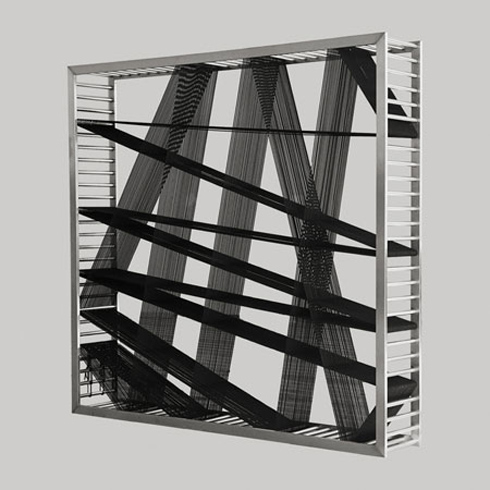
 Laszlo Rozsnoki is a product designer, originally from Budapest, who studied design in the Netherlands. He has designed a series of furniture pieces under the title Questioning the Established, of which this Rope Shelf is a part of. As with the other pieces in the series, the Rope Shelf has a certain twist. Where there are usually solid, horizontal shelves, Rozsnoki has replaced them with diagonal ones made of rope attached to a frame. From certain angles the stretched rope, overlapping another layer, creates a moiré pattern.
I’d love to see what the bookcase looks like with books in it.
 Click to enlarge
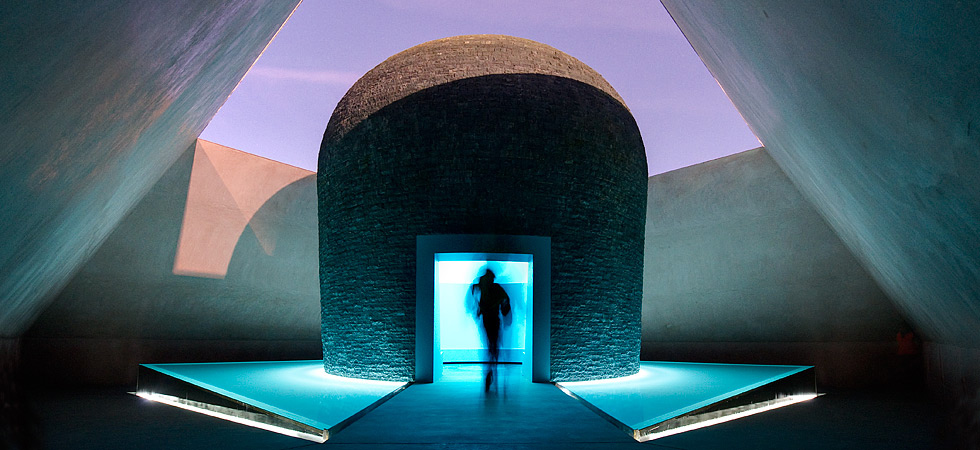
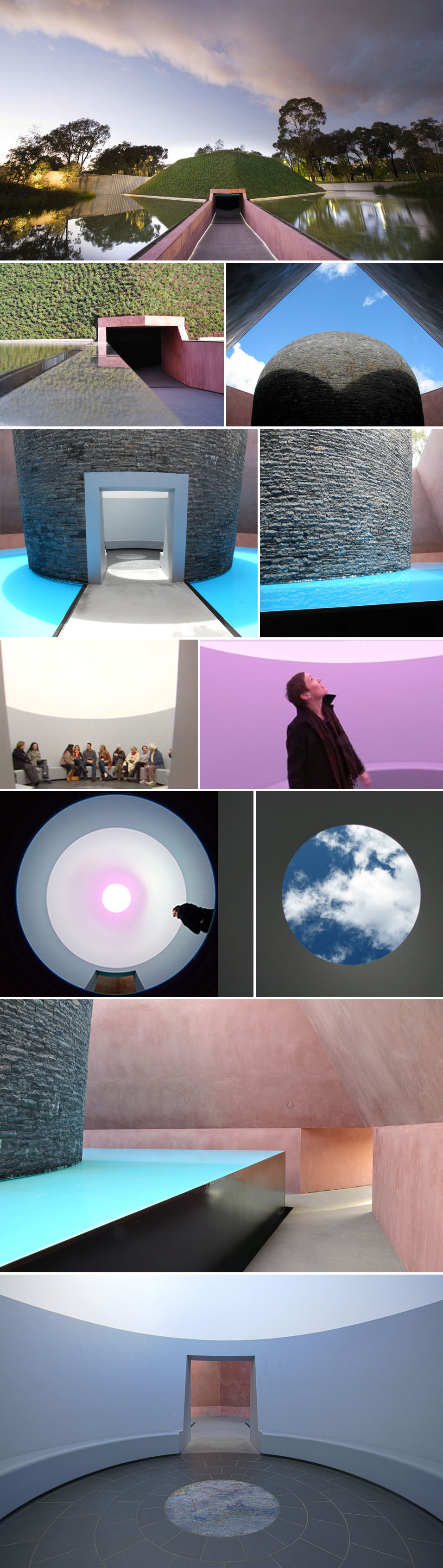
James Turrell’s latest Skyspace, Within Without at the National Gallery of Australia, is one of his largest and most elaborate so far. The Skyspace is entered via a long walkway towards a grass-covered pyramid surrounded by water. Inside, at the center of the pyramid is a domed structure open to the sky, which in turn is surrounded and highlighted by shimmering turquoise water. As in other of Turrell’s Skyspaces, Within Without is most dramatic at dawn and dusk, when there are more changes in light and movement in the sky which are then intensified within the domed space.
You can read more about the exhibit here and see more photos at screenstreet’s and chaoite’s photostreams.

 Click to enlarge.
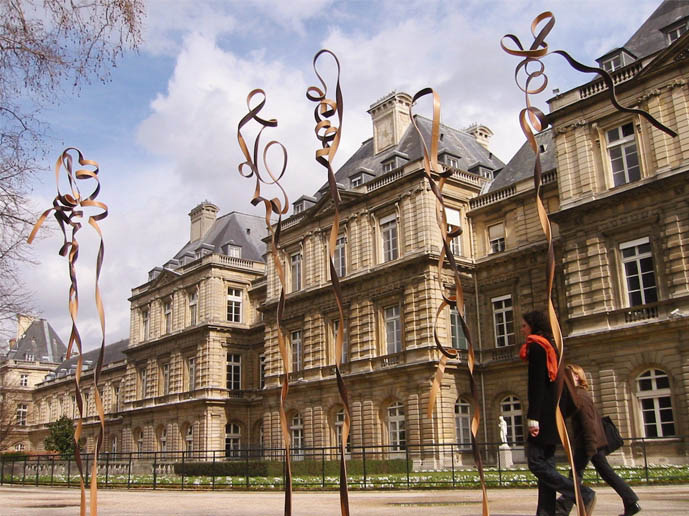
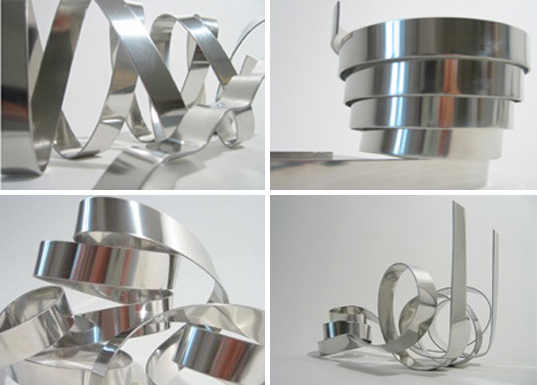
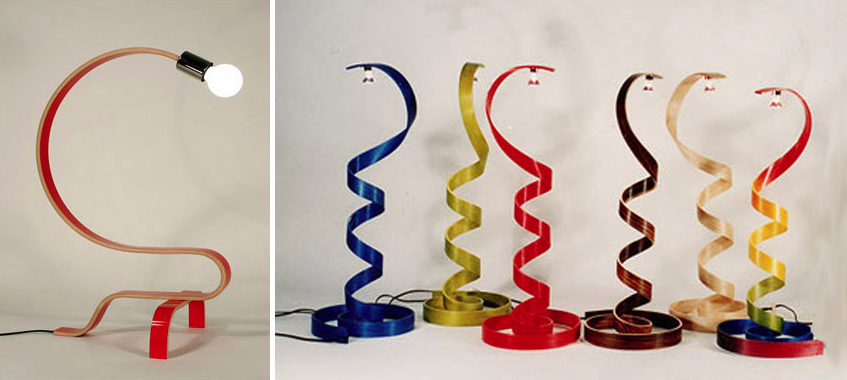
The Spanish artist Jacinto Moros, who we had the good fortune of befriending during his years in NYC, takes wood and makes it dance. His ability to bend and curl the material into beautiful sculptures that, while static, are full of movement, is really amazing.
Though a fan of all of his work, I especially like how his Movimientos Liquidos (Liquid Movements) piece worked in its space, this being the Luxembourg Gardens in Paris. As if abstract flowers or trees fitting in perfectly, yet uniquely, into the park landscape. (Top three images.)
His Architecture Series, designed in wood and cast in stainless steel, is inspired by well-known structures, captured using a continuous line to render the buildings as sculpture. (See stainless steel sculptures in photos, clockwise from top left image are: Guggenheim, Bilbao; Guggenheim, NYC; Reina Sofia, Madrid; Pompidou Centre, Paris.) The series is open-ended with more buildings to follow.
Moros has also designed some products in his curved wood method, including lamps and jewelry.
You can see more of Jacinto Moros’s work on his website, as well as at the Victor Lope Gallery, and OA Madrid online shop.
 Click to enlarge
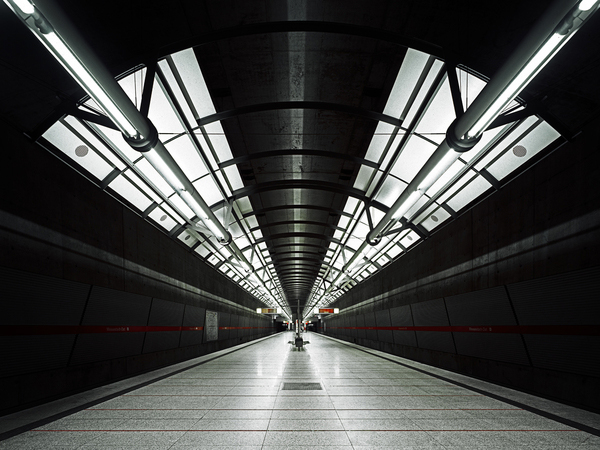
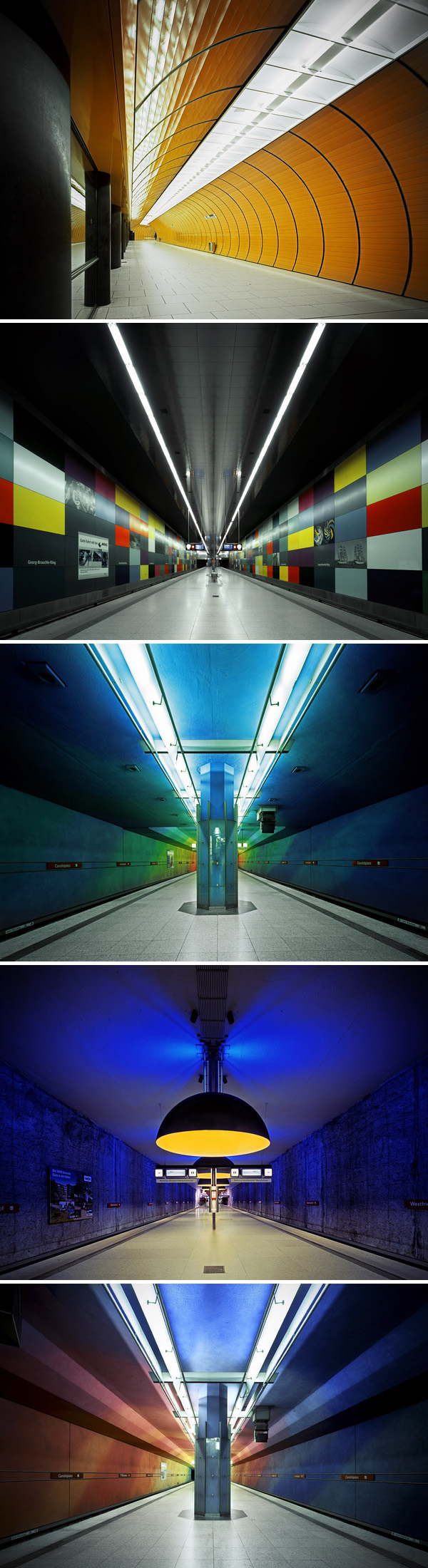
Really like these architecture photographs of train platforms and hallways by German photographer Holger Schilling. From the symmetry to the lighting, very cool effect.
via salvatorres

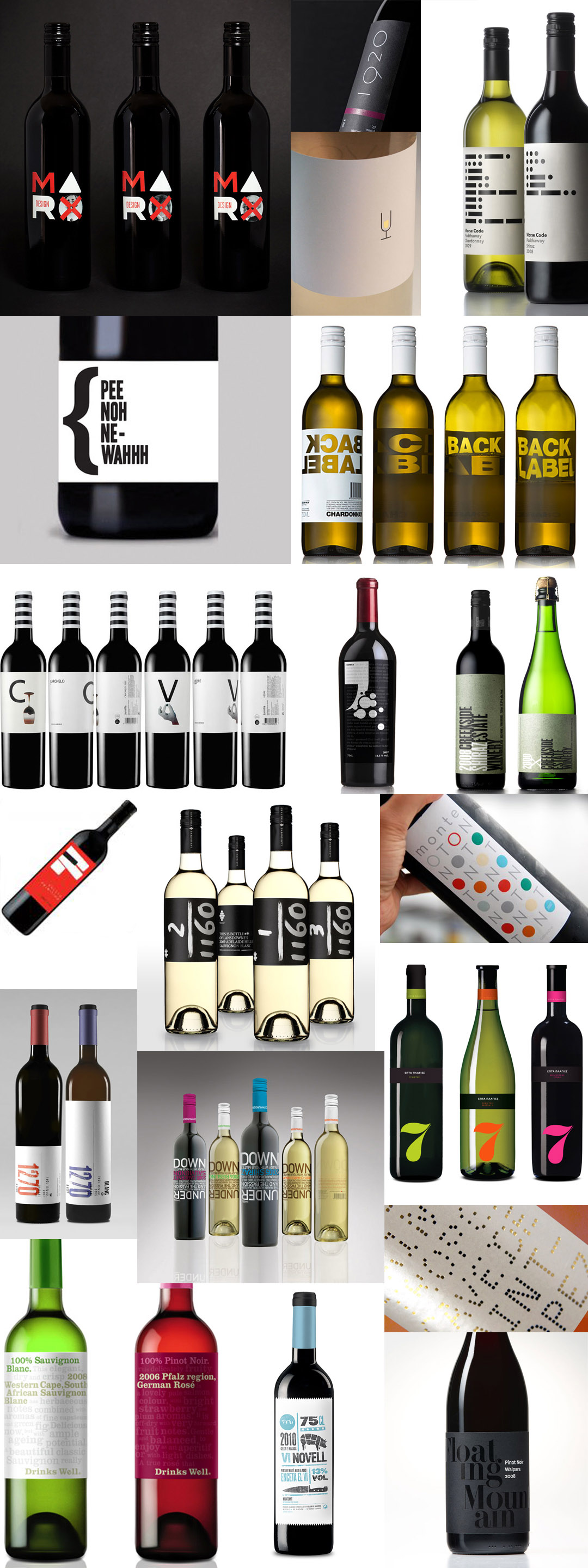 Click images to enlarge
I know it’s not wise, but I am definitely prone to choosing a wine based on its label rather than its vintage, mostly due to ignorance on the subject of fine wine, but also because as a graphic designer I am apt to go for the nicely designed label. And within the nicely designed label category, I am most likely to be lured by a nicely designed, typography-driven label.
Here is a small selection of mostly typographic wine labels that caught my eye on Lovely Package, Graphic Exchange, and, of course, FreshDirect.

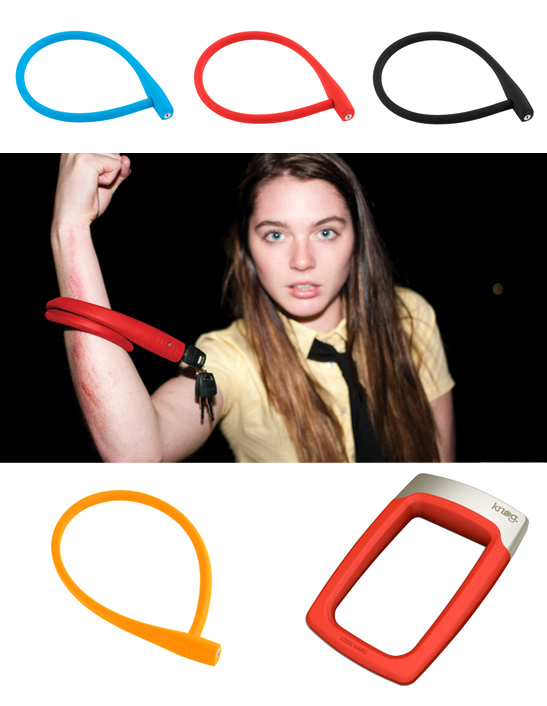 On a walk through Tribeca yesterday afternoon, here in NYC, the three of us wandered over to Adeline Adeline – as their tag line states: “a very nice bicycle shop” – in search of this bicycle helmet. Though we left empty-handed, we fell in love with these Knog bicycle locks. It may be hard to appreciate how nice these colorful silicone locks are from the photos but, trust us, in person, they’re beautiful design objects. There are different thicknesses and prices, but they’re all really nice. The U-lock on the bottom right is due out in November and we did not actually see that one, but I’m liking the look of it on their site.
Knog is an Australian company that sells all kinds of bike accessories. The lights seem to be very popular, based on my google search of Knog. You can check it all out here.
 CollabCubed